






At 50 orders a day, manual shipping is a chore you can manage. Someone opens a courier portal, retypes the address, picks a service, downloads the label and pastes the AWB back into the order sheet. At 500 orders a day the same routine takes hours, and small typos start sending parcels to the wrong pincode. A shipping API fixes this by letting your store, ERP or warehouse system talk to couriers directly, with no portal logins and no retyping.
The cost of staying manual shows up in the data. A 2022 PGA Labs report, covered by Business Standard, put the return rate in Indian e-commerce retail at 18 to 25 percent, which pushes logistics costs up for any brand shipping at volume. Add the daily “where is my order?” emails and one courier that skips pickups in the middle of a sale, and manual shipping breaks well before the business stops growing.
This guide covers what a shipping API is, how it works step by step, why it matters in 2027, the trends behind it, the benefits you can measure, the systems it connects to, real use cases and how to get started. A short section near the end shows how eShipz approaches it.
What Is a Shipping API?
An API (application programming interface) is a set of rules that lets one software system ask another for something and get a structured answer back.
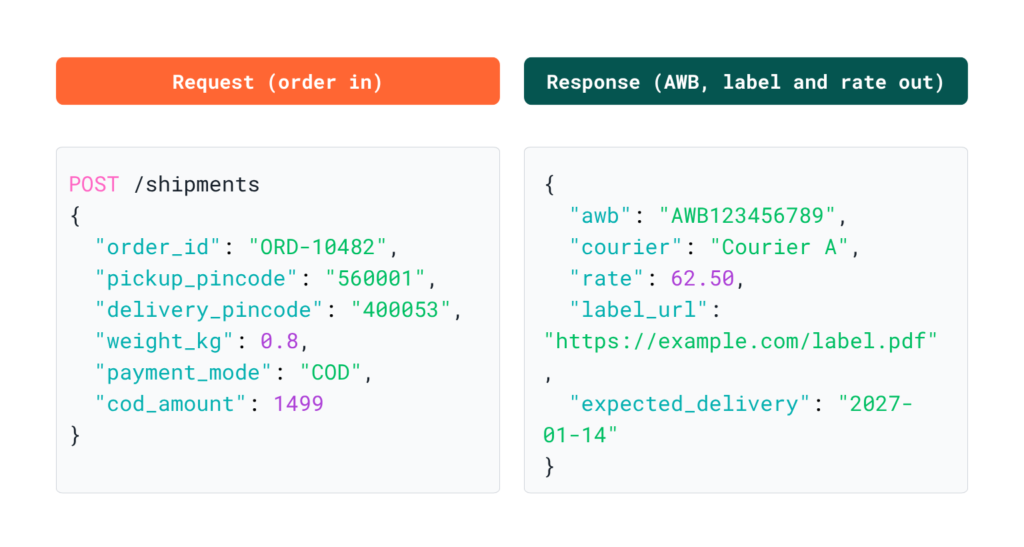
A shipping API applies that idea to logistics. Your software sends order details to a courier or shipping platform, and the shipping API returns rates, an AWB number, a printable label and, later, tracking updates. Nobody logs in to a courier portal.
Here is a simplified example. The field names are illustrative, because each provider uses its own schema.
Single-carrier vs multi-carrier APIs. A single-carrier API connects you to one courier. It works when that courier covers all your pincodes and your volume is low. Every extra courier needs its own courier API integration, with its own format, its own error codes and its own upgrades.
A multi carrier shipping API, also called an aggregator API, connects you to many couriers through one standard format. You send one request, compare rates and serviceability across couriers, and book the best fit. Brands that ship to metros and to Tier 2 and Tier 3 pincodes usually need this version.
How Does a Shipping API Work?
The flow is similar across most providers:
- Order created. A customer places an order on your store, marketplace or ERP.
- API call. Your system sends the order data (address, weight, dimensions, payment mode) to the API.
- Serviceability and rates. The API checks which couriers deliver to that pincode, whether COD is allowed, and what each one charges and promises.
- Courier selection. Your rules pick the courier (cheapest, fastest, best delivery record), or an AI model picks one for each shipment.
- Shipment booked. The API returns the AWB and the label.
- Pickup. A pickup request goes to the courier for your warehouse and time slot.
- Tracking via webhooks. A webhook is a message that the courier or platform pushes to your URL whenever a status changes. Your system receives picked up, in transit, out for delivery and delivered events without asking for them. This is what powers automated shipment tracking and real time shipment visibility.
- NDR handling. When a delivery fails (customer unreachable, wrong address, COD refused), the courier raises a non-delivery report. The API passes it to you so a redelivery request or customer message goes out the same day.
- Returns and reconciliation. Reverse shipments are booked through the same API, and COD remittances and freight invoices are matched against shipment records.
Core endpoints. Most providers expose the same set of endpoints:
- Rates and serviceability: price, speed and COD availability for a pincode pair.
- Shipment creation: books the order and returns the AWB.
- Labels: generates single or bulk labels.
- Pickup: schedules or reschedules a pickup.
- Tracking: returns the current status and full scan history.
- Cancellation: cancels a shipment before pickup.
- Returns: creates a reverse shipment for a delivered order.
Why Is a Shipping API Essential Today?
Customer expectations have changed. Shoppers expect a delivery date before they pay and a live tracking link after. They expect a WhatsApp message when a parcel is delayed, not a support reply three days later. Those experiences need courier data to reach your systems as it happens, and a shipping API is how it arrives.
One courier is a single point of failure. If your only courier pauses pickups, adds a surcharge or marks a block of pincodes non-serviceable during a festive sale, orders stall with no fallback. eShipz’s multi-carrier shipping guide explains how carrier diversification limits that risk.
Manual work causes errors. A wrong pincode, a wrong weight or a mistyped COD amount leads to a failed delivery and often a return to origin (RTO). Each RTO costs you the forward freight, the return freight and the sale.
COD adds complexity. Cash collected by the courier is remitted days later, and the amounts rarely match order records on the first pass. Freight costs also creep up through weight discrepancies. In peak season, volumes can multiply while the team stays the same size, so every minute of manual work per order gets multiplied with them.
Market Trends to Watch in 2027
Steady growth in e-commerce logistics. Mordor Intelligence estimates the Indian e-commerce logistics market at about USD 6.65 billion in 2025, rising to roughly USD 11.14 billion by 2031. Research firms publish different forecasts, so read the number as a direction, not a promise. More parcels across more pincodes means more strain on manual processes.
ONDC and API-first networks. The Open Network for Digital Commerce lets sellers, buyers and logistics providers connect through standard APIs instead of platform-specific integrations. Mordor Intelligence notes that this lowers integration costs for logistics firms. A business already running on a shipping API is better placed to plug into these networks.
AI-based courier allocation. Fixed rules such as “use Courier A for Karnataka” are giving way to models that pick a courier for each shipment using delivery history by pincode, cost and speed. eShipz covers this in its article on AI-powered courier allocation platforms.
Returns automation. Self-serve return requests, automatic pickup booking and reason codes are replacing email threads between support teams and couriers.
Post-purchase experience. Branded tracking pages, proactive delay alerts and accurate estimated delivery dates now shape how buyers judge a brand after checkout.
What this means for you. Shipping data is becoming something you use to make decisions, not just a record of what happened. If your couriers, tracking and returns sit in separate portals, you cannot act on that data fast enough. Connecting them through a single multi carrier shipping API is the practical first step.
Benefits and Outcomes
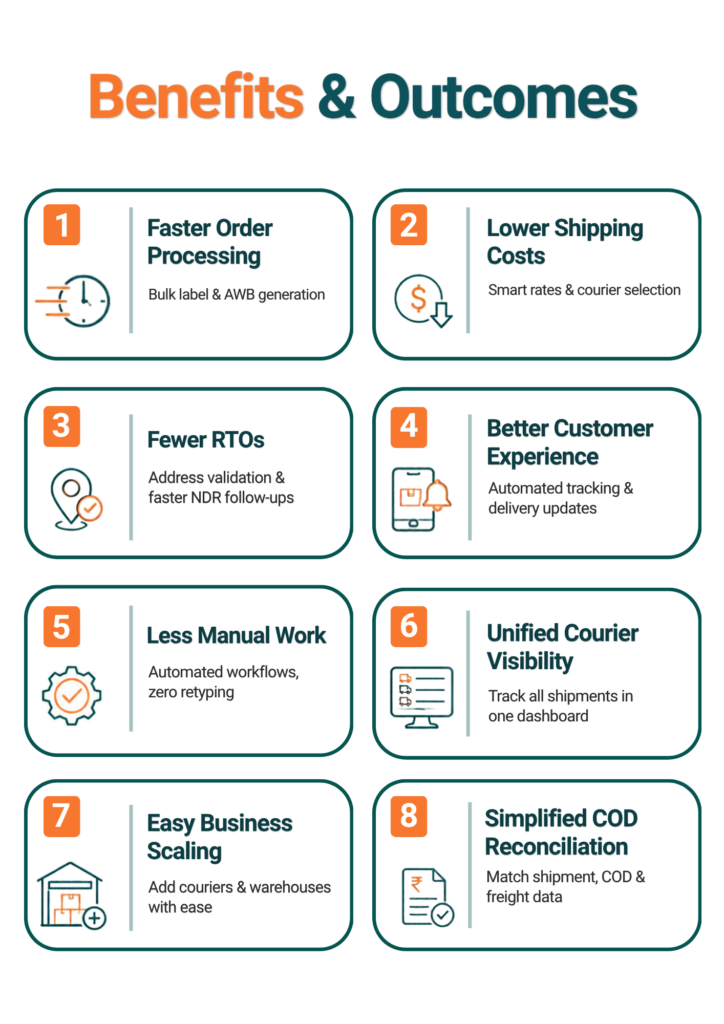
Each benefit below maps to a number you can track.
- Faster order processing. Labels and AWBs are created in bulk, not one by one. Track: minutes from order to label.
- Shipping cost reduction. Live rate comparison, correct weights and better courier fit lower what you pay per parcel. Track: cost per shipment.
- Fewer RTOs. Address checks, serviceability checks and quick NDR follow-up lower failed deliveries. Track: RTO percentage.
- Better customer experience. Automated shipment tracking and delivery estimates answer buyers before they ask. Track: “where is my order?” tickets per 100 orders.
- Less manual work. No retyping and no portal hopping. Track: staff hours spent on dispatch each day.
- One view across carriers. Every courier’s status appears in one place, so a late parcel is visible on day one.
- Easier scaling. Adding a courier or a warehouse means a new configuration, not a new project.
- Cleaner COD and finance reconciliation. Shipment, COD and freight data match against each other. Track: days to close COD reconciliation and the number of unmatched entries.
Pick two or three of these numbers before you start. They become your baseline later.
A small example shows why the baseline matters. If a brand ships 10,000 parcels a month and cuts cost per shipment by even a few rupees through better courier fit, the saving repeats every month. If its RTO rate drops by a couple of percentage points, hundreds of parcels stop making a round trip. Without a before number, none of that is provable, and the finance team has nothing to check the claim against.
Integrations: What Your Shipping Setup Connects To
An API is only as useful as the systems around it. It also feeds logistics automation software, whether you build that layer yourself or buy it, because rules for courier choice, NDR follow-up and reconciliation all depend on courier data arriving in one format. The common connections are:
- Sales channels: Shopify, WooCommerce, Magento and marketplaces, so orders flow in without exports.
- Carriers: each courier API integration, either built one by one or reached through a multi carrier provider.
- ERP: SAP, Oracle, Microsoft Dynamics or Tally, so invoices and dispatch records stay in sync.
- OMS and WMS: pick, pack and dispatch stages trigger shipment creation.
- TMS: for larger consignments, linehaul and route planning.
- Communication tools: WhatsApp, SMS and email for tracking and NDR messages.
- Analytics: BI dashboards for delivery performance, cost and carrier scorecards.
Before you commit to a provider, run through this checklist for any shipping API integration:
- Clear, public API documentation with examples.
- A sandbox where you can test without booking real shipments.
- Webhooks for tracking and NDR events, so you do not need to poll.
- A standard schema across couriers, so one payload works for every carrier.
Use Cases Across Industries
D2C brands. Orders arrive from a website and a few marketplaces, many of them COD. A shipping API checks serviceability at checkout, books the courier with the best delivery record for that pincode and sends tracking links automatically.
B2B. Shipments are heavy, multi-box and often tied to appointment slots. The API handles multi-piece consignments, LR numbers, documents and invoice-level tracking across transporters.
Retail and omnichannel. A retailer fulfils online orders from stores and warehouses. The API routes each order from the location that makes sense and gives the same tracking view whether the parcel left a store or a distribution centre.
Quick commerce. Delivery windows are short, so the API must respond fast and assign riders or partners without delay. Status updates need to arrive in seconds.
3PL. A third-party logistics provider ships for many clients, each with its own rate card and courier mix. One shipping API lets it manage all accounts from a single interface.
Reverse logistics. Returns, exchanges and replacements need reverse pickups, quality checks and refund triggers. The API books the pickup, tracks the parcel back and updates the order system on arrival.
How to Get Started
- Map your current workflow. Write down every step from order to delivery, including who does what and in which tool.
- Record baseline numbers. Capture cost per shipment, RTO percentage, NDR resolution time, support tickets per 100 orders and time to ship.
- Choose single or multi-carrier. If one courier covers your pincodes and volume is low, single-carrier can do. Otherwise go multi-carrier.
- Shortlist providers. Check courier coverage, documentation quality, webhook support and COD handling.
- Test in a sandbox. Run sample orders, failed deliveries and returns before touching live data.
- Integrate. Connect your store, ERP or WMS. Use a ready plugin where one exists and custom code where it does not.
- Set courier rules. Define when to pick by price, speed or delivery record, and what the fallback is.
- Pilot and measure. Move 10 to 20 percent of orders first and compare against your baseline.
- Review monthly. Revisit courier performance, RTO causes and costs, then adjust rules.

How eShipz Does It
eShipz is a shipping automation platform built around a multi-courier shipping API. Its API documentation is public, so your developers can read the endpoints before any sales call. More than 350 brands use it across D2C, retail, B2B and manufacturing.
Behind the API sit the modules most teams end up needing:
- AI courier allocation picks a courier for each shipment based on cost, speed and delivery history.
- Real-time tracking and estimated delivery dates feed branded tracking pages and customer messages.
- NDR and redelivery management turn failed deliveries into quick reattempts.
- COD management and returns cover remittance matching and reverse pickups.
- ePOD stores proof of delivery for disputes and audits.
- Freight audit checks courier invoices against shipment data to catch weight and rate mismatches.
- Control tower shows shipment health across every courier in one dashboard.
It connects with Shopify, ERP, OMS and WMS, and TMS systems, and serves D2C and e-commerce, B2B, retail and fashion, manufacturing, warehouse and distribution, 3PL, beauty, quick commerce and consumer electronics.
One example is MIVI, an Indian consumer electronics brand. It struggled with manual label generation, frequent non-deliveries and poor visibility during launches. eShipz connected its Shopify store to a multi-carrier setup with batch labels, AI courier allocation, branded tracking and automated NDR handling. According to the case study, label errors fell to near zero and shipment handling capacity rose three to five times without extra staff.
Conclusion
Manual shipping works at low volume and fails as orders grow. A shipping API replaces portal logins, retyping and status chasing with one connection that books couriers, prints labels, tracks parcels and handles failed deliveries. Start by recording your current cost per shipment and RTO rate, test a provider in a sandbox and pilot with a slice of orders.
If you want to see how this looks on your own order flow, book a demo with eShipz.
FAQs
- What is a shipping API?
A shipping API is an interface that lets your software request rates, book shipments, print labels, schedule pickups and receive tracking updates from couriers without using their portals. - What is the difference between a shipping API and a shipping aggregator?
A shipping API is the technical connection. An aggregator is a provider that offers one API to many couriers. Most aggregators expose a multi carrier shipping API, so the two terms overlap. - Do I need a developer?
Not always. Plugins for platforms such as Shopify need no code. ERP, WMS or custom storefront connections usually need a developer, and the provider’s documentation and sandbox make that work faster. - Does it handle COD and returns?
Good ones do. They mark orders as COD, track cash collected, support COD remittance reconciliation and book reverse pickups. Confirm both before you choose a provider. - How long does shipping API integration take?
It varies. A ready plugin can go live in days. A custom ERP or WMS build can take several weeks, depending on how many systems and courier rules are involved. - Can it reduce RTO?
It helps. Pincode serviceability checks, correct COD and weight data, fast NDR alerts and delivery-based courier selection all address common RTO causes. Results depend on your product mix and customer base. - How does it support tracking?
Couriers push status events to your system through webhooks. That gives you real time shipment visibility and lets you send proactive updates to customers.