





Most brands still run end-to-end logistics management as a string of separate jobs. The order sits in one tool. The courier is picked in a spreadsheet. Tracking lives on four carrier portals. Returns arrive by email, and the freight invoice shows up a month later as a PDF. Every step works on its own, and nobody sees the whole shipment journey.
That setup is fine when a brand ships a few hundred orders a month with one courier. It breaks once volume, channels and carriers grow. A failed delivery that nobody notices for two days turns into a return. A wrong courier choice turns into a late parcel. A billing error turns into margin that leaves the business without anyone seeing it go.
The fix is an architecture. In this context, that means layers of logistics technology that share data and trigger each other. A label created in one layer feeds tracking in the next. A failed attempt in tracking opens a redelivery task. A delivered parcel starts the invoice check. When the layers talk to each other, end-to-end logistics management stops being a slogan and becomes the way the work runs every day.
This guide covers four things: why this matters in 2027, where the market is heading, how to build it, and where to start. It is written for operations heads, supply chain managers and D2C founders who ship through more than one courier and want a practical path rather than a big-bang transformation.
Why End-to-End Logistics Management Is Essential in 2027
Customers expect accuracy, not only speed
Shoppers want a delivery date they can trust, an update before they have to ask, and a return that does not need three emails. A parcel that arrives on day four after being promised for day two feels late, even if day four is normal for that pincode. Every “where is my order” call or chat message is a cost, and it usually traces back to data that was missing somewhere in the shipment workflow.
Cost pressure hides in small leaks
Failed deliveries, RTOs, wrong courier choices and freight billing errors rarely look big on a single report line. Added together, they take a real bite out of margin.
Take an RTO. You pay forward freight, then reverse freight, and you lose the sale. Every RTO started as an NDR, which means the time between the failed attempt and the first follow-up is the window in which that money can still be saved. Courier choice works the same way. A carrier that performs well in one zone can be a poor pick in another, and without data per pincode the choice defaults to habit. Freight invoices add a third leak. Carriers bill by weight slab and zone, and unless someone checks each line against the contracted rate, overcharges pass through.
Complexity keeps growing
A brand today might sell on its own website, two marketplaces, a quick commerce app and a few retail stores. It may ship B2C parcels and B2B consignments from the same dock, using carriers that each have their own status codes, NDR reasons and API quirks. Spreadsheets and carrier portals were never designed to hold that.
Manual work does not scale
If a person copies statuses from carrier portals and chases couriers by phone, growth means hiring. A team that keeps up at one volume will either add headcount or miss things at four times that volume, and the error rate climbs with the load. Strong end-to-end logistics management means that extra orders do not automatically mean extra people.
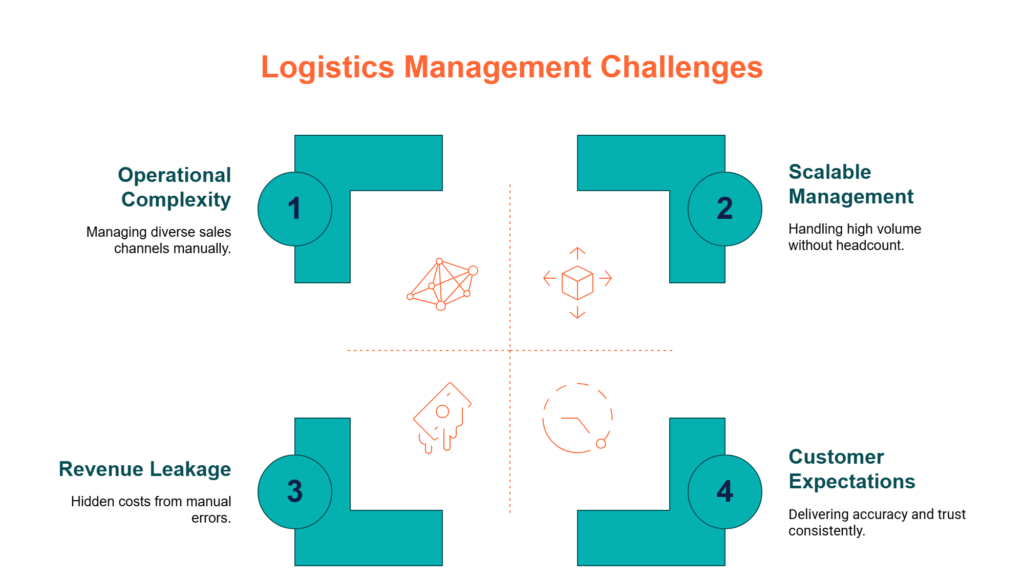
The question is no longer whether to automate, but how to connect everything.
Market Trends Shaping Logistics Management
Four data points show where end-to-end logistics management is heading in the Indian market. Each comes from a named research firm, and the figures are quoted from one source per topic so they stay consistent.
The market is large and still growing. Mordor Intelligence puts the India freight and logistics market at USD 288.89 billion in 2025, rising to USD 476.51 billion by 2031 at an 8.57% CAGR.
Parcel and e-commerce shipping grows faster than the whole. In the same report, Mordor expects the courier, express and parcel segment to grow at a 9.92% CAGR from 2026 to 2031, and notes that e-commerce freight volumes rose 29% in 2024. Brands shipping direct to consumers feel this first, because more parcels mean more exceptions to handle.
Automation grows faster still. IMARC estimates the India logistics automation market at USD 2,181.07 million in 2025, reaching USD 8,010.64 million by 2034, a 15.55% CAGR. IMARC also reports that software holds a 44% share, which tells you where buyers are spending first: on the software layer, before hardware.
Visibility and D2C fulfilment are drivers, not extras. Mordor lists omnichannel and D2C fulfilment among the forces shaping demand, and points to visibility investments that improve asset use and shipper loyalty. Buyers now ask for tracking and predicted delivery dates as a baseline.
Beyond the numbers, four shifts are worth naming:
- AI and machine learning are moving into courier selection, delivery date prediction and failed-delivery handling.
- Cloud-based platforms are reaching mid-sized players, who previously could not afford custom integrations.
- Omnichannel and D2C fulfilment put B2B and B2C flows on the same operation.
- Organized players keep gaining share from the unorganized segment, which raises the bar on service levels for everyone.
Research firms size the Indian logistics market very differently, so treat these figures as direction of travel and name the source when you reuse them.
The New Architecture: The 5 Layers of End-to-End Logistics Management
Logistics analysts now describe the field as layers of connected execution, where data moves through a loop of sensing, deciding and acting. That idea is usually written for enterprise supply chains. Here is an end-to-end logistics management version sized for a shipper with several carriers and a handful of systems.
| Layer | What it does |
| 1. Connectivity | Connects sales channels, ERP, OMS, WMS, TMS and carriers through APIs |
| 2. Intelligent Execution | Automates labels, pickups, manifests and AI-based courier selection |
| 3. Real-Time Visibility | Tracks every shipment and predicts delivery dates |
| 4. Delivery Assurance and Post-Delivery | Handles NDR, redelivery, ePOD and returns |
| 5. Financial Control and Analytics | Audits freight invoices, reconciles COD and reports carrier performance |
Layer 1: Connectivity
This is the base. Orders flow in from every sales channel and from your ERP, OMS or WMS, and carriers connect through APIs rather than separate logins. Without this layer, end-to-end logistics management cannot work, because every later layer runs on partial data. Integrated logistics management starts here, because one shipment record has to be created once and then reused everywhere.
Layer 2: Intelligent Execution
Once orders arrive, labels, pickup requests and manifests are generated automatically. Rules or AI pick the courier by cost, speed and past performance for that pincode. This is the layer where a logistics automation platform removes the most repeated manual work, because the same few decisions are made hundreds of times a day.
Layer 3: Real-Time Visibility
Every shipment is tracked in one place, across every carrier, with normalized statuses. The layer also predicts delivery dates so customers and support teams see an estimate, not just a status. Supply chain visibility software matters most when it flags exceptions early, such as a parcel stuck at a hub or a delivery attempt that failed. For a closer look at how tracking and exceptions connect, read this guide on end-to-end shipment tracking and NDR management.
Layer 4: Delivery Assurance and Post-Delivery
Not every delivery succeeds on the first try. This layer handles NDR actions, redelivery requests, proof of delivery (ePOD with signature, photo or OTP) and returns. It decides what happens in the hours after a failed attempt, which is when a parcel can still be saved. It also gives customers a simple way to start a return without writing an email.
Layer 5: Financial Control and Analytics
The last layer closes the loop. It audits freight invoices against contracted rates, reconciles COD remittances and reports carrier performance on delivery time, NDR rate and RTO rate. Leadership gets carrier-wise data for negotiation, and finance gets fewer disputes.
The control tower on top
A control tower sits across all five layers and shows one dashboard of truth. Operations, finance, support and leadership look at the same shipment data instead of four different exports.
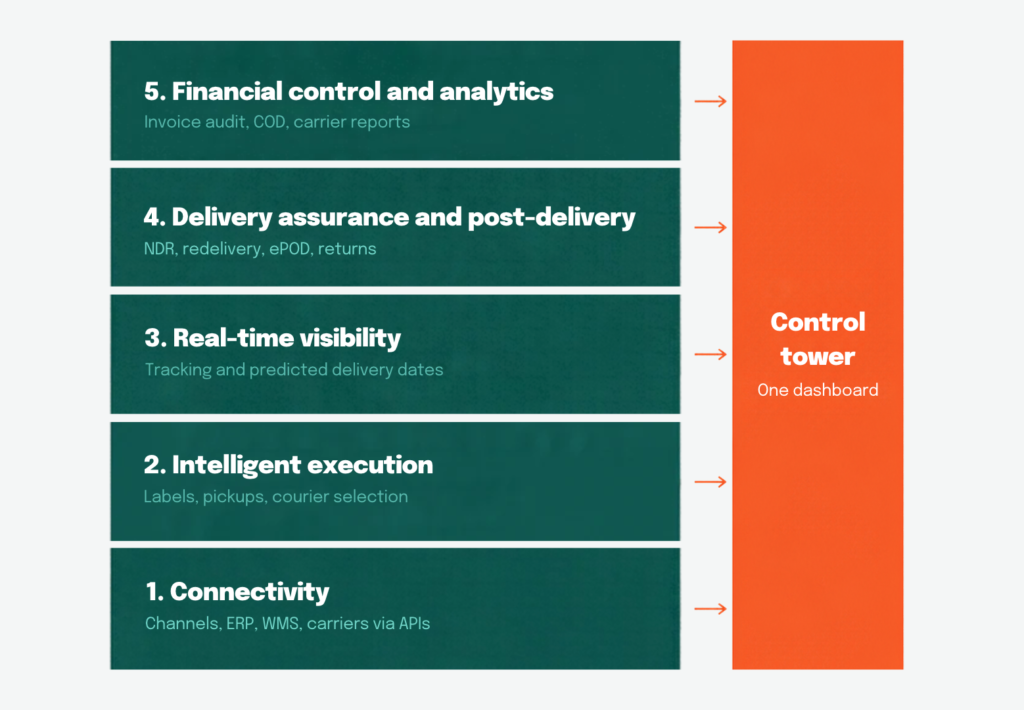
Read the diagram from the base up. Each layer feeds the next, and the control tower reads from all of them at once.
Benefits and Outcomes You Can Expect
End-to-end logistics management pays off in different teams, so it helps to group the gains by who benefits.
Operations. Less manual work, fewer wrong labels and faster dispatch. Teams stop switching between carrier panels and spend their time on exceptions that need a human.
Finance. Fewer billing leaks, cleaner COD reconciliation and a lower cost per shipment. Invoice checks against contracted rates catch overcharges before payment instead of after a dispute.
Customer experience. Accurate delivery estimates, fewer “where is my order” calls and easier returns. Customers hear about a problem from you first.
Leadership. Carrier-wise data for rate negotiation and planning. Instead of arguing from anecdotes, you can show a carrier its own NDR rate in a specific zone.
A real example: MIVI, a D2C audio brand, connected its Shopify store to a multi-carrier automation setup with eShipz. According to the published case study, label errors dropped to near zero and shipment handling capacity went up three to five times without adding staff. The KKCL retail case study follows a similar path, moving from manual and inefficient dispatch to end-to-end automation with real-time visibility.
How to Build It: A Step-by-Step Approach
You can build end-to-end logistics management in stages, without buying everything at once. Work in this order.
- Map your current shipment journey. Write down each step from order confirmation to final settlement. Mark every point where a person copies data, checks a portal or sends a message. Those are your manual steps, and they tell you where to start.
- Unify your systems and carriers through one integration layer. Connect sales channels, ERP or OMS, WMS and carriers to a single platform with APIs. This is the foundation of end-to-end logistics solutions, and skipping it forces you to rebuild integrations later.
- Automate execution. Turn on automatic label generation, pickup booking, manifests and courier allocation rules. Start with simple rules (cost, speed, serviceability) and add AI-based selection once you have a few weeks of data. A useful companion read is this overview of order-to-delivery automation and where AI helps most.
- Add visibility and exception handling. Bring tracking for all carriers into one view, set alerts for stuck or failed shipments, and create a workflow for NDR, redelivery and returns. Decide who owns each exception type and how fast they must act.
- Close the loop with freight audit and analytics. Compare every carrier invoice with the contracted rate, reconcile COD, and review carrier scorecards each month. Feed what you learn back into courier selection in step 3.
Where Can You Start?
Teams often delay end-to-end logistics management because “transformation” sounds huge, so keep the first move small.
Start with your biggest pain point.
- High RTO: begin with NDR management and redelivery.
- Slow dispatch: begin with automation of labels, pickups and courier allocation.
- Billing disputes: begin with freight audit.
Pilot on one channel or one warehouse for 30 to 60 days. One channel gives you clean before-and-after data and limits the risk if a process needs adjusting.
Track three or four baseline KPIs before you begin. Good ones are manual hours per week, RTO percentage, delivery TAT and billing variance. Record them for the 90 days before the pilot so you have something to compare against.
Run this quick readiness checklist:
- Do you ship with more than one carrier?
- Do you track shipments in spreadsheets or on carrier portals?
- Do you verify carrier invoices manually?
- Does your team spend hours each week on status updates and NDR calls?
If you answered yes to two or more, a unified logistics platform will likely pay for itself in saved hours and recovered shipments.
How eShipz Does It: Invisible Shipping. Visible Impact.
eShipz is a logistics technology platform that supports end-to-end logistics management through the same five layers. Here is how its offerings map to each one.
| Layer | eShipz solution |
| Connectivity | Multi-carrier shipping API with 400+ carrier integrations, plus Shopify, ERP, OMS, WMS and TMS integrations |
| Intelligent execution | AutoShip Hub (no-code label generation and courier sync, positioned to cut manual work by 50%) and CarrierSmart AI (picks couriers by speed, cost and performance) |
| Visibility | Track360 (one dashboard for all shipments) and PredictShip ETA (predictive delivery dates) |
| Post-delivery | ReDelivR (AI-led failed-delivery retries, positioned to reduce RTO by up to 10%), NDR management and ReturnEase Portal (branded self-serve returns) |
| Delivery assurance and finance | IntelliProof ePOD (signature, photo and OTP proof) and FreightGuard AI (invoice checks against contracted rates) |
Together these tools work as shipment management software that covers the journey from order to settlement. More than 350 global brands use eShipz, and in 2024 Blue Dart announced a partnership with eShipz to offer a unified shipping API platform for MSMEs and large enterprises.
The platform is used across D2C and eCommerce, B2B and manufacturing, retail and fashion, 3PL and CEP, and quick commerce operations. The common thread is a business that ships through several carriers and wants one place to run and measure that work.
Common Mistakes to Avoid
- Buying tools in silos. A tracking tool, a separate NDR tool and a separate audit tool each need their own integrations and each hold their own version of the data.
- Automating a broken process. If your NDR follow-up is slow and unclear by hand, automating it makes bad outcomes faster. Fix the process on paper first.
- Ignoring post-delivery and billing. Many teams stop at labels and tracking. RTO recovery and invoice audit are where a good share of the money sits.
- Not defining KPIs. Without a baseline you cannot tell whether the pilot worked.
- Choosing a platform with limited carrier coverage. If your key carriers or regional partners are missing, you will end up running two systems again.

Conclusion: Connect the Layers, Then Measure the Result
Logistics in 2027 is a connected system. End-to-end logistics management matters because customers expect accurate dates and easy returns, because small leaks in RTO, courier choice and billing add up, and because manual work cannot keep pace with more channels and carriers. The market is moving the same way, with automation growing faster than the logistics sector as a whole.
The path is practical. Map your shipment journey, connect your systems and carriers, automate execution, add visibility and exception handling, and close the loop with freight audit and analytics. Pick one pain point, run a 30 to 60 day pilot on one channel, and measure manual hours, RTO, delivery TAT and billing variance.
If you want to see how this looks on your own shipment data, book a personalized demo with eShipz.
Frequently Asked Questions
- What is end-to-end logistics management?
End-to-end logistics management is the practice of running every step of a shipment, from order to delivery, returns and billing, on connected systems that share data. It replaces separate tools and spreadsheets with one integrated flow, so teams can see, control and measure the whole journey.
- What are the main layers of an end-to-end logistics solution?
A complete end-to-end logistics solution usually has five layers: connectivity, intelligent execution, real-time visibility, delivery assurance and post-delivery, and financial control with analytics. A control tower sits across them and gives one dashboard for all teams.
- How is a logistics orchestration platform different from a basic shipping tool?
A basic shipping tool usually prints labels or compares rates. A logistics orchestration platform coordinates the full flow: it connects systems, picks carriers, tracks shipments, triggers actions on exceptions and checks invoices, so each step informs the next.
- How long does it take to set up end-to-end logistics management?
A focused pilot on one channel or one warehouse typically runs 30 to 60 days. Timelines depend on how many systems you connect and how many carrier accounts you already hold, so start with the pain point that costs you most.
- Which KPIs should I track?
Track manual hours per week, RTO percentage, delivery TAT, NDR resolution rate, cost per shipment and billing variance. Record a baseline for the 90 days before you start, then review the same numbers monthly.
- Is a unified logistics platform only for large enterprises?
No. Cloud-based platforms now serve mid-sized brands and growing D2C businesses as well as large enterprises. If you ship with more than one carrier or sell on more than one channel, the benefits begin to show at modest volumes.
- Where should I start if my RTO is high?
Start with NDR management and redelivery. Every RTO begins as an NDR, so acting within hours of a failed attempt, with the right customer contact and address, saves parcels that would otherwise return. Pair it with courier allocation by pincode performance.