








A parcel that leaves your warehouse on time can still fail on the last mile. The rider finds a locked gate, the address is incomplete, or the courier hub misses a cut-off. Each of those moments is a delivery exception, and what you do next decides whether the order is delivered or returned.
McKinsey’s survey of more than 1,000 US consumers, published in February 2025, found that about half of shoppers check tracking to confirm an order is progressing and on time. The same research found that consumers rank on-time delivery above speedy delivery. The survey is American, so treat it as a pattern rather than an Indian benchmark. The lesson still applies: shoppers care about reliability, and they notice when a shipment goes quiet.
This guide explains delivery exception management in plain terms. You will learn what causes exceptions, what they cost, and how to build a repeatable workflow. You will also get a prevention checklist, a KPI set and a way to automate the work with eShipz.
What Is Delivery Exception Management?
A delivery exception is any event that stops a shipment from moving through its expected path. It can be a failed attempt, a damaged parcel, a courier delay, a wrong address or a customs hold. Couriers log these events as status codes in their tracking feeds.
Delivery exception management is the process of detecting those events early, classifying them and acting before the customer complains. It covers alerts, customer outreach, courier escalation and the final decision to retry, reroute or return. It is a daily operating habit, not a one-time setup.
Delivery exception management vs NDR management
Non-delivery reports, or NDRs, are one type of exception: the courier tried and failed to hand over the parcel. Delivery exception management is wider. It also covers delays, damage, lost scans and pickup failures that never reach the NDR stage. If you want the failed-delivery angle in depth, read our guide to NDR management in India.
Why delivery exception management matters now
Shoppers expect proactive updates. A brand that tells the customer about a delay before they ask keeps trust, while a brand that stays silent creates support tickets. Good delivery exception management also protects margin, because every unresolved exception moves a shipment closer to a costly return.
Common Causes of Delivery Exceptions
Most exceptions fall into a handful of buckets. Good delivery exception management starts by knowing which bucket a problem belongs to, because that tells you who owns the fix. The table below groups the usual causes and the first action for each.
| Exception type | Typical cause | Who owns the fix | First action |
|---|---|---|---|
| Customer not available | Nobody at the address, phone unreachable | Customer and courier | Message the customer and confirm a reattempt slot |
| Address issue | Incomplete address, wrong pincode, landmark missing | Seller | Validate the address and share the correction with the courier |
| Courier delay | Hub backlog, missed linehaul, weather | Courier | Escalate with the AWB and set a revised delivery date |
| Damaged or tampered parcel | Weak packaging, rough handling | Seller and courier | Raise a claim with photos and offer a replacement |
| Payment problem on COD | Customer refuses or has no cash | Seller | Offer a prepaid link or cancel early |
| Pickup failure | Parcel not ready, label error, manifest mismatch | Seller | Fix the label and rebook the pickup |
| Regulatory hold | Missing document or customs query | Seller | Upload the document and track the clearance |
Notice that many causes sit on the seller side. Address quality and pickup readiness are in your control. That is good news, because fixing them lowers your exception volume before any courier is involved.
What a Delivery Exception Costs You
Every exception adds cost, even when the parcel is eventually delivered. You pay for support time, extra attempts and the risk of an unhappy buyer. When the parcel ends as a return, you also pay the return freight, repacking and a lost sale.
The numbers below are an illustrative model, not benchmarks. They show how cost climbs the longer an exception stays open. Use your own rates to rebuild the table.
| Scenario | Assumption (illustrative) | Cost per shipment |
|---|---|---|
| Resolved within 4 hours | Automated alert plus one customer message | ₹40 |
| Resolved on day 2 | One extra attempt and a support follow-up | ₹95 |
| Resolved after 3 or more attempts | Multiple attempts, agent calls and a delayed order | ₹190 |
| Ends in return to origin | Forward freight, return freight, repacking and lost margin | ₹380 |
The pattern matters more than the exact figures. Teams that invest in delivery exception management usually see the biggest gain from faster first response. Speed of response is the cheapest lever you have. An exception caught in the first hours costs a fraction of one found after the third failed attempt.
Hidden costs beyond freight
There are also costs that never show on a courier invoice. Support agents spend time on where-is-my-order queries. Repeat buyers may stop ordering after a poor delivery experience. Stock tied up in returning parcels cannot be sold again until it is back and inspected, which locks up working capital. Unresolved exceptions also fill the support queue and slow down answers on other orders.
A Step-by-Step Delivery Exception Management Workflow
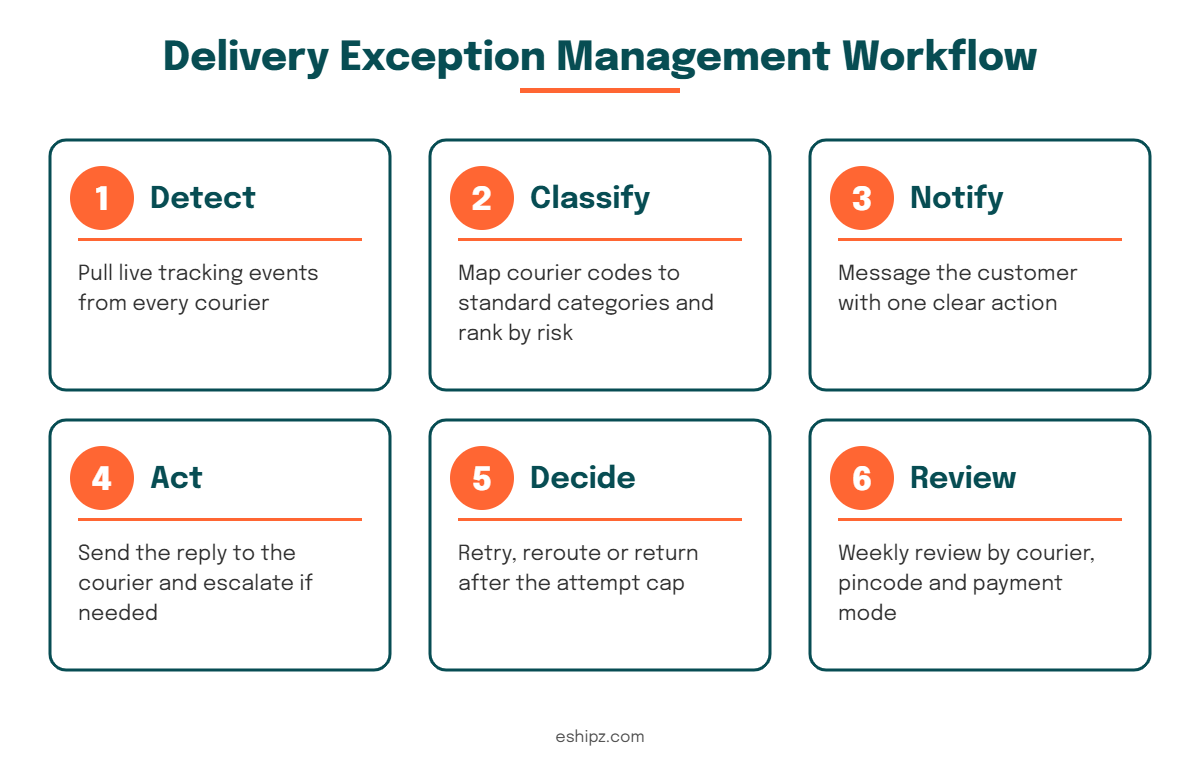
A working process has six steps. Each step has one owner and one time limit. The infographic below summarizes the flow, and the sections after it explain each stage.
Step 1: Detect exceptions from live tracking data
Pull status updates from every courier into one view. Waiting for a daily courier report means you learn about problems a day late. Poll tracking events through carrier APIs and flag any status that is not a normal forward movement.
Step 2: Classify and prioritize
Map each courier code to a standard category such as address issue, customer unavailable or delay. Couriers use different words for the same problem, so a common taxonomy keeps your team consistent. Then rank by risk: high-value orders and COD orders first, since they carry the most to lose.
Step 3: Notify the customer proactively
Send a short message on the customer’s preferred channel as soon as the exception is logged. Say what happened, what you are doing and what the customer needs to do. Ask for one clear action, such as confirming the address or choosing a reattempt time.
Step 4: Act with the courier
Push the customer’s reply to the courier through the API or a bulk file. If the courier is the cause, escalate with the AWB, the last scan and the promised date. Keep an escalation log so you can show a pattern later. A short log of dates, AWBs and replies turns a vague complaint into evidence a courier account manager can act on.
Step 5: Decide: retry, reroute or return
Set an attempt cap and a clear rule for each exception type. After the cap, decide on purpose whether to reroute, switch carrier or return the parcel. A deliberate return is cheaper than an endless loop of attempts.
Step 6: Review and improve
Review exceptions weekly by courier, pincode and payment mode. Look for the repeat offenders. Feed what you learn back into address checks, packaging and carrier choice.
Sample decision rules for each exception type
Written rules stop agents from guessing. The table below shows a starting point. The attempt caps and time limits are examples, so adjust them to your carriers and product margins.
| Exception type | Customer action | Attempt cap (example) | After the cap |
|---|---|---|---|
| Customer not available | Confirm a reattempt slot | 3 attempts | Return to origin |
| Address issue | Share a corrected address | 2 attempts | Cancel and refund or reship |
| COD refusal | Offer a prepaid payment link | 1 attempt | Return to origin |
| Courier delay | No action needed, send a revised date | Not applicable | Escalate, then consider a carrier switch |
| Damaged parcel | Share photos | Not applicable | Replace and file a courier claim |
Message Templates for Delivery Exception Management
Clear messages get faster replies. Keep each one short, name the order and ask for one action. Here are three examples you can adapt to your brand voice.
Customer not available
“Hi, we tried to deliver your order #1234 today but could not reach you. Reply 1 to choose tomorrow, or reply 2 to share a new time. We will arrange the next attempt.”
Address needs correction
“Your order #1234 is on hold because the address looks incomplete. Please reply with your full address and a nearby landmark so the courier can deliver.”
Courier delay
“Your order #1234 is running late because of a delay at the courier hub. The new expected date is shown on your tracking link. No action is needed from you.”
Good delivery exception management treats a message as part of the fix, not an afterthought. Keep a library of approved templates so agents do not write from scratch each time. Review reply rates monthly and rewrite the weakest templates.
Manual vs Automated Delivery Exception Management
Small teams can start delivery exception management with spreadsheets and courier portals. The cost shows up as volume grows. This comparison shows where the two approaches differ.
| Area | Manual handling | Automated handling |
|---|---|---|
| Detection | Team checks courier portals and emailed reports | Tracking events are polled and flagged as they arrive |
| Classification | Agents read each status and decide | Courier codes map to standard categories |
| Customer contact | Agents call or message one by one | Rules trigger WhatsApp, SMS or email messages |
| Courier follow-up | Email threads and phone calls | Responses go to the courier by API or bulk file |
| Reporting | Spreadsheets built at month end | Dashboards by courier, pincode and payment mode |
| Scalability | Needs more people as orders grow | Handles volume growth with the same team |
Automation does not remove people from the loop. It removes the repetitive checking so your team can handle the hard cases. A good rule is to automate every step that follows a fixed rule and keep humans for judgment calls.
Prevention Checklist for Fewer Exceptions
The best exception is the one that never happens. Many causes can be reduced before the parcel leaves the warehouse. Use this checklist as a starting point for delivery exception management in your own operation.
- Validate addresses and pincodes at checkout, and ask for a landmark.
- Confirm COD orders by call or message before dispatch.
- Offer a prepaid discount to reduce COD refusals.
- Print labels from a single source and check barcodes before pickup.
- Pack to the product category, with extra protection for fragile items.
- Share a realistic delivery date at checkout, not the best case.
- Choose carriers by pincode performance rather than a single default.
- Hand over parcels with a manifest and verify the count at pickup.
Run this checklist monthly. Tick what you already do, and pick the two gaps that would remove the most exceptions. Small fixes at the source beat large effort downstream.
Common Mistakes in Delivery Exception Management
Teams repeat the same errors in delivery exception management. Avoiding them is often worth more than buying new tools.
- Waiting for the customer to complain. By then the exception is already old.
- Using one status list for all couriers. Codes differ, so mapping is required.
- No attempt cap. Parcels loop through attempts and still come back.
- Treating all orders alike. A high-value COD parcel needs faster attention than a low-value prepaid one.
- Ignoring seller-side causes. Bad addresses and label errors look like courier problems but start with you.
- Never reviewing the data. Without a weekly review, the same pincodes fail again and again.
McKinsey’s research is a useful reminder here. In that survey about 85% of consumers did not consider an order unacceptably late if it arrived one to two days after the expected time. A small delay with a clear message is often forgiven, while silence is not.
KPIs to Track for Delivery Exception Management
You cannot improve what you do not measure. For delivery exception management, track a small set of metrics and review them on a fixed rhythm. The table lists the most useful ones.
| KPI | What it tells you | How to calculate |
|---|---|---|
| Exception rate | Share of shipments that hit any exception | Exception shipments ÷ total shipments |
| Time to first action | How fast your team responds | Time from exception logged to first customer or courier action |
| Resolution rate | Share of exceptions that end in delivery | Delivered after exception ÷ total exceptions |
| Exception-to-return rate | Share of exceptions that end as returns | Returned after exception ÷ total exceptions |
| First-attempt delivery rate | Overall delivery health | Delivered on first attempt ÷ total shipments |
| Carrier exception share | Which courier causes the most trouble | Exceptions per carrier ÷ shipments per carrier |
Break each metric down by courier, pincode and payment mode. The averages hide the problems. A single weak pincode cluster can drive most of your returns.
How eShipz Supports Delivery Exception Management
eShipz is a shipping automation platform that works with your own courier accounts. Based on the information published on its website, it offers a single tracking dashboard across carriers and automated alerts for delays, NDR and return risk. Please confirm the current feature set with the eShipz team before relying on any point below.
- One tracking view. Shipments from multiple carriers appear in a single dashboard, so your team does not switch between courier portals.
- Early alerts. The platform describes delay detection that flags possible SLA breaches and high-priority orders, such as COD or high-value parcels.
- Customer messages. Automated WhatsApp, SMS and email updates can follow rules you set for when and how customers are contacted.
- NDR actions. Customer responses can be captured and passed to the courier, with single and bulk actions.
- Carrier analytics. Reports compare couriers and pincodes, which helps you see where exceptions repeat.
The point is to move the routine work to rules and keep your team on exceptions that need a human decision. If your team still manages exceptions in spreadsheets, this is the first area to automate.
A 30-Day Rollout Plan for Delivery Exception Management
You do not need a large project to begin delivery exception management. A month is enough to move from ad hoc firefighting to a steady routine. Here is a simple plan.
- Week 1: Export your last 30 days of shipments and list every exception status you find. Group them into the categories used earlier in this guide.
- Week 2: Write the decision rules and message templates. Agree the attempt caps with your operations and support leads.
- Week 3: Start the daily exception review. Assign one owner per exception type and track time to first action.
- Week 4: Review the KPIs by courier and pincode. Fix the top two causes at the source and decide which steps to automate next.
By the end of the month you will know your real exception rate and your most expensive failure types. That baseline makes every later improvement in delivery exception management measurable. Share the numbers with your carriers, too, because data is the strongest tool in a service review. Courier partners respond faster when you show them exact AWB lists, dates and repeat pincodes instead of general complaints. It also gives you the facts you need when you review courier performance.
Conclusion
Strong delivery exception management is not about avoiding every problem. It is about seeing a problem early, telling the customer and taking a clear next step. Start with the basics: one tracking view, standard categories, a customer message and an attempt cap.
Then measure the KPIs weekly and fix the repeat causes at the source. When volume grows, bring in automation so your team can focus on the cases that matter. You can explore how eShipz fits into that workflow on its website.
Frequently Asked Questions About Delivery Exception Management
What is delivery exception management?
Delivery exception management is the process of detecting shipment problems early, classifying them and acting before they become failed deliveries or returns. It covers alerts, customer messages, courier escalation and the final retry, reroute or return decision.
How is delivery exception management different from NDR management?
NDR management deals with failed delivery attempts. Delivery exception management is wider and also covers delays, damage, lost scans and pickup failures that may never become an NDR.
What are the most common delivery exceptions?
The most common ones are customer not available, address problems, courier delays, damaged parcels, COD refusals and pickup failures. The mix varies by courier, region and product category.
How quickly should a delivery exception be handled?
As quickly as you can. Cost rises the longer an exception stays open, so many teams aim to take a first action within a few hours of detection. Set a target that fits your order volume and review it weekly.
Which KPIs matter most for delivery exception management?
Start with exception rate, time to first action, resolution rate, exception-to-return rate and first-attempt delivery rate. Break them down by courier, pincode and payment mode.
Can small sellers manage delivery exceptions without software?
Yes, at low volume. A spreadsheet and courier portals can work for a few dozen orders a day. As volume grows, manual checking becomes slow and costly, and automation pays off.
How does eShipz help with delivery exception management?
eShipz provides a multi-carrier tracking dashboard with delay and NDR alerts, automated customer messages and carrier analytics, based on its published information. Please confirm current features with the eShipz team.