









Every parcel that leaves your warehouse with a bad address is a cost you chose not to catch. Shipping address validation is the check that catches it while the order is still on your shelf, not after the courier has made two failed attempts.
India makes this harder than most markets. India Post’s DIGIPIN policy document notes that a single PIN code covers about 170 sq. km on average, and cites a 2018 study that put the annual cost of poor addressing at USD 10-14 billion. Your orders inherit that problem at the doorstep.
This guide explains shipping address validation in plain terms: what it checks, where addresses go wrong, what a failed address really costs, and how to build a validation step into your dispatch flow. It is written for D2C and marketplace sellers who ship across several carriers.
What Is Shipping Address Validation?
Shipping address validation is the process of checking that a delivery address is complete, correctly formatted and actually reachable before you generate a shipping label. It compares what the buyer typed against known rules and reference data, then flags or fixes problems.
A good shipping address validation step answers four questions. Is the PIN code real and does it match the city and state? Is the address line complete enough for a rider to find it? Is the phone number usable? Does the chosen carrier serve that PIN code?
It is not the same as address verification at checkout alone. Checkout checks catch typing errors early, but shipping address validation also runs at dispatch, when carrier serviceability and delivery mode are known.
Why Delivery Addresses Fail
Most address failures are not fraud. They are ordinary human and system errors that pile up at scale. The table below groups the common causes and the check that catches each one.
| Cause | Example | Check that catches it |
|---|---|---|
| PIN code mismatch | PIN belongs to a different city than the one typed | PIN-to-city-and-state lookup |
| Missing landmark or house number | “Near market, Sector 5” with no building | Minimum-field and length rules |
| Local-language or mixed-script text | Hindi and English mixed in one line | Normalization and transliteration |
| Unserviceable PIN | Carrier does not deliver to that area | Carrier serviceability lookup |
| Unreachable phone number | Nine-digit number, or a landline | Phone format and length check |
| Duplicate or test orders | Same address, repeated within minutes | Duplicate-order rules |
Notice that four of the six causes can be caught by rules alone. You do not need advanced technology to start. You need a consistent step that runs before every dispatch.
Where shipping address validation fits in the failure chain
An address error rarely shows up as “bad address” in your reports. It surfaces as a non-delivery report, a customer call asking where the parcel is, or a return to origin. If you only track those outcomes, you treat the symptom and miss the cause.
For the downstream side, see how eShipz approaches failed deliveries in its guide to NDR management in India. Shipping address validation is the upstream half of the same problem.
What a Bad Address Costs You
A failed delivery is paid for more than once. You pay the forward freight, the return freight, the handling to restock the item, and the support time spent chasing the customer. You may also lose the sale and the repeat order.
The figures below are illustrative, not benchmarks. They use hypothetical assumptions so you can see how the cost stacks up and replace each number with your own.
| Cost component | Illustrative amount (INR per failed order) | Assumption |
|---|---|---|
| Forward freight | 70 | Mid-weight parcel, zonal rate |
| Return freight | 70 | Charged at the same rate as forward |
| Repacking and restocking | 15 | Handling labor and packaging |
| Support time | 10 | Two calls or messages per order |
| Total | 165 | Excludes the lost sale |
On those assumptions, one failed order costs INR 165 before counting the lost margin. If a seller ships 10,000 orders a month and 2% fail on address problems, that is 200 orders and INR 33,000 a month. These numbers are a model, so treat them as a template for your own calculation.
Hypothetical assumptions; replace with your own rates.
Freight is the biggest part of the bill, and you pay it twice. That is why catching the problem before the label is printed saves more than fixing it after the first attempt.
Why Indian Addresses Are Harder to Validate
India does not yet have one universal, fine-grained address standard. According to the India Post document, a PIN code covers about 170 sq. km on average, which is far too coarse to guide a rider to a door. Many addresses depend on landmarks, local names and informal descriptions.
India Post, with IIT Hyderabad and the National Remote Sensing Centre of ISRO, has released DIGIPIN, an open-source grid. It uses a 10-character code made of 16 symbols and identifies a location to about 4 m x 4 m. The code is tied to coordinates, so it does not change when locality names or roads change.
For sellers, the practical point is simple. A coordinate-based reference is more precise than a PIN code, and the industry is moving toward it. Source: India Post, DIGIPIN policy document (May 2025).
Until buyers routinely supply such codes at checkout, your shipping address validation step has to work with PIN code, text and phone data. Build it so it can accept a precise location code when your storefront starts collecting one.
How to Build a Shipping Address Validation Workflow
A reliable workflow has five steps. Each step either passes the order, fixes it, or holds it for a human to review. The infographic below shows the flow.
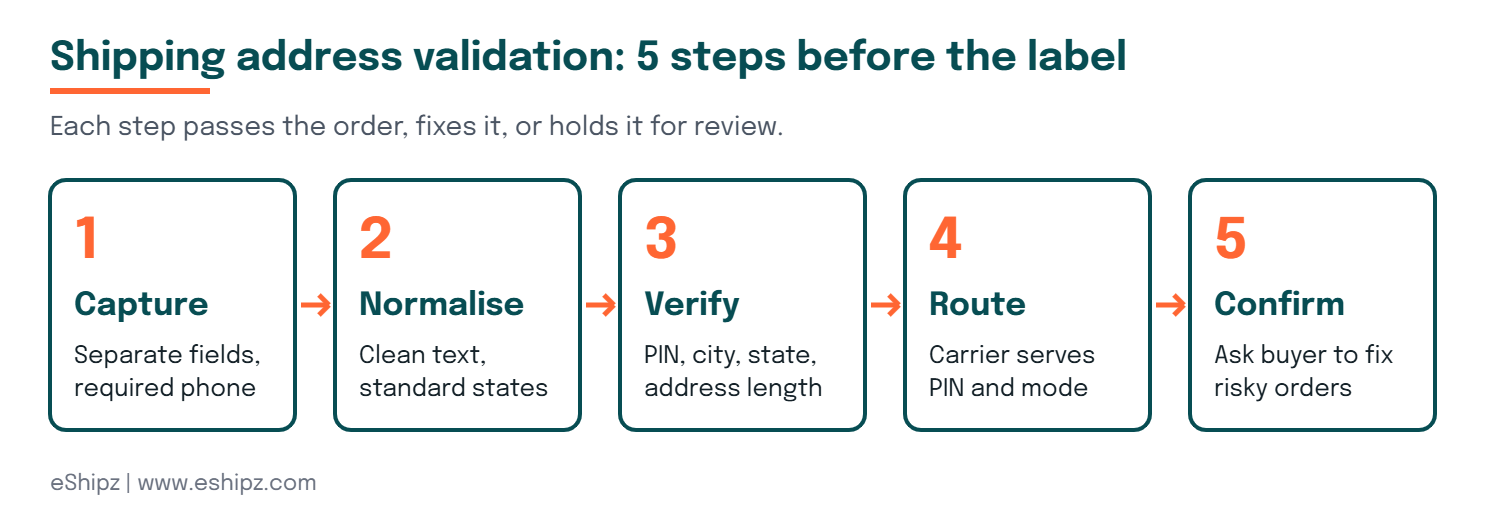
- Capture clean data. Use separate fields for house number, street, locality, city, state and PIN code. Mark the phone number as required and validate its length as the buyer types.
- Normalize the text. Remove extra spaces and symbols, expand common abbreviations, and standardize state names. This is the first automated stage of shipping address validation.
- Verify the details. Check that the PIN code exists and matches the city and state. Check that the address line is long enough and contains a house or building reference.
- Route by serviceability. Confirm that at least one carrier serves the PIN code and delivery mode. Flag cash on delivery orders to unserviceable or low-reliability PIN codes.
- Confirm risky orders. For orders that fail a soft check, send the buyer a message asking for a landmark or a corrected address. Hold the label until they respond or a timeout passes.
Decide what to block and what to flag
Not every issue deserves a hard stop. Block orders with an invalid PIN code or an unusable phone number, because they will almost certainly fail. Flag orders with a thin address line, and let a person or an automated message resolve them.
Write these rules down and review them monthly. A rule that blocks too many good orders costs sales, so measure both sides.
Handle cash on delivery orders with extra care
Cash on delivery orders carry the most risk because the seller pays freight both ways and collects nothing. A cleaner address does not remove that risk, but it removes the part you control.
For these orders, add a confirmation step for any address that fails a soft check. A short message or call that asks the buyer to confirm the landmark and the phone number is usually enough. If the buyer does not respond within a set time, hold the order instead of shipping it blind.
Keep a simple record of confirmed and unconfirmed orders. After a month, compare the failure rate of the two groups. The gap shows what the confirmation step is worth.
Treat marketplace and imported orders separately
Orders from marketplaces, sales teams and bulk uploads often skip your storefront checks. Their addresses may arrive in a single text field, with the PIN code buried in the middle.
Split those fields during import, then run the same checks you use for website orders. Without this step, your cleanest channel looks healthy while your messiest channel drives most of the failures.
Handle local-language and informal addresses
Many buyers write addresses in a mix of English and a local language, or describe the location by landmark. Do not reject these addresses by default. Standardize the script where you can, keep the landmark text, and let a rider or support agent read it.
When a pattern repeats, add a rule for it. For example, if one locality is always spelled three ways, map those spellings to one standard form.
Comparing Shipping Address Validation Methods
There are three common ways to run shipping address validation. The right one depends on your volume, team size and carrier mix.
| Method | Best for | Strength | Limitation |
|---|---|---|---|
| Manual review | Under a few hundred orders a month | No setup cost | Slow, inconsistent, does not scale |
| Rule-based checks | Growing D2C brands | Fast, cheap, catches PIN and phone errors | Cannot judge whether a landmark is findable |
| API or platform-based validation | High volume, multiple carriers | Automated, integrated with carrier data | Needs integration and a data source |
Most sellers start with rules and move to a platform as order volume grows. The point is to make shipping address validation a fixed step, not a favor someone does when they have time.
A 30-Day Rollout Plan for Your Team
You do not need a large project to start. A small team can roll out the first version in a month if each week has one clear job.
| Week | Focus | Output |
|---|---|---|
| Week 1 | Measure the baseline | Address-related failure rate by carrier, state and payment mode |
| Week 2 | Add the basic rules | PIN code, phone and minimum-field checks on every order |
| Week 3 | Add confirmation | Buyer messages for flagged cash on delivery orders |
| Week 4 | Review and adjust | Updated rules, hold rate and correction rate |
Assign one owner for the rules and one for the buyer confirmations. When nobody owns the process, the checks drift and the failure rate creeps back up.
Write a short operating procedure
A one-page procedure keeps the work consistent when staff change. It should list which issues block an order, which only flag it, who resolves flagged orders and how long they wait for a reply.
Review the procedure after the first month. Remove rules that never fire and tighten rules that miss obvious failures. Share the results with your carriers when a pattern points to a serviceability gap on their side.
Shipping Address Validation Checklist
Use this checklist before you label any batch of orders. It works whether you validate by hand or inside a platform.
- The PIN code exists and matches the city and state.
- The address contains a house, flat or building reference.
- The address has a landmark or locality when the area is informal.
- The phone number is complete and not a landline.
- At least one carrier serves the PIN code and delivery mode.
- Cash on delivery orders to risky PIN codes have been confirmed.
- The order is not a duplicate of one placed minutes earlier.
- The label shows the corrected address, not the original.
Print the list or build it into your order screen. A checklist that lives in someone’s head fails when that person is on leave.
Prepare for Sale Seasons and Volume Spikes
Address problems grow with volume. During festive sales, order counts rise quickly, support teams get stretched and carriers run at capacity. Errors that were manageable in a quiet week become expensive in a peak week.
Plan for this before the season starts. Run your rules on last season’s orders to see how many would have been held, and decide in advance how many held orders your team can clear each day. If the number is too high, tighten the rules for the riskiest cases only.
Also brief your carriers early. Share the PIN codes where you expect heavy volume, and ask which areas they find hard to serve. A short conversation before the peak is cheaper than a week of escalations after it.
After the season, record what you learned. Keep the list of PIN codes, localities and address patterns that caused trouble, and use it to refine the rules for the next campaign. Over a few cycles, this record becomes one of your most useful operations assets.
Common Shipping Address Validation Mistakes
The first mistake is validating only at checkout. Checkout checks miss orders created by marketplaces, sales teams or imports, so run shipping address validation again at dispatch.
The second is blocking too aggressively. If your rules reject legitimate informal addresses, you lose orders you could have delivered. Flag unclear cases instead of blocking them.
The third is auto-correcting without telling the buyer. A silent change can turn a nearly correct address into a wrong one. Show the corrected version and ask for confirmation when the change is material.
The fourth is ignoring the feedback loop. If you never tie failed deliveries back to the address rules, the rules never improve. Review each month’s failures and add a rule for any pattern you see.
KPIs to Track for Shipping Address Validation
You cannot improve what you do not measure. Track these metrics weekly and compare them by carrier, state and payment mode.
| KPI | What it tells you | How to calculate |
|---|---|---|
| Address-related failure rate | Share of orders that fail due to address problems | Address-related failures / orders shipped |
| Validation hold rate | How many orders your rules stop | Held orders / orders received |
| Correction success rate | How often held orders get fixed | Corrected orders / held orders |
| First-attempt delivery rate | Overall delivery health | First-attempt deliveries / orders shipped |
| Cost per failed order | The money at stake | Total failure cost / failed orders |
Set a baseline first, then change one rule at a time. That way you can see which rule moved the number.
How eShipz Supports Your Shipping Address Validation Process
eShipz is a multi-carrier shipping platform for Indian businesses. You can see more at the eShipz homepage. The platform’s published guides cover carrier allocation, tracking and non-delivery management, which sit on either side of the address check.
A shipping address validation step works best when it shares data with carrier selection. Serviceability by PIN code decides which carriers can take the order, and delivery history by area tells you which carrier to prefer. Both are reasons to run validation inside the same workflow as your multi-carrier shipping setup.
After dispatch, tracking and non-delivery workflows show which addresses still fail. Feed that learning back into your rules, so your shipping address validation improves with every batch.
Conclusion
Shipping address validation is a small step with a large payoff. It moves the fix from the doorstep, where it is expensive, to the warehouse, where it is cheap.
Start with the checklist, add rules for PIN codes and phone numbers, and measure the failure rate by carrier and state. As your volume grows, move the checks into your shipping platform so every order passes through the same shipping address validation flow.
Shipping Address Validation FAQs
1. What is shipping address validation?
Shipping address validation checks that a delivery address is complete, correctly formatted and serviceable before a label is created. It flags problems such as PIN code mismatches and missing details so you can fix them first.
2. Is shipping address validation the same as address verification?
They overlap. Address verification often means confirming an address exists, while shipping address validation also checks carrier serviceability and delivery mode at dispatch.
3. When should I run shipping address validation?
Run it twice: at checkout, to catch typing errors early, and at dispatch, to catch problems from marketplaces, imports and manual orders.
4. Which orders benefit most from shipping address validation?
Cash on delivery orders benefit most, because a failed delivery means no payment and a return freight charge. Orders to informal or unserviceable areas also carry higher risk.
5. Does shipping address validation reduce return to origin?
It helps when address problems cause the failures. It does not fix refusals or price-related returns, so track the reason for each return before you judge the results.
6. What is DIGIPIN and does it replace validation?
DIGIPIN is India Post’s open-source grid code that identifies a location to about 4 m x 4 m. It gives a more precise reference than a PIN code, but you still need validation to check completeness and serviceability.
7. How do I start with shipping address validation?
Begin with the checklist, add PIN code and phone checks, and measure your address-related failure rate. Then automate the rules inside your shipping platform as volume grows.