




Solution

Integration

Industries

Resources

One platform that brings shipping, tracking, returns, and performance insights together for modern retail operations.

Speed Up Shopify Fulfilment with eShipz Shipping Integration

See how eShipz helps businesses overcome shipping challenges with ease.

Transforming E-Cycle Logistics in India: How EMotorad Scaled Using Smart Shipping

Vero Moda

Bestseller India’s Shift to Faster, Leaner and More Connected B2B Operations

What is B2B Logistics? A Complete Beginner’s Guide

What is B2B Logistics
Topics Covered

What is B2B Logistics? A Complete Beginner’s Guide

India’s B2B Logistics Industry Is Growing Faster Than Ever

India’s B2B logistics industry is entering a period of unprecedented growth, driven by rapid industrialization, digital transformation, expanding manufacturing capabilities, and increasing global trade. According to industry estimates, the Indian logistics market was valued at approximately USD 228.4 billion in 2024 and is projected to reach over USD 357 billion by 2030, growing at a healthy CAGR. This growth is being fuelled by rising ecommerce adoption, the expansion of MSMEs, infrastructure development, government initiatives like the National Logistics Policy and PM Gati Shakti, and the increasing demand for faster, technology-enabled B2B logistics services.

The scale of this transformation is massive. India is home to more than 65 million MSMEs, thousands of manufacturing plants, and one of the world’s fastest-growing retail and export ecosystems. Every day, millions of shipments move between suppliers, manufacturers, distributors, wholesalers, retailers, and enterprise customers. Behind every successful shipment lies an extensive B2B supply chain that depends on efficient transportation, inventory management, warehouse management, freight transportation, and seamless coordination between multiple stakeholders.

However, growth also brings complexity. As businesses expand across Tier 2 and Tier 3 cities, manage multiple warehouses, onboard additional courier partners, and serve customers across different regions, traditional logistics operations are beginning to show their limitations. Businesses that once handled a few hundred shipments each month are now managing thousands of orders daily, making manual logistics processes increasingly difficult to sustain.

What is B2B Logistics? Understanding the Core of Modern Supply Chain Management B2B

Before businesses can optimize their operations, it is important to understand what B2B Logistics actually involves. While many organizations associate logistics with transportation alone, the scope of B2B logistics is much broader. It encompasses every activity required to move products efficiently between businesses, from sourcing raw materials and storing inventory to managing warehouses, selecting transportation partners, fulfilling orders, tracking shipments, and ensuring products reach distributors, wholesalers, retailers, or enterprise customers on time.

A well-planned B2B supply chain connects suppliers, manufacturers, logistics providers, warehouses, distributors, and customers into one coordinated network. Every stakeholder depends on accurate information, efficient transportation, and real-time visibility to keep operations running smoothly. When one part of the supply chain slows down, the impact is felt across procurement, production, inventory, and customer deliveries.

Unlike B2C deliveries that focus on individual consumers, B2B shipping services typically involve bulk shipments, palletized freight, scheduled deliveries, recurring purchase orders, and strict service-level agreements (SLAs). Businesses must also manage GST compliance, e-way bills, commercial invoices, freight documentation, and warehouse coordination, making Supply Chain Management B2B significantly more complex than consumer logistics.

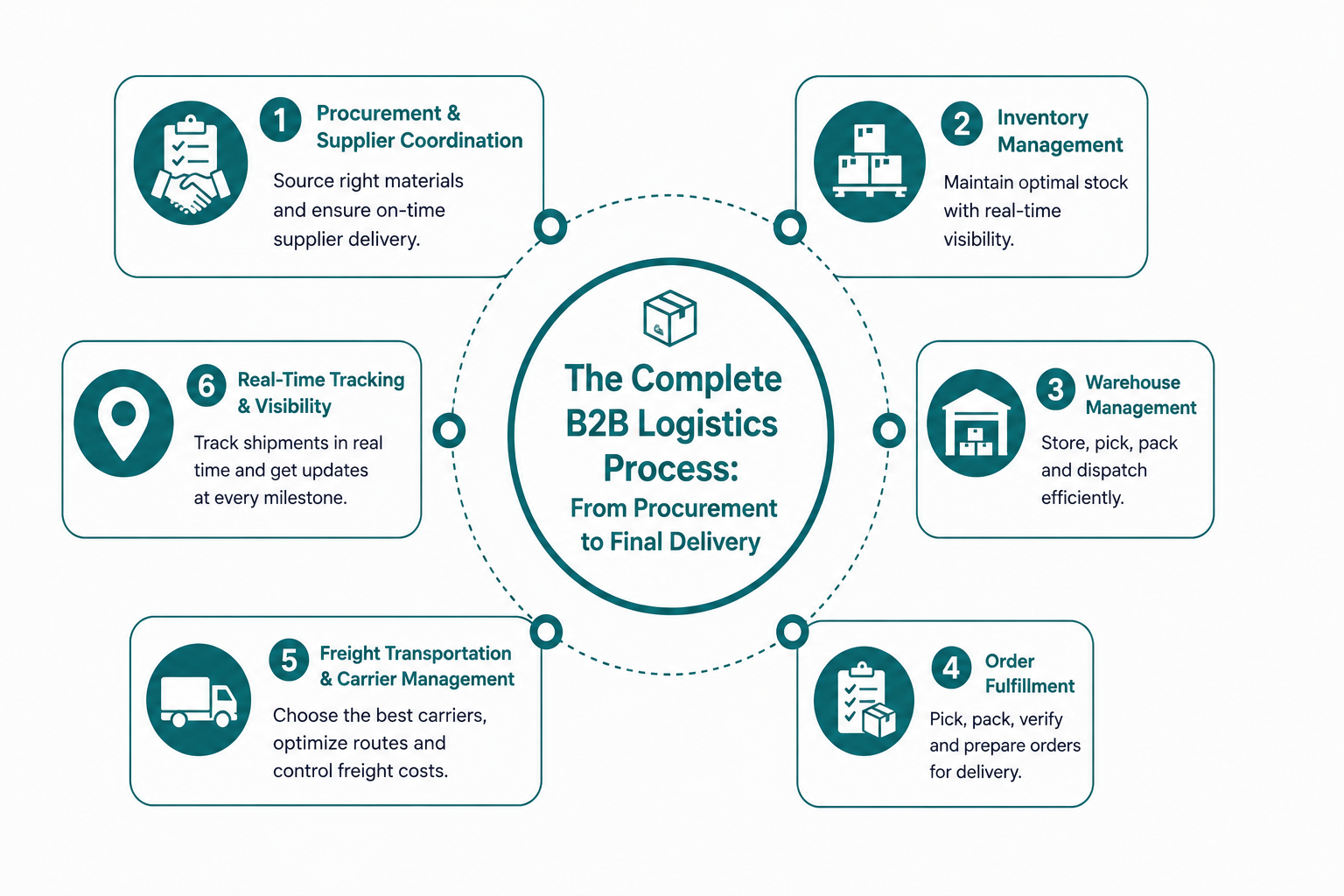
The Complete B2B Logistics Process: From Procurement to Final Delivery

Every successful B2B logistics operation follows a structured workflow. Although industries may differ, the core stages remain largely the same.
B2B

1. Procurement and Supplier Coordination

Every B2B supply chain begins with sourcing raw materials, finished products, or components from suppliers. Procurement teams work closely with vendors to ensure materials are delivered on time, in the right quantities, and at the agreed quality standards.

Efficient procurement reduces production delays, minimizes inventory shortages, and strengthens supplier relationships. Many organizations now integrate procurement systems with their B2B logistics services to improve visibility across inbound shipments.

2. Inventory Management

Once goods arrive, effective inventory management becomes essential. Businesses must maintain optimal inventory levels without overstocking or running out of products.

Modern B2B logistics companies use inventory management systems that provide real-time stock visibility across multiple warehouses. This enables businesses to forecast demand more accurately, improve replenishment planning, reduce carrying costs, and avoid stockouts that could interrupt business operations.

Without proper inventory management, even the most efficient transportation network cannot deliver consistent customer service.

3. Warehouse Management

After inventory is received, products move into warehouse operations. Efficient warehouse management ensures products are stored correctly, picked accurately, packed efficiently, and dispatched on time.

Today’s B2B logistics services increasingly rely on Warehouse Management Systems (WMS), barcode scanning, RFID technology, automated picking, and digital inventory tracking to improve warehouse productivity.

Efficient warehouse operations help businesses:

  • Improve storage utilization
  • Reduce picking errors
  • Accelerate dispatch times
  • Improve order accuracy
  • Lower operational costs
  • Increase workforce productivity

4. Order Fulfillment

Once a customer places an order, the order fulfillment process begins. Products are picked, packed, verified, labelled, and prepared for dispatch.

For businesses handling hundreds or thousands of daily shipments, manual order fulfillment becomes both time-consuming and error-prone. This is why modern B2B logistics companies automate order processing through ERP integrations, warehouse automation, and intelligent shipping platforms.

Faster order fulfillment directly improves customer satisfaction while reducing operational delays.

5. Freight Transportation and Carrier Management

Transportation is one of the most visible components of B2B logistics, but it is also one of the most complex. Businesses often work with multiple regional and national carriers, each offering different pricing, delivery timelines, and service coverage.

Choosing the right transportation partner requires balancing cost, speed, reliability, and service quality.

Modern B2B logistics providers simplify this process by offering:

  • Multi-carrier shipping
  • AI-powered carrier allocation
  • Route optimization
  • Freight cost analysis
  • SLA monitoring
  • Automated carrier selection

These capabilities help businesses reduce freight expenses while improving delivery performance.

6. Real-Time Shipment Tracking and Delivery Visibility

Customers today expect complete visibility into every shipment. Businesses also need accurate delivery updates to manage operations effectively.

Modern B2B logistics services provide real-time shipment tracking, automated notifications, delivery milestones, and exception alerts from a centralized dashboard.

Instead of contacting multiple transporters for shipment updates, businesses gain complete visibility into their B2B supply chain, enabling proactive decision-making whenever delays occur.

Key Components That Make B2B Logistics Successful

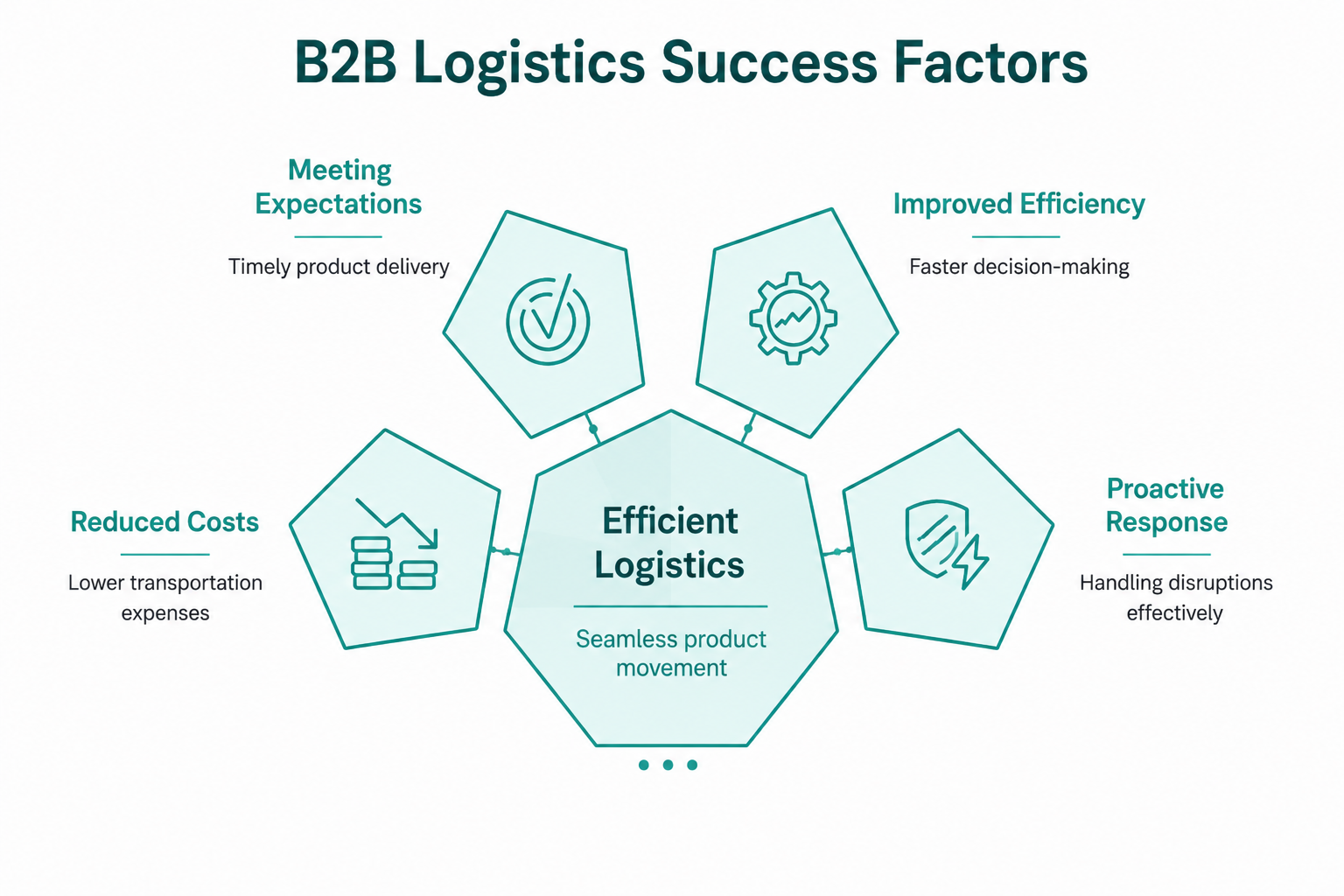
An efficient B2B logistics strategy is built on multiple interconnected processes that work together to ensure products move seamlessly across the B2B supply chain. Every stage—from sourcing raw materials to delivering finished goods, plays a crucial role in maintaining operational efficiency, reducing logistics costs, and meeting customer expectations. When one component underperforms, it creates a ripple effect across the entire supply chain, leading to delays, inventory shortages, increased transportation costs, and poor customer experiences.

Modern B2B logistics services are designed to connect these functions into a single, technology-driven ecosystem. Rather than operating independently, every department shares real-time information, enabling businesses to make faster decisions, improve coordination, and respond proactively to disruptions. Below are the core components that form the foundation of a successful B2B logistics strategy.

B2B

1. Procurement and Supplier Management

Every successful B2B supply chain begins with efficient procurement and strong supplier relationships. Businesses must source raw materials, components, or finished products from reliable suppliers while ensuring timely deliveries and consistent product quality. Delays during procurement can disrupt manufacturing schedules, increase production costs, and create inventory shortages throughout the supply chain.

Modern B2B logistics companies integrate procurement systems with logistics platforms to provide complete visibility into inbound shipments. This allows procurement teams to monitor supplier performance, track incoming deliveries, and identify potential disruptions before they impact operations. Strong supplier management also helps businesses negotiate better pricing, reduce lead times, and build long-term strategic partnerships.

2. Inventory Management

Effective inventory management ensures that businesses maintain the right products in the right quantities at the right locations. Holding excess inventory increases storage costs, while insufficient inventory leads to stockouts, delayed deliveries, and lost sales opportunities.

As businesses expand across multiple warehouses and distribution centres, managing inventory manually becomes increasingly challenging. Modern B2B logistics services provide real-time inventory visibility, automated stock updates, demand forecasting, and replenishment planning. These capabilities enable organizations to optimize working capital, reduce carrying costs, and improve overall Supply Chain Management B2B by ensuring inventory is always available when needed.

3. Warehouse Management

A warehouse is much more than a storage facility, it is the operational hub of every B2B logistics network. Efficient warehouse management ensures products are received, stored, picked, packed, and dispatched quickly and accurately. Poor warehouse operations can result in misplaced inventory, delayed shipments, higher labour costs, and lower customer satisfaction.

Leading B2B logistics providers leverage Warehouse Management Systems (WMS), barcode scanning, RFID technology, and automated picking processes to improve warehouse efficiency. These technologies help businesses maximize storage space, reduce picking errors, improve order accuracy, and accelerate dispatch operations, enabling warehouses to handle increasing shipment volumes without compromising productivity.

4. Order Fulfillment

The order fulfillment process directly influences delivery speed and customer satisfaction. Once a customer places an order, businesses must quickly verify inventory, pick the correct products, pack them securely, generate shipping labels, prepare invoices, and hand over shipments to the selected carrier.

Manual order processing often creates bottlenecks, particularly during peak seasons or large-scale B2B operations. Modern B2B logistics services automate the entire order fulfillment process by integrating with ERP systems, warehouse software, and ecommerce platforms. This reduces human error, shortens processing times, and ensures every order is fulfilled accurately and efficiently.

5. Freight Transportation

Freight transportation forms the backbone of every B2B logistics operation. Whether goods are transported by road, rail, air, or sea, businesses need reliable transportation networks that balance speed, cost, and service quality. Selecting the wrong transportation partner can lead to shipment delays, increased freight costs, damaged goods, and missed delivery commitments.

Today’s B2B logistics companies use intelligent transportation management systems to optimize routes, consolidate shipments, compare carrier rates, and monitor freight performance. By using data-driven transportation planning, businesses can reduce logistics expenses while ensuring products reach their destinations safely and on time.

6. Distribution Network Optimization

An efficient distribution network enables businesses to deliver products quickly while minimizing transportation costs. As organizations expand into new markets, they must strategically position warehouses, fulfilment centres, and regional hubs to reduce delivery times and improve customer service.

Modern B2B logistics providers use advanced analytics and demand forecasting to optimize distribution networks, helping businesses identify the most effective shipping routes, warehouse locations, and delivery schedules. A well-planned distribution strategy improves operational efficiency and supports long-term business growth.

7. Multi-Carrier Management

Working with a single courier partner may not always provide the best service, pricing, or regional coverage. This is why businesses increasingly rely on multi-carrier management as part of their B2B logistics strategy.

By integrating multiple national and regional carriers into a single platform, businesses can compare shipping costs, delivery timelines, service levels, and coverage areas before selecting the most suitable logistics partner for every shipment. This flexibility improves delivery performance while reducing transportation costs and minimizing carrier dependency.

8. Logistics Technology

Modern logistics technology has transformed how businesses manage their B2B supply chain. Cloud platforms, AI, machine learning, APIs, IoT devices, and automation enable organizations to replace manual workflows with intelligent, data-driven processes.

Technology allows businesses to automate repetitive tasks, integrate multiple systems, improve operational visibility, and make faster decisions based on real-time information. As shipment volumes continue to grow, digital transformation has become essential for building scalable and efficient B2B logistics services.

9. Real-Time Shipment Tracking

Customers and businesses alike expect complete visibility throughout the shipping journey. Real-time shipment tracking enables organizations to monitor every shipment from dispatch to final delivery, reducing uncertainty and improving communication.

Modern B2B logistics companies provide centralized tracking dashboards, automated notifications, estimated delivery updates, and exception alerts. These capabilities allow businesses to proactively manage delays, improve customer communication, and maintain greater control over their B2B logistics operations.

10. Reverse Logistics

Returns, replacements, repairs, and product recalls are an unavoidable part of modern business operations. Efficient reverse logistics ensures returned products are collected, inspected, restocked, repaired, or disposed of quickly while minimizing operational costs.

A well-managed reverse logistics process improves customer satisfaction, reduces waste, and helps businesses recover product value. For industries such as electronics, retail, automotive, and manufacturing, reverse logistics is becoming an increasingly important component of Supply Chain Management B2B.

11. Performance Analytics

Successful B2B logistics decisions are driven by data rather than assumptions. Performance analytics provide valuable insights into transportation costs, carrier performance, warehouse productivity, delivery timelines, inventory turnover, and SLA compliance.

By continuously monitoring these metrics, businesses can identify inefficiencies, improve operational planning, reduce logistics costs, and make informed strategic decisions that strengthen their overall B2B supply chain.

12. Compliance and Documentation

Every shipment must comply with applicable regulations, including GST requirements, e-way bills, customs documentation, invoices, and industry-specific compliance standards. Manual documentation increases the likelihood of errors, shipment delays, and financial penalties.

Modern B2B logistics services automate document generation and compliance workflows, ensuring shipments meet regulatory requirements while reducing administrative effort and improving operational efficiency.

13. Customer Communication

Transparent communication is a critical part of a successful B2B logistics strategy. Business customers expect timely updates regarding order confirmation, dispatch, shipment progress, delivery schedules, and potential delays.

Automated notifications, tracking links, and proactive communication help businesses build trust, improve customer satisfaction, and reduce support enquiries. Strong communication also strengthens long-term relationships with distributors, retailers, and enterprise buyers.

14. End-to-End Supply Chain Visibility

Complete supply chain visibility enables businesses to monitor every stage of the B2B supply chain from procurement and warehousing to transportation and final delivery. Centralized dashboards provide a single source of truth, allowing teams to identify bottlenecks, monitor performance, and respond quickly to operational disruptions.

Organizations that invest in end-to-end visibility gain greater control over their B2B logistics operations, improve collaboration across departments, reduce operational risks, and build a more agile, resilient, and future-ready supply chain.

B2B

Why Businesses Are Moving Towards Digital B2B Logistics Services

As businesses scale, managing logistics through manual processes becomes increasingly difficult. Growing shipment volumes, customer expectations for faster deliveries, and the need for real-time visibility have made traditional logistics operations inefficient. This is why organizations are replacing disconnected systems with digital B2B logistics platforms that automate and streamline the entire supply chain.

Traditional B2B Logistics Digital B2B Logistics Services
Manual order processing Automated order processing
Spreadsheets for shipment management Centralized logistics dashboard
Separate carrier portals Multi-carrier platform integration
Manual shipping labels and invoices Automated documentation
Limited shipment visibility Real-time shipment tracking
Reactive issue resolution Proactive alerts and notifications
Higher operational costs Optimized logistics costs
Manual carrier selection AI-powered carrier allocation
Disconnected warehouse and inventory systems Integrated inventory & warehouse management
Difficult to scale operations Easily scalable logistics operations
Limited performance insights Real-time analytics and reporting
Slower decision-making Data-driven operational decisions

Digital B2B logistics is no longer just about moving products from one location to another. It enables businesses to automate workflows, improve visibility, reduce costs, and make faster, data-driven decisions. By connecting procurement, inventory, warehousing, transportation, and shipment tracking into a single platform, organizations can build a more agile, scalable, and customer-centric supply chain while staying competitive in a rapidly evolving market.

Top Challenges in B2B Logistics: Why Traditional B2B Supply Chain Models Struggle to Scale

As businesses grow, managing B2B logistics becomes increasingly complex. Expanding into new markets, handling larger shipment volumes, coordinating with multiple suppliers, and meeting customer expectations require far more than traditional logistics processes. While many organizations continue to rely on manual workflows, spreadsheets, disconnected software, and multiple carrier portals, these outdated methods often create operational bottlenecks that slow business growth.

An efficient B2B supply chain depends on seamless coordination between procurement, inventory management, warehouse operations, freight transportation, order fulfillment, and customer communication. When these functions operate independently, businesses experience delays, higher logistics costs, inventory inaccuracies, and poor shipment visibility. This is why organizations across manufacturing, wholesale, retail, FMCG, pharmaceuticals, automotive, and industrial sectors are investing in modern B2B logistics services to improve efficiency and gain complete control over their supply chain operations.

Below are some of the biggest challenges businesses face while managing B2B logistics.

1. Limited End-to-End Supply Chain Visibility

One of the biggest challenges in B2B logistics is the lack of visibility across the entire B2B supply chain. Many businesses lose track of shipments once they leave the warehouse, making it difficult to identify delays, monitor carrier performance, or provide customers with accurate delivery updates.

Without real-time shipment tracking, logistics teams spend valuable time contacting transporters, checking multiple courier portals, or manually updating customers. This not only reduces operational efficiency but also impacts customer confidence and decision-making.

Modern B2B logistics companies solve this challenge by providing centralized dashboards that offer complete shipment visibility, automated notifications, predictive ETAs, and exception management, allowing businesses to proactively address disruptions before they escalate.

2. Rising Freight Transportation Costs

Transportation represents one of the largest expenses in any B2B logistics operation. Rising fuel prices, inefficient route planning, empty return trips, and poor carrier allocation significantly increase overall logistics costs.

Many businesses continue assigning shipments based on long-term relationships instead of evaluating cost, transit time, and service performance. Without intelligent planning, organizations often pay higher freight charges while receiving inconsistent service.

Advanced B2B logistics services use AI-powered carrier allocation, route optimization, shipment consolidation, and performance analytics to reduce transportation expenses while improving delivery reliability. These capabilities help businesses optimize freight transportation without compromising service quality.

3. Poor Inventory Management Across Multiple Warehouses

As businesses expand into multiple cities and regions, maintaining accurate inventory management becomes increasingly challenging. Inventory discrepancies, delayed stock updates, and poor demand forecasting often lead to stockouts, excess inventory, or delayed customer deliveries.

Disconnected warehouse systems make it difficult for businesses to maintain accurate stock visibility across all locations. As a result, products may be available in one warehouse while another experiences shortages, creating unnecessary transportation costs and fulfillment delays.

Modern B2B logistics providers integrate inventory management with warehouse management, order processing, and transportation planning to ensure inventory is updated in real time. This improves stock accuracy, reduces carrying costs, and strengthens overall Supply Chain Management B2B.

4. Inefficient Warehouse Management and Order Fulfillment

Warehouse operations directly influence delivery speed, order accuracy, and customer satisfaction. Businesses relying on manual picking, paper-based processes, or disconnected warehouse systems often struggle to process growing shipment volumes efficiently.

Poor warehouse management leads to misplaced inventory, incorrect shipments, delayed dispatches, and increased labour costs. During seasonal demand spikes, these inefficiencies become even more noticeable.

Technology-driven B2B logistics services automate warehouse workflows through barcode scanning, Warehouse Management Systems (WMS), automated picking, digital inventory updates, and intelligent order fulfillment processes. These improvements help businesses increase warehouse productivity while reducing operational errors.

5. Managing Multiple Logistics Partners and Courier Networks

Growing businesses rarely depend on a single transportation provider. Instead, they work with several regional and national carriers, each offering different pricing, coverage, and delivery capabilities.

Managing these relationships manually often creates operational complexity. Teams must compare rates, log into multiple courier portals, monitor service performance, and reconcile invoices separately.

Modern B2B logistics companies simplify this process through centralized multi-carrier management, enabling businesses to compare shipping rates, allocate shipments intelligently, monitor SLAs, and manage every logistics partner from one platform.

6. Compliance, Documentation, and Regulatory Challenges

Compliance is one of the most critical aspects of B2B logistics, particularly for businesses operating across multiple states or international markets. Every shipment requires accurate invoices, GST documentation, e-way bills, customs paperwork, and industry-specific compliance records.

Manual documentation increases the risk of data entry errors, shipment delays, financial penalties, and customer dissatisfaction. As shipment volumes increase, maintaining compliance manually becomes increasingly difficult.

Leading B2B logistics services automate document generation and compliance workflows, ensuring every shipment meets regulatory requirements while reducing administrative effort and improving operational efficiency.

7. Lack of Logistics Technology and Automation

Perhaps the biggest challenge affecting modern B2B logistics is the continued dependence on manual processes. Many businesses still rely on spreadsheets, emails, phone calls, and disconnected software to manage shipments, inventory, transportation, and customer communication.

Without integrated logistics technology, businesses struggle to gain actionable insights, optimize transportation costs, or respond quickly to operational disruptions. Manual workflows also make it difficult to scale as shipment volumes continue to grow.

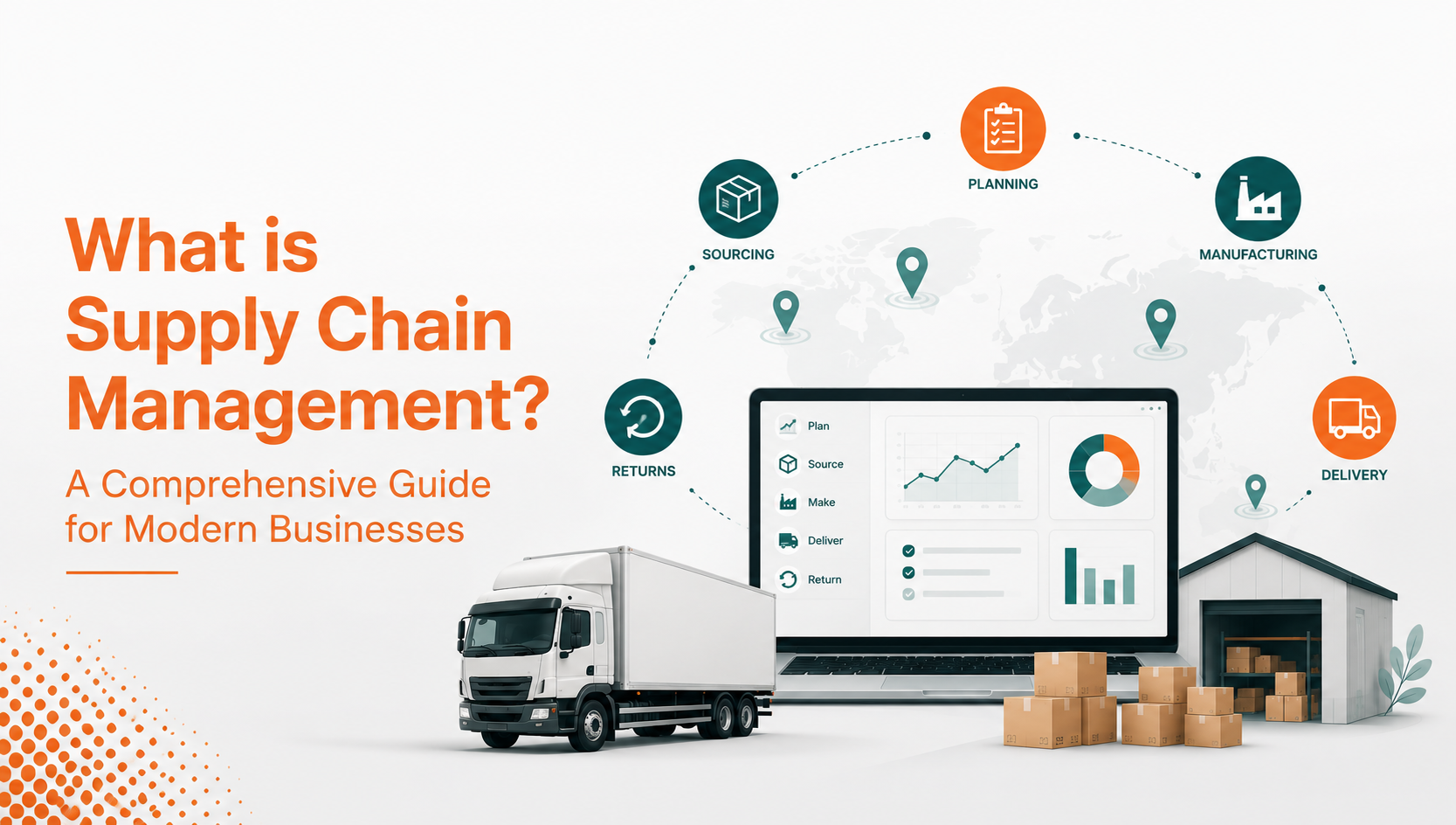
Digital B2B logistics services address these challenges by integrating procurement, inventory management, warehouse management, freight transportation, shipment tracking, analytics, and customer communication into a unified platform. This enables organizations to automate repetitive tasks, improve decision-making, and build a resilient B2B supply chain capable of supporting long-term business growth.
Benefits of Digital B2B Logistics for Modern Businesses

Organizations that invest in modern B2B logistics services gain advantages that extend beyond transportation. By integrating technology across the entire B2B supply chain, businesses can improve operational efficiency, reduce costs, and create a stronger competitive advantage.

1. End-to-End Supply Chain Visibility

Visibility has become one of the most valuable assets in modern B2B logistics. Businesses need to know exactly where every shipment is, whether it is delayed, and when it will arrive.

Digital B2B logistics companies provide centralized dashboards that combine real-time shipment tracking, order status, warehouse updates, carrier performance, and delivery milestones into one platform. Instead of checking multiple courier portals or contacting transporters individually, logistics teams can monitor every shipment through a single interface.

Improved visibility enables businesses to respond faster to delays, communicate proactively with customers, and maintain better control over their B2B supply chain.

2. Faster Order Fulfillment and Warehouse Operations

Order processing speed directly influences customer satisfaction. Manual picking, paper-based documentation, and disconnected warehouse systems often slow dispatch operations and increase fulfilment errors.

Modern warehouse management solutions automate picking, packing, barcode scanning, inventory updates, and dispatch planning, enabling businesses to process thousands of orders accurately within a fraction of the time.

Combined with automated order fulfillment, businesses can reduce dispatch delays, improve warehouse productivity, and increase operational efficiency without expanding their workforce.

3. Intelligent Carrier Allocation and Lower Freight Costs

Selecting the right transportation partner is one of the most important decisions in B2B logistics. Every carrier offers different pricing, service levels, delivery timelines, and regional coverage.

Modern B2B logistics services use AI-powered allocation engines to compare carriers automatically and assign shipments based on cost, transit time, SLA commitments, and service availability.

This intelligent approach helps businesses reduce freight transportation expenses, improve delivery performance, minimize manual decision-making, and maximize the value of their logistics investments.

4. Smarter Inventory Management Across the B2B Supply Chain

Inventory accuracy is essential for maintaining business continuity. Excess inventory ties up working capital, while stock shortages lead to delayed deliveries and lost revenue.

Digital inventory management systems synchronize inventory across multiple warehouses, sales channels, and distribution centres in real time. Businesses gain complete visibility into stock availability, enabling them to forecast demand more accurately, improve replenishment planning, and reduce carrying costs.

When integrated with B2B logistics, inventory decisions become faster, more accurate, and closely aligned with customer demand.

5. Improved Customer Experience Through Real-Time Shipment Tracking

Today’s business customers expect the same visibility and convenience they receive from consumer ecommerce platforms. They want accurate delivery estimates, proactive notifications, and complete transparency throughout the shipping journey.

Modern B2B shipping services provide real-time shipment tracking, automated delivery notifications, proof of delivery, and exception alerts that keep both businesses and customers informed throughout the shipment lifecycle.

This level of transparency improves customer satisfaction, reduces support enquiries, strengthens trust, and enhances long-term business relationships.

6. Automated Compliance and Documentation

Documentation remains one of the most time-consuming aspects of Supply Chain Management B2B. Businesses must generate invoices, GST documents, e-way bills, shipping labels, customs paperwork, and transport manifests for every shipment.

Digital B2B logistics services automate document creation, reducing manual effort while improving accuracy and regulatory compliance.

This minimizes shipment delays, lowers administrative costs, and allows logistics teams to focus on strategic operations instead of repetitive paperwork.

7. Data-Driven Decision Making with Logistics Technology

Successful businesses rely on data, not assumptions, to optimize their logistics operations.

Modern logistics technology provides comprehensive analytics covering transportation costs, carrier performance, warehouse productivity, inventory turnover, SLA compliance, shipment exceptions, and customer delivery performance.

These insights help organizations identify inefficiencies, improve planning, optimize distribution networks, and continuously strengthen their B2B supply chain strategy.

Industry Use Cases: How Different Industries Benefit from B2B Logistics Services

Although every business has unique logistics requirements, the benefits of digital B2B logistics extend across multiple industries.

Industry How B2B Logistics Creates Value
Manufacturing Streamlines raw material movement, production logistics, supplier coordination, and bulk freight transportation.
Retail & Wholesale Improves inventory management, warehouse operations, and multi-location order fulfillment.
FMCG Enables high-volume deliveries with faster replenishment and optimized distribution networks.
Automotive Supports just-in-time inventory, spare-parts logistics, and dealership distribution.
Healthcare & Pharmaceuticals Ensures compliant transportation, temperature-sensitive deliveries, and complete shipment visibility.
Industrial Equipment Manages oversized freight, project-based deliveries, and complex transportation planning.
Electronics Improves secure shipping, reverse logistics, warranty replacements, and inventory accuracy.

Why the Future of B2B Logistics Depends on Technology

The future of B2B logistics will be defined by automation, artificial intelligence, predictive analytics, IoT-enabled shipment tracking, cloud-based logistics technology, and connected B2B supply chain platforms.

Businesses that continue relying on manual workflows will struggle to meet rising customer expectations and increasing shipment volumes. On the other hand, organizations that invest in digital B2B logistics services will benefit from lower operating costs, improved supply chain resilience, greater operational visibility, and faster business growth.

As the logistics landscape continues to evolve, technology-driven B2B logistics companies will play a central role in helping businesses optimize Supply Chain Management B2B, improve freight transportation, strengthen distribution networks, and deliver exceptional customer experiences. By embracing intelligent B2B shipping services, organizations can build a scalable, resilient, and future-ready logistics ecosystem that supports sustainable growth in an increasingly competitive marketplace.

All In One Logistics Management Platform

Explore More

Automate. Optimize. Deliver Smarter.

Centralize Your Logistics Operations

* Only business emails are allowed.

What is B2B Logistics? A Complete Beginner’s Guide

* Only business emails are allowed.