






A failed delivery attempt can turn a completed online order into an expensive operational issue. The customer placed the order, the product was packed and shipped on time, and the shipment may have reached the customer’s city. Yet the final handover can still fail. The order then moves into an exception stage that needs quick action from the brand, courier, or customer.
Nearly 20% of eCommerce shipments result in a failed delivery on the first attempt. If a courier can’t hand over a package, the shipment is marked as delivery failed and a Non Delivery Report (NDR) is generated. A strong NDR Management process helps businesses identify the reason, contact the customer, and schedule a successful reattempt before the shipment becomes an RTO.
A failed delivery may happen because the customer isn’t available, the address is incomplete, the phone number is unreachable, or the delivery executive can’t access the location. Courier operational issues, payment problems, and unexpected local conditions can also cause an unsuccessful delivery. A delivery attempt failed status doesn’t always mean the order is lost. Many shipments can be recovered with prompt customer communication, NDR management, and a timely reattempt delivery. But if no one addresses the issue quickly, the shipment can face repeated unsuccessful delivery attempts and eventually become an RTO.
For eCommerce and D2C brands, managing delivery failure involves more than checking whether an order was delivered. Teams need to know why the delivery failed, decide what to do next, confirm that the customer still wants the order, and recover the shipment where possible. Failed delivery management is a core part of last-mile operations. Better address validation, proactive customer communication, intelligent courier allocation, automated NDR workflows, and delivery analytics can reduce avoidable failed deliveries and improve the delivery experience.
This guide covers the main causes of failed delivery attempts, what follows a delivery failure, how NDR management works, and how eCommerce businesses can improve first-attempt delivery while reducing RTOs.
What Does Failed Delivery Mean? How To Solve It in 2025
A failed delivery means an order could not be successfully handed over to the customer during a delivery attempt. It usually occurs during the final stage of the shipping journey, when the courier reaches the customer’s location but is unable to complete the delivery.
The shipment may have already reached the customer’s city, local delivery hub, or neighbourhood, but an issue prevents the final handover. The courier then updates the shipment with a failed delivery attempt or delivery attempt failed status and records the reason for the unsuccessful delivery.
A failed delivery can happen for several reasons. The customer may not be available, the address may be incorrect or incomplete, the courier may be unable to reach the customer, or access to the delivery location may be restricted. Operational issues on the courier side can also result in a delivery failure.
The reason behind the failed delivery is important because it determines what should happen next. If the customer was unavailable, a reattempt delivery at another time may resolve the issue. If the address is incorrect, the business may first need to collect updated information before another delivery attempt can be made.
This is why a failed delivery should not always be treated as the final outcome of an order. With the right NDR process, timely customer communication, and appropriate recovery action, many unsuccessful deliveries can still be completed successfully.
Common Delivery Statuses:
| Delivery Status | What It Usually Means |
|---|---|
| Out for Delivery | The shipment has been assigned for final-mile delivery. |
| Delivery Attempt Failed | The courier attempted delivery but could not complete the handover. |
| NDR Generated | A non-delivery report has been created with the reason for the unsuccessful attempt. |
| Reattempt Scheduled | Another attempt is planned to complete the delivery. |
| Delivered | The shipment has been successfully handed over to the customer. |
| RTO Initiated | The shipment is being returned to the seller after unsuccessful delivery attempts. |
A delivery attempt failed status is an exception that needs quick action, not the final outcome of an order. The shipment can still reach the customer if you identify and fix the issue promptly. If the customer wasn’t available, contact them to schedule a new delivery window. If the address is incorrect, update it before the next attempt.
Businesses can recover shipments before they enter the return process. Find the cause of the failed delivery, communicate with the customer, and take the appropriate recovery step to improve the odds of a successful reattempt delivery. A clear process also reduces repeat delivery failures, unnecessary logistics costs, and avoidable RTOs.
Key Factors That Lead to Failed Delivery Attempts
There is rarely one universal reason behind every failed delivery. Delivery failures can occur because of customer-related issues, inaccurate order information, courier limitations, operational challenges, or external circumstances. Understanding these causes helps businesses identify which problems can be prevented before shipping and which ones need to be addressed during the last mile.
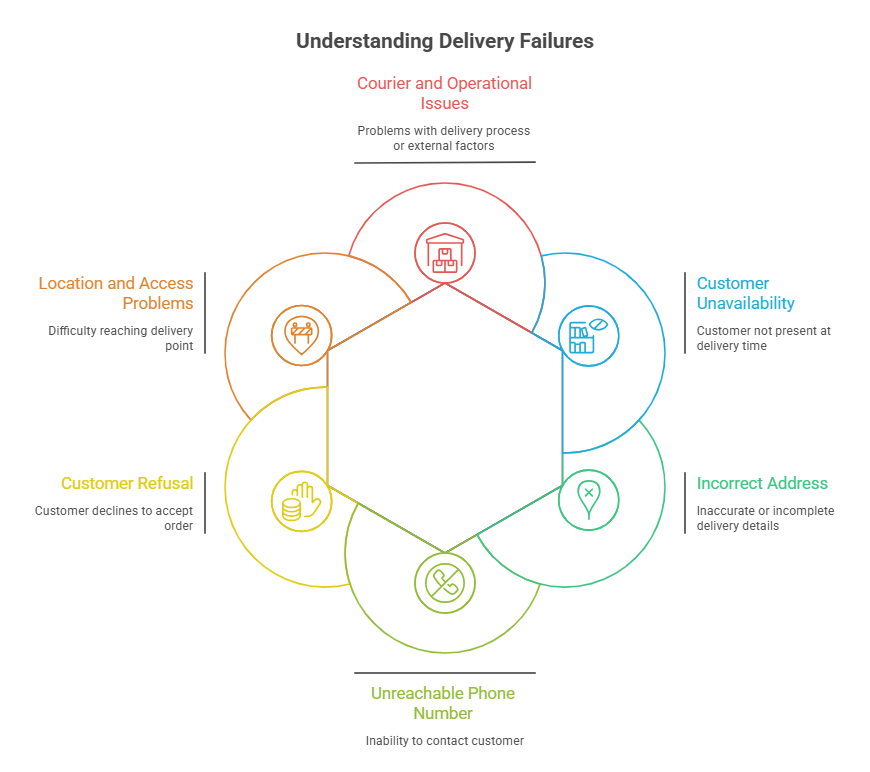
1. Customer Is Unavailable
Customer unavailability is one of the most straightforward reasons for a delivery attempt to fail.
A customer may be at work, travelling, attending an appointment, or simply away from the delivery location when the courier arrives. This is especially common when customers do not know the expected delivery window. The problem is not necessarily that the customer does not want the order. In many cases, the customer may still be interested in receiving it but simply cannot accept it at that particular time. This is where proactive communication becomes important. Delivery reminders, estimated delivery notifications, and real-time shipment updates can give customers enough information to prepare for the delivery. If the customer cannot receive the order, businesses can use an appropriate workflow to support another delivery attempt instead of allowing the shipment to progress towards RTO.
2. Incorrect or Incomplete Address
Address quality has a direct impact on last-mile delivery.
Customers may enter incomplete addresses, miss apartment numbers, provide incorrect pincodes, or use local landmarks that are difficult for delivery executives to identify.
Common address-related problems include:
- Missing house or apartment numbers
- Incorrect pincodes
- Incorrect locality names
- Missing landmarks
- Incomplete street information
- Old or outdated addresses
- Business addresses without floor or department details
An address that looks acceptable during checkout may still create problems once the courier reaches the destination.
Address validation before shipping can help identify these issues earlier. For eCommerce brands shipping across multiple regions, validating addresses and pincodes can reduce the likelihood of an unsuccessful delivery caused by incomplete shipment information.
3. Incorrect or Unreachable Phone Number
The phone number is often an important part of the final-mile delivery process. Delivery executives may need to call customers to confirm their location, clarify directions, or coordinate the handover. If the phone number is incorrect, unreachable, switched off, or belongs to another person, the delivery process can become more difficult. Even when the physical address is accurate, the inability to contact the customer can result in a delivery failure. Businesses can reduce this risk by validating customer contact information and keeping customers informed through automated shipment notifications.
4. Customer Refusal
Another reason for unsuccessful delivery is customer refusal. A customer may refuse to accept an order because they no longer want the product, placed the order accidentally, expected something different, or are unwilling to complete a COD payment. For COD-heavy businesses, this can be particularly important because repeated refusals can contribute to higher RTO levels. Understanding the reason behind refusal can help brands identify patterns. If a particular product category, campaign, customer segment, or payment method produces unusually high refusal rates, the business can investigate the underlying issue.
5. Location and Access Problems
Sometimes the courier reaches the correct area but cannot reach the exact delivery point.
This can happen in:
- Gated residential communities
- Large apartment complexes
- Office campuses
- Business parks
- Restricted-access buildings
- Remote locations
- Areas with difficult road access
For example, a courier may reach a gated community but be unable to enter because of security restrictions or missing access instructions.
Better delivery instructions, landmarks, customer communication, and location details can help reduce these problems.
6. Courier and Operational Issues
Not every delivery failure is caused by the customer. Courier-side issues can also contribute to unsuccessful delivery attempts. High shipment volumes, route allocation problems, delivery executive availability, operational disruptions, and capacity constraints can affect final-mile performance. External factors such as weather or local disruptions can also affect delivery schedules. This is why businesses should analyse delivery failure at both the customer and courier level. If one courier consistently records higher failed delivery rates for certain locations or shipment types, that information can be used when making future courier allocation decisions.
What Happens After a Failed Delivery?
A failed delivery attempt doesn’t automatically mean an order will be returned. In most cases, the shipment moves into an exception-handling process, where the cause of the unsuccessful delivery is identified and the next step is decided.
What happens next depends on why the delivery attempt failed. If the customer wasn’t available, the shipment may need a new delivery window. An incorrect address may require the business to get updated details before the courier tries again. Customer refusal, an unreachable phone number, or an access problem can each call for a different recovery plan.
A delivery attempt failed status is a chance to intervene, not the end of the delivery journey. The sooner a business finds the cause of the delivery failure and acts on it, the better its chances of recovering the shipment.
A typical failed delivery journey might look like this:
Delivery Attempt → Failed Delivery → NDR Generated → Reason Identified → Customer Contacted → Corrective Action → Reattempt Delivery → Delivered or RTO
The exact workflow can vary depending on the courier partner, shipment type, location, and reason for the unsuccessful delivery. However, the objective remains the same: resolve the delivery exception before the shipment progresses towards RTO.
Step 1: The Shipment Status Is Updated
After an unsuccessful delivery, the courier updates the shipment status to show that the order couldn’t be delivered. This is the first sign that an issue occurred during the final-mile delivery process.
The reason logged against the shipment helps determine the next recovery step. It may be customer unavailability, an incorrect or incomplete address, customer refusal, an unreachable phone number, access restrictions, COD-related issues, or courier-side operational challenges.
For businesses, this is more than a tracking update. It signals that the shipment needs attention.
If the customer wasn’t available, the order may not need any major changes. Sending a notification and offering another delivery window could be enough. But if the address is wrong, scheduling another delivery attempt alone may lead to another failed delivery.
Recording the reason accurately helps businesses decide what to do next.
Step 2: An NDR Is Generated
Once the delivery attempt has failed, an NDR, or Non-Delivery Report, is typically generated to record the reason for the unsuccessful delivery.
The NDR is an important part of the delivery recovery process because it gives the business information about what prevented the shipment from being delivered.
Different NDR reasons require different responses.
| NDR Reason | Possible Recovery Action |
|---|---|
| Customer unavailable | Contact the customer and schedule another attempt |
| Wrong or incomplete address | Verify and update the delivery address |
| Customer unreachable | Request customer confirmation or an alternate contact |
| Customer refusal | Confirm whether the customer still wants the order |
| Access issue | Collect additional delivery instructions or landmarks |
| COD/payment issue | Confirm payment readiness before another attempt |
| Operational issue | Coordinate with the courier for another delivery attempt |
For example, sending the same generic notification for every NDR would not be particularly useful. A customer who was unavailable needs a different message from someone whose address needs correction.
This is where structured NDR management becomes important. Instead of treating every delivery failure in the same way, businesses can create workflows based on the specific reason recorded against the shipment.
Without structured NDR management, operations teams may have to manually check multiple courier systems, identify failed shipments, review individual NDR reasons, contact customers, and decide what action should be taken. As shipment volumes increase, this can become time-consuming and difficult to manage consistently.
Step 3: The Customer Is Contacted
Once the reason for the delivery failure is identified, the next step is usually to communicate with the customer.
Customer communication is important because many failed delivery attempts are recoverable. A customer who was unavailable during the first attempt may still want the order. Similarly, a customer may be willing to accept the shipment after correcting an address or providing additional location information.
Businesses can communicate through channels such as:
- SMS
- Phone calls
- In-app notifications
- Other available customer communication channels
The message should ideally be relevant to the specific delivery issue.
For example, instead of simply sending a message that says the delivery failed, the brand can explain that the courier was unable to complete the delivery and provide the customer with an appropriate next step.
Depending on the situation, the customer may be asked to confirm their availability, provide a corrected address, share additional delivery instructions, or confirm that they still want the order.
This makes customer communication an active part of delivery recovery rather than just a tracking notification.
Step 4: The Appropriate Recovery Action Is Taken
Once the customer responds, the business can determine what should happen next.
Not every failed delivery requires exactly the same recovery process. The appropriate action depends on the NDR reason and the customer’s response.
For example:
- A customer-unavailable shipment may need a new delivery window.
- An incorrect-address shipment may require updated address information.
- An access-related issue may require a landmark or delivery instruction.
- A COD-related issue may require confirmation that the customer is ready to make the payment.
- A customer refusal may require confirmation before another attempt is made.
This step is important because simply requesting another delivery attempt without resolving the original problem can result in another unsuccessful delivery.
The goal should therefore be to address the reason behind the delivery failure before the shipment is sent out again.
Step 5: Reattempt Delivery Is Planned
If the issue has been resolved and the customer still wants the order, the business can initiate a reattempt delivery.
A reattempt delivery gives the shipment another opportunity to reach the customer instead of immediately progressing towards RTO.
The timing and process can depend on the courier’s operational rules, delivery location, NDR reason, and number of attempts already made.
For example, a customer who was unavailable during the first attempt may be able to receive the shipment during a later delivery window. Similarly, a corrected address may allow the courier to successfully complete the next attempt.
However, businesses should avoid treating every reattempt as an automatic step. The original reason for the delivery failure should first be addressed wherever possible.
A well-managed reattempt can recover an order that might otherwise have become an RTO, helping businesses protect both the customer experience and the value of the original shipment.
Step 6: The Shipment Is Delivered or Moves Towards RTO
The next outcome depends on whether the recovery action succeeds.
If the reattempt is successful, the courier completes the handover and the order moves to a delivered status. If the next attempt also fails, the shipment may remain in the NDR process, depending on the courier’s rules and the number of delivery attempts permitted. If the shipment continues to remain undelivered after the permitted attempts, it may eventually enter the RTO process and begin its journey back to the seller. This is why the period between the initial failed delivery and the next action is important. A delivery exception that remains unresolved for too long can reduce the time available to recover the shipment.
Step 7: The Outcome Is Tracked
The process should not end once a reattempt has been scheduled. Businesses also need to track what happened after the recovery action. Was the shipment successfully delivered? Did the customer respond? Did another delivery attempt fail? Did the shipment eventually become an RTO? Tracking these outcomes helps businesses understand whether their NDR and delivery recovery processes are actually working. Over time, this data can reveal useful patterns. For example, a business may discover that customer-unavailable NDRs have a high reattempt success rate, while certain address-related failures frequently become RTOs. These insights can help businesses improve their future delivery strategy.
The time between a failed delivery attempt and the next action can have a direct impact on the possibility of recovering the shipment. If an NDR remains unresolved for several days, the shipment may continue moving through the courier’s exception process and eventually reach the point where an RTO is initiated. A faster response gives businesses more time to understand the issue, contact the customer, correct the problem, and initiate a reattempt delivery where appropriate. This is why automated NDR workflows can be valuable for high-volume eCommerce operations. Instead of waiting for an operations team to manually identify every unsuccessful delivery, the system can help surface exceptions quickly and trigger the appropriate next step. Ultimately, the objective is not simply to record that a delivery attempt failed. It is to understand why the delivery failed, respond while the shipment is still recoverable, and give the order the best possible opportunity to reach the customer successfully.
What Is the Impact of Failed Delivery Attempts?
A single failed delivery may seem like a small operational issue, but repeated failed delivery attempts can have a wider impact on an eCommerce business. From higher logistics costs and RTOs to customer dissatisfaction and additional operational work, a delivery failure can affect multiple parts of the fulfilment process. When a delivery attempt failed status appears, businesses need to identify the reason quickly and take the right action. Resolving an unsuccessful delivery early can increase the chances of completing a reattempt delivery before the shipment moves towards RTO.
Higher Logistics Costs
Every additional delivery attempt requires extra transportation, handling, labour, and coordination. If a shipment that could have been delivered in one attempt requires multiple attempts, these additional costs can quickly add up. For high-volume eCommerce businesses, reducing avoidable failed delivery cases can help control fulfilment costs and make better use of existing logistics resources.
Higher RTO Risk
An unsuccessful delivery does not always result in an RTO. In many cases, the shipment can be recovered through a reattempt delivery. However, repeated delivery failures can eventually lead to the order being returned to the seller. RTO adds reverse transportation and handling costs and can also delay the availability of inventory.
Poor Customer Experience
Customers expect their orders to arrive within the promised delivery window. When a failed delivery attempt occurs without clear communication, customers may be unsure about what happened or what they need to do next. Timely notifications about the delivery failure, NDR reason, and next delivery attempt can help customers understand the situation and make it easier to complete the delivery.
Inventory Remains in Transit
When a delivery attempt fails, the shipment remains within the logistics network until it is successfully delivered or returned. This means the inventory remains tied up for longer, which can affect stock availability and fulfilment planning, particularly for fast-moving products.
More Manual Work
A delivery failure can create additional work for operations teams. Without automation, teams may need to:
- Identify the failed delivery
- Check the NDR reason
- Contact the customer
- Collect updated information
- Coordinate with the courier
- Arrange a reattempt delivery
- Monitor the final outcome
As order volumes increase, manually managing every unsuccessful delivery becomes difficult. Automating these workflows can help businesses respond faster, reduce repeat delivery failures, and improve the overall delivery experience.
How to Reduce Failed Delivery Attempts
Reducing failed delivery attempts requires more than reacting after a shipment fails. Businesses can prevent many delivery problems by improving the process before shipping, keeping customers informed during transit, and responding quickly when an exception occurs. The goal is to identify common causes of unsuccessful delivery early and put the right processes in place to reduce avoidable delivery failures.
Validate Addresses Before Shipping
Accurate address information is one of the simplest ways to reduce delivery problems. Before an order is shipped, businesses can validate the pincode, city, state, address details, contact information, and serviceability.
Identifying an incorrect or incomplete address during checkout or order processing is much easier than correcting it after a delivery attempt has already failed.
For businesses serving multiple regions, pincode-level serviceability data can also help determine which courier is suitable for a particular destination. This can reduce the chances of an avoidable failed delivery attempt caused by serviceability or location-related issues.
Communicate With Customers Before Delivery
Customer communication can play an important role in preventing unsuccessful deliveries. Keeping customers informed throughout the shipment journey gives them a better idea of when their order is expected to arrive.
Useful updates can include:
- Order confirmation and shipment dispatch
- Estimated delivery date
- Shipment movement updates
- Out-for-delivery notifications
- Delivery reminders
- COD payment instructions
A simple reminder before the delivery attempt can help customers make arrangements to receive their order. It can also reduce situations where the customer is unavailable when the courier arrives.
Offer Flexible Delivery Options
Customers may not always be available during the first delivery window. Providing flexibility can therefore help businesses recover shipments that might otherwise become a delivery failure.
Where supported by the logistics network, businesses can offer options such as rescheduling, alternate delivery instructions, or pickup locations.
For example, if a customer knows they will not be available at home, allowing them to select another delivery window can improve the chances of a successful reattempt delivery.
This can be particularly useful for customers who work away from home or receive shipments at offices, gated communities, or locations with restricted access.
Improve Courier Allocation
The courier selected for a shipment can also influence delivery performance. Different carriers may perform differently across specific pincodes, regions, shipment types, and service levels.
Instead of selecting a courier based only on shipping cost, businesses can consider performance indicators such as:
| Metric | Why It Matters |
|---|---|
| First-attempt delivery rate | Shows how often shipments are delivered successfully on the first attempt |
| Failed delivery rate | Helps identify recurring delivery problems |
| NDR rate | Indicates how frequently shipments require exception handling |
| RTO rate | Shows the number of shipments ultimately returned |
| Pincode performance | Highlights location-specific delivery patterns |
| COD performance | Helps identify payment-related delivery issues |
| Reattempt success rate | Shows how effectively failed deliveries are recovered |
Using these insights during courier allocation can help businesses choose delivery partners based on overall performance rather than price alone.
Automating NDR Management
NDR management becomes increasingly important as shipment volumes grow. A manual process may require operations teams to monitor courier portals, identify failed deliveries, check NDR reasons, contact customers, and coordinate the next delivery attempt.
When hundreds or thousands of NDRs are generated, managing each case manually can slow down recovery and increase the chances of missed follow-ups.
Automation can bring these activities into a structured workflow:
NDR Generated → Reason Identified → Customer Notified → Response Captured → Action Triggered → Reattempt Initiated → Outcome Tracked
Different NDR reasons can also trigger different actions. A customer-unavailable case may prompt the customer to confirm another delivery window, while an address-related issue can request updated information.
Similarly, a COD-related NDR can trigger a message asking the customer to confirm their availability and payment readiness.
This allows businesses to resolve routine delivery exceptions faster while allowing operations teams to focus on cases that require human intervention.
Using AI to Prevent Delivery Failures:
AI and predictive analytics can help businesses identify potential delivery problems before they result in a failed delivery attempt.
Instead of waiting for a delivery failure to occur, businesses can analyse historical shipment data to identify patterns linked to unsuccessful deliveries.
This can include:
- Pincode-level delivery performance
- Courier performance
- Previous NDR reasons
- Customer delivery behaviour
- COD versus prepaid orders
- Reattempt outcomes
- Delivery timelines
- Shipment characteristics
For example, if a courier consistently records higher delivery failures for a particular pincode, that information can be considered during courier allocation.
Similarly, if previous orders show that a customer is frequently unavailable during a particular delivery window, an early notification or alternative delivery option may help improve the chances of successful delivery.
AI can therefore complement existing shipping operations by helping businesses identify delivery risks earlier, take proactive action, and reduce avoidable delivery failures.

Failed Delivery Management for Indian D2C and eCommerce Brands
Failed delivery management is often complex for Indian eCommerce businesses because delivery conditions vary widely by region and customer location. A D2C brand may send orders to metropolitan cities, Tier-2 and Tier-3 cities, rural areas, gated communities, business parks, and remote pincodes. Each setting brings its own delivery challenges.
A delivery attempt failed in a metropolitan area may result from traffic, security restrictions, or an unavailable customer. In a remote location, an unsuccessful delivery may be tied to serviceability, limited delivery coverage, or difficulty locating the address. Incorrect addresses, unreachable phone numbers, COD refusals, and access restrictions can also lead to repeated failed delivery attempts.
For businesses handling high shipment volumes, these patterns matter. Knowing where and why a delivery failure happens helps brands improve courier allocation, customer communication, and reattempt delivery processes.
This is particularly important for D2C brands expanding beyond major cities. As their delivery network reaches more regions and pincodes, manual failed delivery management becomes harder. Pincode-level insights, automated NDR workflows, and proactive customer communication help businesses spot delivery issues sooner and improve the likelihood of a successful delivery.
| Delivery Environment | Potential Challenge |
|---|---|
| Metro cities | Traffic, apartment access, gated communities |
| Tier-2 cities | Address variations and local delivery complexity |
| Tier-3 cities | Serviceability and address challenges |
| Remote locations | Longer distances and limited delivery coverage |
| COD-heavy markets | Payment-related refusals |
| Gated communities | Security and access restrictions |
| Business addresses | Limited receiving hours and restricted access |
For Indian D2C brands, this makes a single delivery strategy difficult to apply across every location.
A brand may need different approaches depending on courier performance, customer behaviour, pincode characteristics, and shipment type. This is where centralized shipping visibility and delivery analytics can become valuable. Businesses can identify where delivery attempts are failing and understand whether the underlying problem is related to the customer, address, courier, payment method, or location.
How eShipz Helps Businesses Manage Failed Deliveries
Growing eCommerce businesses often struggle to manage failed delivery attempts across several courier partners. A brand may handle thousands of shipments in different regions, and each courier can use separate tracking systems, NDR processes, delivery timelines, and exception workflows. Without one clear view, delivery issues are easy to miss.
eShipz brings shipping, courier management, tracking, NDR management, and delivery workflows into one centralized system. Teams can spot a delivery failure sooner and act before an unsuccessful delivery becomes an RTO.
Centralized Shipment Visibility
Managing shipments through multiple courier partners makes it hard to pinpoint delivery issues and see which orders need immediate attention. eShipz gives businesses a centralized view of shipments, so teams can track movement, delivery statuses, exceptions, NDRs, and failed delivery attempts across their courier network.
Instead of logging into each courier system, teams can review all shipment activity in one place. They can quickly spot orders where a delivery attempt failed and decide which shipments need follow-up.
Structured NDR Management
An NDR is often where the recovery process begins after a failed delivery. As shipment volumes grow, reviewing every NDR manually and deciding what to do next becomes harder. eShipz gives businesses a clearer way to manage NDRs, so teams can identify the cause of a delivery failure and respond quickly.
Depending on the issue, they can contact the customer, update delivery details, or arrange another delivery attempt. This keeps unresolved NDRs from sitting in the logistics network without prompt action.
Customer Communication
Clear customer communication helps recover an unsuccessful delivery. Customers may still want the order, but they might not know the delivery attempt failed or what to do next.
Timely shipment updates and delivery notifications keep customers aware of their order status and any delivery exceptions. Clear instructions also help them respond if they were unavailable, need to provide more delivery details, or want to confirm a new delivery window. That makes the recovery process easier and improves the chance of completing the delivery.
Supporting Reattempt Delivery
A delivery attempt failed status doesn’t always mean the order must be returned. Many shipments can still be recovered through a reattempt delivery. eShipz helps businesses manage these cases by connecting NDR identification, customer communication, and delivery actions in one process.
Rather than letting an unsuccessful delivery move toward RTO without action, businesses can spot eligible shipments and respond in time. That gives the shipment another chance to reach the customer.
Courier Performance Analytics
Courier performance varies by region, pincode, shipment type, and service level. A courier that works well in one location may deliver different results elsewhere. eShipz gives businesses clearer visibility into delivery performance, including delivery outcomes, NDRs, failed deliveries, and RTOs. This helps teams identify where delivery failures occur and assess courier performance based on more than shipping cost. Over time, the data supports better courier allocation and shipping decisions.
Reducing RTO Through Faster Recovery
The objective of failed delivery management is not simply to track shipments that could not be delivered. The larger opportunity is to recover those shipments before they become returns. By identifying delivery exceptions quickly, understanding NDR reasons, communicating with customers, and supporting the appropriate reattempt delivery process, businesses can create more opportunities to complete the original order. This approach helps turn failed deliveries into recoverable shipments and gives businesses greater control over the final-mile delivery process as their order volumes grow.
Turn Failed Deliveries Into Successful Deliveries
A failed delivery attempt does not necessarily mean that an order has reached the end of its journey. In many cases, the shipment can still be recovered when the business understands why the delivery failed and responds quickly. The key is to treat delivery failure as an operational signal rather than simply a shipment status. Address quality can reveal problems before dispatch. Customer communication can reduce avoidable delivery failures. Courier intelligence can improve carrier allocation. NDR automation can accelerate exception resolution. Pincode-level analytics can identify location-specific patterns. Reattempt delivery workflows can help recover shipments before they become RTOs.
For growing eCommerce and D2C brands, these capabilities can create a more connected approach to last-mile delivery.
Instead of simply reacting when a delivery attempt failed, businesses can build processes that prevent avoidable failures, resolve NDRs faster, improve reattempt outcomes, and create a more predictable experience for customers. With the right combination of shipping automation, customer communication, courier intelligence, and delivery analytics, businesses can turn more unsuccessful delivery attempts into successful deliveries while creating a more efficient and scalable delivery operations.