






Every shipping team knows the drill. Someone types shipment details into a spreadsheet. Someone else calls three carriers to compare rates. A third person prints labels, another checks tracking pages one by one, and by the end of the week, someone is still reconciling freight invoices that do not quite match the quote. This is what manual shipping operations look like in most warehouses and logistics teams, and it is exactly the kind of repetitive work that a logistics management system is built to remove. So the real question businesses are asking today is: which logistics management systems reduce manual shipping operations significantly? According to Fortune Business Insights, the global transportation management system market is projected to grow from $21.30 billion in 2026 to $44.84 billion by 2034, a clear signal that companies are actively replacing manual shipping workflows with automated platforms.
This article breaks down the specific categories of logistics management systems that cut manual shipping work, what tasks each one automates, and how to figure out which one actually fits your operation.
Manual Shipping Work Is Bigger Than Most Teams Realize
Manual shipping operations usually involve a long list of small, repetitive tasks. Entering shipment details by hand. Logging into multiple carrier portals to compare rates. Creating labels and shipping documents one at a time. Checking tracking pages across different couriers. Sending status updates to customers manually. Reconciling freight invoices against quoted rates line by line. On their own, none of these tasks look like a big deal. Together, they eat up hours every day and open the door to errors that are expensive to fix later, from mistyped addresses to duplicate carrier charges.
This is where a logistics management system comes in. Instead of employees jumping between spreadsheets, emails, and separate carrier websites, a logistics management system centralizes these activities and automates the ones that do not need a human decision. The question worth asking is not whether automation helps, most businesses already accept that it does, but which type of system actually removes the most manual work for a specific shipping process.
What Are Logistics Management Systems?
A logistics management system is software that plans, executes, and tracks the movement of goods from origin to destination. Rather than treating each shipping task as a separate activity, it connects the different stages of transportation and shipping into one workflow, order creation, carrier selection, documentation, tracking, delivery, and invoice settlement.
Modern platforms rarely work in isolation. They are built to integrate with ERP systems for order and inventory data, warehouse management systems (WMS) for fulfillment status, e-commerce platforms like Shopify or Magento for order capture, and carrier or marketplace networks for rate shopping and label generation. This connectivity is what allows a logistics management system to remove manual data entry between systems, not just automate one isolated step.
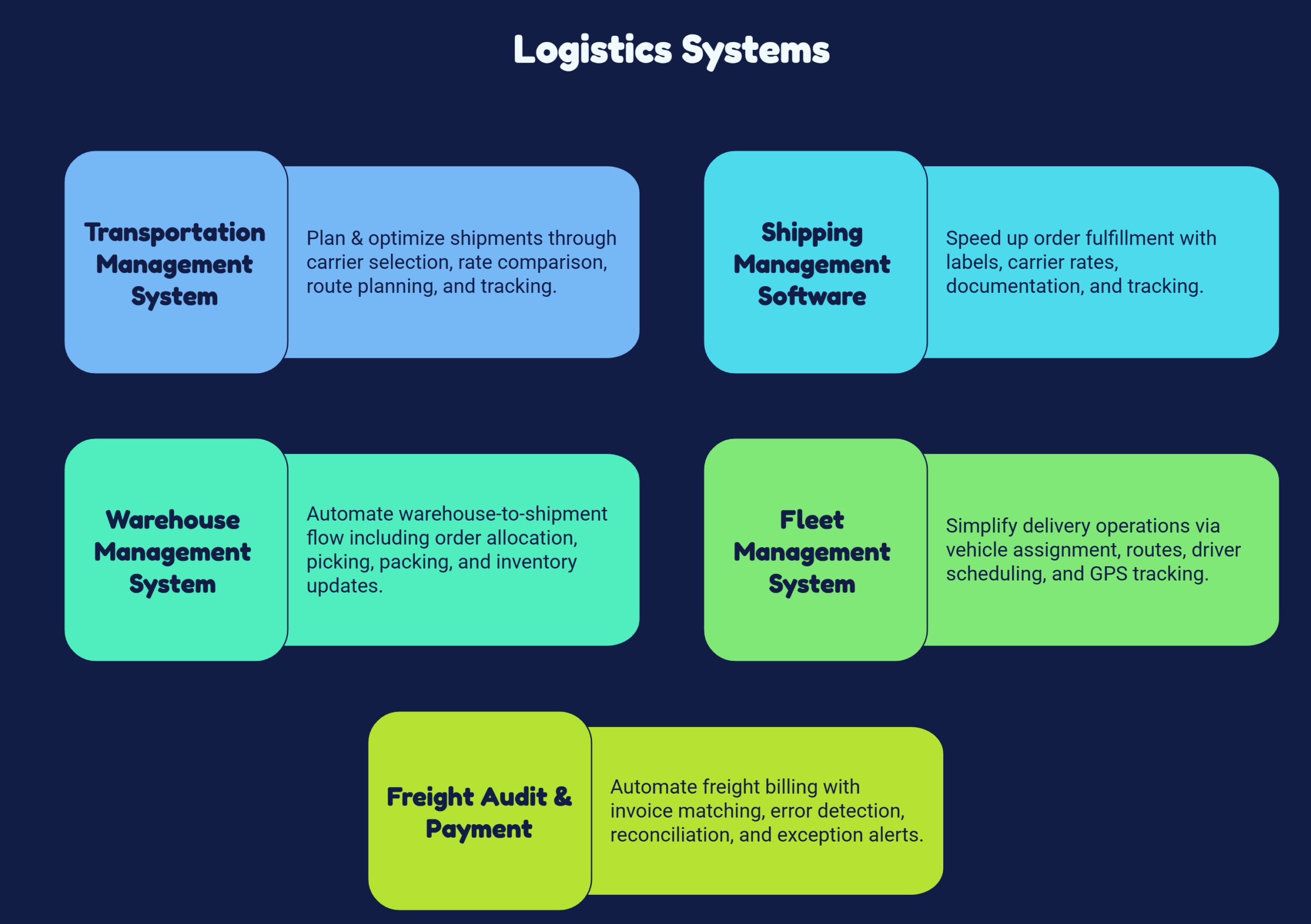
It also helps to separate the terms people use loosely. A transportation management system (TMS) focuses on planning and executing freight movement. Shipping management software focuses on day-to-day parcel and order shipping. A warehouse management system handles what happens inside the four walls before a shipment leaves. Fleet management systems manage a company’s own vehicles and drivers. Each solves a different piece of the manual-work problem, which is why the next section breaks them down individually.
Which Logistics Management Systems Can Reduce Manual Shipping Work?
Transportation Management Systems (TMS)
A TMS manages the planning and execution side of transportation. It automates carrier selection based on rate and service level, compares freight rates across multiple carriers, plans shipments and optimizes routes, tenders loads to carriers automatically, tracks shipments in transit, audits freight invoices, and generates reports.
Before a TMS, this work usually happens across spreadsheets, phone calls, emails, and separate carrier portals, with someone manually pulling everything together to get a full picture. A TMS replaces that patchwork with a single planning and execution layer. Current TMS research shows the market moving toward integrated workflows that cover planning, carrier procurement, execution, visibility, and settlement in one system rather than five disconnected tools, which is a major part of why manual coordination work is dropping across the industry.
Shipping Management Software
Shipping management software focuses specifically on execution rather than planning. It automates label generation, carrier rate comparison at the point of shipping, documentation like invoices and customs paperwork, tracking updates, and the workflow from order to shipment.
This category matters most for e-commerce, retail, and any business shipping a high volume of parcels, because the manual cost of creating one label at a time, or manually choosing a carrier for every order, scales badly as order volume grows. Shipping management software is often the first system a growing business adopts because it targets the most visibly repetitive task: getting a package labeled and out the door.
Warehouse Management Systems (WMS)
Manual shipping work does not start when a package leaves the warehouse. It starts earlier, with order allocation, picking, packing, inventory updates, and barcode scanning. A WMS automates these steps before the shipment is even ready to move.
When a WMS is paired with shipping software, the process from order to delivery becomes far more connected. Orders are allocated automatically, picking lists are generated without manual sorting, inventory updates in real time as items are packed, and the shipment is handed off to the shipping system with accurate data already attached. Without this pairing, warehouse staff often re-enter information that already existed somewhere else in the system, which is one of the most common sources of manual duplication in logistics.
Fleet Management Systems
For companies running their own delivery vehicles, fleet management systems automate vehicle assignment, route planning, driver scheduling, GPS tracking, maintenance alerts, and delivery monitoring. Instead of a dispatcher manually assigning routes and calling drivers for updates, the system handles assignment and monitoring in real time.
This reduces a specific kind of manual work: the back-and-forth coordination between dispatch teams and drivers that used to happen over phone calls and radio. It also catches maintenance issues before they cause a breakdown mid-route, which prevents a whole separate category of manual firefighting.
Freight Audit and Payment Systems
Freight invoices rarely match the original quote exactly, and catching the difference by hand is slow, repetitive work. Freight audit and payment systems automate invoice matching against contracted rates, detect duplicate charges, reconcile invoices automatically, and flag exceptions for review.
This eliminates one of the most tedious manual processes in logistics: line-by-line spreadsheet checking of freight bills. Businesses that skip this automation often only catch billing errors weeks later, if at all.
Which Shipping Processes Can Be Automated?
The table below maps common manual shipping tasks to their automated alternative, which makes it easier to see exactly where a logistics management system removes work.
| Manual Process | Automated Alternative |
| Entering shipment details | Automated order/shipment import |
| Comparing carrier rates | Automated rate shopping |
| Selecting carriers | Rule-based or AI-assisted carrier selection |
| Creating shipping documents | Automated document generation |
| Tracking shipments manually | Real-time shipment visibility |
| Sending status updates | Automated notifications |
| Route planning | Automated route optimization |
| Checking freight invoices | Automated freight audit |
| Preparing reports | Automated dashboards and analytics |
Seeing it laid out this way makes the pattern clear. It is almost never one giant task that gets automated. It is a series of small, repetitive decisions and data transfers, and a logistics management system removes them one by one until the whole shipping process runs with far less manual intervention.
Why Is Reducing Manual Shipping Operations Essential?
Reduces Human Errors
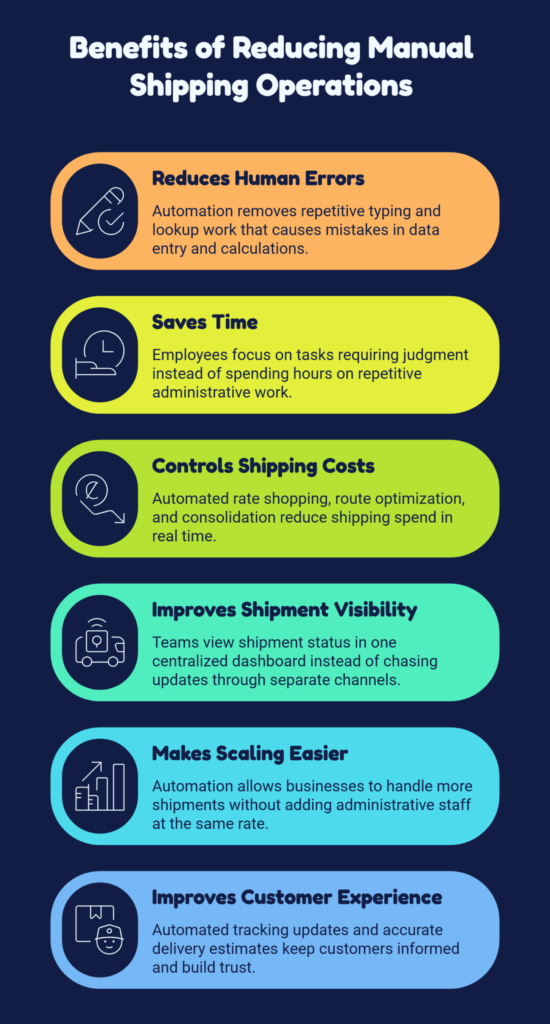
Manual data entry and manual rate calculations are where mistakes creep in, wrong addresses, incorrect shipment weights, mismatched carrier rates, or missing documentation. Automation removes the repetitive typing and lookup work that causes most of these errors in the first place.
Saves Time and Improves Productivity
When employees are not spending hours on repetitive administrative tasks, they can focus on exceptions, customer needs, and decisions that actually require judgment. This is usually the fastest, most visible return a business sees after adopting a logistics management system.
Helps Control Shipping Costs
Automated rate shopping, route optimization, shipment consolidation, and billing discrepancy detection all directly reduce shipping spend. A team checking rates manually simply cannot compare options as fast or as consistently as a system doing it in real time.
Improves Shipment Visibility
Instead of chasing updates through emails, phone calls, and separate carrier websites, teams can see shipment status in one centralized dashboard. This alone removes a large chunk of the manual “checking in” work that logistics teams do every day.
Makes Scaling Easier
Manual processes get harder to manage as shipment volume grows, often requiring more headcount just to keep up. Automation lets a business handle more shipments without adding administrative staff at the same rate, which is one of the clearest reasons companies invest in logistics management systems as they scale.
Improves Customer Experience
Automated tracking updates and more accurate delivery estimates keep customers informed without anyone on the team having to send a manual update. This is a small operational change with a direct effect on customer trust and repeat business.
Taken together, these benefits explain why the underlying question, which logistics management systems reduce manual shipping operations significantly, keeps coming up in industry research. Current TMS research consistently points to real-time visibility, transportation execution, scalability, and automation as the top adoption drivers for these platforms.
What Does the Current Market Trend Have to Say About Logistics Automation?
The TMS Market Is Expanding
Market estimates vary depending on methodology and scope, but they consistently point in the same direction. Fortune Business Insights values the global TMS market at $21.30 billion in 2026, projected to reach $44.84 billion by 2034 at a 9.8% compound annual growth rate. That kind of sustained growth reflects a broader shift away from manual shipment coordination toward software-driven planning and execution.
AI Is Moving Into Logistics Decision-Making
AI and predictive analytics are increasingly built into route optimization, demand forecasting, ETA prediction, carrier selection, and exception management. Current market research identifies these AI-driven capabilities as one of the defining trends shaping transportation management technology going forward, since they let systems make routine decisions that used to require a human to review every case.
Cloud-Based Systems Are Becoming More Important
Cloud-based TMS and shipping platforms offer easier implementation, lower IT overhead, real-time access from anywhere, and simpler integration with other business systems. Industry data shows cloud-based deployment leading the TMS market by deployment model in recent years, largely because it removes the manual setup and maintenance burden that on-premise systems carry.
Logistics Is Moving From Point Solutions to Connected Platforms
There is a clear shift happening from single-purpose tools toward connected platforms that link the full chain: orders, warehouse, transportation, carrier, tracking, freight audit, and payment. This matters because automating one isolated task does not remove manual work if employees still have to manually transfer information between disconnected systems. A logistics management system only delivers its full value when these pieces talk to each other.
Automation Is Becoming a Competitive Requirement
The ASCM 2026 Top 10 Supply Chain Trends report identifies automation as a defining trend for the year, particularly in e-commerce and logistics, where businesses face constant pressure to cut costs and speed up delivery. The report describes e-commerce and logistics as an epicenter of automation, where robotics, autonomous vehicles, and connected systems are becoming standard rather than optional.
In India specifically, industry research points to growing demand for scalable logistics automation, including AI-driven transportation management, automated freight procurement, dynamic routing, execution monitoring, and invoice reconciliation, as businesses try to keep pace with rising e-commerce volumes and tighter delivery expectations.
How to Choose the Right Logistics Management System
Choosing a logistics management system is not about picking the one with the longest feature list. It is about identifying which platform removes the most manual work from your specific shipping process. Before comparing vendors, it helps to map out your own operation against a short checklist.
- Shipment volume and how fast it is growing
- Number of carriers you work with regularly
- Transportation modes involved (parcel, LTL, FTL, air, ocean)
- Need for integration with e-commerce, ERP, or WMS systems
- Real-time tracking requirements
- Level of automation needed, from basic label generation to full rate shopping
- Interest in AI-driven features like predictive ETAs or dynamic routing
- Reporting and dashboard needs
- Scalability for future order volume
- Implementation cost and timeline
- Ease of use for the team that will run it daily
- API availability for custom integrations
A business shipping a few hundred parcels a week has very different needs than one managing multi-carrier freight across states. Matching the system to the actual manual bottleneck, whether that is rate comparison, documentation, tracking, or invoice reconciliation, matters more than chasing every available feature.
What Should Businesses Look for in a Modern Logistics Management System?
Looking ahead, a handful of capabilities separate a genuinely modern logistics management system from an outdated one:
- AI-powered automation for carrier and route decisions
- Real-time shipment visibility across all carriers
- Automated carrier selection based on rate and service level
- Dynamic routing that adjusts to real-world conditions
- Open API integrations with ERP, WMS, and sales channels
- Digital documentation instead of manual paperwork
- Automated freight audit and invoice reconciliation
- Predictive analytics for ETAs and demand
- Exception management that flags problems automatically
- Centralized dashboards instead of scattered reports
The market is increasingly shifting toward connected “control tower” style platforms that give a single view across the entire shipping process, rather than isolated tools that each solve one small piece of the puzzle. This is also where teams looking to plan smarter delivery routes can benefit from reading more about route optimization strategies for logistics efficiency, which digs deeper into how automated routing reduces manual planning work specifically.

Conclusion: From Manual Shipping to Intelligent Logistics
There is no single system that eliminates every manual shipping task on its own. Transportation management systems reduce planning and execution work, shipping management software cuts down day-to-day label and documentation tasks, warehouse management systems remove manual fulfillment steps before a shipment even ships, fleet management systems cut manual dispatch coordination, and freight audit systems eliminate manual invoice checking.
The businesses that see the biggest reduction in manual shipping operations are usually the ones that connect several of these systems rather than running them separately. That is really the answer to which logistics management systems reduce manual shipping operations significantly: it is not one category acting alone, it is an integrated combination that removes manual work at every stage, from order to delivery to payment.
Logistics automation today is no longer just about cutting administrative work. It is about building shipping operations that are faster, more visible, more scalable, and driven by real data instead of manual guesswork.
Frequently Asked Questions
- What is a logistics management system?
A logistics management system is software that plans, automates, and tracks the movement of goods from order creation to final delivery. It typically connects with ERP, WMS, e-commerce platforms, and carrier networks to remove manual steps from the shipping process. - Which logistics management systems reduce manual shipping operations significantly?
Transportation management systems, shipping management software, warehouse management systems, fleet management systems, and freight audit platforms each reduce a different category of manual shipping work, and the effect is strongest when they operate together as a connected system rather than in isolation. - What is the difference between a TMS and shipping management software?
A TMS focuses more on transportation planning, carrier tendering, and freight execution, while shipping management software focuses on day-to-day parcel shipping tasks like label generation, rate comparison, and documentation. Many businesses use both, depending on shipment volume and complexity. - Do small businesses need a logistics management system?
Small businesses shipping a low volume of orders may manage manually for a while, but as order volume grows, manual processes like rate comparison and label creation become time-consuming and error-prone. A logistics management system becomes more valuable as shipping volume and carrier complexity increase. - How does a logistics management system reduce shipping costs?
It reduces costs through automated rate shopping across carriers, route optimization, shipment consolidation, and freight invoice auditing that catches billing discrepancies and duplicate charges that would otherwise go unnoticed in manual checks. - Cana logistics management system integrate with an existing ERP or WMS?
Yes, most modern logistics management systems are designed to integrate with ERP and WMS platforms through APIs, which allows shipment, inventory, and order data to flow automatically instead of being re-entered manually across systems. - What role does AI play in modern logistics management systems?
AI is increasingly used for dynamic route optimization, ETA prediction, demand forecasting, and automated carrier selection. Instead of a human reviewing every shipment decision, AI-assisted logistics management systems can make routine calls automatically and flag only genuine exceptions for review.