








Shipping every order from one warehouse is simple, but it gets expensive as customers spread across the country. In Bain & Company’s retail fulfillment article from January 2021, Bain describes a US specialty retailer that moved to a store-centric fulfillment model and forecast a rise in operating costs of less than 1% while on track to double its same-day and next-day delivery capacity. That is a US example, but the lesson travels: stock placed closer to buyers can raise speed without a large cost penalty.
Multi warehouse shipping applies the same idea to Indian ecommerce. This guide explains what it is, when it pays off, how to set it up in five steps and how to route orders once you have more than one dispatch point. It is written for D2C and marketplace sellers who ship with several couriers.
What Is Multi Warehouse Shipping?
Multi warehouse shipping means fulfilling orders from two or more stock locations and choosing the best location for each order. The locations can be your own warehouses, a 3PL partner’s facilities or a mix of both. Each order leaves from the point that gives the best balance of speed, cost and stock availability.
The idea sounds simple, but it changes several daily tasks. Inventory has to be split across locations, orders need a routing decision, and every courier pickup must match the right address. Without clear rules, a second warehouse can create more mistakes than savings.
A useful way to think about it is as a decision made for every order. The system asks which location holds the stock, which one is closest to the buyer and which one can dispatch today. The answer decides the label, the courier and the promised delivery date.
Why Multi Warehouse Shipping Matters
Distance is the biggest driver of courier cost and delivery time in a country as large as India. When a parcel crosses several zones, you pay a higher rate and the buyer waits longer. Multi warehouse shipping shortens that distance for a large share of your orders.
Faster Delivery Promises
A parcel that travels a shorter route reaches the customer sooner. That lets you show a tighter delivery date on the product page and at checkout. Shoppers who see a firm, short date are more likely to complete the purchase.
Lower Courier Cost
Courier rates rise with zone distance, so shipping from a closer location moves orders into cheaper zones. The saving per parcel is modest, but it repeats on every order. Zone-based rate cards make this effect easy to see in your own courier invoices.
Better Resilience
One warehouse is a single point of failure. A flood, a strike or a local courier backlog can stop every dispatch. With more than one location, orders can shift to another node while the problem is fixed.
Single Warehouse vs Multi Warehouse Shipping
Neither model is right for every brand. A single warehouse is cheaper to run, while multi warehouse shipping pays off when customers are spread across regions. The table below compares the two models.
| Factor | Single warehouse | Multi warehouse shipping |
|---|---|---|
| Delivery speed | Slower to distant regions | Faster to regions near each node |
| Courier cost per order | Higher for far zones | Lower when orders ship from the nearest node |
| Inventory needed | Lower total stock | Higher total stock across nodes |
| Operations effort | One team, one process | More coordination and system rules |
| Risk if one site fails | All dispatch stops | Orders can move to another node |
| Best suited for | Small or regional order volume | Pan-India demand with clear regional clusters |
If most of your orders come from one region, a second site may not pay for itself yet. Look at where your orders go before you commit to new space. The next sections show how to do that analysis.
Costs and Trade-Offs of Multi Warehouse Shipping
Every extra location adds cost as well as savings. The honest question is whether the courier saving and the conversion lift exceed the added expense. Map each cost line before you decide.
| Cost line | What drives it | How to control it |
|---|---|---|
| Rent and labor | Number of sites and staff per site | Start with a 3PL partner before leasing |
| Inventory holding | Safety stock needed at every node | Keep fast movers at each node and slow movers at one |
| Inbound freight | Moving stock from supplier or factory to each node | Ship full loads and plan replenishment cycles |
| Stock transfers | Balancing stock between nodes | Forecast by region to reduce rebalancing |
| Technology | Routing rules and system integration | Use a shipping platform that supports routing rules |
| Split parcels | One order filled from two nodes | Set rules that prefer a single-node fill |
Split parcels deserve special attention. When one order is filled from two nodes, you pay for two shipments and the customer receives two boxes. Our guide on split shipment in ecommerce explains when splitting makes sense and when it does not.
Multi Warehouse Shipping Cost Model (Illustrative)
The chart below is a hypothetical model for a store with 10,000 monthly orders. It compares average courier cost per order for one, two and three warehouses. All numbers are illustrative and use assumed zone rates that you should replace with your own rate card.
The assumptions are simple. Zone rates are Rs 40 for local, Rs 55 for regional, Rs 70 for metro to metro and Rs 90 for national deliveries. The order mix shifts toward nearer zones as nodes are added, from 10% local and 40% national with one warehouse to 35% local and 15% national with three.
On those assumptions the average cost falls from Rs 72 to Rs 58 per order, or Rs 1,40,000 a month on 10,000 orders. That saving must still cover extra rent, stock and transfers, so treat it as one side of the equation. Use your own zone mix before you act.
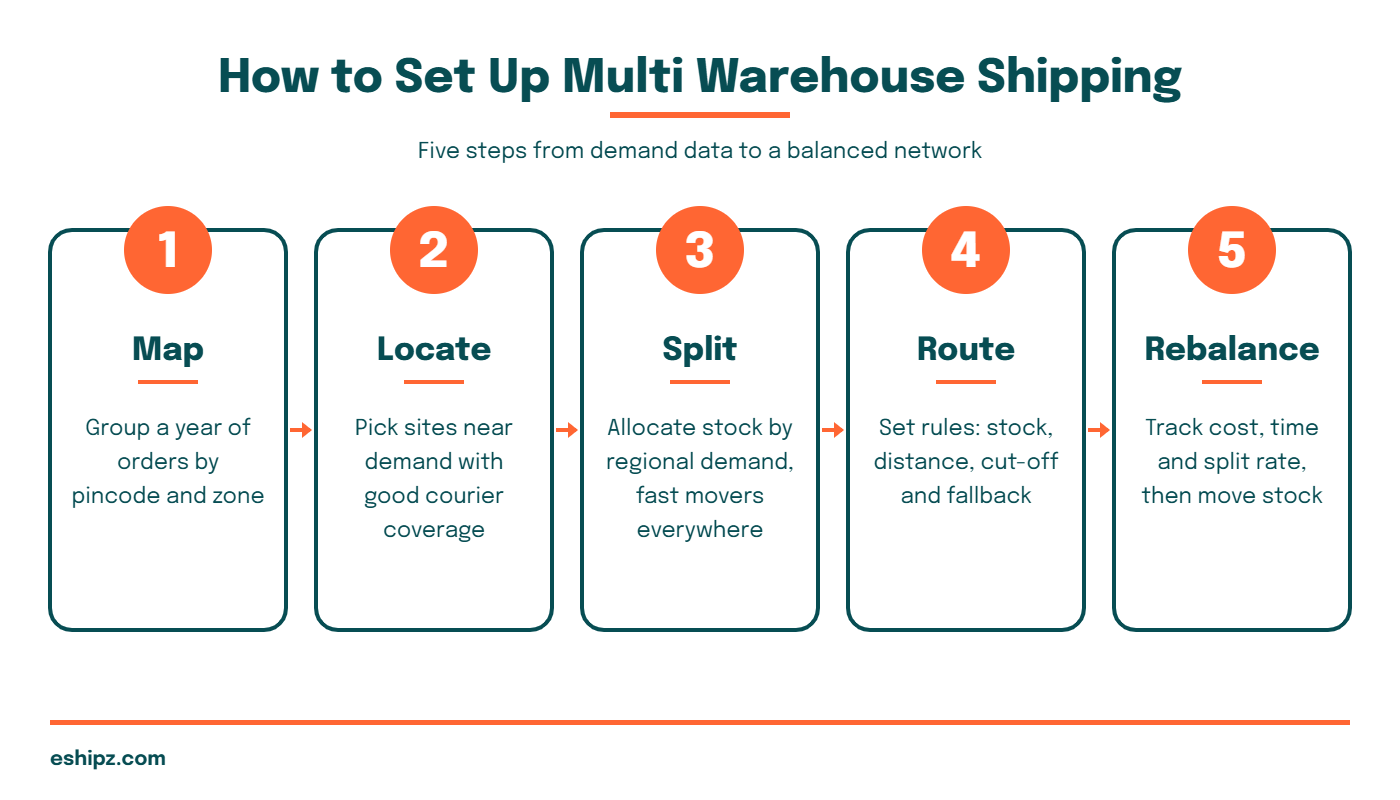
How to Set Up Multi Warehouse Shipping in 5 Steps
A clear process keeps a second location from becoming a second source of errors. The steps below follow the order most teams find easiest to manage.
Step 1: Map Demand by Pincode
Export a year of orders and group them by destination pincode and zone. Look for regional clusters that make up a large share of volume. Those clusters show where a new node would help most.
Step 2: Choose Locations
Pick locations that sit close to demand clusters and have good courier coverage. Check pickup availability and serviceability for each pincode group. A cheap site with weak courier pickup can cost more than it saves.
Step 3: Split Inventory by Demand
Allocate stock to each node in line with regional demand. Keep fast-moving items at every node and slow movers at a single location. Review the split every month because demand shifts.
Step 4: Set Routing Rules
Write the rules that decide which node fulfills each order. Start with stock availability and distance, then add rules for order type, delivery promise and carrier. Test the rules on past orders before you apply them to live ones.
Step 5: Monitor and Rebalance
Track delivery time, cost per order and split-parcel rate by node. Move stock when one node runs short while another holds excess. Adjust the rules as soon as the data shows a pattern.
Order Routing Rules for Multi Warehouse Shipping
Routing rules are the heart of the system. They turn a stock map into a clear decision for each order. Keep the first set short and add rules only when the data justifies them.
| Rule | How it works | Example |
|---|---|---|
| Stock first | Only nodes holding every item are eligible | Skip a node that lacks one item in the cart |
| Nearest node | Pick the eligible node closest to the delivery pincode | Order for Pune ships from the western node |
| Cut-off time | Prefer a node that can still dispatch today | Move an order if a node has passed its pickup cut-off |
| Cost cap | Choose the lowest total cost within the promise | Ship from a farther node only if the date is still met |
| Order type | Route COD, fragile or bulky orders by node capability | Send bulky items to the node with the right packing area |
| Fallback | Define a second choice when the first fails | Use the backup node if the first has a stock error |
Document each rule in plain language so the operations team can follow it. Review rule performance every quarter. A rule that no longer fits demand should change or go.
Inventory Allocation Strategies Across Warehouses
Routing only works when stock is in the right place. Two approaches are common. One keeps a full range at every node, and the other keeps fast movers everywhere and slow movers in one place.
The second approach is usually cheaper for small and mid-size brands because it limits safety stock. It does mean some orders must ship from a farther node. Accept that trade-off for slow-selling items, since few customers expect the fastest delivery on them.
Pair allocation with a regular stock review. Compare sell-through by node and by SKU, then move stock before shortages cause cancellations. Stock transfers cost money, so reduce them by forecasting demand by region.
Own Warehouses or 3PL Nodes for Multi Warehouse Shipping
You do not need to lease space to start. Many brands begin with a 3PL partner in a second region and move to owned sites once volume is proven. The right choice depends on volume, control and cash.
| Option | Best for | Watch out for |
|---|---|---|
| Own warehouse | High, steady volume in one region | Lease commitments and fixed staff cost |
| 3PL node | Testing a new region with low commitment | Per-unit fees and less control over packing |
| Mixed model | Brands with one core site and flexible regional nodes | Different processes at each location |
| Marketplace fulfillment | Sellers who rely on one marketplace | Rules set by the marketplace, not by you |
Whichever option you choose, write down the pickup address, cut-off time and packing standard for each node. That one-page profile helps couriers, staff and your routing rules stay aligned.
When Multi Warehouse Shipping Pays Off
Multi warehouse shipping tends to pay off when four conditions hold. First, a large share of your orders go to far zones. Second, your customers care about delivery speed. Third, your order volume is steady enough to justify holding stock in more than one place. Fourth, your team can follow simple routing rules every day.
If only one or two of these are true, improve your courier mix and delivery promise first. A better rate card or carrier allocation can deliver savings without new inventory. Revisit the idea when volume and regional demand grow.
Technology Needed to Run Multi Warehouse Shipping
Manual routing breaks down quickly once you have more than one location. A spreadsheet cannot check stock, distance, cut-off time and courier rates for every order. You need a system that holds stock by location and applies your rules automatically.
Look for four capabilities: live stock by node, configurable routing rules, courier allocation and label creation by pickup address, and one tracking view across all locations. Connections to your store, ERP and warehouse system keep the data in sync. Test the setup with a week of past orders before going live.
Multi Warehouse Shipping Best Practices
The brands that run multiple nodes well share a few habits. They keep rules simple, keep data clean and keep customers informed. Use this list as a starting point.
Keep Item and Location Data Clean
Every node needs correct item codes, weights and dimensions. A wrong weight in one location can cause weight discrepancies and billing disputes. Audit master data before you add a node.
Show Delivery Dates by Pincode
Use routing to power the date customers see before they pay. A date based on the nearest node is more accurate and builds trust. Tie this to your estimated delivery date logic.
Prefer Single-Node Fills
Fill an order from one node whenever possible. If you must split, tell the customer clearly and track both parcels. Fewer splits mean fewer boxes, lower cost and fewer support contacts.
Align Courier Pickups With Each Node
Each location needs its own pickup schedule and manifest. Confirm that couriers service every node on time. A missed pickup at one site undoes the speed you hoped to gain.
Common Multi Warehouse Shipping Mistakes
Most problems come from rushing the rollout. Avoid these four mistakes.
Opening Nodes Before Analyzing Demand
A new location chosen by convenience rather than data may serve few orders. Always start with the pincode analysis in step one.
Holding Too Much Stock Everywhere
Copying the full range into every node ties up cash. Keep fast movers at each node and slow movers at one.
Ignoring Return Flows
Returns need a clear destination. If they flow to the wrong node, stock sits unavailable. Decide which node receives returns for each region.
Skipping Measurement
Without node-level data, you cannot see which location earns its cost. Track cost, time and split rate for each node from the first week.
KPIs to Track for Multi Warehouse Shipping
Choose a short list of indicators and review them weekly. Record a baseline before you add a node so the comparison is fair.
| KPI | How to calculate it | What it tells you |
|---|---|---|
| Average courier cost per order | Total courier spend divided by orders shipped | Whether nearer nodes lower cost |
| Average delivery time | Mean days from dispatch to delivery | Whether speed improved by region |
| Split-parcel rate | Orders shipped in two or more parcels divided by total orders | Whether routing prefers single-node fills |
| Stock-out rate by node | Orders held for lack of stock divided by orders routed | Whether allocation matches demand |
| Cancellation rate | Cancelled orders divided by orders placed | Whether stock errors reach customers |
| Stock transfer cost | Transfer spend divided by units moved | Whether rebalancing is affordable |
Read these indicators together. A falling cost per order with a rising split-parcel rate may signal that savings are being eaten elsewhere. A healthy system improves cost and speed without raising splits.
How eShipz Supports Multi Warehouse Shipping
eShipz is a multi-carrier shipping platform, and its courier allocation page lists warehouse routing, which it describes as fulfilling from the nearest hub for faster delivery. The same page says you can set rules by shipping zone, preferred carrier, delivery SLA, order value, package weight and warehouse location. You can explore the platform on the eShipz homepage.
According to the eShipz website, the platform connects ecommerce channels with OMS, WMS, TMS and ERP systems and applies your allocation rules to every shipment. It also lists order consolidation to combine multiple orders and save on cost and packaging. That gives teams one shipping layer for several dispatch points.
To see how these rules would work for your own nodes and courier mix, visit eShipz and ask for a walkthrough. Bring a sample of your pincode data so the discussion starts with real numbers.
Conclusion: Start Multi Warehouse Shipping With Data, Not Guesswork
Multi warehouse shipping can cut distance, lower courier cost and make your delivery promise firmer. It also adds stock, rent and coordination cost, so the case must be proven with your own pincode data. The Bain example shows that faster delivery need not mean a large operating cost increase, but every network is different.
Start small. Add one node, keep the routing rules simple and measure cost, time and split rate against a baseline. Expand only when the numbers support it, and review the rules every quarter as demand shifts.
Multi Warehouse Shipping FAQs
What is multi warehouse shipping?
Multi warehouse shipping means fulfilling orders from two or more stock locations and choosing the best location for each order. The choice balances stock availability, distance and dispatch time. It aims to deliver faster and at a lower courier cost.
When should I move to multi warehouse shipping?
Consider it when your orders come from several regions and far-zone shipments make up a large share of volume. Check your pincode data first. If most orders are local to one region, a single warehouse is usually enough.
Does multi warehouse shipping reduce shipping cost?
It can, because parcels travel through fewer or cheaper zones. The saving must be weighed against extra rent, stock and transfer costs. Use your own rate card and order mix to test it.
How are orders routed in multi warehouse shipping?
Orders are routed by rules such as stock availability, nearest node, dispatch cut-off and delivery promise. A fallback rule handles cases where the first choice fails. Test the rules on past orders before going live.
How should I split inventory across warehouses?
Keep fast-moving items at every node and slow movers at one location. Allocate stock in line with regional demand and review it every month. Forecast by region to reduce costly transfers.
How do I avoid split parcels in multi warehouse shipping?
Set routing rules that prefer a single node that holds every item in the order. Stock the right bundles together at each node. Track the split-parcel rate and adjust allocation when it rises.
Which KPIs should I track for multi warehouse shipping?
Track average courier cost per order, delivery time, split-parcel rate, stock-out rate by node, cancellation rate and transfer cost. Record a baseline first. Review them weekly for the first two months.