



A brand spends weeks of effort and a real slice of its ad budget to get a shopper to click “Place Order.” Then the confirmation email goes out and the brand goes quiet. The next message the customer sees is often a courier SMS with a tracking link that has nothing to do with your store. A post-purchase experience platform exists to close that gap.
Checkout is not the finish line. Delivery, tracking, returns and support decide whether the customer buys again. The National Retail Federation and Happy Returns found in their 2025 Retail Returns Landscape report that 71% of consumers are less likely to shop with a retailer again after a poor returns experience, up from 67% a year earlier.
This guide covers what a post-purchase experience platform does, why it matters, the trends shaping 2027, what to look for, a shortlist of top post purchase platforms, and how eShipz approaches the problem from the logistics side.
What Is a Post-Purchase Experience Platform?
A post-purchase experience platform is software that manages and improves everything between order confirmation and the customer’s next purchase. It pulls order and shipping data from your store and carriers, then turns it into updates, delivery fixes and return options the customer can see.
Most platforms cover:
- Order and shipment tracking
- Proactive delivery notifications
- Estimated delivery dates (EDD)
- Failed-delivery (NDR) resolution
- Returns and exchanges
- Customer engagement and feedback
A shipping tool books labels. A helpdesk answers tickets. A post-purchase experience platform sits between them and connects logistics data to the customer experience. Shipment tracking software on its own tells you where a parcel is. Post purchase experience software acts on that data, for example by messaging the customer the moment a delivery attempt fails.
Why Is Post-Purchase Experience Essential?
- Delivery is the real moment of truth. The product experience begins when the parcel arrives. A late or damaged delivery gets blamed on your brand, whichever courier carried it. Impact: fewer bad reviews and refund requests.
- Retention is cheaper than acquisition. A repeat customer needs no ad click to come back and usually spends more over time. Impact: lower blended acquisition cost.
- “Where is my order?” (WISMO) queries overload support. Each proactive update is a ticket your team never has to answer. Impact: lower support cost per order.
- Failed deliveries and RTOs hurt margins. In COD-heavy markets like India, you pay for the forward trip, the return trip and the handling on an order that earns nothing. Impact: margin you get back on every avoided RTO.
- Returns decide loyalty. The NRF figure above shows that a bad return can lose the customer. A smooth one gives you a second chance at the sale. Impact: higher repeat-purchase rate.
- Brand ownership. Courier-branded tracking pages send customers away from your store. A branded tracking page keeps them with you. Impact: more engagement and room for offers.
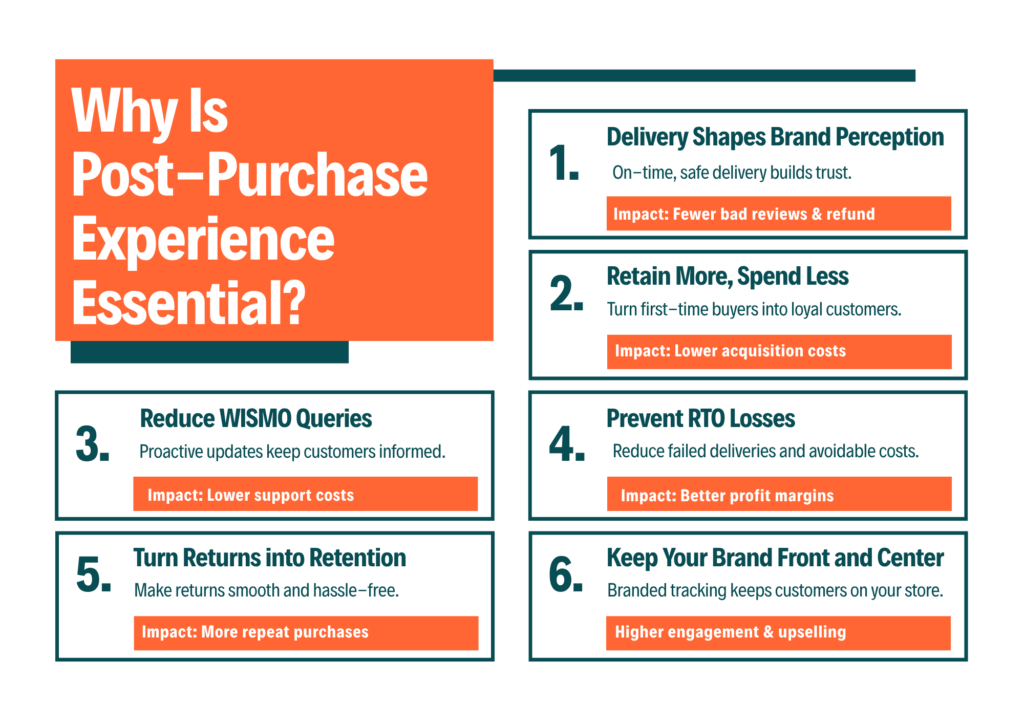
A good post-purchase experience platform addresses all six.
Market Trends Shaping Post-Purchase Experience in 2027
AI-driven logistics. Platforms now predict delivery dates from past carrier performance on each pin code, pick couriers by expected success rate, and answer routine NDR cases without an agent. A post-purchase experience platform that learns from your own shipment history gets better every month.
Proactive over reactive communication. Customers expect updates on WhatsApp, SMS and email before they ask. Notification delivery matters as much as the content: a “delayed” alert that arrives after the courier has already tried the door helps nobody.
Returns as a retention lever. NRF’s 2025 report estimated that 19.3% of online sales would be returned, and 76% of consumers said they are more likely to choose a return option with an instant refund or exchange. Easy exchanges, instant store credit and automated reverse logistics now influence who gets the next order.
Branded, on-site tracking. Customers tend to open a tracking link several times while they wait. A branded tracking page turns those visits into room for cross-sell, offers and review requests.
Multi-carrier, unified visibility. Most growing brands ship with several couriers, so they want one shipment visibility platform instead of five carrier portals. Our multi-carrier shipping guide explains how to run that setup well.
Quick commerce and faster delivery expectations. When delivery windows shrink to hours, the accuracy of the estimate matters more than the promise itself.
Data and analytics. Delivery time, RTO rate and carrier scorecards now decide which couriers get which pin codes. For more on this, read our piece on logistics analytics for smarter eCommerce delivery.
Sustainability. Fewer failed attempts and fewer returns mean fewer wasted trips and less packaging in the bin.
Key Features to Look for in a Post-Purchase Experience Platform
Use this as a checklist when you compare any post-purchase experience platform:
- Branded tracking page and notifications. Keeps the customer inside your brand and gives you space for offers.
- Multi-channel messaging (WhatsApp, SMS, email). Reaches customers on the channel they actually read.
- Accurate EDD. A reliable date sets expectations early and cuts cancellations.
- Real-time tracking across carriers. One view instead of switching between courier portals.
- NDR and redelivery management. Collects customer responses fast and schedules reattempts automatically.
- Returns, exchange and refund workflows. Self-serve flows reduce support load and keep the sale alive.
- COD verification and management. Filters risky orders and speeds up cash reconciliation.
- Proof of delivery (ePOD). Digital proof settles “I never received it” disputes.
- Analytics and dashboard. Shows which courier, pin code or product causes the most trouble.
- Integrations (Shopify, ERP, OMS/WMS, carriers). Data should flow without manual exports.
- Ease of setup and support. A tool that takes months to launch will miss your next peak season.
Benefits and Outcomes of the Right Platform
The right post-purchase experience platform ties each capability to a number you can track. Treat the outcomes below as targets to measure against your own baseline.
| Capability | Outcome |
| Proactive tracking and alerts | Fewer WISMO tickets, lower support cost |
| Accurate EDD | Higher trust, fewer cancellations |
| NDR automation | Lower RTO, higher delivery success |
| Smooth returns | Better retention and repeat purchase |
| Branded experience | More engagement, upsell opportunities |
| Unified dashboard | Faster decisions, carrier accountability |
How to Build a Great Post-Purchase Experience: Step by Step
You do not need a big project to improve this. Work through six steps in order.
- Audit the current experience. Map every touchpoint from order confirmation to delivery to return, including the messages customers receive and who sends them.
- Find the pain points. Pull your WISMO ticket volume, RTO rate, return rate and late-delivery numbers for the last 90 days.
- Automate communication. Trigger updates at shipped, out for delivery, delayed and delivered, on the channel each customer prefers.
- Fix failed deliveries. Set up NDR workflows that ask the customer for a new time or address and book the reattempt automatically.
- Simplify returns. Offer self-serve returns and exchanges so nobody has to email support to start one.
- Measure and optimise. Track delivery time, NPS, repeat rate and carrier performance every month, then change couriers or rules based on what you see.
Where Can You Start? A Simple 30-60-90 Day Plan
- First 30 days: Integrate your store and carriers. Launch a branded tracking page and notifications.
- Days 30 to 60: Turn on NDR automation. Show EDD on product and checkout pages.
- Days 60 to 90: Launch returns and exchange workflows. Set up analytics and carrier scorecards.
Roll out your post-purchase experience platform in phases like this, and begin with the single biggest pain point, usually WISMO or RTO, instead of switching on everything at once. A phased rollout also shows you which change moved which number.
Best Post-Purchase Experience Platforms for eCommerce in 2027
These are the top post purchase platforms eCommerce brands most often shortlist. Post purchase experience software ranges from returns specialists to full logistics suites, so the right pick depends on your market, volume and where you lose money today. Features and pricing change often, so confirm current details on each vendor’s site before you decide.
| Platform | Best for | Key strengths | Limitations |
| eShipz | Brands that want logistics depth behind the customer experience | Multi-carrier shipping, tracking, EDD, NDR, COD, returns and analytics in one system | Strongest where shipping is the bottleneck; marketing-led teams should compare campaign tooling |
| AfterShip | Brands that want a branded tracking page across many carriers quickly | Wide carrier coverage, notifications, tracking page, returns option | Pricing tiers scale with volume; check depth of NDR and COD workflows |
| Narvar | Large retailers with complex returns and many channels | Mature tracking, notification and returns suite | Setup and cost can be heavy for small D2C brands |
| Loop Returns | Shopify brands where returns and exchanges are the main pain | Exchange-first flows and store credit | Covers returns, not forward logistics or NDR |
| parcelLab | Enterprise brands running communications in several countries | Orchestrated notification and return flows | Enterprise focus; may be more than a smaller brand needs |
| Shiprocket Engage / ClickPost | India-focused brands | WhatsApp engagement, NDR and returns tuned to Indian couriers | Built around the Indian market; check coverage if you ship abroad |
eShipz starts from shipping, which suits brands whose biggest losses come from failed deliveries and COD.
AfterShip is a fast way to add a branded tracking page across many carriers. Compare plan tiers against your shipment volume.
Narvar fits large retailers with many channels. Smaller brands may not use that depth.
Loop Returns is a strong pick when returns are the main problem. You will need another tool for tracking and NDR.
parcelLab suits enterprise brands that run post-purchase communication across markets.
Shiprocket Engage and ClickPost are built around Indian logistics. If you ship internationally, ask about coverage first.
How eShipz Powers the Post-Purchase Experience
Post-purchase starts in logistics. A customer’s mood is set by whether the courier hits the promised date, so eShipz works as a post-purchase experience platform built on shipping data. Its post shipment engagement module keeps customers informed after dispatch with branded communication.
Tracking and visibility. Problem: customers and support teams chase a different courier link for every order. Solution: real-time shipment tracking gives one view across carriers, and the control tower and dashboard let your ops team act as one shipment visibility platform. Outcome: fewer WISMO tickets and faster carrier follow-up.
Delivery dates. Problem: customers get vague promises and cancel. Solution: estimated delivery date shows a reliable date early, and AI courier allocation picks the best-performing courier for each shipment. Outcome: better delivery success before the customer starts waiting.
Failed deliveries and COD. Problem: NDRs sit in a courier panel while RTO climbs. Solution: NDR management collects the customer’s response, redelivery management books the reattempt, COD management handles cash reconciliation and ePOD gives digital proof of delivery. Outcome: lower RTO and fewer disputes.
Returns. Problem: manual returns frustrate customers and bury your team. Solution: returns management covers reverse logistics, returns and exchanges. Outcome: a smoother return that keeps the customer.
The platform connects with Shopify and other sales channels, ERP, OMS/WMS and TMS systems, and a wide carrier network.
eShipz serves 350+ brands, and its site says the platform helps businesses cut manual effort and errors by 80%.

How to Choose the Right Post-Purchase Experience Platform
Ask these six questions on every demo call:
- Does it work with your carriers and sales channels? Gaps here mean manual work later.
- Does it fix logistics problems (NDR, RTO) or only send notifications? Many tools stop at messaging.
- Can you brand the experience? Check the tracking page, the emails and the WhatsApp templates.
- How fast can you go live? Ask for a real timeline from a customer of your size.
- Does it scale during peak season? Ask how it handled the last big sale period.
- What does support look like? Find out who answers at 9 pm on a sale day.
If your biggest losses come from failed deliveries and returns, choose a platform with logistics depth. A tracking widget will not fix those.
Conclusion
Post-purchase is now a competitive advantage, not an afterthought. The brands that win repeat orders tell customers what is happening, fix failed deliveries fast and make returns easy. The right post-purchase experience platform gives you happier customers, lower support and RTO costs, and a higher repeat rate.
See how eShipz can streamline your post-purchase journey. Book a Demo
FAQs
What is a post-purchase experience platform?
A post-purchase experience platform is software that manages everything that happens after a customer places an order: tracking, delivery notifications, estimated delivery dates, failed-delivery resolution, returns and feedback. It connects logistics data with customer communication so shoppers stay informed and the brand keeps control of the experience.
How does post-purchase experience affect customer retention?
Customers judge a brand by how delivery and returns go. NRF found that 71% of consumers are less likely to buy again from a retailer after a poor returns experience. Clear updates, on-time delivery and easy returns give customers fewer reasons to leave.
How can I reduce WISMO tickets?
Send proactive updates at every key milestone, add a branded tracking page so customers can check status without contacting you, and show an accurate EDD from the product page onward. Then fix the root cause by acting on delays and failed deliveries before the customer notices.
What is NDR management and why does it matter?
NDR stands for non-delivery report. A courier raises one when a delivery attempt fails, for reasons such as a wrong address, an absent customer or a refused COD payment. Resolving NDRs quickly, with customer input and a scheduled reattempt, is the most direct way to lower RTO.
Can small D2C brands use these platforms?
Yes. A brand shipping a few hundred orders a month already pays for WISMO tickets and RTOs. Start with a branded tracking page and notification delivery, then add NDR and returns workflows as volume grows. Check that pricing scales with your order count.
How long does implementation take?
It depends on scope. Connecting a store and carriers and launching tracking and notifications often takes days to a few weeks. NDR automation, returns and analytics fit into the 30-60-90 day plan above. Ask any vendor for a timeline based on your own carriers and sales channels.
Which metrics should I track to measure post-purchase performance?
Track WISMO tickets per 100 orders, first-attempt delivery rate, RTO rate, return rate, NPS and repeat purchase rate. Review them by carrier and pin code so you know where to act.