



Ecommerce Platforms in India has moved far beyond listing products online and waiting for orders. In 2026, digital commerce connects marketplaces, D2C sites, payments, inventory tools, fulfilment centres, shipping networks, customer engagement platforms, analytics, and returns management. India’s online shopper base reached nearly 290–300 million in 2025, and Tier 2 and smaller cities accounted for around 65% of new online shoppers. Demand is shifting well beyond the country’s largest metros. The wider Indian ecommerce market is projected to grow from around US$125 billion in 2024 to US$345 billion by 2030. For sellers, brands, retailers, and growing businesses, selecting an ecommerce platform is a business decision, not merely a technology purchase.
Growth in digital commerce has made customer experience more demanding. India’s online retail market reached approximately US$80 billion in FY2026, with around 21% year-on-year growth. Quick commerce was already a US$7–8 billion market in FY2025, which shows how much shoppers value convenience and faster fulfilment. Digital payments are accelerating this shift. UPI processed 22.35 billion transactions worth approximately ₹29.03 lakh crore in April 2026, showing that digital transactions are deeply embedded in everyday commerce. Customers want simple product discovery, several payment options, accurate product details, fast fulfilment, live order tracking, easy returns, and clear updates when an order goes wrong. At the same time, businesses need an ecommerce platform India companies can rely on to reach more buyers, manage rising order volumes, connect existing systems, and sell across channels. That’s driving demand for integrated ecommerce solutions India that go beyond storefront management and support the full customer and operational journey.
India has a broad, competitive mix of marketplaces, D2C platforms, and digital commerce infrastructure. The top ecommerce platforms in India serve different buyer groups and business models instead of chasing the exact same customers. Tier 2+ cities contributed around 65% of incremental online shoppers in 2025, while Gen Z and middle-income households have become major sources of new ecommerce demand. Amazon India and Flipkart continue to operate at significant scale, while Meesho has changed how value-conscious consumers and shoppers in smaller cities take part in online retail. Myntra and AJIO have built strong fashion-focused propositions, and Nykaa has developed a specialised beauty and lifestyle ecosystem. India’s D2C market is also projected to cross US$100 billion in 2025, giving brands a stronger reason to invest in their own stores alongside marketplace channels. The ecommerce platforms India 2026 market is far more varied than a basic marketplace list.
The biggest changes extend beyond checkout. India’s ecommerce warehousing market reached approximately US$10 billion in 2025 and is projected to reach about US$39.1 billion by 2034. That growth reflects the infrastructure required to store, process, and fulfil online orders at scale.
Selling online involves much more than a polished website or marketplace presence. Inventory control, fulfilment, carrier allocation, shipment tracking, delivery management, NDR handling, returns, and customer communication all affect the buyer experience. As businesses sell through marketplaces, D2C websites, quick commerce, and omnichannel channels, they need connected ecommerce solutions India that work with daily operations. The role of ecommerce software India 2026 is growing as well, with companies looking beyond storefront tools to order processing, inventory, fulfilment, customer engagement, analytics, and logistics automation.
For businesses launching their own stores, the choice is different. Marketplaces provide access to an established customer base, while independent commerce platforms give brands more control over their storefront
Top 10 Ecommerce Platforms in India for 2026
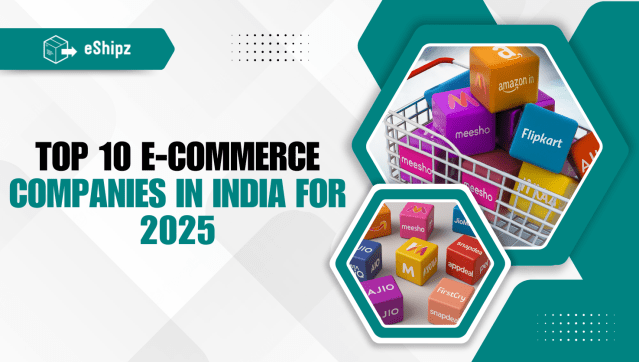
India’s ecommerce market includes horizontal marketplaces, category-specific platforms, digital retail ecosystems, value-focused marketplaces, and independent ecommerce infrastructure. These ten platforms take different approaches to online commerce and suit businesses with different needs.
1. Amazon India
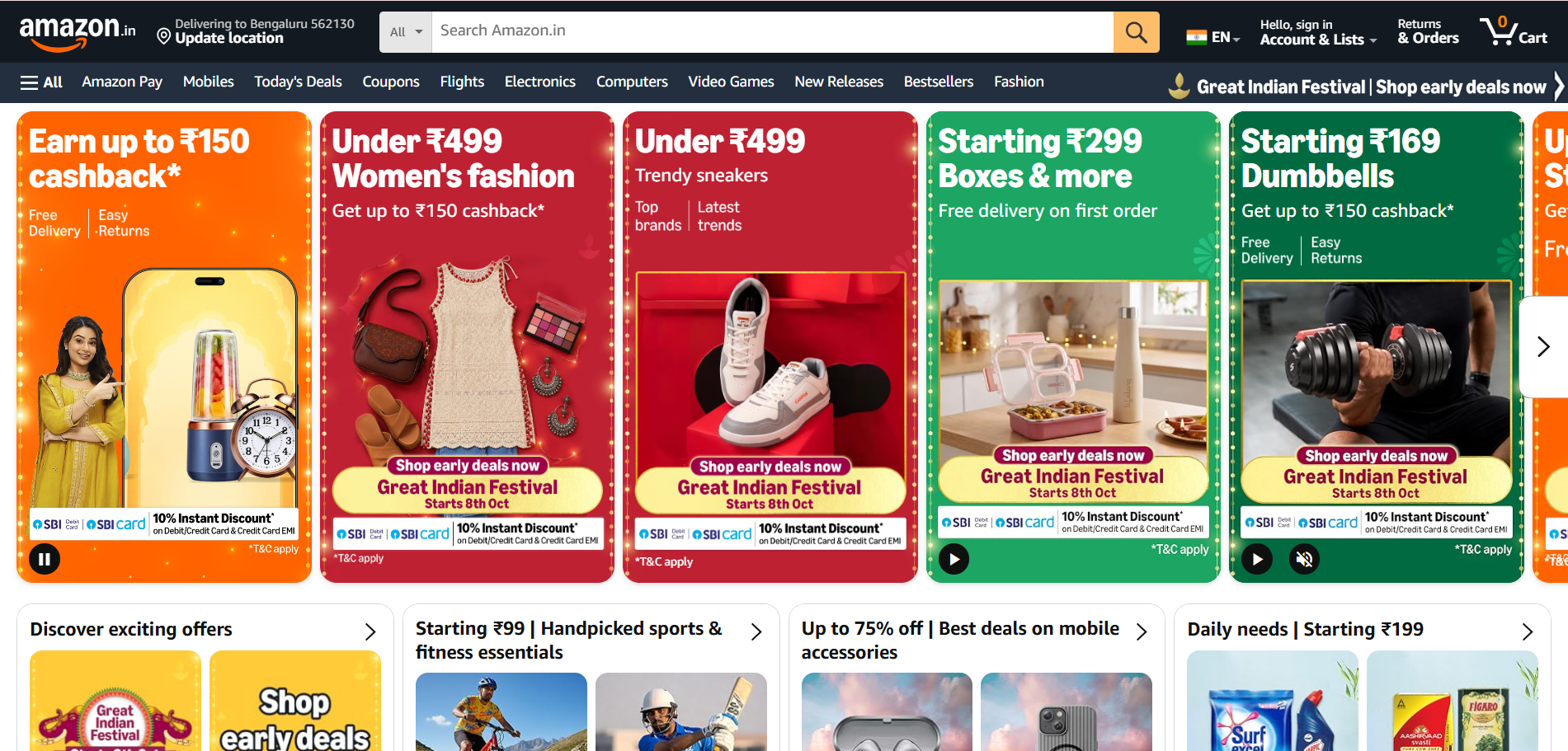
Amazon India remains one of the most recognisable names in Indian ecommerce and gives sellers access to a broad customer base across numerous categories. Its horizontal marketplace model allows businesses to sell products ranging from electronics and home products to fashion, beauty, groceries, books, personal care, and everyday essentials. This wide category coverage makes the platform relevant to both established brands and smaller sellers looking to expand their online presence.
One of Amazon’s major strengths is the ecosystem surrounding its marketplace. Sellers can access tools and services related to product listings, inventory, fulfilment, advertising, reviews, order management, and delivery. This means businesses do not necessarily need to build every part of their online selling infrastructure independently.
Key Features of Amazon India
- Wide Product Categories: Supports a broad range of consumer and business product categories.
- Large Customer Reach: Provides access to customers across metropolitan and smaller markets.
- Seller Central: Gives sellers tools for managing listings, pricing, inventory, orders, and performance.
- Fulfilment Options: Supports different fulfilment models depending on seller requirements.
- Advertising Tools: Provides advertising options to help brands promote products.
- Customer Reviews and Ratings: Helps shoppers evaluate products through customer feedback.
- Order and Delivery Infrastructure: Supports order processing and delivery across a wide geographic network.
- Marketplace Analytics: Provides sellers with information about sales and marketplace performance.
- Multi-Category Selling: Allows businesses to operate across different product segments.
- Returns and Customer Support: Supports post-purchase processes including returns and customer issues.
As sales grow, marketplace operations get harder to manage. Sellers must handle inventory, fulfilment, shipping, tracking, delivery exceptions, returns, and customer communication. It becomes even more demanding when the business sells on Flipkart, Meesho, other marketplaces, and its own D2C website.
Connected ecommerce and logistics technology can simplify this work. Instead of manually handling orders, labels, carriers, tracking updates, delivery exceptions, and returns across separate channels, businesses can link these workflows into one post-purchase operation.
2. Flipkart
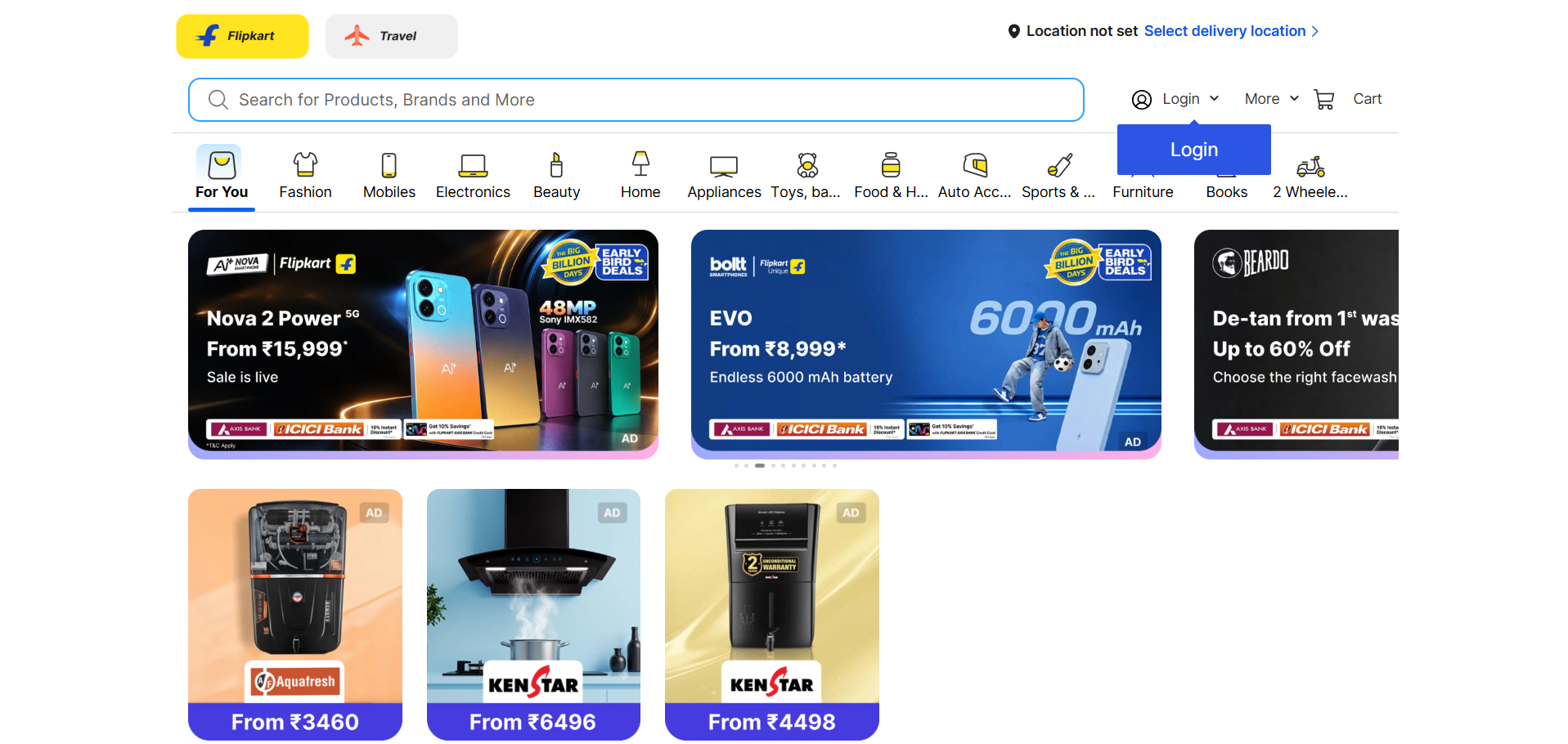
Flipkart has played a significant role in the development of online retail in India and remains an important marketplace across categories including electronics, fashion, home, appliances, lifestyle, and everyday products. Its established customer base and marketplace infrastructure make it a relevant channel for brands and sellers looking to expand their online distribution.
The platform is particularly relevant to businesses that want marketplace distribution instead of relying entirely on their own websites to generate traffic. Sellers can use the existing shopping environment to reach customers while managing their products and orders through the marketplace ecosystem.
Key Features of Flipkart
- Wide Product Selection: Supports multiple consumer product categories.
- Large Indian Customer Base: Provides access to shoppers across different regions.
- Seller Management Tools: Supports product, inventory, pricing, and order-related activities.
- Marketplace Distribution: Gives brands an additional online sales channel.
- Fulfilment Support: Provides fulfilment-related options for marketplace sellers.
- Promotional Opportunities: Sellers can use marketplace promotions and advertising to improve product visibility.
For businesses operating across multiple channels, however, marketplace growth can create operational challenges. Orders may arrive from several platforms while fulfilment and shipping teams need to process them through different workflows. Connected order and shipping systems can help bring these processes into a more unified operation.
3. Meesho
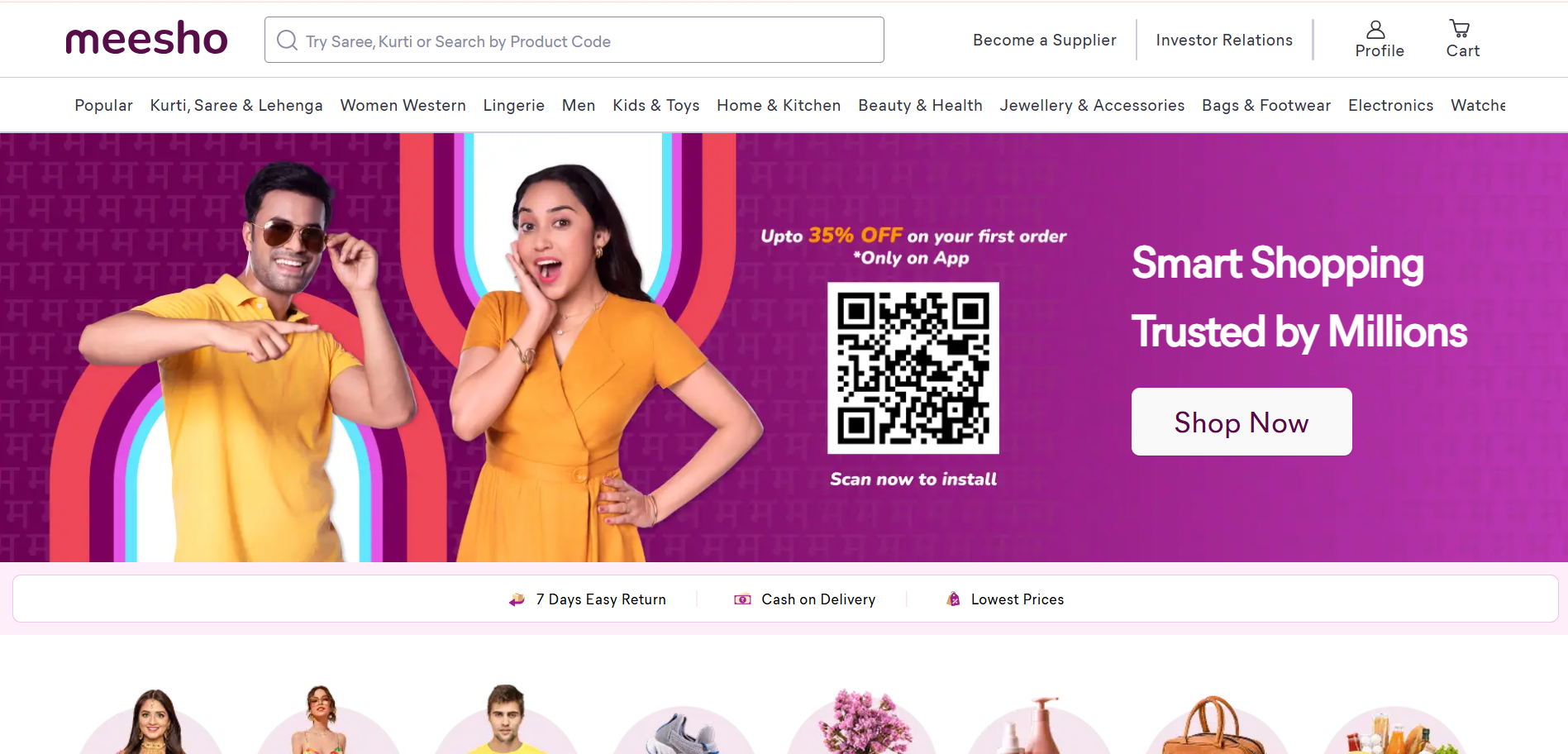
Meesho has broadened participation in Indian online commerce by creating a marketplace that is particularly relevant to value-conscious shoppers, small businesses, resellers, and emerging sellers. Its growth also reflects the wider expansion of ecommerce into Tier 2, Tier 3, and smaller markets.
For smaller businesses, the platform provides an established environment to list products, reach customers, manage orders, and build online sales without having to develop an entire customer acquisition ecosystem independently. Its focus on affordability, mobile-first shopping, social discovery, and a broad product assortment has made it an important name among the top ecommerce platforms in India.
Key Features of Meesho
- Wide Seller Base: Supports small businesses, manufacturers, resellers, and emerging brands.
- Value-Focused Shopping: Strong presence across affordable fashion, home, beauty, accessories, and lifestyle products.
- Broad Customer Reach: Helps sellers reach customers beyond major metropolitan markets.
- Simple Seller Tools: Supports catalogue, pricing, inventory, and order management.
- Mobile-First Experience: Built around smartphone-based product discovery and shopping.
- Multiple Categories: Allows sellers to operate across different product segments.
As order volumes grow, sellers still need to manage inventory, fulfilment, shipping, tracking, returns, and delivery exceptions efficiently. Businesses using multiple marketplaces can benefit from connecting these processes instead of managing every channel separately.
4. Myntra
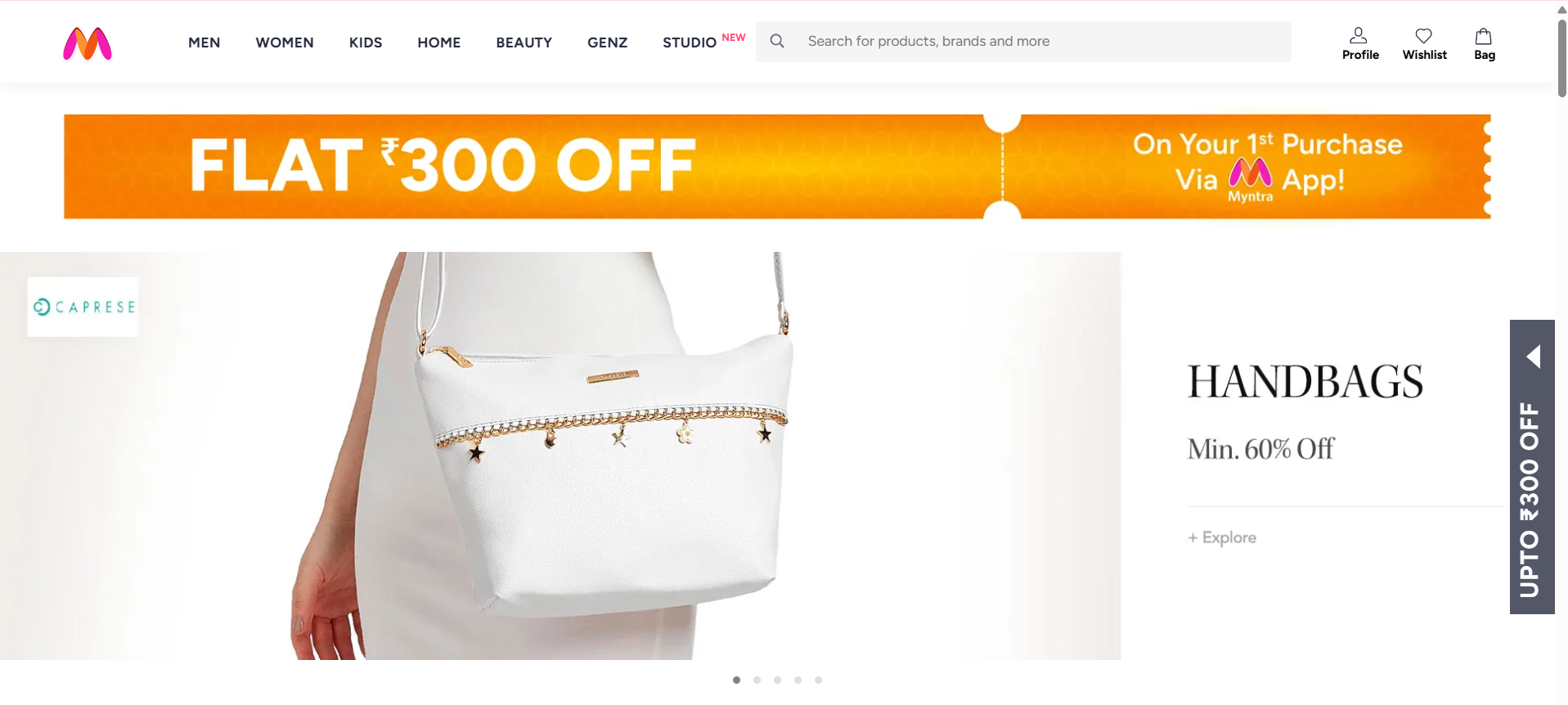
Myntra has developed a strong position in India’s online fashion and lifestyle market. Unlike horizontal marketplaces, it focuses primarily on apparel, footwear, accessories, beauty, and lifestyle products. This category-focused approach allows brands to reach shoppers who are already interested in fashion and lifestyle products.
Fashion shoppers often expect detailed product information, high-quality images, size options, reviews, recommendations, trend-based discovery, and convenient returns. This makes the overall shopping journey more specialised than a standard product purchase.
Key Features of Myntra
- Fashion-Focused Marketplace: Strong presence across apparel, footwear, accessories, beauty, and lifestyle.
- Wide Brand Selection: Brings together established brands and emerging labels.
- Personalised Discovery: Recommendations and curated collections support product discovery.
- Detailed Product Experience: Provides product information, images, ratings, reviews, and size details.
- Strong Customer Reach: Helps fashion brands reach a large online shopper base.
- Returns and Exchanges: Supports important post-purchase processes for fashion customers.
For fashion brands, online selling also creates operational requirements around size-level inventory, exchanges, returns, reverse logistics, and fulfilment. Connecting orders with inventory, shipping, tracking, and returns becomes increasingly important as volumes grow.
5. AJIO
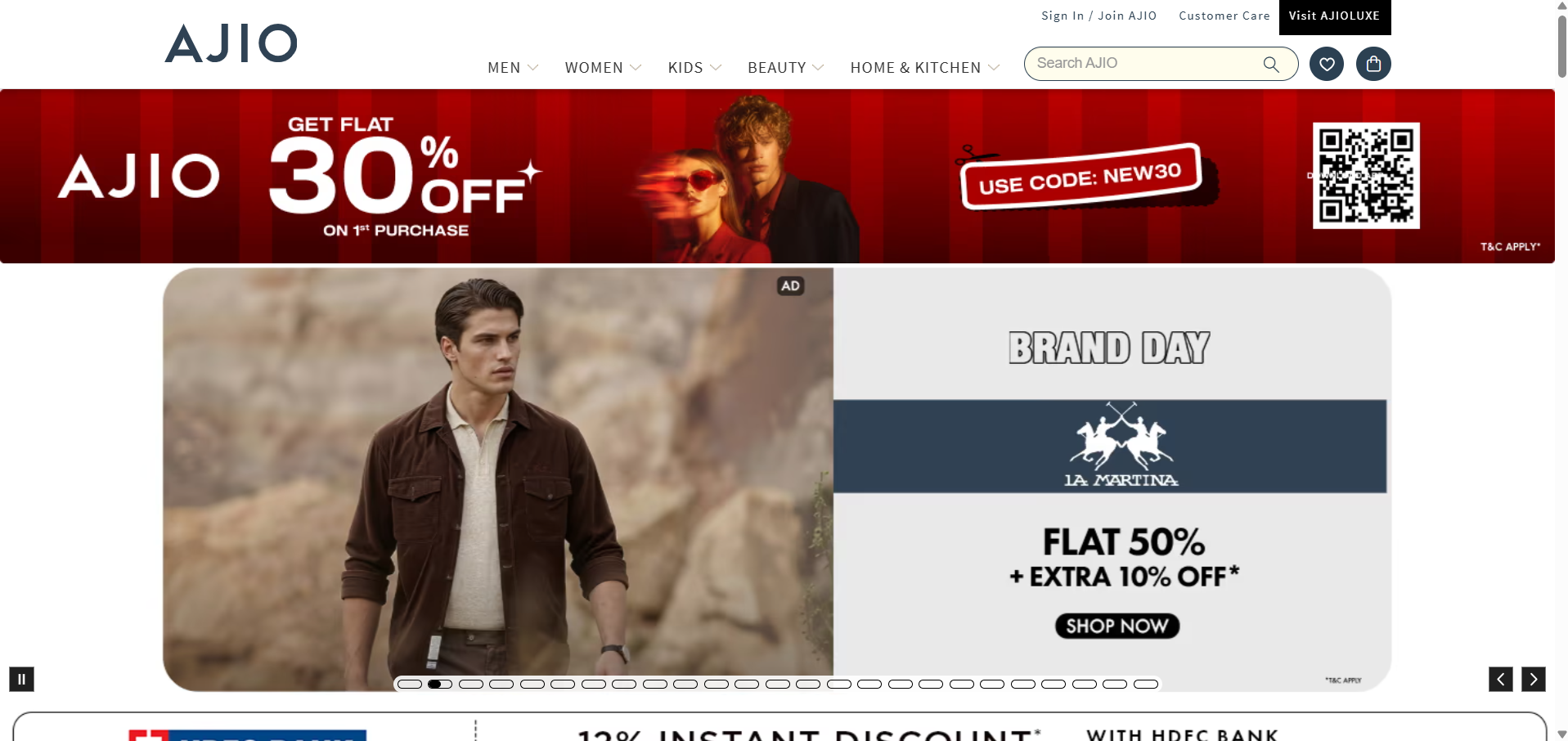
AJIO has established itself as a significant fashion and lifestyle shopping platform in India, with a strong focus on apparel, footwear, accessories, and lifestyle products. Its digital-first approach combines product discovery with curated fashion experiences, giving brands another channel through which to reach online shoppers.
For fashion businesses, AJIO provides an opportunity to showcase products in an environment where customers are already exploring clothing, accessories, and lifestyle collections.
Key Features of AJIO
- Fashion and Lifestyle Focus: Strong presence across apparel, footwear, accessories, and lifestyle.
- Curated Product Discovery: Helps customers explore collections, styles, and trends.
- Brand Variety: Provides space for established and emerging labels.
- Digital Shopping Experience: Supports online fashion discovery and purchasing.
- Broad Customer Reach: Helps brands expand their digital presence.
- Returns and Exchanges: Supports important post-purchase requirements in fashion.
Fashion can be operationally demanding because customers may purchase multiple sizes or request exchanges and returns. Brands therefore need accurate inventory, efficient fulfilment, dependable shipping, and effective reverse logistics.
6. Nykaa

Nykaa has built a specialised digital commerce ecosystem around beauty, personal care, cosmetics, wellness, and lifestyle products. Its category-focused model differentiates it from broad marketplaces because customers often visit the platform with a specific interest in beauty products, brands, trends, and related content.
The platform combines product assortment with content, reviews, recommendations, brand partnerships, and product information, creating a shopping experience tailored to beauty and personal care.
Key Features of Nykaa
- Beauty-Focused Marketplace: Strong presence across cosmetics, skincare, haircare, fragrances, and personal care.
- Wide Brand Selection: Includes established beauty brands and specialised labels.
- Content-Led Discovery: Uses content and product information to support customer discovery.
- Detailed Product Information: Reviews and product details help customers evaluate products.
- Omnichannel Presence: Combines digital commerce with physical retail.
- Customer-Focused Experience: Emphasises discovery, convenience, and beauty-focused shopping.
As brands expand across marketplaces, websites, and physical stores, maintaining accurate inventory across channels becomes more important. Orders also need to be fulfilled, shipped, tracked, and returned efficiently.
This makes connected technology increasingly valuable. Modern ecommerce software India 2026 can form part of a broader technology stack that links commerce, inventory, fulfilment, shipping, and customer engagement.
7. JioMart
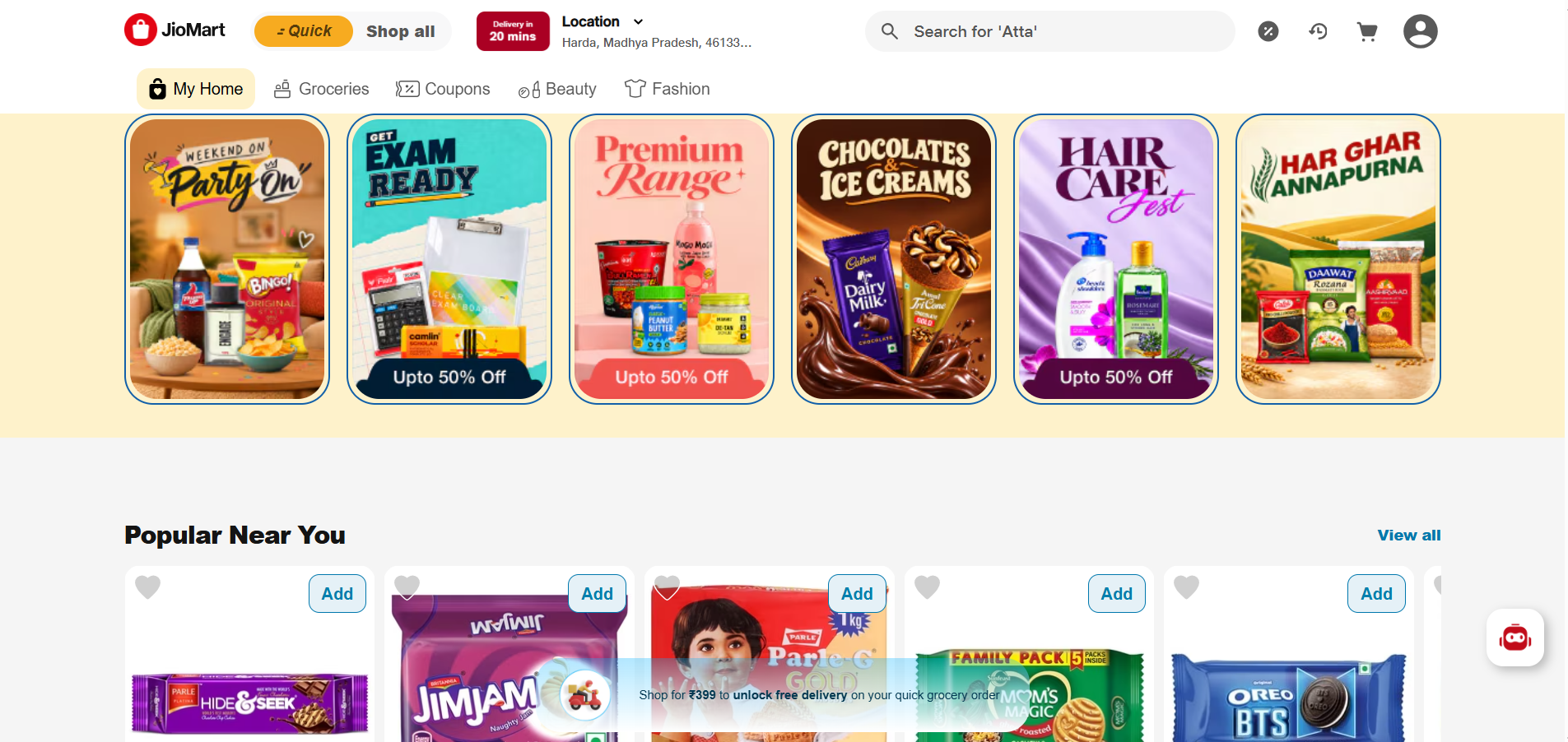
JioMart represents an important part of India’s evolving digital retail landscape, with a strong presence across grocery, everyday essentials, and an expanding range of consumer products. Its connection between digital shopping and India’s extensive retail ecosystem makes it particularly relevant to the growth of omnichannel commerce.
Key Features of JioMart
- Grocery and Everyday Essentials
- Broad Product Assortment
- Omnichannel Retail Experience
- Digital Shopping Convenience
- Wide Customer Reach
- Connection with Retail Networks
As shopping increasingly moves between physical stores, apps, marketplaces, and websites, retailers need systems that keep these channels connected. Inventory visibility is particularly important when products can be located across stores, warehouses, fulfilment centres, or different sales channels.
Accurate inventory, order routing, fulfilment, delivery, and customer communication therefore become important parts of the overall retail operation.
8. Tata Neu
Tata Neu represents an ecosystem approach to digital commerce by bringing together multiple Tata brands, consumer services, and retail experiences within a single digital environment. Rather than operating only as a conventional shopping destination, the platform connects commerce with a broader range of consumer touchpoints.
Key Features of Tata Neu
- Multi-Category Digital Ecosystem
- Integrated Shopping Experience
- Multiple Consumer Services
- Cross-Category Discovery
- Digital Loyalty and Rewards
- Connected Brand Experiences
An ecosystem model can create opportunities for customers to interact with multiple categories and services, but it can also introduce operational complexity. Businesses operating across different channels need to coordinate orders, inventory, fulfilment, shipping, and customer interactions.
A connected operational layer can help businesses maintain consistency as their digital presence expands across marketplaces, ecosystems, and independent websites.
9. Snapdeal
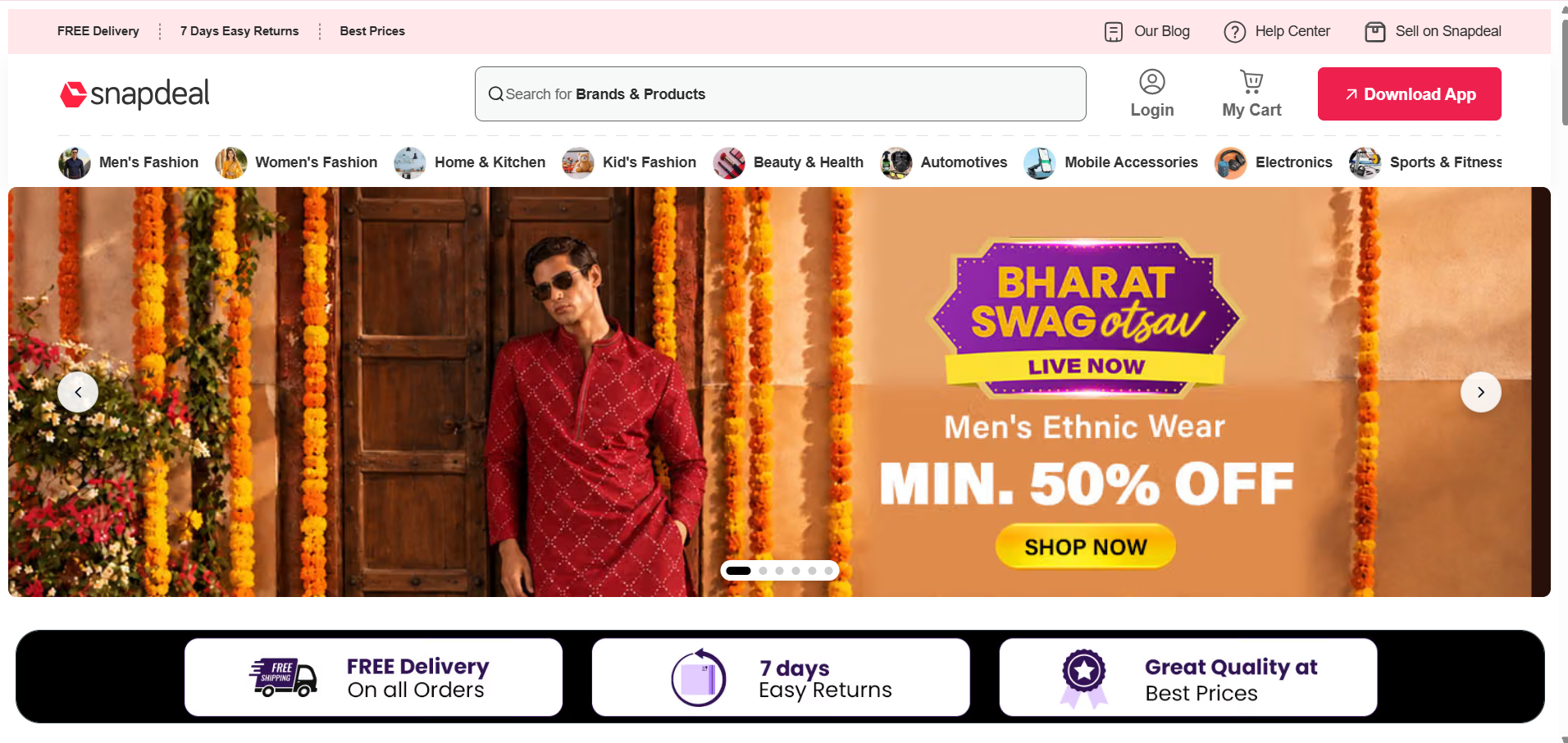
Snapdeal continues to have a presence in India’s digital retail landscape, particularly in value-focused online shopping. Its positioning reflects the diversity of Indian online consumers, where factors such as price, product selection, convenience, trust, and delivery experience can influence purchasing decisions.
Key Features of Snapdeal
- Value-Focused Shopping
- Broad Product Selection
- Marketplace Seller Network
- Price-Conscious Customer Base
- Multiple Product Categories
- Convenient Online Shopping
For sellers, platform selection depends on their target audience, category, pricing strategy, fulfilment capabilities, and business model. A value-focused seller can have very different requirements from a premium D2C brand. As sellers expand across multiple channels, manual management of orders, shipment creation, tracking, delivery exceptions, and returns can become increasingly difficult. Shipping automation can help bring these workflows together and reduce repetitive operational work.
10. Shopify

Shopify differs from the other platforms on this list because it is primarily ecommerce infrastructure rather than a traditional marketplace. Instead of placing brands within a shared marketplace environment, Shopify enables businesses to create and operate their own online stores with greater control over branding, product presentation, customer journeys, and direct customer relationships. This distinction is important when comparing different types of platforms. Marketplaces provide access to established audiences, while independent store platforms provide greater control over the storefront and customer experience.
Key Features of Shopify
- Customisable Online Storefronts
- Product and Catalogue Management
- Payment Integrations
- App and Integration Ecosystem
- Order Management
- Marketing and Customer Tools
For D2C brands, this flexibility can support stronger brand identity and customised shopping experiences. However, building a store does not automatically generate demand. Businesses still need to manage marketing, inventory, fulfilment, shipping, tracking, returns, and customer service. This makes Shopify particularly relevant when considering ecommerce website builders India 2026, while also highlighting why independent stores often need additional technology for fulfilment and logistics.
India’s Ecommerce Landscape in 2026: From Marketplaces to Connected Commerce
India’s ecommerce market in 2026 isn’t shaped by one business model. A customer might find a product on a marketplace, spot it again on social media, compare prices through search, visit the brand’s website, then buy from the channel that offers the best mix of price, convenience, trust, and delivery. As these journeys become more connected, businesses need to look beyond single sales channels and build a wider commerce strategy.
Marketplaces still matter because they give sellers access to existing customer traffic, payment infrastructure, product discovery, and fulfilment networks. For an emerging brand, selling through a marketplace can help it reach customers without building every part of the online buying journey from the ground up. Many businesses are also putting money into their own websites. This gives them direct customer relationships, control over the brand experience, more repeat purchases, and room for personalised shopping journeys.
Online shopping is growing well beyond India’s largest metropolitan cities. Customers in Tier 2, Tier 3, and smaller markets are taking part in digital commerce in greater numbers, opening up opportunities for brands that offer relevant products and reliable fulfilment and delivery. Mobile-first shopping, digital payments, regional preferences, and wider logistics networks are helping expand the online customer base.
The customer experience doesn’t end at checkout. A shopper may have a smooth browsing and buying experience, yet a delayed shipment, incorrect tracking update, failed delivery attempt, or difficult return can still damage their view of the brand. That’s why modern ecommerce solutions India businesses use now go beyond website creation. They need to connect product discovery and checkout with order processing, fulfilment, shipping, delivery, returns, and customer communication.
The ecommerce platform is now the starting point for a larger operational ecosystem. Businesses looking to scale must consider how they generate orders and how efficiently those orders are processed, shipped, tracked, delivered, and handled after delivery.
How to Choose the Right Ecommerce Platform in India in 2026
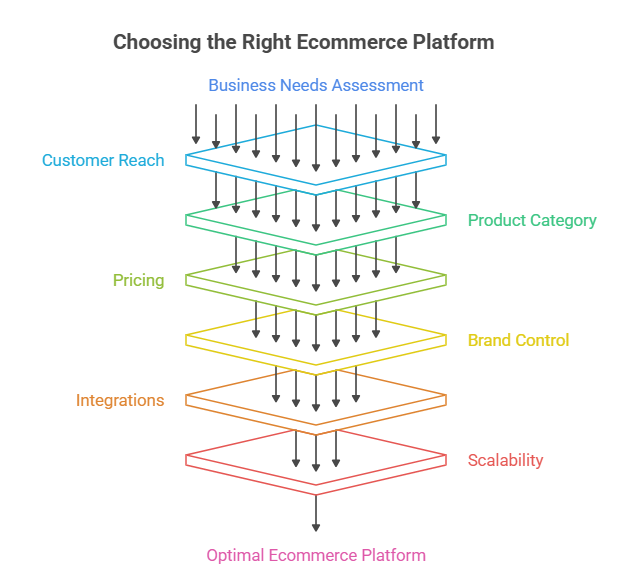
There is no single platform that will suit every business in exactly the same way. A large marketplace seller, fashion brand, beauty company, neighbourhood retailer, manufacturer, or D2C startup can have very different requirements. As a result, the best ecommerce platform in India for one business may not necessarily provide the same advantages for another. Before choosing a platform, businesses should look beyond popularity and consider factors such as customer reach, pricing, product category, integrations, scalability, fulfilment, and the level of control they need over the customer experience.
Key Factors to Consider When Choosing an Ecommerce Platform
Choosing the right ecommerce platform in India requires looking beyond features and pricing to understand how well a platform fits the business’s customers, products, operations, and growth plans. These factors can help businesses compare different ecommerce solutions India and identify a platform that supports both their current requirements and future expansion.
1. Customer Reach and Market Presence
Customer reach is one of the first factors businesses should evaluate. Large marketplaces can provide access to established audiences across India, while specialised platforms may be more relevant for specific categories such as fashion, beauty, electronics, or grocery. Businesses should consider whether they want access to an existing marketplace audience or prefer to build their own traffic through a branded online store.
2. Product Category and Target Audience
The platform should match the products being sold and the customers a business wants to reach. A fashion brand may benefit from a platform where shoppers are already looking for apparel and lifestyle products, while a beauty company may prefer a specialised beauty-focused environment. Businesses should evaluate product categories, customer demographics, shopping behaviour, and regional reach before making a decision.
3. Pricing, Commissions, and Overall Costs
The cost of selling is another important consideration. Businesses should look beyond the basic subscription or listing cost and evaluate marketplace commissions, fulfilment charges, payment processing fees, advertising expenses, shipping costs, return-related charges, and other operational expenses. A platform that generates a high number of orders still needs to provide a commercially sustainable model after these costs are considered.
4. Storefront and Brand Control
Businesses building their own online stores should consider how much control they need over the storefront and customer journey. This includes website design, product presentation, checkout experience, promotions, customer data, branding, and communication. Businesses evaluating ecommerce website builders India 2026 should therefore look beyond templates and design features and examine the broader technology and operational capabilities available after the website goes live.
5. Integrations and Ecommerce Technology
As an online business grows, its ecommerce platform rarely operates in isolation. It may need to connect with ERP systems, inventory management software, warehouse systems, payment gateways, CRM platforms, accounting tools, analytics platforms, marketplaces, and shipping solutions. Strong integrations can reduce manual data entry and help information move more efficiently between different parts of the business.
6. Inventory and Order Management
Inventory accuracy becomes increasingly important when businesses sell through multiple channels. A suitable platform should support product catalogues, stock visibility, order processing, and synchronisation across sales channels. Without proper inventory management, businesses can face overselling, stock discrepancies, fulfilment delays, and order cancellations.
7. Fulfilment and Shipping Capabilities
The buying experience does not end at checkout. Businesses should consider how orders will be packed, dispatched, shipped, tracked, and delivered. Support for multiple carriers, shipping integrations, automated label generation, shipment creation, and carrier allocation can become particularly important as order volumes increase.
8. Scalability and Business Growth
A platform should be able to support the business as it grows. Increasing order volumes, larger product catalogues, additional warehouses, new sales channels, more customers, and higher shipping volumes can place greater demands on the underlying technology. Businesses should therefore evaluate whether the platform can support their future requirements rather than selecting a solution based only on their current order volume.
9. Returns and Post-Purchase Experience
Returns, exchanges, refunds, delivery exceptions, and customer support can significantly affect the overall shopping experience. Businesses should examine how easily the platform can connect with return management, tracking, customer communication, and reverse logistics workflows. This becomes especially important for categories such as fashion, lifestyle, beauty, and consumer products where returns may form a significant part of the post-purchase journey.
10. Analytics and Business Insights
Data can help businesses understand which products are selling, where customers are coming from, how orders are performing, and where operational problems are occurring. Useful analytics around sales, inventory, customers, fulfilment, shipping, and returns can help businesses make better operational decisions as they scale.
Marketplace vs Independent Ecommerce Store
Another important consideration is whether a business needs a marketplace or an independent ecommerce store. Marketplaces such as Amazon India, Flipkart, Meesho, Myntra, and other category-focused platforms can provide access to an existing customer base. Independent store platforms, meanwhile, give businesses greater control over branding, customer experience, website design, and direct customer relationships.
For many businesses, the choice does not have to be one or the other. A brand may use marketplaces to expand customer reach while operating its own D2C website to build direct relationships and encourage repeat purchases. This makes it important to select technology that can support multiple channels rather than treating every sales channel as a separate operation.
Ultimately, comparing the top ecommerce platforms in India and evaluating the best ecommerce platforms India 2026 is less about identifying one universal option and more about understanding which platform fits a particular business model. Customer reach, category relevance, pricing, brand control, integrations, inventory, fulfilment, shipping, scalability, analytics, returns, and customer experience should all form part of the evaluation. For businesses looking beyond the storefront itself, ecommerce solutions India increasingly involve a connected technology ecosystem that brings together sales channels, inventory, fulfilment, shipping, tracking, returns, and customer communication. The right ecommerce platform should therefore be evaluated not only on how easily it can generate orders, but also on how effectively those orders can be managed from checkout through final delivery.
Ecommerce Software in India: The Technology Behind Modern Online Stores
Choosing an ecommerce platform is only the first step in running an online business. After a customer places an order, a broader technology ecosystem gets to work. The order must be confirmed, inventory updated, and the right fulfilment location selected. Shipping then needs to be arranged, tracking details sent to the customer, and delivery issues resolved when something goes wrong.
That’s why ecommerce software India 2026 is about far more than building a website. A modern ecommerce technology stack may include order management, inventory synchronisation, payment processing, warehouse management, CRM, analytics, fulfilment, shipping, returns, and customer engagement tools. Integration matters even more as a business grows. If an ecommerce platform lists a product as available but the warehouse has no stock, the business may have to cancel the order or delay fulfilment. And if tracking updates don’t flow into the customer communication system, shoppers often contact support for information they should have received automatically.
Shipping adds another challenge. Growing businesses usually can’t depend on one carrier for every order. Carrier performance changes by location, service type, parcel weight, delivery promise, cost, and operational coverage. Businesses need smarter carrier selection and automated shipping workflows to keep deliveries on track.
The modern ecommerce stack is increasingly connected. The storefront creates the order, while the order management system processes it and inventory systems show available stock. The warehouse fulfils the order, the shipping layer assigns a carrier and manages dispatch, and tracking keeps customers updated. Returns technology then supports the post-delivery experience.
From Checkout to Delivery: Why Ecommerce Logistics Matters More Than Ever
The ecommerce experience doesn’t end when a customer clicks “Place Order.” That’s often where the most demanding operational work begins. A customer may enjoy browsing and checkout, but a delayed shipment, inaccurate tracking, or failed delivery attempt without clear communication can still damage the overall experience. Logistics is a major part of customer experience. For brands selling across several channels, shipping can get complicated fast. Orders may come through Amazon, Flipkart, Meesho, a D2C website, or other marketplaces, while multiple carriers handle deliveries. Managing every workflow manually makes consistent service levels harder to maintain.
Shipping automation helps businesses bring carrier connections into one workflow, generate shipping labels automatically, apply carrier allocation rules, monitor shipment movement, and improve tracking visibility. It cuts repetitive work and gives teams a clearer view of shipment operations. Delivery exceptions also matter in ecommerce logistics. An NDR, or Non-Delivery Report, is created when a delivery attempt fails because the customer is unavailable, the address is incorrect, the customer can’t be reached, or another delivery issue occurs. Spotting these exceptions quickly and taking the right follow-up action can help recover shipments before they move toward return.
Returns matter just as much, especially in fashion, beauty, lifestyle, and consumer goods. Reverse logistics affects both operating costs and customer experience, so efficient return workflows become more important as online sales grow. This is where eShipz can complement the ecommerce platforms discussed above. Instead of replacing the storefront or marketplace, eShipz works as a logistics automation layer that connects ecommerce orders with shipping and post-purchase workflows. Businesses can manage multiple carrier integrations, automate shipping processes, track shipments, handle delivery exceptions, support NDR workflows, and manage returns through a connected operational environment. The result is a broader ecommerce workflow where the marketplace or storefront handles the commerce experience, while the logistics layer manages what happens after the order is created.
Marketplaces vs D2C Stores: Understanding the Two ecommerce platform india Models
Choosing an ecommerce platform is only the start of running an online business. Once a customer places an order, several systems need to work together. The order has to be confirmed, inventory updated, and the correct fulfilment location chosen. Shipping must then be arranged, tracking details shared with the customer, and delivery problems handled if they arise. For businesses comparing an ecommerce platform India option, these operational needs can matter as much as storefront design and customer-facing features.
That’s why ecommerce software India 2026 involves much more than building a website. A modern ecommerce technology stack can include order management, inventory synchronisation, payment processing, warehouse management, CRM, analytics, fulfilment, shipping, returns, and customer engagement tools. Businesses reviewing ecommerce solutions India also need to look at how well these systems connect. If an ecommerce platform shows a product as available while the warehouse has no stock, the business may need to cancel the order or delay fulfilment. If tracking updates don’t reach the customer communication system, shoppers may contact support for updates they should have received automatically.
For businesses searching for the best ecommerce platform in India, integrations and operational flexibility matter. The same is true when comparing the top ecommerce platforms in India. A platform may bring in orders effectively, yet still need extra systems for inventory, fulfilment, shipping, and post-purchase work. Businesses should also consider whether their technology stack can support expansion across marketplaces, D2C websites, mobile channels, and other sales channels.
Shipping creates its own challenge. Growing businesses usually can’t rely on one carrier for every order. Carrier performance varies by location, service type, parcel weight, delivery promise, cost, and operational coverage. Businesses need better carrier selection and automated shipping workflows to keep deliveries moving. This matters even more for brands selling through multiple ecommerce platforms India 2026, where manually handling separate order and shipping workflows can become complicated fast.
The modern ecommerce stack is increasingly connected. The storefront creates the order, the order management system processes it, and inventory systems show available stock. The warehouse fulfils the order, while the shipping layer assigns a carrier and manages dispatch. Tracking keeps customers informed, and returns technology supports the post-delivery experience. Businesses comparing the best ecommerce platforms India 2026 should assess this wider ecosystem alongside each platform’s core selling features.
The same applies to businesses exploring ecommerce website builders India 2026. An attractive online store matters, but the website is only one part of the customer journey. As order volumes grow, businesses need technology that connects the storefront with inventory, fulfilment, shipping, tracking, returns, analytics, and customer communication. A connected ecommerce technology stack helps businesses manage the full journey, from checkout through delivery and beyond.
What Indian Businesses Need Beyond an Ecommerce Platforms in India
As ecommerce platforms in India for 2026 grow, the challenge often shifts from simply generating orders to managing those orders efficiently. A business may begin with a small catalogue, one sales channel, and a limited number of shipments, where spreadsheets and manual processes are manageable. As order volumes increase, however, so do SKUs, warehouses, customers, carriers, delivery locations, returns, and exceptions.
A scalable operation therefore needs to manage the complete post-purchase journey:
| Stage | What Happens | What Businesses Need |
|---|---|---|
| Storefront | Customers browse products and place orders | Product catalogue, pricing, checkout, payments, and customer experience |
| Order Management | Orders arrive from different sales channels | Centralised processing, validation, and synchronisation |
| Inventory | Products need to be available at the right location | Stock visibility and inventory synchronisation |
| Fulfilment | Orders are prepared for dispatch | Warehouse coordination, allocation, packing, and fulfilment workflows |
| Shipping | Parcels are handed over to carriers | Carrier selection, rate comparison, shipment creation, and labels |
| Tracking | Customers need visibility after dispatch | Shipment tracking, status updates, and proactive notifications |
| Delivery | Shipments reach customers | Delivery monitoring and exception handling |
| NDR Management | Some deliveries fail on the first attempt | Customer communication, reattempt workflows, and NDR resolution |
| Returns | Customers request returns or exchanges | Return processing, reverse logistics, tracking, and refund coordination |
| Customer Experience | Customers interact with the brand throughout the journey | Consistent communication, updates, support, and post-purchase engagement |
Each stage affects the next. Inventory accuracy influences fulfilment, fulfilment affects dispatch speed, and carrier selection can influence delivery performance. Tracking can improve customer visibility, while effective NDR and returns management can help control operational costs. This is why businesses should not evaluate ecommerce platforms only on storefront, catalogue, or checkout capabilities. As sales channels and order volumes increase, the ability to connect ecommerce systems with inventory, fulfilment, shipping, tracking, returns, and customer communication becomes equally important. For businesses evaluating ecommerce platforms India 2026, the bigger question is therefore not simply where an order is placed, but how efficiently that order moves through the entire operational journey after purchase.
This is where an integrated logistics and shipping automation layer such as eShipz can become valuable. By connecting order processing, carrier allocation, shipping, tracking, NDR management, returns, and customer communication, businesses can reduce manual work and create a more connected post-purchase experience across their sales channels.
The Future of Ecommerce in India: Building a Connected Commerce Ecosystem
Ecommerce Platforms in India for 2026 is moving toward tighter links between commerce, technology, data, and logistics. Businesses are replacing disconnected systems with connected ecosystems that share information throughout the customer journey. Artificial intelligence and automation will play a bigger part in this shift. Companies can use data to forecast demand, optimise inventory, flag delivery risks, improve carrier allocation, personalise experiences, and automate routine work. Customers also expect dependable delivery, accurate tracking, easy returns, flexible payment options, and timely communication.
That’s why the discussion around top ecommerce platforms in India now goes beyond the platforms themselves. Businesses need to assess how well each commerce channel connects with the technology around it. The ten platforms in this guide show the range of India’s ecommerce ecosystem. Amazon India and Flipkart are major horizontal marketplaces, while Meesho highlights the growth of value-focused digital commerce. Myntra and AJIO show the strength of fashion-focused platforms, Nykaa represents specialised beauty commerce, JioMart and Tata Neu operate as broader digital retail ecosystems, Snapdeal targets value-oriented online demand, and Shopify supports the independent D2C store model.
Businesses comparing best ecommerce platform India 2026 should look past platform visibility and assess the full business model. Customer reach, category relevance, commercial structure, technology, integrations, scalability, fulfilment, logistics, returns, and customer experience all affect whether a platform suits a particular business. A storefront alone doesn’t create ecommerce growth. Growth depends on every part of the customer journey working together, from product discovery and checkout through fulfilment, delivery, tracking, and returns. Each interaction shapes the overall customer experience.
For growing brands, eShipz can support the wider ecommerce ecosystem. It connects ecommerce orders with multiple carriers and automates shipping, tracking, NDR, returns, and other post-purchase workflows. That operational layer becomes more important as sales channels and order volumes grow. The future of Indian ecommerce isn’t simply about selling more online. It’s about building a connected commerce experience where orders are easier to process, shipments are easier to track, deliveries are easier to manage, and customer interactions remain consistent.
![The Complete Guide to Returns Automation in eCommerce [2027]](https://www.eshipz.com/wp-content/uploads/2026/10/The-Complete-Guide-to-Returns-Automation-in-eCommerce-2027.png)