






The Upcoming Top Shipping Trends point at one place: your own operation. Freight is hard to plan around. Tariff rules change on short notice, carriers add surcharges every quarter, and capacity gets tight every peak season. Brands can’t control any of that. They can control how they pick carriers, how they promise delivery dates, how they handle returns, and how well their systems share data.
That is where shipping technology and logistics automation are moving fastest. Gartner forecasts that spending on supply chain software with agentic AI will grow from under $2 billion in 2025 to $53 billion by 2030, according to its April 2026 press release. Money at that scale attracts hype, so this guide separates what works today from what is still early.
You will find eight trends, one optional privacy topic, a short list of things not to over-invest in, and a readiness timeline. If you want the earlier baseline, our post on ecommerce shipping trends for 2026 covers where the year started.
How Shipping Has Become Part of the Buying Experience
Shipping has changed from a back-office task into part of the buying experience. Shoppers compare delivery dates before they compare prices, and a late parcel or a hard return often costs a brand the next order as well. At the same time, carrier costs keep rising, and many brands now sell across their own site, marketplaces and social channels, each with its own order flow. Small gaps in carrier choice, tracking or returns handling add up quickly at that scale. The trends below show where brands are putting effort and where the returns are still unproven, so you can plan your 2027 shipping budget with fewer guesses.
The Top Shipping Trends Shaping the Industry
AI Moves From Assistant to Agent:
Now: Most ecommerce shipping teams use AI for narrow jobs. It suggests a carrier, estimates a delivery date, or flags a shipment that has not moved in 48 hours. A person still makes every decision.
2027: The next step is an agent that completes a chain of tasks. Picture a parcel flagged as delayed. The agent checks alternate carriers for the remaining route, rebooks if the cost stays under a limit you set, updates the customer, and pings your team only when the limit is exceeded. Gartner says simple agents already handle discrete tasks, and that clusters of agents orchestrating multi-step workflows could arrive within 12 to 18 months.
Reality check: Gartner also expects agentic AI to be five to 10 years from mainstream adoption in supply chain. It has separately predicted that over 40% of agentic AI projects across industries will be canceled by the end of 2027, citing rising costs, unclear value and weak risk controls. That figure covers agentic projects in general, not shipping alone, but the causes apply here too. Gartner has also warned about “agent washing”, where older chatbot or automation tools are relabeled as agentic.
Action: Start with low-risk tasks such as exception alerts, address checks and delay notifications. Keep a human approving anything that spends money. Ask vendors what the agent did in real customer accounts last month, not what it could do.
Multi-Carrier Strategy and Smarter Carrier Allocation
Relying on one carrier is simple until that carrier has a bad month. A strike, a system outage or a sudden surcharge hits every order at once.
Multi-carrier shipping means routing each order by four factors: cost, speed, reliability and destination. A carrier that performs well in metro pin codes may miss delivery promises in remote ones. A carrier that is cheapest for a 500 gram parcel may be expensive at 3 kg. Rules or a scoring model can pick the right carrier per order, and the results improve when you feed back real delivery performance instead of the rate card.
Two habits protect you in 2027. First, keep carrier optionality. Avoid exclusivity clauses, and keep at least two live carriers for every major zone, even if one gets most of the volume. Second, review carrier performance monthly using delivered-on-time rate, first-attempt delivery rate and return-to-origin rate, not just price per kg. Our multi-carrier shipping guide walks through the selection factors in more detail.
Last-Mile Delivery: Speed, Flexibility and Cost
The last mile is the most expensive leg and the one customers remember. Three changes are worth planning for.
- Delivery windows. Letting customers pick a day or a time slot cuts failed first attempts, which are costly everywhere and especially so in markets with cash on delivery.
- Alternative delivery points. Pickup points, lockers and neighbor drop-offs help when nobody is home. They also reduce repeat attempts.
- Faster, clearer promises. A reliable date beats a fast but wrong one. Show the delivery estimate at checkout and make sure your carrier data can back it up.
Drones and autonomous delivery vehicles get plenty of press. They are early-stage. Pilots exist, but market forecasts vary widely and current scale is small, so treat them as something to watch, not something to budget for in 2027.
Returns as a Margin and Retention Issue
Returns used to be a customer service topic. They are now a margin topic. The National Retail Federation and Happy Returns forecast that 15.8% of US retail sales, or $849.9 billion, would be returned in 2025, and that 19.3% of online sales would come back. These are US figures, but the pattern holds in most online markets: ecommerce returns run higher than in-store returns.
Retailers are responding in two ways. Some are charging for returns to cover processing and carrier costs. The NRF found that 29% of merchants were implementing return fees to prevent fraud. Others are tightening checks. The same research found 9% of returns are fraudulent, and that 85% of retailers use AI to detect or prevent return fraud.
The tension is real. In the same NRF study, 82% of consumers said free returns matter when they shop online. Charge too much and you lose repeat buyers. Charge nothing and you absorb the cost of every bracketed size and every empty-box claim.
What tends to work:
- Capture a reason code at the start of every return, so you can fix the product page or size chart behind the top cause.
- Automate labels and routing, so a return goes straight to restock, refurbish or liquidate instead of sitting in a pile.
- Flag repeat returners and mismatched weights for review before a refund is issued.
- Offer free returns or exchanges for loyal customers and charge a small fee for others, instead of one policy for everyone.
This is a balance between customer experience and cost. Track both, and adjust when either moves.
Shipping Visibility and a Unified Data Layer
Real-time tracking is now a basic expectation. What separates brands in 2027 is what they do with the data.
Proactive communication is the first step. Tell the customer about a delay before they write in. Many “where is my order” tickets exist only because the brand knew about the delay and said nothing.
The second step is one view across carriers and channels. Every carrier uses its own status codes, and every marketplace has its own order format. A unified data layer maps them into one set of statuses, so your team sees “out for delivery” once, not in six spellings.
This ties directly to the first two trends. An AI agent choosing between carriers is only as good as the data it reads. Gartner’s own advice is that data quality, integration across systems, workforce capability and operating model maturity will decide whether agentic AI works at scale. Integration is the most common place these projects fail, so fix the data before you buy the agent.
Cloud-Based Shipping Platforms and Composable Stacks
Cloud shipping platforms and composable stacks (separate tools for rating, labels, tracking and returns, connected by APIs) are a common recommendation. Independent evidence that they outperform older systems is thin, and most published claims come from vendors. So judge them on specific benefits you can test:
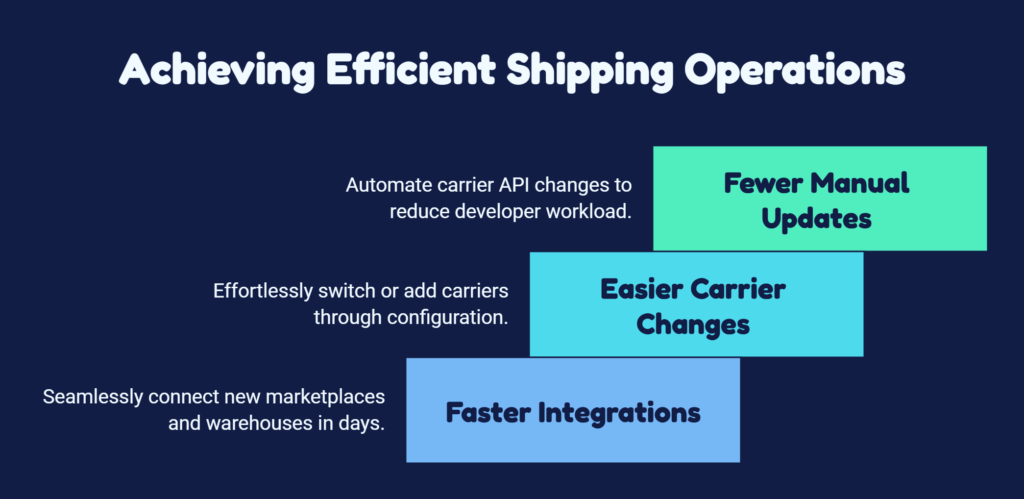
- Faster integrations. Adding a new marketplace or warehouse should take days, not a quarter.
- Easier carrier changes. Switching or adding a carrier should be a configuration change, not a development project.
- Fewer manual updates. Carrier API changes should be handled by the platform, not by your developers.
Before signing, ask for API documentation, a sandbox, webhook support and a clear way to export your own data. If a vendor is vague about any of these, that tells you something.
Warehouse and Fulfilment Automation: Selective, Not Universal
Warehouse automation is growing, but most warehouses still run largely on manual work. That is fine. Automation pays off in specific places, not everywhere.
Start where errors and labor cost you the most. Barcode scanning at pick and pack, better pick paths and carton-size suggestions cost little and remove common mistakes. Conveyors, sortation systems and robotic picking make sense at higher volumes, where labor and overtime are your biggest cost and the workload is steady enough to keep machines busy.
A quick test before any purchase: write down the cost of one mispick, one hour of overtime and one late dispatch. If the equipment does not clearly reduce one of those, wait. For smaller brands, outsourced ecommerce fulfillment with a good 3PL usually beats a capital purchase.
Data, Privacy and Trust in Shipping Communications (Optional)
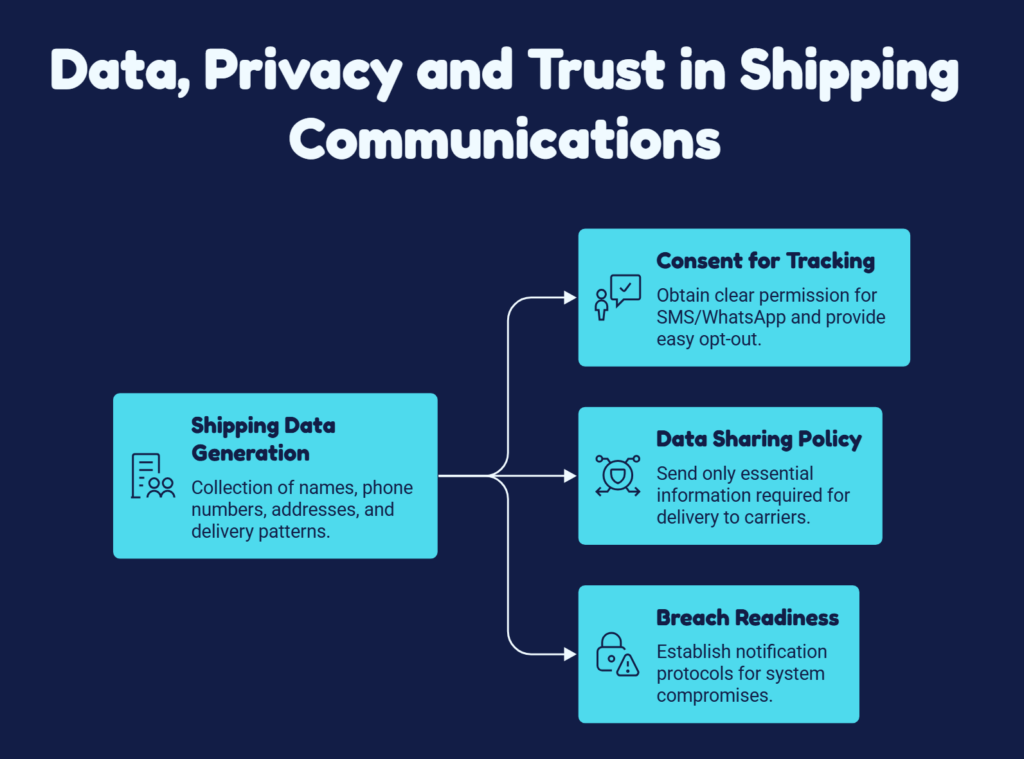
Shipping generates personal data: names, phone numbers, addresses and delivery patterns. Three habits keep you on solid ground.
- Consent for tracking messages. Get clear permission before sending SMS or WhatsApp updates, and make opting out easy.
- Data shared with carriers. Send only what the carrier needs to deliver. A carrier rarely needs a customer’s email or order history.
- Breach readiness. Know who is notified, and how fast, if a system holding customer data is compromised.
Rules differ by region. GDPR in Europe, India’s Digital Personal Data Protection Act and state laws such as California’s CCPA all set different requirements, so check the ones that apply to where your customers live.
The 2027 Readiness Checklist
Here is a simple timeline. Adjust it to your own volumes and markets.
Now, through peak season 2026
- Confirm you have at least two working carriers for each major zone.
- Set up delay and exception alerts so customers hear from you first.
- Review your returns policy and fraud checks before holiday volumes arrive.
Q1 2027
- Audit your data: carrier statuses, address quality and order sync across channels.
- Pull a carrier scorecard: on-time rate, first-attempt success and return-to-origin rate.
- Add EU carbon surcharges to landed cost if you ship to or from Europe.
Mid-2027
- Pilot one narrow AI task, such as automated carrier selection for a single zone, with human approval.
- Test one warehouse automation step where errors cost you the most.
- Review your privacy consent flow for tracking messages.
Signals to watch
- Gartner’s updates on agentic AI adoption in supply chain.
- Carrier surcharge changes and any new carbon rules in your lanes.
- Return-fee trends among competitors and how customers react.
- Delivery cost per order, tracked monthly.
Conclusion
The Top Shipping Trends for 2027 reward brands that get the basics right. Clean data comes first. Carrier choice comes second, and a returns process that protects margin comes third. AI agents, cloud platforms and automation all work better on top of that base, and worse without it.
Pick two or three items from the checklist and finish them before peak season. If you are looking at tools, eShipz is one option for teams that want multi-carrier allocation, tracking, NDR and returns in a single platform. Whatever you choose, test it on your own shipments before you commit.
Frequently Asked Questions
- What are the top shipping trends for 2027?
The top shipping trends for 2027 are AI moving from assistant to agent, multi-carrier allocation, flexible last-mile options, returns management, unified shipping data, cloud platforms, selective warehouse automation and carbon compliance. Most of them sit inside your own operation. - Will AI agents replace shipping teams in 2027?
No. Gartner expects agentic AI to be five to 10 years from mainstream use in supply chain. In 2027, agents are best used for narrow tasks such as exception alerts, with a person approving any decision that costs money. - Why use more than one carrier?
Different carriers perform better on different routes, weights and delivery types. Using several lets you route each order to the best option and protects you when one carrier has delays, outages or price increases. - How can brands reduce return costs?
Collect return reasons, automate labels and routing, flag repeat returners and check returned items for fraud. Balance this against customer experience, since 82% of shoppers say free returns matter when buying online. - Do I need warehouse automation?
Not always. Most warehouses still rely on manual work. Start with low-cost steps like barcode scanning and better pick paths. Consider conveyors or robots once volumes are high and labor or errors are your largest cost. - How do EU carbon rules affect my shipping costs?
Ocean carriers must now cover 100% of emissions on intra-EU voyages under the EU ETS, and FuelEU Maritime adds fuel rules. Many carriers pass this on as a surcharge, so it can appear on your freight invoice. - Which technologies should I avoid over-investing in?
Be careful with drones, autonomous vans and humanoid-style warehouse robots. Adoption is early and forecasts are inconsistent. Put money into carrier performance tracking, data quality and returns first.