



AI in logistics is changing how e-commerce brands handle shipping, fulfilment and delivery. Logistics used to be mostly about getting an order from a warehouse to a customer’s doorstep. Today, each shipment requires hundreds of decisions about carriers, delivery timelines, inventory, capacity, routes, customer behaviour and exceptions.
The challenge grows quickly as an e-commerce business expands. A brand sending a few hundred orders each day may still manage carrier selection and shipment exceptions manually. Once volumes reach thousands or hundreds of thousands of orders, that process becomes difficult to sustain. AI in logistics helps businesses process large volumes of logistics data, identify patterns, predict outcomes and act faster, rather than relying solely on fixed rules or reacting after issues occur.
The shift is already under way. Nearly 90% of shippers surveyed by McKinsey in 2027 had adopted at least one transportation AI use case. DHL’s 2025 research found that almost half of surveyed e-commerce businesses were already integrating AI into their operations. DHL also reported that 81% of global shoppers abandon carts if their preferred delivery options aren’t available.
India’s logistics landscape is growing more complex as well. The country’s express parcel market is projected to reach 24–29 billion shipments by FY30, while e-commerce already makes up more than half of estimated FY25 parcel volumes. For brands operating in this market, the task goes beyond simply moving shipments. They need to make the right logistics decision at the right time across thousands of orders in motion. This is where AI in logistics can help e-commerce businesses automate decisions, respond to changing conditions and manage growing shipment volumes more efficiently.
Why E-Commerce Is Becoming a Strong Use Case for AI
Every online order triggers a series of logistics decisions. A business must choose the right carrier, select a suitable service level, estimate when the package will arrive, and identify anything that could affect delivery. Those decisions don’t stop once the shipment is in transit.
The system must track movement, flag unusual delays, assess delivery risk, and decide whether an exception needs attention. After delivery, teams still need answers about returns, customer behaviour, carrier performance, and inventory recovery. At low volumes, people can manage much of this work manually. As order volumes grow, though, the information becomes too much to review by hand.
AI logistics management helps teams focus on the shipments that need action. Rather than checking every order continuously, AI can identify patterns and flag exceptions worth investigating. If a carrier has a history of delays on a specific route, that data can inform future carrier allocation and ETA predictions. If certain pin code, payment method, and carrier combinations have produced higher NDR rates, those patterns can help identify future delivery risk. The system goes beyond reporting past events. It uses past outcomes to support better decisions about what may happen next.
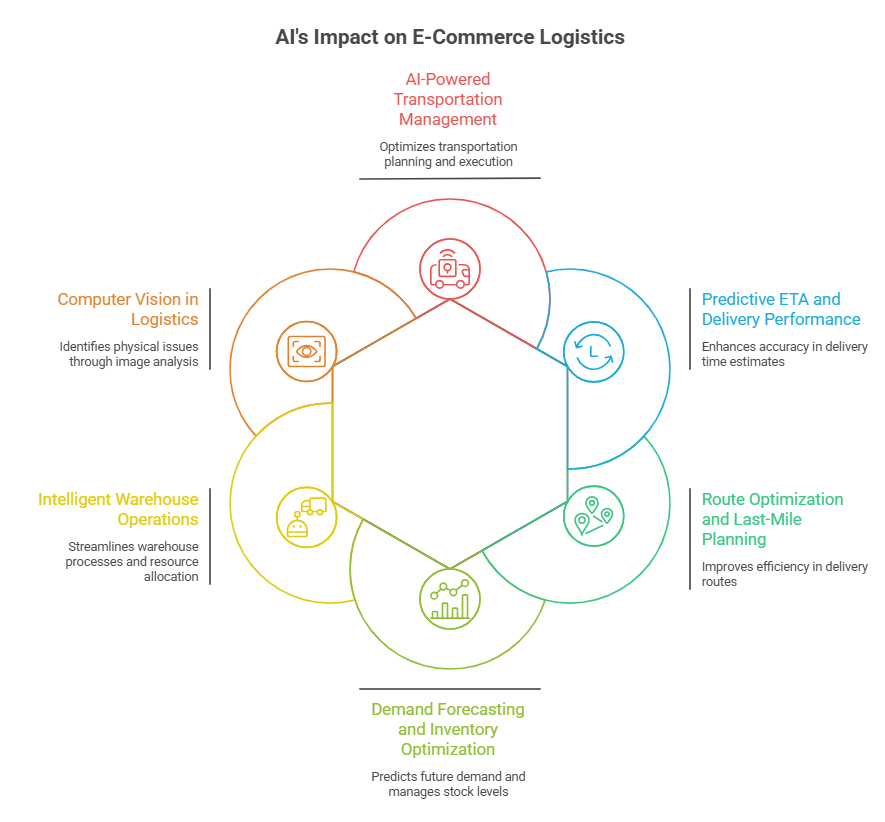
Predictive ETA and Delivery Performance:
Customers expect accurate updates on when their orders will arrive. But estimating an ETA takes more than calculating the distance between two locations. Carrier performance, service type, route history, current shipment status, hub delays, and other operational factors can all affect delivery times. AI can combine these signals to support predictive ETAs.
For example, historical data may show that shipments on a specific route often face delays under certain conditions. That information helps create a more realistic delivery estimate. AI for logistics supports internal planning and customer communication. If a shipment starts showing signs of delay, businesses can spot the risk sooner and act before the promised delivery date is missed.
Route Optimization and Last-Mile Planning:
The last mile is one of the most complex parts of logistics because businesses need to balance distance, time, delivery windows, vehicle capacity and customer expectations. AI logistics automation can support route planning by considering a broader set of operational variables, such as:
- Delivery locations
- Traffic conditions
- Vehicle capacity
- Delivery windows
- Historical travel times
- Stop duration
- Shipment priority
- Driver constraints
- Previous route performance
The goal is not simply to find the shortest route. A practical route needs to balance distance, time, capacity, cost and the delivery promise. For businesses handling large delivery volumes, even relatively small improvements in route planning can have an impact when applied across thousands of shipments.
Demand Forecasting and Inventory Optimization:
AI is changing decisions long before a shipment is created. E-commerce demand can shift sharply around festivals, promotions, discounts, marketplace events, product launches, seasonal behaviour, and regional demand. Traditional forecasting often depends on historical sales patterns. AI can analyse a broader set of signals to spot trends and estimate future demand. That helps brands make better inventory decisions. The question isn’t only how much inventory a business should hold. It’s also where that inventory should sit. If demand is expected to rise in a specific region, keeping stock closer to those customers can affect fulfilment time and transportation requirements.
This links demand forecasting with inventory planning, fulfilment, and transportation. It’s a core part of AI supply chain logistics.
Intelligent Warehouse Operations:
The role of AI in logistics extends beyond transportation. Warehouses generate large volumes of operational data, from inventory movement and picking times to order patterns and equipment performance. AI can use this information to support areas such as:
- Intelligent product slotting
- Picking optimization
- Inventory accuracy
- Warehouse capacity planning
- Workforce planning
- Predictive maintenance
- Order prioritisation
For instance, fast-moving products may be positioned in locations that make them easier to access, while slower-moving inventory can be placed elsewhere. The objective is not simply to automate warehouse operations. It is to make warehouse decisions more responsive to actual demand and operational behaviour.
Computer Vision in Logistics:
Some logistics problems cannot be identified from shipment data alone. A package may be damaged. An incorrect item may have been packed. A box may have been loaded incorrectly. Computer vision allows AI systems to analyse images and video to identify physical events that traditional logistics software cannot directly observe.
Potential applications include:
- Package damage detection
- Product identification
- Packaging inspection
- Loading verification
- Inventory identification
- Order discrepancies
As AI logistics software becomes increasingly connected to warehouse operations, computer vision can provide another source of information for improving accuracy and quality control.
AI-Powered Transportation Management:
Transportation management systems are also evolving. A modern AI logistics platform. Transportation management systems are evolving fast. A modern AI logistics platform brings intelligence to carrier selection, transportation planning, load optimization, shipment visibility, ETA prediction, and freight analysis.
For example, load optimization helps businesses consolidate shipments based on weight, volume, priority, and vehicle constraints. AI can also flag unusual freight charges by comparing invoices with shipment details and agreed rates. This makes AI logistics management about more than individual shipments. It helps companies make better transportation decisions across the network.
Moving From Tracking to Intelligent Shipment Visibility
Basic tracking answers a straightforward question: where is the shipment? For a large e-commerce operation, that may not be enough. A shipment can still appear to be moving while gradually falling behind its expected timeline. Another shipment may have reached a location where delays historically occur. A third may be approaching a situation associated with higher NDR risk. An AI-enabled control tower can bring these signals together and help operations teams understand where attention may be needed.
Instead of manually reviewing thousands of shipments, the system can identify unusual movement, potential SLA risks and other exceptions based on available data. For example, imagine a brand managing 10,000 active shipments. Most may be progressing normally, while a smaller group begins showing signs of delay or delivery risk. The value of the control tower is not simply displaying those 10,000 shipments.
It is helping the team distinguish routine movement from situations that may require intervention. This is an important difference between basic tracking and AI logistics management. Visibility tells teams what is happening. Intelligent visibility can help them understand what it means and where action may be required.
Predicting NDRs and Reducing RTO
NDR and RTO are particularly relevant areas for e-commerce brands because they directly affect delivery costs and customer experience. A non-delivery event can create additional work through customer calls, reattempts, operational intervention and eventually reverse transportation. Historical shipment data can reveal patterns associated with unsuccessful delivery attempts.
Those patterns may involve:
- Pincode
- Carrier
- Payment method
- Address quality
- Previous delivery attempts
- Customer behaviour
- Historical NDR patterns
With the right data, logistics AI solutions can help identify shipments that show characteristics associated with higher delivery risk. The same principle applies to RTO. Rather than waiting for a shipment to complete several failed delivery attempts, a predictive model can potentially flag higher-risk shipments earlier. The prediction itself is only the first step. The real value comes from connecting the prediction to an appropriate intervention. That could involve customer communication, address verification, delivery reattempt strategies or another predefined workflow. This creates a more useful model:
Risk → Intervention → Outcome
That is where AI logistics automation can turn prediction into an operational process.
Making Returns More Intelligent
Returns are another area where AI for logistics can provide useful insights. A brand may know how many products were returned, but understanding why those returns are happening is often more valuable.
AI can help identify patterns across:
- Product-level return rates
- Return reasons
- Regional return behaviour
- Carrier performance
- Processing times
- Customer behaviour
- Inventory recovery
For example, if one product has an unusually high return rate in a particular region, the underlying issue may not necessarily be transportation. Customers may be misunderstanding the product specifications, sizing or usage. That insight can help the business address the underlying problem rather than simply improving the return process. This is one reason AI supply chain logistics needs to be viewed as a connected system rather than a collection of individual shipping features.
Connecting Logistics Intelligence With Customer Experience
Customers rarely see the technology behind their delivery. They see whether the order arrived when promised, whether the tracking information was accurate and whether the brand communicated clearly when something changed. Generative AI can help turn logistics information into more useful customer communication across channels such as:
- SMS
- Chat
- Customer support
For example, instead of sending a generic “Your shipment is delayed” message, a connected workflow can use actual shipment information to create a more relevant update. However, the principle should remain clear: AI should improve the communication of logistics information, not invent logistics information. When operational data and customer communication work together, AI-powered logistics can influence not only internal efficiency but also the customer experience.
What Are the Benefits of AI in Logistics?
The value of AI in logistics should ultimately be measured through business outcomes rather than the number of AI features implemented.
Cost Optimization
The first potential benefit is better cost management. But logistics cost should not be measured only by the initial shipping rate. A more realistic view includes:
Shipping cost + failed deliveries + reattempts + returns + support + operational effort
This is why a carrier with a slightly higher rate may sometimes produce a better overall result if it has stronger delivery performance. AI can help businesses make these decisions using more information rather than optimizing one metric in isolation.
Better Delivery Performance
AI can support delivery performance through carrier selection, route optimization, predictive ETA, shipment-risk detection and exception management. Each capability addresses a different stage of the delivery process. Together, they can help businesses move from reactive logistics towards more proactive operations.
Higher Operational Productivity
Operations teams should not have to manually inspect every shipment to find the small percentage that may need attention. AI logistics solutions can help identify potential exceptions and prioritize operational attention. This allows people to focus on solving problems rather than continuously searching for them.
Improved Scalability
An operation that works at 10,000 shipments may not work the same way at 100,000. As volumes increase, businesses also deal with more carriers, routes, exceptions, customer interactions and operational data. AI logistics management can help businesses handle this complexity without requiring manual decision-making to grow at exactly the same rate as shipment volume.
Better Customer Experience
Accurate ETAs, proactive communication, fewer failed deliveries and faster exception handling can all contribute to a better customer experience. Customers may never know that an AI logistics platform helped make a particular decision. They simply experience a delivery process that feels more predictable and reliable.
Sustainability Opportunities
AI can also support sustainability initiatives. Better route planning can reduce unnecessary kilometres. Load optimization can improve vehicle utilization. More accurate demand planning can reduce unnecessary inventory movement, while fewer failed delivery attempts can reduce repeat transportation. These improvements can potentially support both operational efficiency and sustainability goals.
What Challenges Should Brands Consider?
AI is not a magic solution for every logistics problem. Its effectiveness depends heavily on the quality of the data, systems, integrations and processes supporting it.
| Challenge | What It Means for E-Commerce Brands |
| Data Quality | AI models depend on reliable information. Incomplete addresses, inconsistent carrier statuses or inaccurate historical records can reduce the accuracy and usefulness of AI-driven predictions. |
| Fragmented Systems | Orders, inventory, customer data, shipment information and returns may sit across different platforms. Without the right integrations, an AI system may only have visibility into part of the logistics journey. |
| Implementation Complexity | Introducing AI can require changes to existing workflows, integrations, governance and operational processes. The technology needs to fit into the way teams already work rather than create unnecessary complexity. |
| Explainability | When an AI system recommends one carrier over another or identifies a shipment as high risk, operations teams need enough context to understand why. Explainability becomes increasingly important as AI starts influencing operational decisions. |
| Security and Governance | Logistics systems can contain customer, operational and commercial information. Brands need appropriate controls around data access, security, privacy and governance when implementing AI-based systems. |
| Automating the Wrong Process | Not every process needs to be automated simply because it can be. Brands should first determine whether automation will genuinely improve the outcome and where human judgement is still necessary. |
The goal is not to automate everything at once. For many businesses, a gradual approach can help teams build confidence in the technology before expanding its role:
Human decision → AI-assisted decision → AI recommendation → Controlled automation
This allows brands to introduce AI logistics automation in a measured way while keeping people involved where their judgement adds value.
The Future of AI in Logistics
The next stage of AI in logistics is moving beyond individual features towards connected decision-making. Today, AI can help with carrier selection, predictive ETAs, shipment-risk detection, NDR management and delivery visibility. The bigger opportunity is connecting these capabilities so that one decision can inform the next.
Consider a shipment moving through a large e-commerce network. An AI logistics platform can select a carrier based on shipment characteristics and historical performance, generate a predicted delivery timeline and continuously monitor the shipment as it moves. If the shipment begins showing signs of delay, the system can identify the deviation before an SLA is missed. The operations team can investigate, an appropriate customer communication can be triggered and, if the shipment later shows NDR risk, another workflow can respond.
Once the shipment is delivered, its outcome becomes part of the data used for future decisions. This creates a continuous learning cycle where every shipment can contribute information that helps improve future logistics decisions. An important part of this evolution is agentic AI. Instead of simply generating a prediction or recommendation, AI agents can potentially handle multiple connected steps within a defined workflow. An agent could detect a shipment exception, review the relevant information, assess the potential impact, recommend an action and execute an approved workflow. The key word is approved. Agentic logistics does not mean unrestricted automation. Businesses still need clear permissions, business rules, escalation paths and human oversight. Lower-risk and repetitive actions can be automated, while decisions with greater financial or customer impact can remain under human control.
This could make AI logistics automation significantly more capable over time. Rather than automating individual tasks, AI could help coordinate complete workflows, from identifying a problem and understanding its cause to recommending the appropriate response.
For e-commerce brands, the future of AI for logistics is therefore not simply about adding more AI features. It is about creating connected systems that can understand what is happening across the logistics network, identify potential issues earlier and support the right action at the right moment.
That is the larger promise of AI logistics solutions: making logistics operations more predictive, connected and responsive while keeping people involved where human judgement matters most.
How eShipz Helps E-Commerce Brands Apply AI in Logistics
eShipz brings shipping automation, multi-carrier management, tracking and delivery intelligence together to help e-commerce brands make faster, data-driven logistics decisions. Instead of managing carrier selection, shipment tracking, delivery exceptions and customer updates across disconnected systems, brands can use eShipz to bring these workflows into one connected shipping operation.
With AI and logistics intelligence, eShipz can help businesses:
- Make smarter carrier decisions based on shipment requirements and carrier performance.
- Improve delivery visibility by monitoring shipments and identifying potential exceptions.
- Support predictive delivery decisions with shipment and carrier performance data.
- Identify NDR and RTO risks and trigger appropriate workflows for intervention.
- Automate repetitive shipping workflows so operations teams can focus on exceptions that need attention.
- Connect multiple carriers and logistics systems to create a more unified view of shipping operations.
- Use logistics data more effectively to understand performance and improve future shipping decisions.
The goal is not to replace logistics teams with AI. It is to give them better data, connected workflows and intelligent automation so they can make the right decision at the right time.
For e-commerce brands scaling across carriers, locations and shipment volumes, this creates a practical foundation for moving from reactive shipping operations towards more predictive and connected AI in logistics.
Where Logistics Goes From Here
The real value of AI in logistics is not simply processing more data. It is about using that data to make better decisions, earlier. From choosing the right carrier and predicting delivery timelines to identifying NDR and RTO risks before they become costly issues, AI can help e-commerce brands move from reactive operations to more proactive logistics management.
The goal is not to automate every decision. It is to connect data, intelligence and workflows in a way that helps teams understand what is happening, identify what needs attention and act at the right moment. For e-commerce brands, this is where AI for logistics becomes practical, helping build logistics operations that are more connected, responsive and easier to scale.
With shipping automation, multi-carrier management, tracking and delivery intelligence, eShipz helps brands bring these capabilities together and build a smarter shipping operation as they grow. Because the future of logistics is not just about moving shipments faster. It is about knowing what is happening, anticipating what comes next and making every logistics decision count.
Frequently Asked Questions About AI in Logistics
What is AI in logistics?
AI in logistics refers to the use of artificial intelligence, machine learning and predictive analytics to analyse logistics data, identify patterns, predict outcomes and support or automate logistics decisions.
How is AI used in e-commerce logistics?
AI for logistics can support carrier selection, predictive ETA, route optimization, demand forecasting, warehouse management, shipment visibility, NDR prediction, RTO risk detection, returns intelligence and customer communication.
What are AI logistics solutions?
AI logistics solutions use artificial intelligence and predictive analytics to improve logistics planning, transportation, fulfilment, delivery, warehouse operations and returns.
What is AI logistics software?
AI logistics software uses logistics data and AI models to support decisions such as carrier allocation, ETA prediction, exception management, route planning and shipment-risk detection.
What is an AI logistics platform?
An AI logistics platform connects logistics data, integrations, AI capabilities and operational workflows so businesses can apply intelligence across different parts of the shipment lifecycle.
What is AI logistics management?
AI logistics management involves using artificial intelligence to support logistics planning and operational decisions across transportation, carriers, fulfilment, delivery, exceptions and returns.
What is AI-powered logistics?
AI-powered logistics uses AI and predictive analytics to identify patterns, anticipate potential issues and support more informed logistics decisions.
What is logistics automation with AI?
Logistics automation with AI combines traditional rule-based automation with AI-driven prediction and decision support. AI can identify a potential risk while automation executes a predefined workflow.
Can AI reduce RTO in e-commerce?
AI can identify patterns associated with higher RTO risk and help businesses prioritize shipments for interventions such as customer communication, address verification, carrier optimization or delivery reattempts.
Can AI predict delivery delays?
Yes. Predictive AI can analyse historical shipment performance and current operational signals to estimate the likelihood of a delivery delay or SLA miss.
How does AI improve route optimization?
AI can consider delivery locations, traffic, delivery windows, vehicle capacity, historical travel times and shipment priorities to support more efficient route planning.
Can AI help with warehouse management?
Yes. AI can support intelligent slotting, picking optimization, inventory accuracy, workforce planning, capacity management, predictive maintenance and computer vision.
What data is needed for AI in logistics?
Depending on the use case, useful data can include order history, shipment records, carrier performance, delivery timestamps, pincode information, NDR and RTO records, inventory data, payment method, returns and SLA performance.
How should an e-commerce brand start using AI?
Start with one clearly defined logistics problem, assess the available data, connect the relevant systems, establish KPIs, run a focused pilot and measure the business impact before expanding.
Will AI replace logistics teams?
AI can automate repetitive analysis and support decision-making, but human judgement remains important for complex situations, exceptions, relationships and accountability.
What is the difference between AI and logistics automation?
Traditional logistics automation generally follows predefined rules, while AI can analyse data, identify patterns, predict potential outcomes and support decisions. The two can work together through AI logistics automation.
What are logistics AI solutions used for?
Logistics AI solutions can support carrier selection, transportation planning, predictive ETA, route optimization, NDR and RTO management, warehouse operations, returns and shipment visibility.
What is AI supply chain logistics?
AI supply chain logistics refers to applying artificial intelligence across supply-chain and logistics activities to analyse data, anticipate demand or disruptions and support better operational decisions.
What should businesses look for in AI logistics software?
Businesses should consider data connectivity, integrations, predictive capabilities, workflow automation, explainability, security, scalability and the ability to measure business outcomes when evaluating AI logistics software.
What is the future of AI in logistics?
The future is moving towards predictive logistics, intelligent control towers, connected AI logistics platforms, AI agents, real-time decision-making and controlled autonomous workflows.