




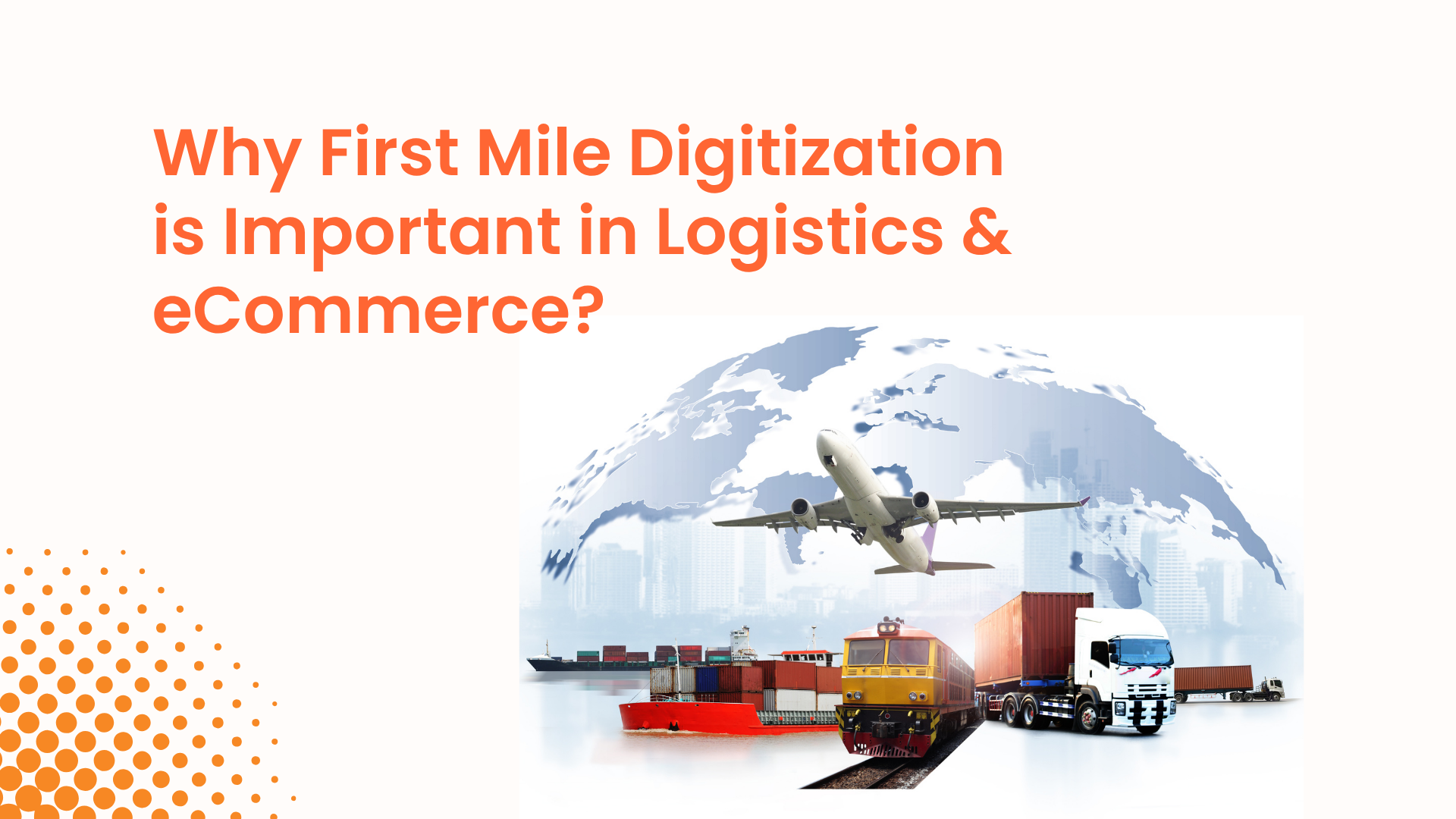
In today’s highly competitive eCommerce environment, delivery performance is no longer determined only by what happens on the road. It begins much earlier, at the moment an order is prepared, validated, packed, and handed over to the logistics network. This is where First Mile Digitization in Logistics & eCommerce becomes essential.
First-mile logistics refers to the initial stage of the supply chain where products move from a seller, warehouse, fulfillment center, or manufacturer into the transportation network. While businesses often invest heavily in last-mile delivery optimization, customer communication, and delivery tracking, the first mile frequently remains dependent on manual processes, spreadsheets, and disconnected systems.
The reality is simple: mistakes made during pickup preparation and dispatch can affect every stage of the delivery journey. An incorrect address, a missing invoice, or a mislabeled package can trigger delays, failed deliveries, increased logistics costs, and poor customer experiences. In many cases, the quality of delivery outcomes is determined before the shipment even leaves the warehouse.
As eCommerce volumes continue to rise, businesses are recognizing that digitizing first-mile operations is no longer optional. According to Globe Newswire, the global first and last mile delivery market is expected to grow significantly over the coming decade, driven by eCommerce expansion and increasing investments in logistics automation. At the same time, customers increasingly expect faster delivery timelines, real-time tracking, and error-free fulfillment experiences.
Recent Market Trends: Why the First Mile Is Gaining More Attention
Several market shifts are making first-mile efficiency a strategic priority for businesses.
The rapid growth of eCommerce has significantly increased order volumes across industries. In India, online retail continues to expand as consumers demand faster fulfillment and greater convenience. IMARC Group Reports show that same-day and next-day delivery expectations are becoming standard, forcing businesses to rethink their fulfillment and logistics operations.
At the same time, quick commerce models are reshaping customer expectations. Consumers no longer compare delivery experiences only with direct competitors. They compare them with the fastest delivery experience they have received from any brand.
This growing demand creates pressure on logistics teams to ensure that every shipment enters the delivery network accurately and quickly. Delays during order processing, dispatch preparation, or courier handover can make it nearly impossible to meet promised delivery timelines.
As a result, businesses are increasingly investing in automation, data accuracy, real-time visibility, and connected logistics systems that improve performance from the very first stage of fulfillment.
Common First-Mile Challenges That Impact Logistics Performance
The first mile may seem straightforward on the surface, but it is often where operational inefficiencies begin.
Many logistics issues that eventually appear as delivery failures, customer complaints, or return-to-origin (RTO) shipments originate during dispatch preparation.
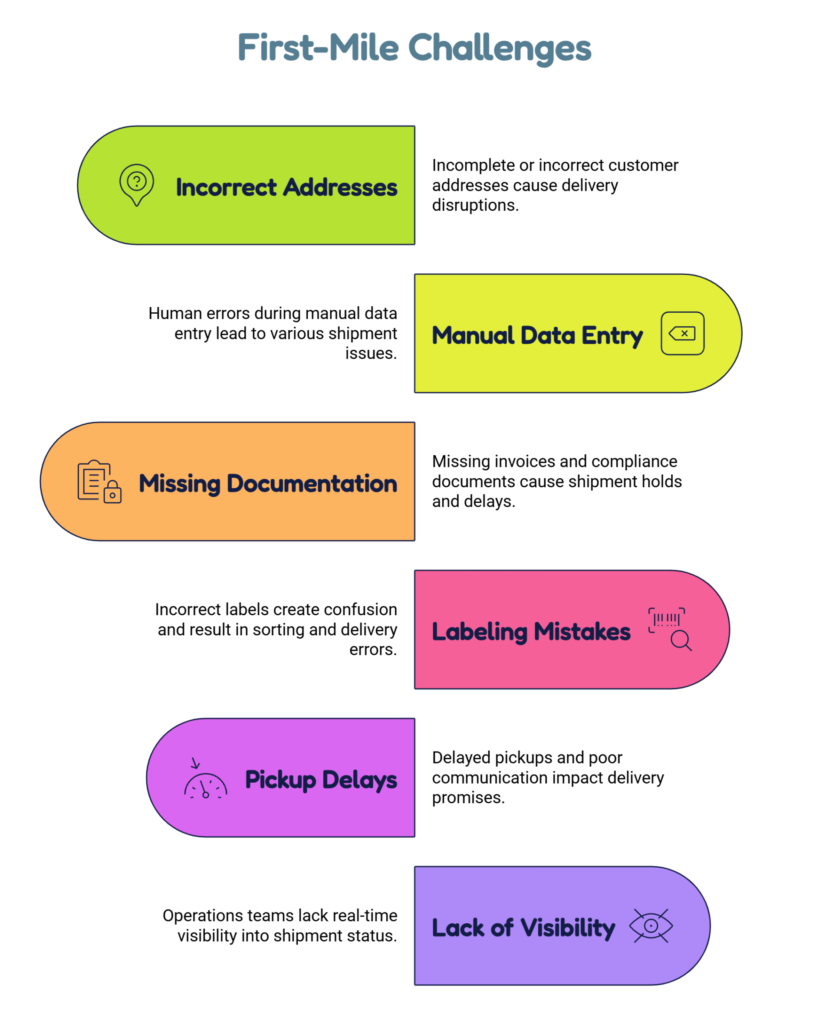
Incorrect or Incomplete Customer Addresses
Address-related errors remain one of the most common causes of delivery disruptions.
When customers enter incomplete addresses or warehouse teams manually update information incorrectly, shipments can be routed to the wrong destination. Even a small error in a PIN code can cause substantial delays.
Manual Data Entry Errors
Many businesses still rely on manual order processing and spreadsheet-based workflows.
Human errors during data entry can result in:
- Incorrect recipient information
- Wrong shipment dimensions
- Duplicate shipments
- Incorrect courier assignments
- Billing discrepancies
As order volumes increase, the likelihood of errors rises significantly.
Missing Invoice and Compliance Documentation
For interstate shipments, B2B orders, or regulated product categories, documentation accuracy is critical.
Missing invoices, e-way bills, tax documents, or compliance paperwork can lead to shipment holds, transit delays, and additional operational costs.
Shipment Labeling Mistakes
Incorrect labels can create confusion across multiple stages of transportation.
A misplaced barcode, incorrect courier label, or mismatched order information may result in:
- Sorting errors
- Delivery delays
- Shipment misrouting
- Increased handling costs
Delays in Pickup Coordination
Many businesses struggle with coordinating pickup schedules across multiple carriers.
When pickups are delayed or shipment readiness is not communicated effectively, orders remain in warehouses longer than planned, impacting delivery promises.
Lack of Shipment Readiness Visibility
Operations teams often lack real-time visibility into which orders are packed, ready for dispatch, awaiting documentation, or pending courier pickup.
Without centralized visibility, logistics managers cannot proactively identify bottlenecks before they affect delivery performance.
A Real-World Scenario
Imagine a warehouse team processing thousands of orders daily.
A customer order is entered with an incorrect PIN code during dispatch preparation. The package is labeled and shipped without verification. Several days later, the shipment reaches the wrong delivery hub. The courier attempts rerouting, resulting in additional transit time and higher shipping costs.
The customer receives the order late, contacts support multiple times, and leaves a negative review.
What appears to be a delivery issue actually originated from a simple first-mile error.
The lesson is clear: small mistakes at dispatch often create expensive problems later in the supply chain.
Why First Mile Digitization in Logistics & eCommerce Matters More Than Ever
The expectations surrounding delivery have changed dramatically over the past few years.
Customers now expect:
- Faster deliveries
- Real-time tracking
- Accurate delivery estimates
- Transparent communication
- Reliable fulfillment
Meeting these expectations requires operational precision from the moment an order is created.
Rising Customer Expectations
The growth of online shopping has raised service standards across industries.
Consumers increasingly expect same-day or next-day delivery options, particularly in urban markets. Businesses that cannot consistently meet these expectations risk losing customers to competitors.
The Need for Accurate Shipment Data
Every logistics process depends on accurate information.
When shipment data is incomplete or incorrect, downstream operations become less efficient.
Digitization helps businesses standardize and validate critical information, including:
- Customer details
- Addresses
- Product information
- Shipment dimensions
- Compliance requirements
This significantly reduces operational errors.
Real-Time Visibility Improves Decision-Making
One of the biggest advantages of digitization is visibility.
When logistics teams can track shipment readiness, pickup status, and dispatch performance in real time, they can identify issues before they become costly problems.
Real-time insights allow businesses to:
- Monitor warehouse productivity
- Reduce dispatch delays
- Improve carrier coordination
- Enhance customer communication
Automation Accelerates Order Processing
Manual processes create bottlenecks.
Digitized workflows automate routine tasks such as:
- Order synchronization
- Shipment creation
- Label generation
- Documentation management
- Courier allocation
This reduces processing times and improves operational consistency.
Reduced Delivery Failures
Many delivery failures stem from preventable first-mile errors.
Digitization improves data accuracy, standardizes workflows, and reduces manual intervention, helping businesses lower failure rates before shipments even enter transit.
Improved Customer Experience
Customers may never see what happens inside a warehouse, but they experience the results.
Accurate dispatch processes lead to:
- Faster deliveries
- Fewer shipment issues
- Better communication
- Greater trust in the brand
Better Carrier Performance
Carriers perform best when shipments are prepared accurately and handed over on time.
Digitized first-mile operations provide carriers with complete shipment information, reducing confusion and improving delivery efficiency.
As delivery expectations continue to rise, manual first-mile processes increasingly become a competitive disadvantage.
The Business Benefits of Digitizing First-Mile Operations
Beyond operational efficiency, first-mile digitization delivers measurable business value.
Organizations that modernize dispatch processes often experience improvements across cost control, customer satisfaction, and scalability.
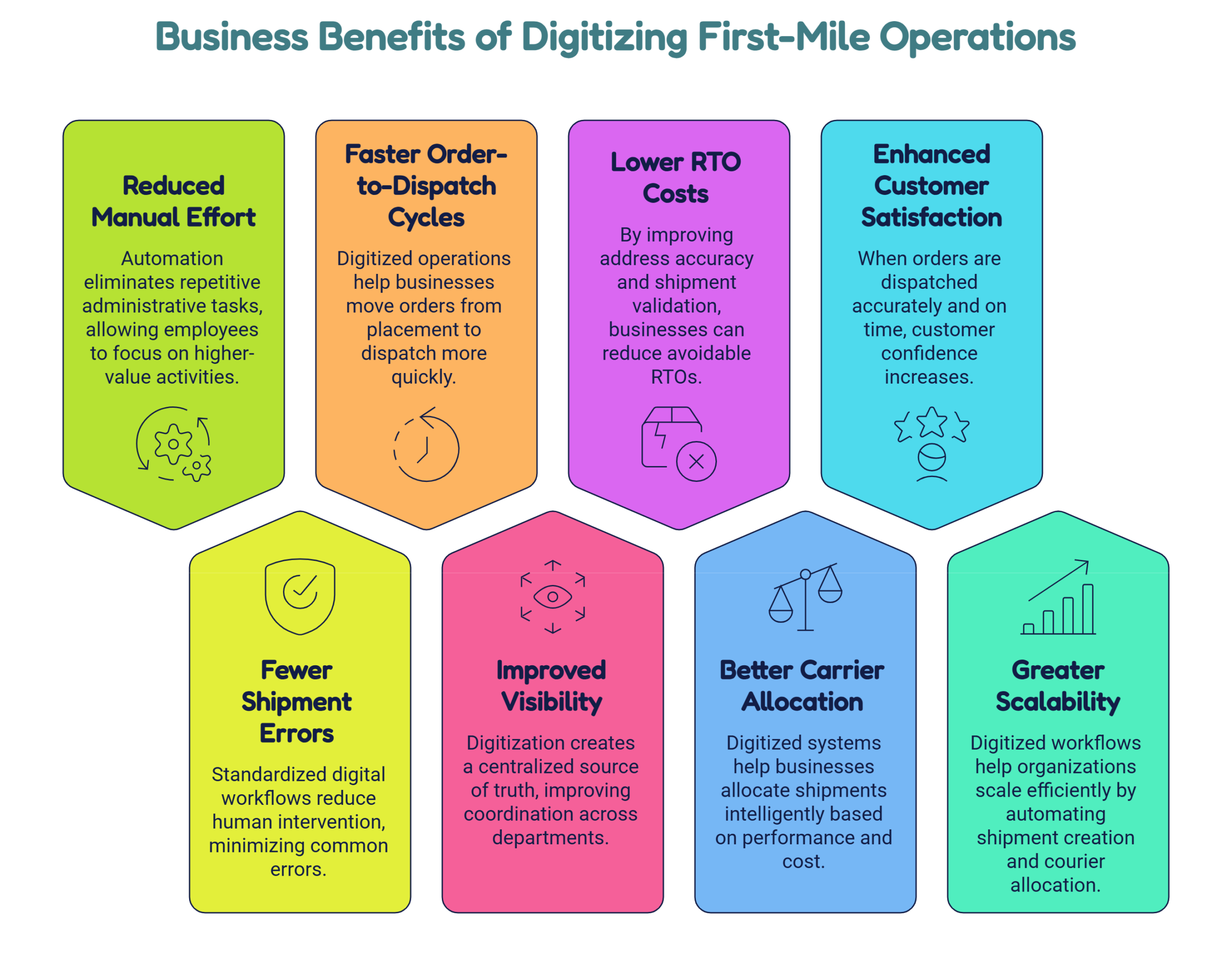
Reduced Manual Effort
Automation eliminates repetitive administrative tasks.
Instead of manually entering shipment information across multiple systems, teams can automatically synchronize order data and generate shipping documentation.
This allows employees to focus on higher-value activities.
Fewer Shipment Errors
Standardized digital workflows reduce human intervention.
This minimizes common errors such as:
- Wrong addresses
- Duplicate orders
- Incorrect labels
- Missing documentation
The result is a more reliable shipping process.
Faster Order-to-Dispatch Cycles
Speed is a major competitive advantage in eCommerce.
Digitized operations help businesses move orders from placement to dispatch more quickly by eliminating manual delays.
Faster dispatch directly supports faster deliveries.
Improved Inventory and Shipment Visibility
Digitization creates a centralized source of truth.
Warehouse teams, operations managers, customer service representatives, and logistics partners can access the same shipment information in real time.
This improves coordination across departments.
Lower Return-to-Origin (RTO) Costs
RTO shipments are expensive.
They increase transportation costs, create inventory management challenges, and negatively affect customer experience.
By improving address accuracy, shipment validation, and dispatch quality, businesses can reduce avoidable RTOs.
Better Carrier Allocation Decisions
Different carriers perform better in different regions and service categories.
Digitized systems help businesses allocate shipments intelligently based on:
- Delivery performance
- Service levels
- Cost efficiency
- Geographic coverage
This improves delivery outcomes while controlling logistics expenses.
Enhanced Customer Satisfaction
Customers value reliability.
When orders are dispatched accurately and on time, customer confidence increases.
Satisfied customers are more likely to:
- Make repeat purchases
- Recommend the brand
- Leave positive reviews
Greater Scalability During Peak Sales Periods
Peak sales events create enormous operational pressure.
Festive seasons, flash sales, and promotional campaigns can increase order volumes dramatically within a short period.
Businesses that rely on manual dispatch processes often struggle with:
- Order backlogs
- Labeling errors
- Delayed pickups
- Operational bottlenecks
Digitized workflows help organizations scale efficiently by automating shipment creation, labeling, documentation generation, and courier allocation.
Scenario Example
Consider a retailer processing 15,000 orders during a festive sales campaign.
Without automation, warehouse teams may spend hours generating labels, coordinating carriers, and validating shipment information.
With digitized first-mile operations, much of this work happens automatically. Orders are synchronized instantly, labels are generated in bulk, shipments are assigned to carriers based on predefined rules, and dispatch readiness becomes visible across teams.
The result is faster fulfillment, fewer errors, and improved customer satisfaction.
Ultimately, first-mile digitization is not simply an operational improvement. It directly influences profitability, customer retention, and long-term business growth.
Building a Connected Logistics Journey Starts at the First Mile
While first-mile digitization delivers substantial benefits on its own, the greatest impact occurs when it becomes part of a connected logistics ecosystem.
Modern logistics operations involve multiple moving parts:
- Order management
- Inventory management
- Carrier allocation
- Shipment tracking
- Delivery monitoring
- Returns management
When these systems operate independently, businesses often face data silos and process inefficiencies.
The Problem with Disconnected Systems
Many organizations use separate tools for:
- Order processing
- Warehouse management
- Shipping operations
- Customer communication
As data moves between disconnected platforms, visibility decreases and operational complexity increases.
Common consequences include:
- Duplicate data entry
- Inconsistent shipment information
- Delayed status updates
- Reduced operational transparency
Why Unified Logistics Automation Matters
Connected logistics systems enable information to flow seamlessly across every stage of fulfillment.
This creates a continuous delivery journey where:
- Orders move automatically into shipping workflows
- Carriers receive accurate shipment information
- Tracking updates remain synchronized
- Delivery performance can be monitored centrally
- Returns can be managed efficiently
The result is greater operational control and improved customer experiences.
The Future of Logistics Is End-to-End Visibility
Businesses increasingly recognize that optimization cannot happen in isolated stages.
Improving only last-mile delivery while neglecting dispatch accuracy creates limited results.
Similarly, improving warehouse efficiency without visibility into carrier performance leaves critical gaps in the customer journey.
Organizations that achieve the best logistics outcomes focus on building connected, data-driven operations from the first mile through the final delivery.
Beyond First-Mile Digitization: Creating an End-to-End Automated Logistics Ecosystem
First-mile digitization is only one part of a successful delivery strategy. As businesses scale, they need seamless coordination between order processing, courier allocation, shipment tracking, delivery monitoring, and returns management.
A unified logistics automation platform helps businesses eliminate manual processes, gain real-time visibility, and deliver consistent customer experiences across the entire shipping journey. Businesses that connect every stage of fulfillment, from first mile to last mile, are better positioned to reduce operational costs, improve delivery performance, and support long-term growth.
Explore how logistics automation can help streamline your shipping operations from dispatch to delivery.
For businesses looking to understand how a connected logistics ecosystem works, the eShipz Logistics Automation Platform provides an example of how automation, visibility, and carrier integration can support modern logistics operations.

Conclusion
The success of any delivery operation begins long before a package reaches the customer.
Accurate shipment data, streamlined dispatch workflows, proper documentation, and effective carrier coordination all originate during the first mile. When these processes remain manual, businesses expose themselves to avoidable errors, delays, and rising logistics costs.
As eCommerce continues to evolve and customer expectations continue to rise, First Mile Digitization in Logistics & eCommerce is becoming a foundational requirement for operational excellence. It enables faster order processing, reduces shipping errors, improves visibility, and creates a stronger foundation for end-to-end logistics performance.
The businesses that invest in digitizing the first mile today will be better equipped to deliver the speed, accuracy, and customer experience required to compete tomorrow.