



A customer finds a D2C kurta brand on Instagram and orders on a Friday. The fabric is excellent. The delivery is not. The courier marks her “unavailable” at 11 am without calling, tracking sits on the same status for two days, and when she asks for a return, nobody can say when the pickup will happen. She never leaves a bad review of the kurta. She just doesn’t order again. In 2027, an AI-powered logistics platform is what separates D2C brands that scale from brands that spend every sale season firefighting.
That gap grows with every order. McKinsey estimates that India’s D2C channel, worth $10 billion to $12 billion in sales today, could reach $60 billion by 2030. More orders mean more deliveries that can go wrong. This guide covers why logistics automation matters for D2C brands, the trends shaping 2027, what the software actually does, how it changes each shipping stage, and where to start.
Why an AI-Powered Logistics Platform Is Essential for D2C Brands
Picture a skincare brand running a Diwali sale. Orders triple in four days. By day six, cash-on-delivery parcels start coming back, the support inbox holds 900 “where is my order” messages, and two people on the ops team are copying courier statuses into a spreadsheet. Nobody planned for this, and nobody has time to fix it while orders keep arriving.
Most D2C logistics problems fall into three buckets.
Cost. RTO (return to origin) is the biggest leak. A returned parcel costs you forward freight, return freight and sometimes a damaged product. Choosing the wrong carrier for a pincode raises the odds of that happening, and every extra delivery attempt adds cost without adding revenue.
Customer. Shoppers expect updates without having to ask. When tracking goes quiet, a late parcel feels later. A failed attempt with no call feels careless. A return that takes three emails to arrange means the buyer won’t come back for a second order.
Capacity. Manual work grows with order count. Printing labels, booking pickups and chasing couriers across your website, Amazon and Instagram shop means hiring another person every time you add a channel.
The cost of doing nothing is hard to notice in the moment and easy to measure later. You lose repeat customers after a single bad delivery. Your margin shrinks by the cost of every avoidable RTO. Your best operations people spend their week on phone calls instead of fixing carrier performance. An AI-powered logistics platform exists to remove that repeated manual work before it compounds.
Market Trends Shaping D2C Logistics in 2027
Three numbers set the context.
- McKinsey finds D2C adoption is accelerating nearly three times faster than e-commerce marketplace growth.
- A Unicommerce report found Tier 2 and Tier 3 markets accounted for nearly two-thirds of new orders in FY2025-26. That means more unfamiliar pincodes, vaguer addresses and couriers of uneven quality.
- Data from Shipway, Unicommerce’s logistics platform, showed RTO rates of about 39% during the November 2025 festive season, falling to around 21% by February 2026. RTO swings that much with the season, so planning for peaks matters.
Six logistics trends for 2027 follow from those numbers. Together they are the logistics automation trends for 2027 that D2C operations teams are planning around.
- AI-driven carrier selection and route optimization
Instead of one default courier per brand, AI in logistics scores each shipment on pincode, weight, payment mode and past carrier performance, then assigns the carrier most likely to deliver. Route optimization applies the same scoring to pickups and last-mile planning. See how AI carrier allocation works in detail.
- Predictive RTO and NDR management
Models flag risky orders before dispatch, such as COD parcels headed to pincodes with a history of refusals. After a failed attempt, the NDR (non-delivery report) workflow starts within minutes. A common target is resolving an NDR within 24 to 48 hours. Here is a closer look at how to reduce RTO with AI.
- Conversational automation: AI voice and WhatsApp agents
Voice bots call customers right after a failed attempt, confirm availability and capture a new time, address or alternate number. WhatsApp flows do the same by text. Both replace the manual call queue that slows down NDR follow-up.
- Branded post-purchase experience
Tracking pages with the brand’s logo, colors and offers keep customers on the brand’s own pages instead of a courier site. Proactive SMS and WhatsApp updates answer “where is my order” before anyone types it.
- Unified multi-carrier, multi-channel platforms
D2C brands sell on their own site, marketplaces and quick commerce at the same time. The direction for 2027 is one AI-powered logistics platform that takes orders from every channel and ships through any courier, instead of a separate tool for each carrier.
- Reverse logistics as a competitive edge
Fashion and beauty see high return volumes. Automated pickups, quality checks and refund triggers make returns quick, and a fast return makes a first-time buyer more willing to order again.
Logistics is moving from reactive to predictive.
What Does an AI-Powered Logistics Platform Actually Do?
An AI-powered logistics platform is one system that connects your sales channels, your courier partners and your customers, and automates the shipping decisions between them. People still set the rules. The software handles the repeat work and flags only the exceptions that need a human. On a good AI-powered logistics platform, you decide the policy once and it applies to every order.
Core capabilities:
- Order sync from stores and marketplaces
- Bulk label and manifest generation
- Smart carrier allocation
- Real-time tracking across couriers
- NDR and returns management
- Analytics on cost, speed and carrier performance
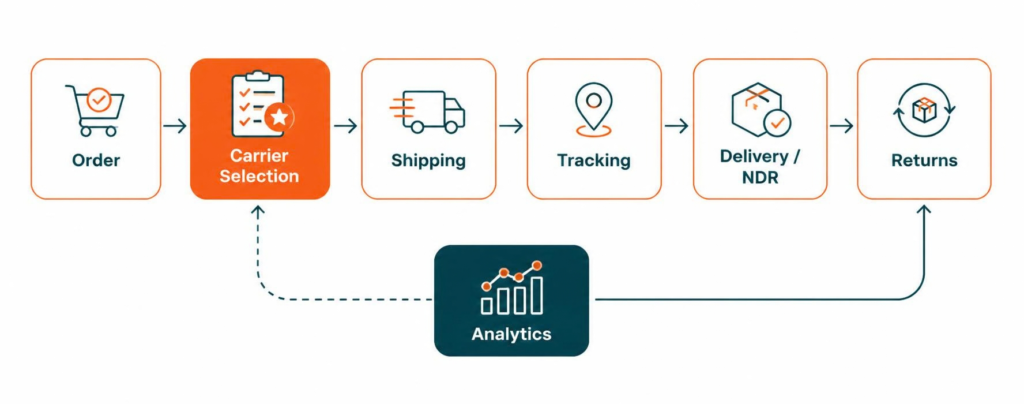
That loop is the point. Delivery and return data goes back into carrier selection, so a courier that struggles on a route gets fewer parcels on it next week.
How Automation Reshapes the Shipping Lifecycle
With an AI-powered logistics platform in place, each of the six stages changes in the same way: manual effort goes down and decisions get faster.
- Order processing
Before: staff download orders from each channel and key them into courier portals.
With automation: orders sync from every store, and labels, AWBs and manifests generate in bulk.
Outcome: large order batches ship the same day with fewer typing errors.
- Carrier selection
Before: one default courier, or a person picks from memory.
With automation: rules and AI score carriers on cost, speed, serviceability and RTO history.
Outcome: lower freight cost and better delivery rates on difficult pincodes.
- Tracking and communication
Before: support agents check courier sites and paste updates into replies.
With automation: status changes trigger branded tracking links and SMS or WhatsApp messages.
Outcome: fewer WISMO (where is my order) tickets.
- NDR
Before: an agent calls the customer, waits, calls again, then emails the courier. That is three manual calls for one parcel.
With automation: an AI voice agent calls within minutes of the failed attempt, records the re-attempt, address change or cancellation, and passes it to the courier automatically.
Outcome: the parcel is rescheduled the same day instead of waiting two days for someone to get to it.
- Returns
Before: the customer emails for a return and ops books a pickup by hand.
With automation: a return request creates a reverse shipment, picks a carrier and updates the customer.
Outcome: faster pickups and faster refunds.
- Analytics
Before: monthly spreadsheets built from courier reports.
With automation: live dashboards show RTO, delivery time and cost by carrier and pincode.
Outcome: carrier decisions happen weekly instead of after the quarter closes.
| Stage | Manual process | Automated process |
| Order processing | Copy orders into portals | Auto sync, bulk labels |
| Carrier selection | One default courier | Scored per shipment |
| Tracking | Agents check and reply | Proactive branded updates |
| NDR | Repeated manual calls | AI voice agent, same-day action |
| Returns | Email and manual booking | Auto reverse shipment |
| Analytics | Monthly spreadsheets | Live dashboards |
Key Benefits and Outcomes for D2C Brands
- Lower RTO and fewer lost orders. Early NDR contact and risk-based carrier choice recover parcels that would otherwise go back to the warehouse.
- Lower shipping cost. Allocation based on pincode performance cuts re-attempts and return freight.
- Less manual effort. Bulk labels and manifests turn a morning of data entry into a few minutes.
- Fewer “where is my order” tickets. Proactive messages answer the question before the customer asks it.
- Better customer experience and repeat purchases. Predictable delivery and an easy return are what bring people back for a second order.
- Room for sale-season spikes. The same rules process 500 orders or 5,000 without adding people to the ops team.
Where Can You Start? A Practical Roadmap
- Audit your current logistics. Pull the last 90 days and note RTO %, average delivery time, cost per shipment and NDR resolution rate. You can’t improve what you haven’t measured.
- Find your biggest leak. Is it failed deliveries, freight cost, support load or returns? Pick one. Fixing a single leak first gives you a result you can show your team.
- Centralize first. Connect your store and couriers in one platform before automating anything. Automation on top of scattered tools just moves the mess around.
- Automate the repetitive work. Start with labels, manifests, tracking updates and NDR follow-ups. These run daily and rarely need judgment.
- Measure and iterate. Review carrier performance every month and shift volume toward the couriers that deliver.
Track these five metrics from day one:
| Metric | What it tells you | How to calculate |
| RTO % | How many parcels come back | RTO shipments ÷ total shipped |
| NDR resolution rate | How many failed deliveries you recover | Delivered after NDR ÷ total NDR |
| Cost per shipment | Your real freight cost, returns included | Total shipping spend ÷ shipments |
| Delivery time | Speed from dispatch to doorstep | Average days per shipment |
| WISMO tickets | Gaps in customer communication | Tickets per 100 orders |
Common mistakes: automating everything at once, which makes it hard to see what worked, and choosing an AI-powered logistics platform with limited carrier coverage, which caps how much routing can improve.
How eShipz Powers AI-Driven Logistics for D2C Brands
eShipz is a Bengaluru-based shipping automation and logistics intelligence platform for eCommerce brands, retailers and 3PLs. We built it around the problems this guide describes: failed deliveries, guesswork in carrier choice and manual follow-ups. Here is what D2C brands use us for.
- Multi-carrier integration. Ship through 400+ carriers from one dashboard, and move volume away from a courier that slips without renegotiating anything.
- Automated workflows. Orders sync from your store, and bulk labels, AWBs and manifests generate without manual entry.
- Real-time tracking. Branded tracking pages with SMS and WhatsApp notifications keep customers informed and cut WISMO tickets.
- NDR management with an AI Voice Agent. The agent calls customers on failed deliveries and captures a re-attempt request, address change, cancellation or alternate number.
- Returns management. Forward and reverse shipments sit in one place, so a return is booked and tracked like any other order.
- IntelliProof ePOD. AI-driven proof of delivery speeds up invoicing and gives you evidence when a delivery is disputed.
- Route and carrier optimization. Analytics show which carriers perform on which routes, and allocation follows the results.
- Integrations. Shopify, Unicommerce, ERPNext and APIs connect the tools you already run.
Onboarding takes three steps: Connect store and couriers → Set automation rules → Track and optimize.
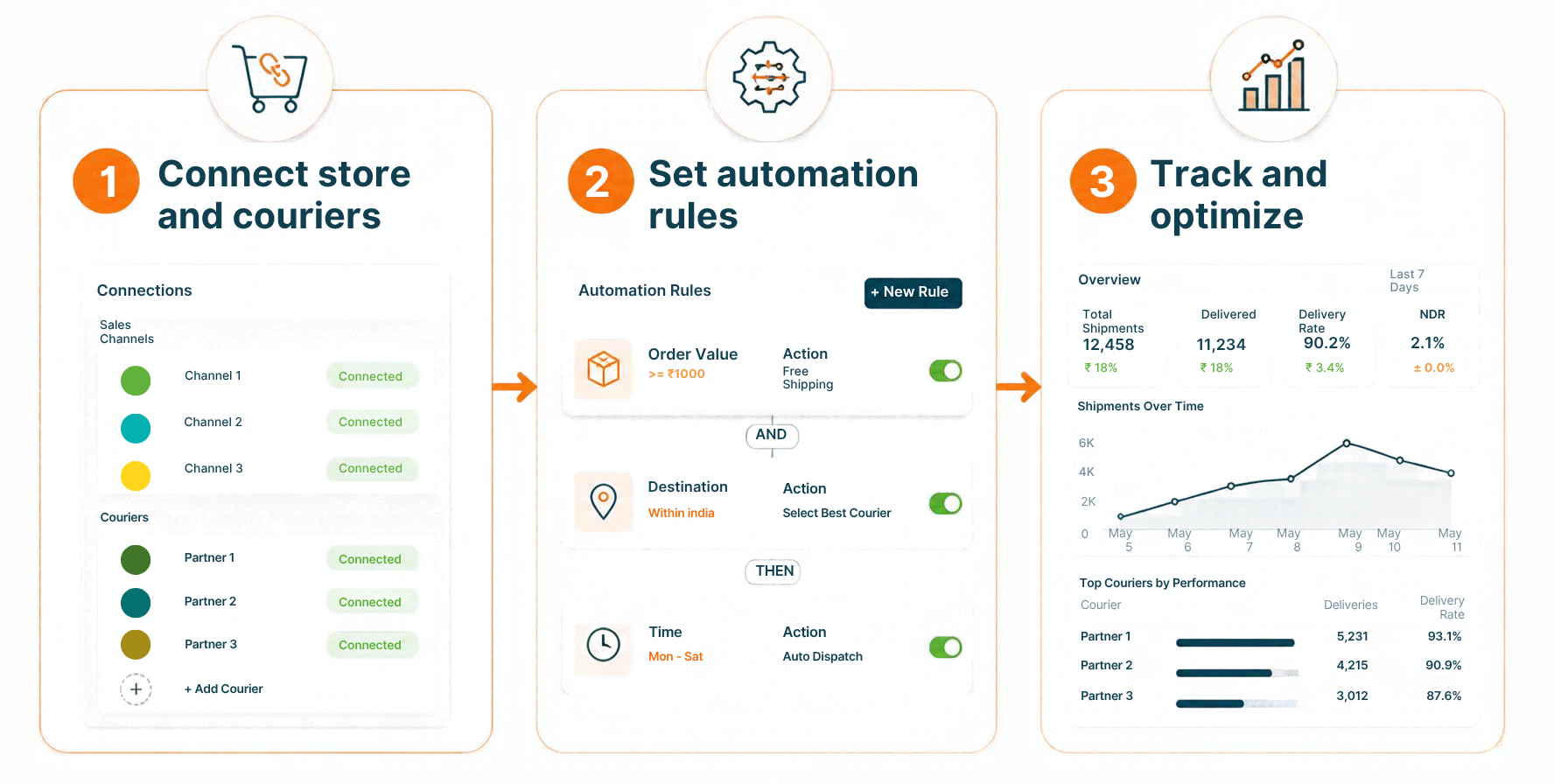
The aim is simple: lower RTO, lower cost per shipment, and a delivery experience customers remember for the right reasons. Brands keep control of the rules while the platform handles the volume.
The Future: Logistics in 2027 and Beyond
Expect more prediction and less reaction. Platforms will estimate delivery risk at checkout, suggest the right delivery option for each customer, and show ops teams which pincodes need attention before the next sale starts. Logistics will be run as a growth function with its own targets and weekly reviews. Brands that adopt an AI-powered logistics platform early will hold a cost and experience advantage while others are still building manual workarounds.
Conclusion
Automation is now a requirement for D2C logistics. The trends for 2027 point to AI-led operations, from carrier selection to NDR calls, and starting with one leak and one platform beats waiting for a perfect plan. An AI-powered logistics platform gives a small team the reach of a much larger one.
Ready to cut RTO and automate your shipping? Book a demo with eShipz.
FAQs
- What is an AI-powered logistics platform?
It is software that connects your sales channels, couriers and customers, and uses AI to automate carrier selection, tracking, NDR handling and returns. You set the rules, and it runs them on every shipment.
- How does automation reduce RTO for D2C brands?
It acts at two points. Before dispatch, it flags risky orders and picks the carrier most likely to deliver. After a failed attempt, it contacts the customer within minutes to reschedule, correct the address or cancel.
- Do I need technical skills to set up shipping automation?
No. Most setup is connecting your store and couriers, then choosing rules such as which carrier to use for which pincode. Developers are only needed if you want custom API work.
- Can I use multiple couriers on one platform?
Yes. A multi-carrier setup lets you compare couriers on cost, speed and delivery rate, and shift volume without changing your workflow.
- How long does onboarding with eShipz take?
Onboarding follows three steps: connect your store and couriers, set automation rules, then track and optimize. [Confirm the typical timeline with the eShipz team before publishing.]
- Is an AI-powered logistics platform only for large brands?
No. Small D2C brands often gain the most, because a few hundred orders a day already creates more NDR calls and tracking questions than one person can handle.
- Which logistics trends will matter most for D2C brands in 2027?
Predictive RTO management, AI voice and WhatsApp follow-ups, carrier selection based on delivery performance, branded tracking, and automated returns.