




Learning how to pack toys for shipping is trickier than it looks, because toys vary so widely in size, shape, material, and fragility. A plush bear, a die-cast car, a puzzle, and a battery powered drone all pass through the same conveyor belts and delivery vans, yet each needs a different packing approach. Treat them all the same way and you end up with scratched paint, snapped accessories, crushed boxes, missing pieces, or a toy that will not turn on when it arrives.
These are not rare accidents. A survey by DS Smith and The Harris Poll found that 60 percent of Americans said they had received a damaged package from an online retailer in the past year, with roughly 700 million packages arriving damaged in the US alone. Toys, with their odd shapes, small parts, and mix of plastic, fabric, wood, and electronics, sit right in that risk zone.
This Ultimate Guide to Packing Toys for Shipping, By Type, breaks packing down by category instead of treating “toys” as one single group. Once you match the packaging to the product, you cut damage, lower returns, and give customers an unboxing experience that matches what they paid for. Consumers now expect the same care from a shipped parcel that they would get walking out of a toy store, and packaging has quietly become part of the product experience rather than an afterthought.
Understanding the Biggest Challenges of Shipping Toys
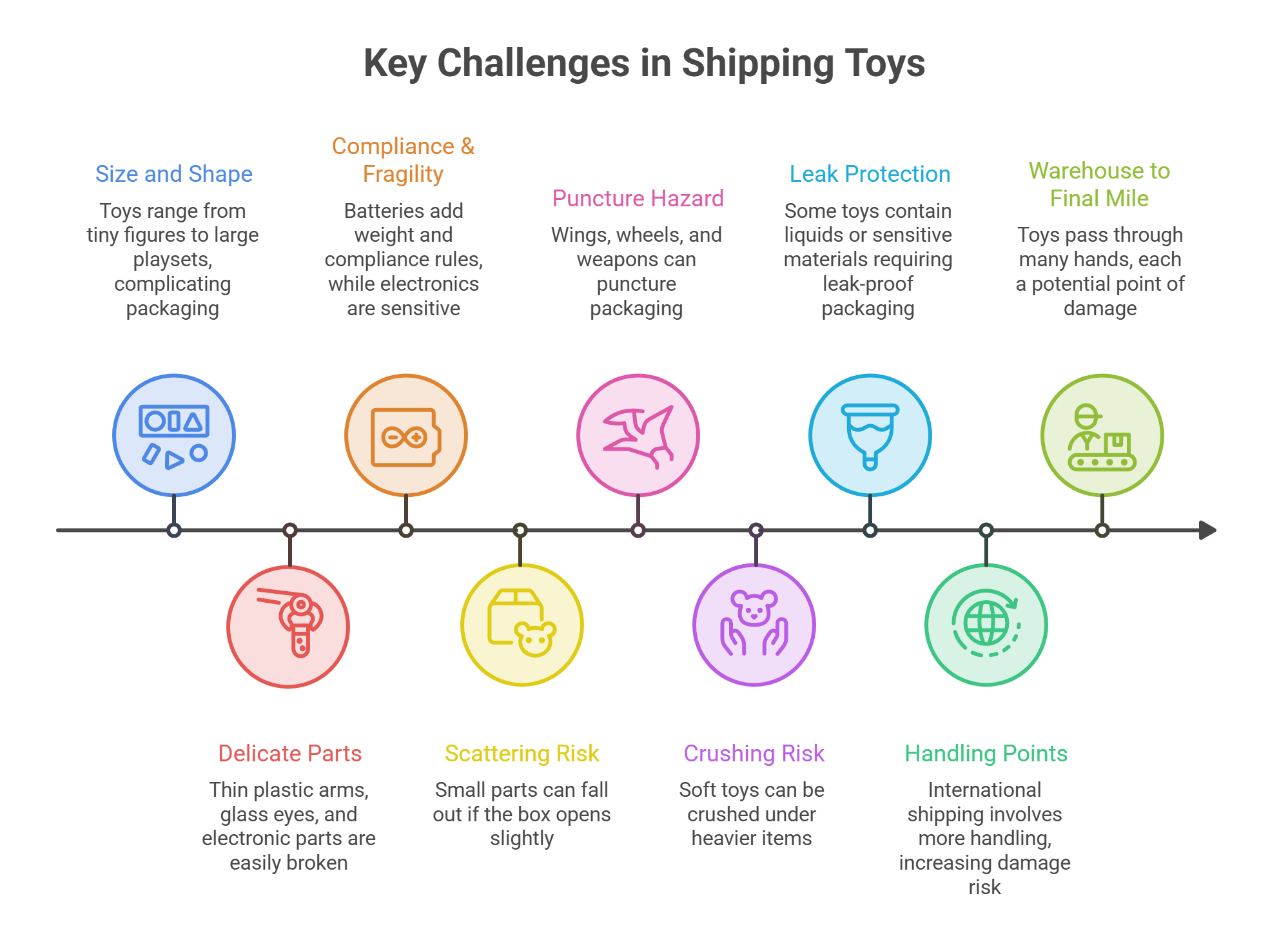
Before choosing packaging, it helps to know what can actually go wrong in transit. Toy shipments combine several risks that most other product categories do not face all at once:
- Wide variation in size and shape across a single catalog
- Fragile components such as thin plastic arms or glass eyes
- Electronic and battery powered parts that add fragility and compliance rules
- Small detachable pieces that can scatter if a box opens slightly
- Sharp edges or protruding parts like wings, wheels, or weapons
- Compressible soft toys that can be crushed under heavier boxes
- Liquid or sensitive fill material that needs leak protection
- Long-distance and international transit with more handling points
- Multiple touchpoints, from warehouse to hub to final mile courier
Online toy sales have grown steadily as more parents and collectors buy directly from brand websites and marketplaces instead of visiting a store, which means toys are now shipped individually far more often than before. Knowing which of these risks applies to your product is step one before picking packaging.
The Golden Rules of Packing Toys for Shipping
A few universal principles apply no matter what you are shipping:
- Choose the right sized outer box, not too big or too small
- Prevent internal movement with filler, inserts, or dividers
- Protect fragile components individually before boxing
- Separate loose or detachable pieces into sealed bags
- Add cushioning where impact is likely
- Guard against moisture with poly bags or liners
- Seal the package securely on every seam
- Label correctly, including fragile or battery related markings
- Test packaging before shipping at scale
Keep these as a baseline checklist, then layer on the type-specific advice below.
How to Pack Different Types of Toys for Shipping
This section is the core of the Ultimate Guide to Packing Toys for Shipping, By Type.
Plush Toys and Stuffed Animals
Make sure the toy is clean and completely dry before packing, since anything damp can develop mildew in transit. Place it in a protective poly bag, and gently remove excess air if the toy can safely be compressed. Use a sturdy corrugated box or shipping mailer sized close to its dimensions, and add light cushioning around any delicate accessories like bows or glasses. Avoid squeezing the toy into an undersized box, since permanent creasing can affect how it looks on arrival. Minimal, right-sized packaging works well here since plush items rarely need heavy protection.
Plastic and Action Figures
Keep figures in their original packaging when possible, since manufacturers design inserts specifically to hold them still. Otherwise, wrap each figure individually, paying attention to thin parts like arms, weapons, or stands that can snap. Fill empty space inside the box so figures cannot slide or collide, since even a short drop can chip paint or break a joint.
Dolls and Doll Accessories
Protect the doll’s face and painted details with a soft wrap, and keep hair and clothing free of pressure points. Store accessories, shoes, and outfits in a separate sealed bag rather than loose, since these pieces frequently go missing when they shift. If the doll has its own retail box, wrap that box before placing it in the shipping carton, then add cushioning on all sides. Presentation matters more here since dolls are often bought as gifts.
Board Games and Puzzles
Game boxes are easy to crush or tear, especially thin lids. Keep the box upright where possible, and use stretch wrap or light film to hold the lid closed without damaging the artwork. Add cushioning around all sides inside a strong, appropriately sized carton, and avoid gaps that let the box slide and crush against the outer walls. For puzzles, make sure the inner bag of pieces is sealed and centered.
Electronic and Battery-Operated Toys
Turn the toy off before packing so buttons are not triggered in transit, and follow applicable battery shipping requirements, particularly for lithium batteries. Use the manufacturer’s original packaging when available, cushion generously around screens or ports, and add light moisture protection. Our guide on the best way to ship consumer electronics safely covers cushioning and carrier compliance that also applies to electronic toys.
Remote-Controlled Cars, Drones, and Vehicles
Secure moving parts before packing, and remove detachable pieces like propellers, antennas, or controllers so they cannot snap off. Pack the controller separately with its own cushioning, and wrap wheels and antennas individually if they protrude. Pay particular attention to battery requirements, since these toys commonly use lithium batteries with specific shipping rules.
Building Blocks and Construction Sets
The biggest risk here is incompleteness, not breakage. Keep bags of pieces sealed and organized by their original grouping, and protect the printed retail box the same way you would a board game box. Prevent inner bags from shifting, since movement is usually what tears open a seam. Use an appropriately sized outer box rather than an oversized one.
Wooden Toys
Wrap wooden surfaces to prevent scratches, and add extra protection at corners where chipping is most likely. If shipping multiple pieces together, add cushioning between them so they do not knock against each other. Wood is sensitive to moisture, so a barrier layer is worth the small extra cost, and a rigid outer carton gives the structural support these heavier items need.
Ride-On Toys and Large Toys
Disassemble any parts that can be safely removed, and protect exposed components like wheels, handles, and seats with padding or corner guards. Use reinforced, heavy-duty cartons built for the product’s weight, and secure the toy so it cannot shift, since a large object moving even slightly can cause structural damage. For very large or bulk shipments, palletization is worth considering.
Collectible and Premium Toys
Treat the retail box as part of the product’s value, using protective sleeves or shrink wrap to guard against scuffs. Add corner protection before placing it in the outer carton, and consider double-boxing high-value items to buffer the retail packaging from the outside world. Avoid materials that could scratch printed or glossy surfaces, since collectors often consider even minor cosmetic damage unacceptable.
Choosing the Right Packaging Materials
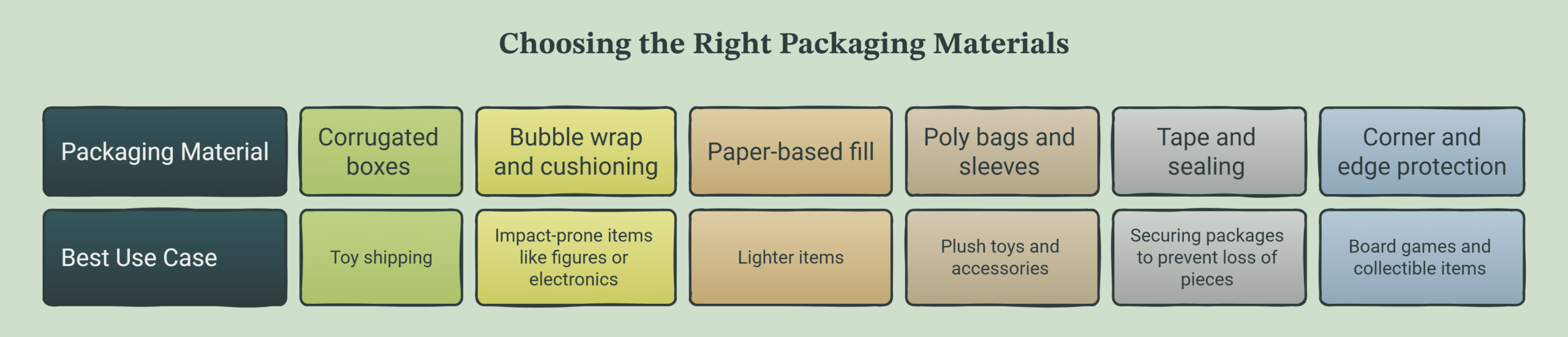
Corrugated boxes remain the backbone of toy shipping, with strength and sizing directly affecting protection. Bubble wrap and cushioning suit impact-prone items like figures or electronics but can be overkill for softer toys. Paper-based fill, including kraft paper and molded pulp, works well for lighter items and aligns with the shift toward recyclable materials. Poly bags and sleeves protect plush toys and accessories from moisture and dust. Tape and sealing matter more than sellers often realize, since a package that opens even slightly is far more likely to lose pieces. Corner and edge protection is especially useful for board games and collectible items with a retail box worth preserving.
There is a broader industry shift toward recyclable, lightweight, right-sized packaging across every product type. Our guide to ecommerce packaging by product category covers how these same principles apply beyond toys.
How to Choose the Right Box Size
Box size sits at the center of the relationship between toy dimensions, cushioning, void space, and cost. An oversized box lets the product shift and collide with the walls, increasing damage risk. An undersized box can crush contents or force seams to bulge. Right-sized packaging also affects dimensional weight, which many carriers use for pricing, meaning excess air inside a box often costs more to ship, not less. Using inserts or dividers to hold the toy in place lets you use a smaller outer box while keeping it secure.
Sustainable Toy Packaging: What Is Changing
Sustainability has moved from a nice-to-have to an expectation in ecommerce, and toys are part of that shift. Trends worth tracking include recyclable corrugated and paper materials replacing single-use plastic fill, reduced plastic in wraps and void fill, right-sized packaging that avoids excess volume, reusable formats for repeat customers, lightweight materials that cut both weight and footprint, and minimalist design that communicates a brand’s values.
The important caveat is that sustainability should never come at the cost of protection. A lighter box that lets a toy arrive broken creates a worse outcome than a slightly heavier box that protects it the first time, since a damaged item usually needs to be replaced and reshipped entirely.
How Packaging Affects Shipping Costs
Package dimensions and weight feed directly into carrier pricing, especially through dimensional weight calculations that penalize oversized boxes regardless of actual product weight. Excess void fill adds bulk without adding protection, and multiple-box shipments for one order add unnecessary handling fees. The cheapest packaging material is not always the cheapest packaging solution. A slightly more protective box can be more economical overall if it meaningfully cuts damage claims, replacements, and returns.
Common Toy Packing Mistakes to Avoid
- Using an oversized box that allows too much movement
- Leaving empty space without adding filler
- Applying insufficient cushioning around fragile parts
- Overpacking, which wastes material and raises dimensional weight
- Ignoring detachable components that can snap off
- Failing to protect the original retail box on premium items
- Using weak or undersized cartons for heavy toys
- Ignoring battery shipping requirements
- Poor sealing that leaves boxes vulnerable to opening
- Skipping packaging tests before shipping at scale
How to Test Toy Packaging Before Shipping at Scale
A package that looks secure on a table can behave differently once dropped, stacked, or shaken during real transit. Before rolling out a method across thousands of shipments, run it through a few checks: drop testing from a realistic height, compression testing under stacked weight, vibration testing to mimic truck and conveyor movement, shake testing to see whether contents move, moisture exposure checks for sensitive products, and a post-test inspection to confirm nothing shifted or cracked. For high-volume shippers, referencing recognized packaging test standards helps formalize this process before it turns into a wave of complaints.
The Business Benefits of Getting Toy Packaging Right
Getting this right pays off in several connected ways: fewer damaged products because packaging matches the actual risk profile, lower returns and replacement costs, a better customer experience with toys arriving as expected, stronger brand reputation through consistent quality, improved sustainability through right-sized materials, and more efficient fulfillment through standardized, type-specific packing.
Toy Shipping Packaging Checklist
- Is the toy clean and dry?
- Are loose parts secured or bagged separately?
- Is the toy protected against impact?
- Is the retail packaging itself protected, where relevant?
- Is there unnecessary empty space inside the box?
- Is the outer box strong enough for the weight and shape?
- Is the package sealed securely on all seams?
- Are battery requirements addressed, if applicable?
- Is the packaging suitable for the shipping distance?
- Can unnecessary material be removed without losing protection?
- Has this packaging been tested before shipping at scale?

Pack for the Journey, Not Just the Toy
A stuffed animal, a collectible figure, a battery powered vehicle, a board game, and a large ride-on toy all face different risks in transit, so none of them should get the same generic box. Getting this right consistently means fewer damages, lower replacement costs, a better customer experience, and a stronger brand reputation over time.
As ecommerce keeps shaping how toys are bought and delivered, packaging will keep needing to balance protection, cost, sustainability, and the unboxing moment customers expect. That is the real takeaway from this Ultimate Guide to Packing Toys for Shipping, By Type: match the box to the toy, test before you scale, and the rest of the shipping process gets noticeably easier to manage.
Frequently Asked Questions
- What is the best way to pack toys for shipping?
It depends on the toy type, but the universal approach involves a right-sized corrugated box, cushioning around fragile or protruding parts, sealed bags for loose accessories, and enough filler to prevent movement. Matching the method to the specific toy category gives the most reliable results. - How do I pack fragile toys for shipping?
Wrap fragile components individually, keep them separated from harder items in the same box, and fill remaining void space so nothing can shift. Corner protection helps for toys with thin plastic parts or printed retail packaging. - Can I ship toys with batteries?
Yes, but battery-operated toys often carry specific requirements depending on battery type and carrier, particularly for lithium batteries. Turn the toy off before packing, protect the battery compartment, and check current carrier guidelines before dispatching electronic or remote-controlled toys. - What packaging materials work best for toy shipping?
Corrugated boxes form the structural base, while bubble wrap, paper cushioning, poly bags, and corner protectors handle specific risks like impact, moisture, and scuffing. The right combination depends on the toy’s fragility and whether the retail box needs preserving. - How do I choose the right box size for toys?
Choose a box that closely matches the toy’s dimensions once cushioning is included, since oversized and undersized boxes both raise damage risk. Right-sized boxes also reduce dimensional weight charges, lowering shipping cost. - Do I need special packaging for international toy shipping?
International shipments face more handling points and longer transit, so extra cushioning, moisture protection, and secure sealing matter even more. Battery-powered toys may also face added documentation depending on the destination country. - How can I reduce toy shipping damage and returns?
Start with type-specific packing methods, adequate cushioning, and right-sized boxes, then test packaging under real conditions like drops and stacking before scaling up. Consistency across every toy category is what actually reduces returns over time.