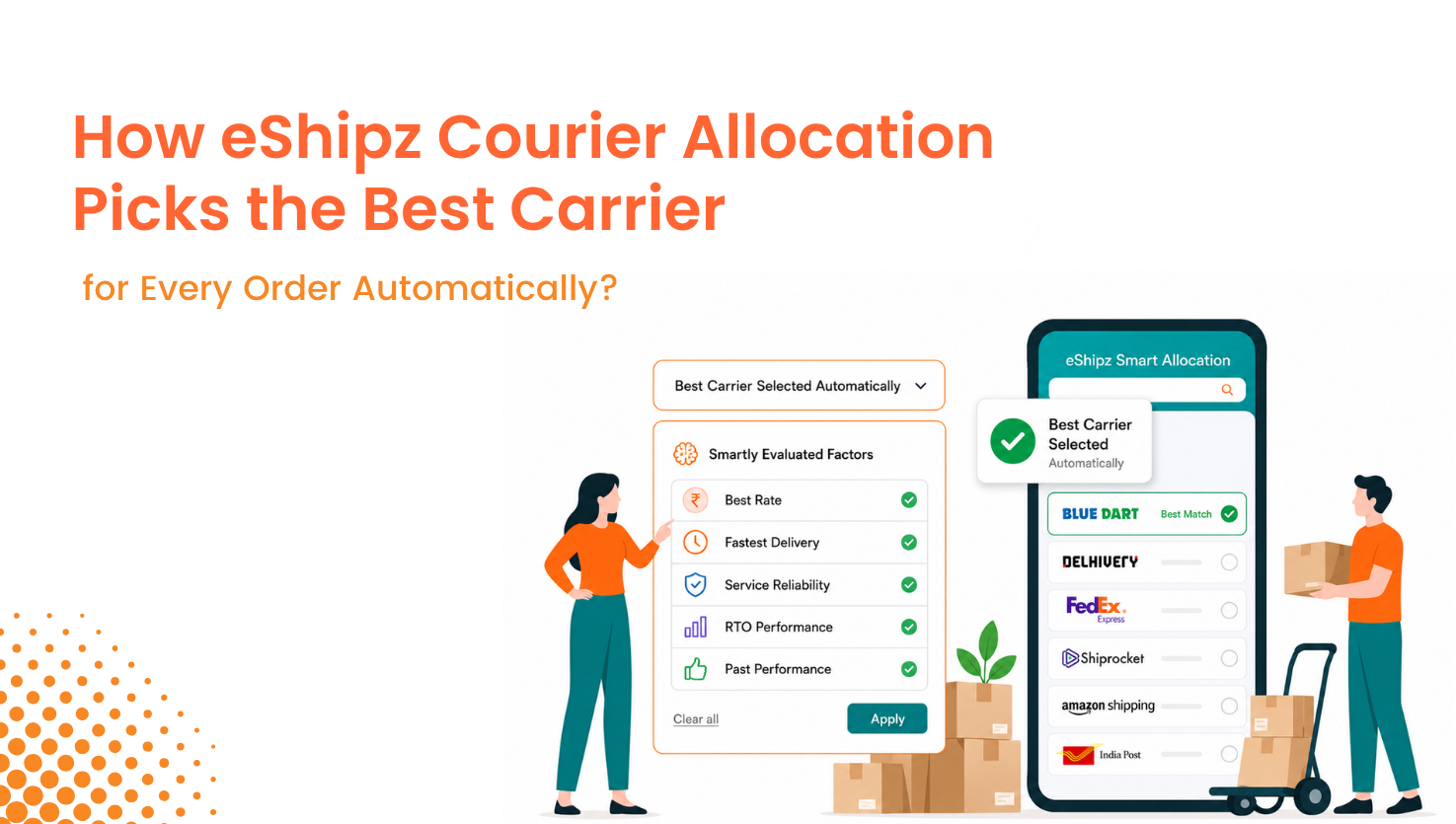







It is festive sale week. Your only courier skips two days of pickups, announces a fuel surcharge, and marks a block of Tier 2 pincodes as non-serviceable. Parcels stack up at the dock, support tickets multiply, and you have no second carrier to call. Multi-carrier shipping is the fix for exactly this situation.
2026 is almost over, and brands are now planning their 2027 logistics. That makes this the right moment to deal with carrier dependency, before the next peak exposes it again. This guide covers why diversification matters, the market trends behind it, the benefits, a step-by-step method, a 30-60-90 day starting plan, and how eShipz runs it day to day.
What Is Multi-Carrier Shipping and Carrier Diversification?
Multi-carrier shipping means using several courier and logistics partners through one unified workflow, instead of sending every order through a single company. You keep one order system, one label flow, and one tracking view, with many carriers behind it.
Carrier diversification is the strategy that decides how volume gets divided. You spread shipments by zone, service type, weight band, and payment mode (prepaid or COD). A 300 g prepaid parcel to Pune and a 12 kg COD parcel to a Tier 3 town should not default to the same courier.
How you run it matters as much as the idea. Managing carriers by hand means rate cards in spreadsheets, five courier portals, and a person picking a partner for each order. Errors creep in: wrong AWBs, missed NDRs, duplicate bookings. Multi carrier shipping software replaces that with rules that assign the carrier, print labels and manifests together, and feed tracking into one screen. The manual method strains at a few hundred orders a day. The platform method keeps working as volume grows.
| Factor | Single carrier | Multi-carrier |
| Risk | One outage or strike halts all orders | Volume shifts to another partner |
| Cost | You accept their rate revisions | Quotes are compared, split volume gives bargaining power |
| Coverage | Gaps in some pincodes | Best carrier per pincode |
| Flexibility | One service menu | Mix of express, surface, and hyperlocal |
| Visibility | One portal, one partial view | One dashboard across all partners |
Why Carrier Diversification Is Essential Going Into 2027
Relying on one courier feels simple until it stops being simple. Six things push brands toward diversification.
Concentration risk. One carrier’s strike, system outage, or capacity crunch stops your entire order flow. If 90% of your volume sits with one partner, 90% of your revenue waits when they stall.
Peak-season pressure. Festive and sale periods bring surcharges, late pickups, and delivery failures. Carriers ration capacity, and a brand with a single contract gets whatever is left.
Uneven serviceability. No carrier is best in every pincode. One is strong in metros and weak in the Northeast. Another reaches remote districts but is slow in Mumbai. Tier 2, Tier 3, and remote areas need different partners.
Rate and negotiation power. Locked into one carrier, you accept every rate revision they send. Split volume across partners and you can compare quotes and push back with real numbers.
RTO and NDR leakage. A weak carrier in a given region raises your return-to-origin and failed-delivery costs directly. You pay forward freight, return freight, and sometimes lose the product’s resale value.
Customer expectations. Shoppers judge your brand for a late parcel and rarely remember the courier’s name. Your reviews absorb the result of a decision made in a rate negotiation.
In 2027, resilience will matter more than the lowest rate.

Market Trends Shaping Carrier Strategy in 2026 to 2027
Growth is moving to smaller cities. India’s online retail market reached roughly US$80 billion in FY26, up 21% year on year, with quick commerce and Tier II and III cities driving much of that growth, according to IBEF. More orders to smaller towns means more pincodes where one carrier’s coverage runs thin, so multi-carrier shipping is no longer a metro-only concern.
Faster promises. Quick commerce has taught shoppers in the top cities to expect delivery in hours. Brands shipping nationally feel pressure to tighten delivery times, which is hard when a single carrier sets the pace.
AI courier allocation is becoming expected. Choosing a courier by cost, serviceability, and recent performance used to be a selling point. Buyers now assume it.
Visibility is standard. Live tracking, estimated delivery dates, and automated NDR messages are baseline features. Shoppers get annoyed when they have to ask where their parcel is.
Cost pressure. India’s logistics cost was about 7.97% of GDP in FY24, according to a DPIIT and NCAER study cited in the Economic Survey 2025-26, down from 8.84% in FY23. The national figure is falling, but a D2C brand’s own freight bill still sits near the top of its cost list, so freight audit and billing accuracy get more attention.
Returns are a bigger share of the work. Unicommerce’s April 2026 D2C report, built on 410 million shipments from 6,000+ brands, found COD returns ran at 58% in the festive quarter, with RTO passing one in three orders at the peak. Fashion and electronics feel this most, which is why reverse logistics now sits beside forward shipping in planning.
API-first stacks. Storefronts, ERP, OMS, WMS, and carriers are expected to connect through APIs, so a new carrier can be added without rebuilding anything.
The 2027 outlook. Brands will move from using multiple carriers to running carrier orchestration on live performance data: rules and models that decide, shipment by shipment, who carries what.
Benefits and Outcomes of Carrier Diversification
Each benefit below maps to a number you already track.
- Higher delivery success. Pick the best-performing carrier for each pincode instead of the one with the nicest rate card.
- Lower RTO and NDR. Route risky orders and COD shipments to carriers that deliver them best in that region.
- Lower shipping cost. Rate-based allocation and a stronger negotiating position help you reduce shipping costs. Moving a heavy lane to a cheaper partner is how brands minimize shipping costs without cutting service.
- Business continuity. If one carrier fails, volume shifts to another fast.
- Faster delivery and better CX. Accurate delivery dates and fewer delays lead to repeat purchases.
- Visibility and control. One dashboard replaces ten carrier portals.
- Less manual work. Labels, manifests, and tracking updates are generated automatically.
Here is what that looks like before and after (qualitative):
| Area | Before | After |
| Carrier choice | One default courier, or a person picks from memory | Rules pick per shipment |
| Carrier outage | Orders wait | Volume reroutes |
| COD in remote pincodes | High failure, high RTO | Sent to the carrier that performs there |
| Tracking | Five portals | One dashboard |
| Billing | Disputes found late or never | Audited against rate cards |
| Peak season | Scramble | Pre-agreed backup carriers |
How to Build a Multi-Carrier Shipping Strategy (Step by Step)
- Audit current performance. Pull delivery rate, TAT, RTO, NDR, and cost per shipment for each carrier and zone over the last 90 days. Look at zones, not just carrier averages. A carrier that looks average overall often hides one excellent lane and one terrible one.
- Segment your shipments. Group by region, weight, order value, prepaid versus COD, and B2C versus B2B. Each group has different needs.
- Shortlist carriers. Match national, regional, and hyperlocal partners to those groups. A regional carrier with strong coverage in the South can beat a national one on that lane.
- Define allocation rules. Decide whether each segment optimizes for cost, speed, serviceability, or past performance, and write the rule down. “COD above Rs 3,000 to Zone D goes to the carrier with the best NDR resolution rate” is a rule. “Use the good ones” is not. Our guide to AI-powered courier allocation shows how these rules get automated.
- Integrate through one platform or API. Building and maintaining each carrier integration yourself costs developer time every time a carrier changes its API. Carrier management software handles that once for all partners.
- Automate allocation and fallback. If a carrier is unserviceable for a pincode or its pickup rate drops, the system reassigns the order without anyone stepping in.
- Monitor, audit, and optimize. Review carrier scorecards each month and run freight audit to catch billing errors. Shipping analytics platforms make that review faster.
This is the flow every order should follow:
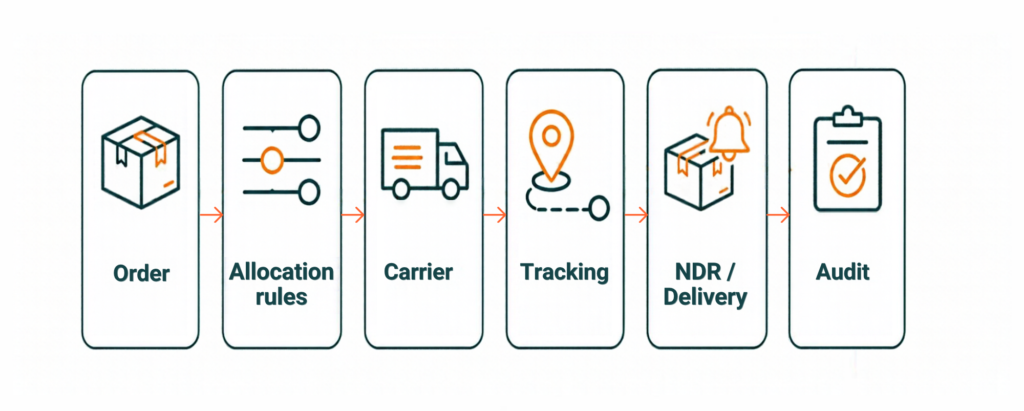
Each arrow is a handoff that should happen without a person copying data between screens.
Where to Start: A 30-60-90 Day Roadmap
A multi-carrier shipping rollout works best in three short phases, each with one job.
Days 1 to 30: Measure. Collect shipment data, find your worst pincodes by RTO and NDR, and calculate your carrier dependency: what share of volume goes to your top carrier? If one partner carries most of your volume, that is your exposure number.
Days 31 to 60: Pilot. Onboard 2 to 3 additional carriers, run allocation rules on 10 to 20% of volume, and connect your sales channel or ERP so orders flow in without manual entry.
Days 61 to 90: Scale. Extend the rules to all volume, introduce AI-based allocation, turn on NDR and tracking automation, and set up monthly carrier scorecards.
Pre-peak tip. Finish all three phases before Q1 2027 sale events and well ahead of the next festive cycle. If you start this month, day 90 lands in early January. Changing carriers in the middle of a sale is risky.
Quick wins: Start with your worst-performing zone and your COD orders. Those two segments are where a better carrier match is most likely to show up in your numbers fast.
Common Mistakes to Avoid
Most carrier diversification projects stumble on the same few points.
- Adding carriers without clear allocation rules. More partners with no logic means more confusion.
- Choosing carriers only on rate. A cheap carrier with a high RTO costs more in the end.
- Ignoring serviceability and pincode-level performance.
- Running carriers in silos with no unified tracking.
- Skipping freight audit, so overcharges slip through.
- Splitting volume so thin that you lose negotiating power with every partner.
How eShipz Makes Multi-Carrier Shipping Simple
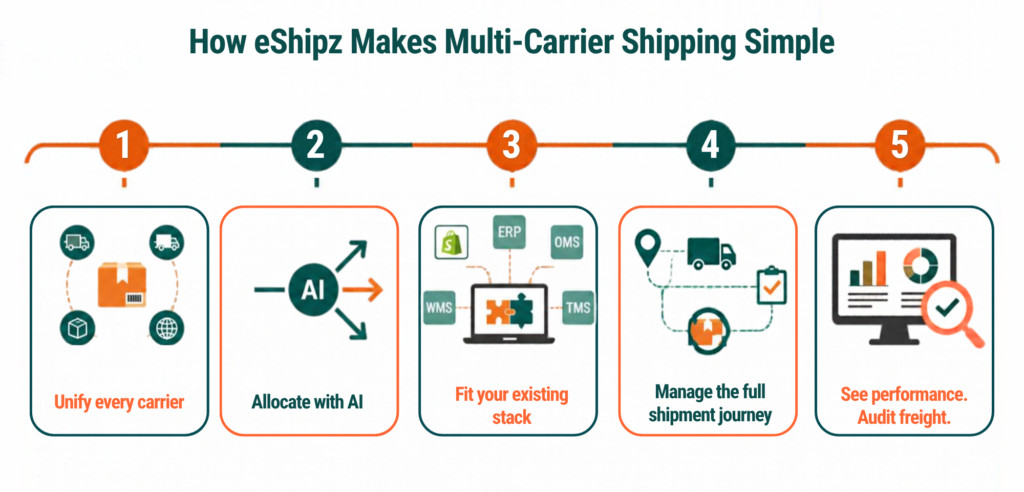
eShipz turns the strategy above into daily operations. Here is how, piece by piece.
Unified multi-carrier shipping. One multi-courier shipping API and a library of carrier integrations put every partner on one platform, with one label flow and one tracking record.
AI-powered courier allocation. Courier allocation picks the carrier for each shipment based on cost, serviceability, and past performance, and reassigns when a carrier is unserviceable.
Integrations. eShipz connects with Shopify and other sales channels, ERP, OMS, WMS, and TMS, so allocation fits the stack you already run.
After the parcel ships. Real-time tracking, estimated delivery dates, NDR management, redelivery, ePOD, and COD management run in the same workflow. Returns management covers reverse shipments in that same flow.
Control tower and freight audit. One dashboard shows carrier performance across all partners, and freight audit flags billing discrepancies before they become accepted costs.
See how eShipz can set up your multi-carrier workflow. Book a demo.
Your 2027 Carrier Diversification Checklist and Conclusion
- Carrier audit done, with data by zone
- 3 or more carriers active
- Allocation rules written and tested
- One dashboard for all carriers
- NDR and tracking automated
- Freight audit enabled
- Peak plan ready, with backup carriers named
Carrier diversification is no longer optional. Multi-carrier shipping protects service levels when one partner fails, helps cut freight costs, and prepares you for the demand 2027 will bring. Brands that spend the next 90 days on it will enter the next peak with a backup plan. Brands that wait will face the same risks again.
Ready to start? Book a demo or talk to the eShipz team about your multi carrier logistics setup.
Frequently Asked Questions
- What is multi-carrier shipping?
Multi-carrier shipping is the practice of using several courier and logistics partners through one workflow, so each order goes with the carrier that fits its destination, weight, and payment mode. - What is carrier diversification?
It is the strategy of spreading shipment volume across carriers by zone, service, weight, and payment mode, so no single partner can stall your business. - How many carriers should a brand use?
Three is a practical starting point: a national carrier, a regional one, and a backup. Add specialists such as hyperlocal or heavy-cargo partners when your data shows a gap. Too many carriers dilute your volume and weaken your negotiating position. - Does multi-carrier shipping reduce shipping costs?
Yes, in two ways. Rate-based carrier allocation sends each parcel to the cheapest partner that still delivers reliably, and split volume gives you comparison quotes to negotiate with. Savings also come from lower RTO, since each returned parcel costs you freight twice. To minimize shipping costs, track cost per delivered order, not cost per booked order. - What is carrier allocation?
Carrier allocation is the rule or model that picks a carrier for each shipment. Rules can weigh cost, speed, serviceability, or historical performance. AI-based allocation updates those choices as carrier performance changes. - When should I start?
Now. A 90-day rollout begun in October finishes in early January, before Q1 sale events. Starting during peak makes every change riskier. - Do I need carrier management software, or are spreadsheets enough?
Spreadsheets can work for a few dozen orders a day across two carriers. Past that, manual allocation causes errors and delays. Carrier management software automates allocation, labels, tracking, and audit in one place.