



B2C vs D2C matters for businesses that want to grow ecommerce sales, reach new customers, and build a profitable sales strategy in 2027. Both models sell products or services to individual consumers, but they differ in how businesses distribute products, manage customer relationships, shape the buying experience, and handle fulfilment. These differences are particularly relevant across industries such as fashion and apparel, beauty and personal care, consumer electronics, food and beverages, and home and lifestyle. According to the India Brand Equity Foundation (IBEF), India’s ecommerce market was valued at US$125 billion in 2024 and is projected to reach US$345 billion by 2030, highlighting the growing opportunities for businesses selling to consumers
A B2C business model lets companies sell through retailers, online marketplaces, physical stores, and ecommerce websites. A D2C business model allows brands to sell directly to customers without a traditional retail intermediary handling the transaction. For example, a fashion company may distribute products through retail outlets and online marketplaces, while a skincare brand may sell directly through its own website. Both models can support online growth, but they offer different levels of control over customer relationships and data, along with different investment needs and operational responsibilities.
As B2C ecommerce and D2C ecommerce evolve, businesses are exploring marketplaces, owned websites, social commerce, quick commerce, and omnichannel distribution. India’s online retail market is projected to grow beyond major metropolitan areas, creating opportunities for brands across industries to reach customers in new regions. For businesses planning to scale in 2027, product positioning and customer experience matter, but so do fulfilment efficiency, shipping costs, returns management, and logistics automation. Choosing the right business model and distribution strategy can help brands manage these operational demands while building a sustainable ecommerce business.
What Is B2C? Meaning of the B2C Business Model
B2C stands for business-to-consumer and describes a business model in which a company sells products or services directly to individual consumers for personal use. Transactions may take place through physical retail stores, online marketplaces, ecommerce websites, social commerce platforms, or other consumer-facing channels. For example, a customer purchasing a smartphone from an electronics retailer or ordering groceries through an online platform is participating in a B2C transaction.
The B2C business model covers a wide range of industries, including fashion, electronics, groceries, beauty, furniture, food delivery, and consumer services. In B2C ecommerce, customers discover products, compare options, place orders, and make payments through digital channels, while businesses fulfil those orders through their own operations or third-party partners. Companies can sell through their own websites, established marketplaces, or retail partners depending on their target audience, distribution strategy, and available resources.
One of the main advantages of B2C is its potential to reach a broad customer base through established sales channels. Businesses may benefit from existing marketplace traffic, retail networks, and fulfilment infrastructure without building every capability independently. However, selling through intermediaries may limit access to customer information, control over the buying experience, and flexibility in pricing or promotions, making channel selection an important part of business planning.
What Is D2C? Meaning of the D2C Business Model
D2C stands for direct-to-consumer: a brand or manufacturer sells to the final customer without a traditional retailer handling the transaction. Sales can happen on the brand’s website, in its mobile app or physical store, or through another channel it manages. A skincare company that sells on its own website and ships orders to customers follows a D2C approach. The d2c business model gives brands more control over product presentation, pricing, promotions, and the purchase experience. With d2c ecommerce, brands can also access first-party customer data, including purchase history and product preferences, subject to customer consent and applicable privacy requirements. They can use that information to improve products, personalise communication, and make the buying experience more relevant.
That control means taking on customer acquisition, technology, fulfilment, shipping, support, and returns. Cutting out traditional retailers doesn’t guarantee higher profits because marketing, delivery, and operating costs can be significant. A successful D2C strategy still needs a strong product, efficient fulfilment, and a customer experience people can rely on.
B2C vs D2C: What Is the Difference?
The main difference between B2C and D2C is how a business reaches and serves its customers. B2C describes the broader business-to-consumer relationship, while D2C describes a more specific approach in which a brand sells directly to consumers through channels it operates or manages. This means D2C is not necessarily separate from B2C, because a brand selling directly through its own website is also conducting a B2C transaction.
| Comparison factor | B2C business model | D2C business model |
| Meaning | Businesses sell products or services to individual consumers. | Brands sell directly to consumers without relying on a traditional retail intermediary for the transaction. |
| Sales channels | Retail stores, marketplaces, ecommerce websites, and distributors. | Brand-owned websites, applications, stores, and other direct sales channels. |
| Customer relationship | May be shared with retailers or marketplaces. | The brand manages the direct customer relationship. |
| Customer data | Access depends on the sales channel and data-sharing arrangements. | Greater access to first-party data through owned channels, subject to consent and privacy requirements. |
| Brand control | Can vary depending on the retailer or platform. | Greater control over product presentation and the direct buying experience. |
| Marketing | May involve retailer promotions, marketplace advertising, and brand campaigns. | Often relies on brand-led content, performance marketing, community building, and customer retention. |
| Initial investment | Can benefit from existing retail and marketplace infrastructure. | May require investment in ecommerce, marketing, fulfilment, and customer service. |
| Distribution | Can use established retail networks and marketplace logistics. | Often requires the brand to coordinate direct order fulfilment, although third-party providers can support operations. |
| Customer feedback | May pass through retailers or platforms. | Can be collected directly through brand-owned channels. |
| Growth opportunities | Retail expansion, marketplace reach, distribution partnerships, and online sales. | Owned-channel growth, customer retention, personalised experiences, and expansion into additional channels. |
The B2C business model can help companies reach a wide audience through established retail and marketplace networks, while the D2C business model can support stronger direct customer relationships and greater control over the buying journey. Neither approach is automatically more profitable, as the outcome depends on customer acquisition costs, channel fees, fulfilment expenses, product margins, and repeat purchases. Many businesses combine both models to expand their reach while developing direct relationships with customers.
B2C vs D2C Ecommerce: How Do the Online Models Work?
The b2c vs d2c distinction isn’t about whether a sale happens online. Both approaches sell to consumers, but they differ in how businesses reach customers and manage the sale. In a b2c business model, a company may sell through a marketplace or retailer’s website, where the platform provides product discovery, checkout, payment processing and sometimes fulfilment. A d2c business model puts more of that experience in the brand’s hands, from discovery and checkout to post-purchase communication.
How b2c ecommerce works:
A b2c ecommerce business can list products on its own website or third-party marketplaces. Customers browse, compare prices and order products for delivery through the seller’s fulfilment network or a platform-supported service. Marketplace traffic, retail partnerships, advertising, search visibility and promotions can help the business reach new customers. As sales grow, it needs to keep inventory, order status, delivery promises and customer service consistent across channels.
How d2c ecommerce works:
In d2c ecommerce, customers usually discover products through search, social media, advertising, recommendations or content before buying from a brand-owned storefront or direct sales channel. The brand manages the buying experience and can use customer insights to improve recommendations, communication, loyalty programmes and repeat purchases. It also handles order processing, inventory, shipping, support and returns, either internally or with fulfilment and shipping partners. logistics automation can help coordinate that work as order volumes grow. A business can run a b2c ecommerce store and still sell directly to consumers. Likewise, a D2C brand can use marketplaces and retail partners while keeping its direct channel. The right approach depends on its goals, customer expectations, resources and ability to manage operations.
Key Advantages of the B2C Business Model
The B2C business model helps companies reach a broad customer base and make products available through established distribution networks. It suits products with appeal across large or varied consumer segments. Choosing the right sales channels and keeping their costs in check can give companies room to grow distribution and revenue.
- Wider Market Reach
B2C businesses can sell through retail stores, online marketplaces, ecommerce websites, and distribution partners. Established retailers and marketplaces may bring customer traffic that a company couldn’t reach through its own platform alone. Before entering another market, businesses still need to assess channel costs, audience fit, and demand.
- Access to Established Sales Infrastructure
Retailers and marketplaces may already have systems for product discovery, payments, promotions, and fulfilment. That means a business doesn’t have to build every capability itself, which can help when it’s entering a new market or testing demand before a larger investment. Support differs by platform, commercial agreement, and operating model, so fees and responsibilities need a close look.
- Opportunities to Scale Sales Volumes
A broad distribution network can make products available to more customers across regions. Retail partnerships and marketplace listings can also help companies test demand, spot popular products, and expand what sells. As orders grow, businesses need to watch margins, inventory, and fulfilment capacity. More sales only help if the operation can support them profitably.
- Multiple Revenue Channels
A B2C business can sell in physical stores, through online marketplaces and distributors, and on its own ecommerce website. Selling across channels reduces reliance on any one source and reaches people with different shopping habits. It also takes coordination: product details, stock levels, orders, and deliveries need to stay accurate wherever customers buy.
- Opportunities to Test New Markets
Marketplaces and retail partners let businesses test demand in new regions before investing heavily in their own distribution infrastructure. Sales data, customer feedback, and product performance can show where growth looks strongest. Businesses should also check delivery coverage, shipping costs, competition, and the work required to serve customers in each market.
Disadvantages of the B2C Business Model
Broad distribution brings trade-offs. Competition, limited customer data, margin pressure, and channel coordination can all become harder to manage when retailers and marketplaces have different policies. Businesses need to account for those limits rather than chase sales volume at the expense of profitability.
- Strong Competition
On marketplaces and in large retail networks, customers can quickly compare products by price, reviews, features, and delivery options. Businesses need clear positioning, dependable availability, and a reason for customers to choose them. Price cuts alone can erode margins, making quality, service, convenience, and differentiation worth protecting.
- Limited Control Over the Customer Experience
When a retailer or marketplace handles the sale, a business may have little say over product presentation, promotional placement, customer communication, or returns. Keeping the brand experience consistent across channels becomes harder. Clear channel guidelines and regular reviews of customer feedback can reveal where the buying experience falls short.
- Pressure on Profit Margins
Marketplace commissions, retailer margins, discounts, advertising, and fulfilment charges all reduce what a business keeps from each sale. Even high sales volumes may deliver weak financial results if acquiring and serving customers costs too much. Companies should calculate contribution margins by channel, including product costs, shipping, returns, and marketing.
- Dependence on Third-Party Platforms
Relying heavily on one marketplace or retail partner leaves a business vulnerable to changes in fees, policies, visibility, or commercial terms. Third-party platforms can bring in customers, but too much dependence limits flexibility and adds risk. Developing other sales channels, where it makes commercial sense, can help a business keep its reach without relying on one partner.
- Fragmented Operational Data
Selling through several channels can leave inventory figures, order statuses, customer information, and delivery updates out of sync. Teams may have to switch between systems to manage orders and shipments, adding manual work and opportunities for error. Integrated order management, tracking, and logistics automation can cut that work and make information easier to find.
Key Advantages of the D2C Business Model
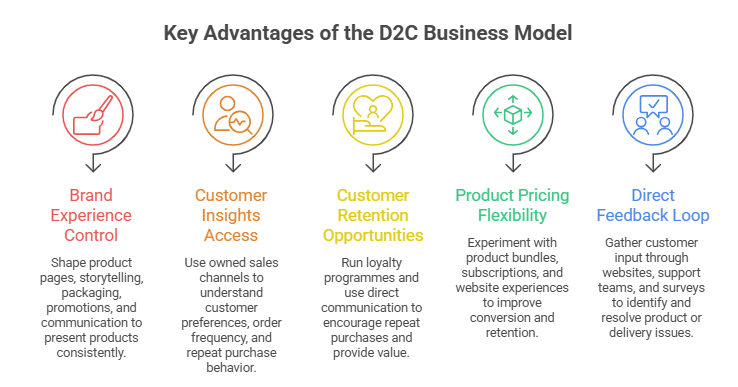
The D2C business model gives brands a direct relationship with customers and more control over the buying experience. Customer insights can inform growth, especially when a brand has a clear product proposition and can acquire customers at a sustainable cost. Direct channels also make it easier to test ideas and build relationships that last beyond a single purchase.
- Greater Control Over the Brand Experience
A D2C brand can shape its product pages, storytelling, packaging, promotions, and customer communication. That gives it a better chance of presenting products consistently and reflecting its positioning and values. Control is more limited when the brand also sells through marketplaces or retail partners.
- Direct Access to Customer Insights
Owned sales channels can show brands what customers prefer, which products they choose, how often they order, and whether they buy again. With appropriate consent and privacy safeguards, brands can use that information to improve products, customer segmentation, and communication. It can also help them make better-informed marketing decisions and identify gaps in what they offer.
- Opportunities for Customer Retention
Direct communication lets brands run loyalty programmes, recommend relevant products, explain how to use them, and encourage repeat purchases. Email, messaging, and other channels can support that work when brands respect customer preferences and use them responsibly. Retention efforts should offer real value, not bury customers in promotions.
- Greater Flexibility in Product and Pricing Experiments
Through their own channels, D2C brands can try product bundles, limited editions, subscriptions, new packaging, and different website experiences. Customer feedback can show what people value and whether a change improves conversion or retention. Businesses should judge experiments against relevant performance indicators, not short-term sales alone.
- A More Direct Feedback Loop
Customers can reach a brand through its website, support team, reviews, and post-purchase surveys. Their feedback can flag product concerns or delivery problems before more customers run into them. When a business connects those comments to order and shipment data, it’s easier to tell whether the problem lies with the product, fulfilment, or the customer experience.
Disadvantages of the D2C Business Model
The D2C approach offers control, but it also requires investment and operational discipline. Brands need to build demand, manage fulfilment, and maintain customer trust while ensuring that the cost of acquiring and serving each customer remains sustainable. These responsibilities can become more challenging as the business expands into new markets or experiences higher order volumes.
- Higher Customer Acquisition Responsibilities
A brand-owned website does not automatically attract customers, so businesses often need to invest in search engine optimisation, content, paid advertising, social media, creator partnerships, and other acquisition channels. These activities can help generate demand, but costs may rise as competition increases or advertising performance changes. If acquisition costs become too high relative to the revenue and margin generated by each customer, growth can become difficult to sustain.
- Fulfilment and Shipping Complexity
D2C brands must ensure that orders are processed accurately and delivered within reasonable timeframes. They may need to coordinate warehouses, carriers, delivery exceptions, tracking updates, and returns, particularly when serving customers across multiple regions. As the business expands, connected shipping workflows and logistics automation can help teams manage increasing complexity without relying entirely on manual processes.
- Responsibility for Customer Support
Customers expect the brand to answer questions about orders, delivery delays, damaged products, returns, and refunds. The business must establish clear support processes and provide timely, accurate updates throughout the customer journey. Poor post-purchase communication can undermine customer trust even when the product itself meets expectations.
- Investment in Technology and Operations
A growing D2C business may require an ecommerce platform, payment tools, inventory management, analytics, customer relationship management, and shipping systems. The business must decide which capabilities to build internally and which to obtain from external providers based on its size, budget, and operational needs. Technology should solve actual business problems and support future growth without creating unnecessary complexity.
- Managing Returns and Reverse Logistics
Returns can create additional shipping costs, inventory handling, inspection work, and refund processing. D2C brands need clear return policies and workflows for collecting products, inspecting their condition, updating inventory, and resolving customer requests. Monitoring return reasons can also help businesses identify recurring product or fulfilment problems and make improvements that reduce avoidable returns.
B2C vs D2C: Which Model Offers Better Profitability?
Neither B2C nor D2C is automatically more profitable. The result depends on product margins, customer acquisition costs, distribution expenses, fulfilment costs, returns, order frequency, and the company’s operating structure. The B2C business model can draw on existing retail networks and marketplace traffic, though commissions, retailer margins, and promotional requirements cut into what a company keeps from each sale. The D2C business model gives brands more control over pricing and customer relationships, but marketing, website operations, fulfilment, shipping, and support can eat up the savings from bypassing intermediaries.
A brand might bring in more revenue through its own website while spending heavily on advertising and last-mile delivery; another might earn less per marketplace sale but make up for it with higher order volumes and efficient fulfilment. The better choice delivers sustainable contribution margins, meets customer expectations, and supports the company’s growth objectives, so businesses should compare customer acquisition cost, average order value, gross margin, fulfilment cost per order, return rate, repeat purchase rate, and contribution margin after variable costs before deciding where to invest.
Growth Strategies for B2C Businesses in 2027
B2C businesses can grow by expanding distribution, improving the online buying experience, strengthening fulfilment, and making better use of customer and operational data. The right approach depends on the product category, target audience, competition, and current sales channels. A clear growth strategy should balance customer acquisition with profitable sales, dependable delivery, and a consistent customer experience.
- Build a Multi-Channel Sales Strategy
Businesses can combine marketplaces, physical stores, retail partnerships, and their own ecommerce websites to reach different customer groups. Each channel should have a defined purpose, such as product discovery, regional expansion, or building direct customer relationships. Companies should monitor channel profitability and avoid expanding into channels that generate sales but fail to deliver sustainable returns.
- Improve Product Discovery and Conversion
Clear product descriptions, accurate images, transparent pricing, customer reviews, and useful product comparisons can help customers make informed decisions. In B2C ecommerce, businesses should also review website speed, checkout friction, payment options, and mobile usability to identify barriers to purchase. Regular testing can help determine which changes improve conversion and create a more convenient shopping experience.
- Use Customer Insights Responsibly
Businesses can analyse sales patterns, customer feedback, product performance, and repeat purchase behaviour to improve their offers. Personalised recommendations and relevant promotions can make shopping more convenient when based on appropriate data practices and customer consent. Companies should maintain clear privacy practices and focus on collecting information that supports genuine business and customer needs.
- Strengthen Inventory and Fulfilment Planning
Product availability and delivery reliability influence the customer experience, making inventory planning an important part of business growth. Businesses should forecast demand, maintain suitable stock levels, and coordinate inventory across warehouses and sales channels to reduce stockouts, excess inventory, and cancellations. Better planning can also help improve order fulfilment and reduce avoidable operational costs.
- Improve Shipping Visibility and Customer Communication
Customers want clear information about order dispatch, shipment progress, delivery delays, and final delivery status. Connecting tracking information with customer communication can reduce uncertainty and help support teams respond to questions more efficiently. Businesses should ensure that delivery estimates are realistic and that exception messages provide useful information about the next steps.
- Use Logistics Automation to Support Scale
As order volumes grow, manual processing can create errors, delays, and additional workload for operations teams. Logistics automation can help streamline repetitive shipping tasks, connect shipment data, monitor delivery progress, and identify exceptions that require attention. Businesses should prioritise workflows that create measurable improvements in processing time, accuracy, visibility, or cost.
Growth Strategies for D2C Businesses in 2027
D2C brands need to balance customer acquisition with retention, brand differentiation, and operational efficiency. A strong direct channel can provide valuable customer insights, but long-term growth requires more than generating website traffic. Businesses must create a compelling reason for customers to buy directly while ensuring that the experience from checkout to delivery meets expectations.
- Build a Distinct Brand Proposition
Customers need a clear reason to choose a brand over competing products, whether through product quality, specialised features, design, convenience, service, or a distinctive brand story. Product pages, content, packaging, and customer communication should reinforce the same proposition across the buying journey. Consistent positioning can help brands build recognition and give customers a stronger reason to return.
- Invest in Organic Discovery and Useful Content
Search-optimised product pages, informative blog content, product guides, and relevant answers to customer questions can help brands attract people who are actively researching their needs. Organic discovery can complement paid advertising and reduce dependence on a single acquisition channel over time. Content should answer genuine customer questions and provide useful information rather than focus solely on keyword repetition.
- Develop Customer Retention Programmes
Repeat customers can contribute to more sustainable growth when the product meets expectations and the brand delivers consistent service. Businesses can use loyalty benefits, replenishment reminders, subscriptions, relevant recommendations, and post-purchase education where appropriate. Retention efforts should be measured through repeat purchase rate, customer lifetime value, and engagement rather than message volume alone.
- Expand Through Marketplaces and Omnichannel Distribution
D2C does not require a brand to sell exclusively through its own website. Marketplaces, quick-commerce platforms, physical stores, and retail partnerships can help brands reach new audiences while maintaining their direct channels. The key is to define the role of each channel and coordinate pricing, product information, inventory planning, and fulfilment wherever possible.
- Improve Delivery and Returns Experiences
A customer’s experience continues after checkout, making accurate order processing, reliable shipping, accessible tracking, proactive delay communication, and straightforward returns important parts of D2C growth. Brands should regularly review delivery performance and customer complaints to identify problems that require operational changes. A dependable post-purchase experience can help strengthen customer trust and support repeat purchases.
- Automate Repetitive Logistics Tasks
As a D2C brand grows, manual carrier selection, shipment creation, tracking checks, and exception follow-ups can consume time that teams need for higher-value work. Logistics automation can help coordinate supported carrier workflows, centralise shipment visibility, and reduce repetitive administrative tasks. The right tools should fit the brand’s shipping volume, carrier network, technology environment, and service requirements.
- Monitor Unit Economics Before Scaling
Rapid revenue growth does not guarantee a sustainable business. D2C brands should understand the contribution margin of each product, channel, and order type after accounting for discounts, advertising, shipping, payment fees, and returns. Reviewing these measures can help businesses identify profitable growth opportunities and avoid scaling channels that consistently lose money.
The Role of Logistics Automation in B2C and D2C Growth
Logistics becomes increasingly important as businesses expand across channels, regions, and customer segments. Both B2C and D2C companies need to process orders accurately, select suitable carriers, track shipments, manage delivery exceptions, and handle returns, although the level of operational responsibility varies according to the sales channel and fulfilment arrangement. Disconnected systems and manual workflows can make it harder to maintain visibility as shipment volumes increase, which is why logistics automation can be valuable for growing businesses.
How Logistics Automation Supports B2C Operations
For B2C businesses handling orders across several sales channels, logistics automation can help coordinate shipping processes and make shipment information easier to access. Connecting order data with shipping workflows can reduce manual entry, support more consistent processing, and provide operations and customer service teams with a shared view of shipment progress across supported carriers. Businesses should establish shipping rules based on delivery destination, service requirements, cost, and carrier capability while monitoring performance to ensure that automation supports their commercial objectives.
How Logistics Automation Supports D2C Operations
D2C brands often need to manage shipping, tracking, and customer communication as part of their direct customer experience. Logistics automation can help streamline individual order processing, connect carrier information, and reduce manual tracking follow-ups, while suitable integrations can help teams identify delayed shipments and respond to delivery issues. Businesses still need clear exception-handling procedures, accurate order information, carrier performance monitoring, and timely customer updates to ensure that automated workflows support reliable delivery.
Automation does not remove the need for operational oversight, but it can help businesses manage growing workloads more consistently. The objective is to improve fulfilment reliability while allowing the company to scale without increasing manual work at the same rate as order volume. Businesses should evaluate automation based on measurable improvements in processing time, shipment visibility, delivery performance, and operating costs.
How eShipz Supports Shipping Automation and Shipment Visibility
As B2C and D2C businesses grow, managing several carriers and tracking shipments gets harder. eShipz brings shipping information together through multi-carrier integration, shipment tracking, delivery visibility, and logistics automation. That can mean fewer manual checks across carrier portals. How much it helps depends on the integrations and features a business configures. For companies selling across several channels, centralised shipment visibility helps teams follow delivery progress and spot shipments that need attention. Shipping automation can make workflows more consistent and cut repetitive administrative work. That gives operations teams more time to handle exceptions and improve service. Before choosing a shipping solution, businesses should check whether its capabilities fit their workflows, from manual shipment processing and limited tracking visibility to carrier coordination, delivery exceptions, and reporting requirements.
Connecting shipping processes with broader logistics operations can make fulfilment more efficient and shipment information easier to access. For ecommerce teams coordinating different carriers and delivery networks, eShipz offers a way to manage deliveries more consistently and maintain visibility as order volumes grow.
How to Choose Between B2C and D2C
Choosing between B2C and D2C depends on the business’s goals, available resources, product category, and desired customer relationship. Some businesses benefit from established retail and marketplace distribution, while others gain more value from controlling the direct customer experience, and many brands use a combination of both. The best approach is to evaluate how each channel contributes to customer reach, profitability, operational efficiency, and long-term growth. Before deciding on a strategy, businesses should understand where their target customers discover products, how much control they need over the buying experience, and what resources they can invest in technology, marketing, customer service, fulfilment, and returns. They should compare margins after channel fees, acquisition costs, and shipping expenses, while checking whether inventory, order management, and delivery processes can support higher volumes. Finally, businesses should establish clear performance measures for conversion, retention, delivery performance, returns, and contribution margin so they can adjust their channel strategy based on results rather than assumptions.
Future Trends Shaping B2C vs D2C in 2027
Changing customer expectations, digital discovery, omnichannel retail, and pressure to run more efficient operations will shape B2C and D2C in 2027. Businesses don’t have to choose one approach over the other. Many are looking for ways to combine broad distribution with closer customer relationships. The right mix depends on what customers need and what the business can support as market conditions change.
Omnichannel Commerce
Selling through owned websites, marketplaces, physical stores, and other digital channels gives customers more ways to find and buy products. It can make shopping more convenient, but keeping product information, inventory, promotions, and fulfilment in sync takes work. Businesses need a clear purpose for each channel and processes that keep the customer experience consistent.
More Personalised Customer Experiences
Customer insights can guide product recommendations, content, and the timing of messages. Personalisation works best when it follows appropriate data practices and helps shoppers without feeling intrusive. Understanding customer needs also helps brands make better choices about products, marketing, and customer engagement.
Greater Focus on Profitable Growth
Revenue alone doesn’t show whether a channel is profitable. Businesses need to track what each order costs, including customer acquisition, fulfilment, and returns. Repeat purchases matter too. Those figures can reveal sustainable growth opportunities, especially when a business enters new channels or spends more to acquire customers.
Faster and More Transparent Fulfilment
Shoppers expect dependable delivery, realistic estimates, useful tracking updates, and clear communication about delays. Connected shipping workflows and logistics automation can help businesses deliver that consistently as they grow. Delivery data can also show where problems keep occurring so businesses can address them.
Expansion Beyond Major Cities
Growing digital access and changing shopping habits are opening opportunities in Tier 2 and Tier 3 markets. Before expanding, businesses need to account for delivery coverage, shipping costs, payment preferences, return logistics, and customer support. Plans should fit local demand and fulfilment conditions, not simply copy what works in major cities.
Conclusion
B2C vs D2C is not simply a choice between selling through retailers and selling through a website, but a decision about how a business reaches customers, manages the buying experience, builds relationships, and organises its operations. The B2C business model can provide broad distribution through marketplaces and retail networks, while the D2C business model gives brands greater control over direct customer interactions and owned sales channels. Both approaches offer growth opportunities, but businesses need to evaluate customer acquisition, product margins, fulfilment expenses, returns, and customer experience before deciding where to invest.
As ecommerce evolves in 2027, operational efficiency will remain an important part of sustainable growth. Logistics automation, connected shipment tracking, and reliable fulfilment workflows can help businesses manage growing order volumes while maintaining visibility across delivery operations. For businesses looking to improve shipping efficiency and shipment visibility as they scale, eShipz offers solutions that support multi-carrier integration, shipment tracking, and logistics automation, helping companies work towards more connected shipping operations and a more consistent customer experience.
Frequently Asked Questions About B2C vs D2C
- What is the difference between B2C and D2C?
B2C means business-to-consumer and describes a company selling products or services to individual consumers. D2C means direct-to-consumer and describes a brand selling directly to consumers without relying on a traditional retail intermediary for the transaction. D2C is a specific approach within the broader B2C market, and a business can use both direct and indirect channels.
- What is a B2C business model?
A B2C business model allows a company to sell products or services to individual consumers through physical stores, online marketplaces, ecommerce websites, or other consumer-facing channels. The business may sell directly or work with retailers and distribution partners to reach customers. Its performance depends on factors such as product demand, channel costs, customer experience, and fulfilment efficiency.
- What is a D2C business model?
A D2C business model allows a brand or manufacturer to sell directly to customers through channels such as its own website, application, or brand-operated store. It provides greater control over the direct customer relationship and access to first-party insights through owned channels, subject to privacy requirements. However, the brand may need to invest more in customer acquisition, technology, fulfilment, shipping, and support.
- Is D2C better than B2C?
Neither model is universally better because each offers different advantages and operational responsibilities. D2C can provide more control over the customer experience and direct customer relationships, while broader B2C distribution can help businesses reach customers through established retailers and marketplaces. The best approach depends on the company’s products, resources, margins, and growth objectives.
- What is the difference between B2C ecommerce and D2C ecommerce?
B2C ecommerce includes online transactions in which businesses sell products or services to consumers through websites and marketplaces. D2C ecommerce specifically focuses on direct sales through brand-managed channels, allowing companies to control more of the customer journey. A D2C brand can also sell through third-party platforms as part of a broader distribution strategy.
- Can a business use both B2C and D2C models?
Yes, a brand can sell through retailers and marketplaces while also operating its own website or application. This approach can help the business combine broad market reach with direct customer relationships and more control over its owned channels. However, it requires consistent inventory management, pricing decisions, fulfilment coordination, and channel performance measurement.
- What are the main challenges of D2C ecommerce?
Common challenges include customer acquisition costs, fulfilment and shipping expenses, customer support, returns management, and technology investment. D2C brands must also build customer trust and maintain a reliable buying experience from checkout through delivery. Sustainable growth requires balancing revenue with the total cost of acquiring, fulfilling, and retaining customers.
- How does logistics automation help ecommerce businesses?
Logistics automation can help streamline repetitive shipping activities, connect shipment information, improve tracking visibility, and support exception management. Depending on the solution, it may reduce manual data entry and make it easier for teams to coordinate shipments across multiple carriers. Businesses should select automation capabilities based on their actual operational requirements and measure their impact on cost, accuracy, and service quality.
- Which model is more suitable for startups?
The right choice depends on the startup’s product, budget, audience, and distribution needs. Marketplaces and retail partnerships may provide access to existing customers, while a direct channel can help a startup build its own customer relationships and collect relevant first-party insights. Testing different channels and monitoring profitability can help determine the most effective mix.
- What should businesses prioritise in 2027?
Businesses should prioritise sustainable customer acquisition, clear product positioning, strong customer experience, profitable channel selection, accurate inventory management, reliable delivery, and effective use of operational data. Connecting sales, fulfilment, and customer communication can help both B2C and D2C businesses manage growing order volumes more efficiently. Regularly reviewing performance metrics will help companies adapt their strategies as customer expectations and market conditions change.