







Why failed deliveries are the most expensive “almost sales” in Indian ecommerce
India’s online retail market reached about $65–66 billion in gross merchandise value in 2025, growing 19–21%, according to Bain & Company and Flipkart’s How India Shops Online 2026. Shoppers have roughly doubled in five years to 290–300 million, and Tier 2+ cities contributed about half of the incremental orders in 2025.
More orders from more towns means more doorsteps your courier has never visited, more addresses typed on a phone screen, and more customers who are not home when the rider arrives. Each of those moments can end in a failed delivery attempt, and each failed attempt raises a Non-Delivery Report (NDR). That is why NDR management in India has become a core operations skill.
This is where margin quietly leaks. The product has been picked, packed, handed over and paid to move. If the order turns around now, you pay for shipping twice and earn nothing. NDR management in India, the process of resolving failed deliveries before they become returns, is one of the cheapest places in your logistics stack to win money back.
In this guide to NDR management in India, you will learn what an NDR is, why deliveries fail, what a failed delivery really costs, a 7-step workflow you can run this week, how to prevent NDRs before dispatch, which KPIs to track, and how automation changes the economics.
What is NDR (Non-Delivery Report) in ecommerce?
NDR stands for Non-Delivery Report. A courier raises an NDR when a delivery attempt fails and the parcel cannot be handed to the customer. The shipment is not lost and not yet returned. It sits in a decision window where the brand, the customer or the courier must say what happens next.
NDR management in India is the set of actions you take inside that window: find out why the attempt failed, reach the customer, capture a clear instruction, pass it to the courier, and track the outcome.
Picture the delivery journey as a chain: order confirmed, packed, handed to the courier, in transit, out for delivery, then either delivered or an NDR. The NDR is the one point in that chain where a human decision, yours or the customer’s, can still change the result. Everything before it is logistics execution. Everything after it, if the parcel goes back, is cost.
NDR vs RTO: how they relate
- NDR is the event: a failed attempt, with a reason code from the courier.
- RTO (Return to Origin) is one possible outcome: the parcel travels back to your warehouse.
- Well-run NDR management in India turns most NDRs into successful deliveries, so fewer shipments ever reach RTO.
Couriers usually allow a limited number of attempts before a shipment is returned automatically. The exact limit differs by courier and service level, so check your agreement and plan your workflow around it.
Why deliveries fail: the seven most common NDR reasons
NDR management in India starts with knowing why deliveries fail. Most failures trace back to a short list of causes, and each cause points to a fix.
| # | Cause | What it looks like | Best fix |
|---|---|---|---|
| 1 | Customer not available | Door locked or customer out when the rider arrives | Share the delivery window by WhatsApp or SMS before the attempt and let the customer pick a slot |
| 2 | Incomplete or wrong address | Missing landmark, flat number or mismatched pincode | Validate the address at checkout and confirm it by message for COD orders |
| 3 | Phone unreachable | Number switched off, wrong, or calls go unanswered | Verify the number with an OTP at checkout and collect an alternate number |
| 4 | COD refusal or cash not ready | Customer declines the parcel or has no cash | Send a COD confirmation message and nudge the buyer toward prepaid |
| 5 | Reschedule request | Customer asks for another day | Offer a self-serve link to choose the reattempt date |
| 6 | Area hard to serve | Remote pincode or out-of-delivery-area (ODA) location | Check serviceability up front and route to the courier that covers the pincode best |
| 7 | Courier-side issue | Rider capacity, vehicle trouble or a missed attempt | Track NDR rates by courier, escalate repeat problems and reroute |
Notice the pattern. Causes 1 to 5 are information problems: a quick conversation with the customer solves them. Causes 6 and 7 are routing problems: only your own delivery data and courier selection solve them. Good NDR management in India handles both.
What a failed delivery really costs
A brand at 20% RTO on 10,000 monthly shipments spends about ₹3.1 lakh a month on shipping that earns no revenue. The model below makes the arithmetic visible. Swap in your own volumes and rates to see your number.
At 20% RTO, 10,000 shipments waste ₹3.1 lakh a month
Each extra 5 points of RTO adds ₹77,500 a month
Illustrative model: 10,000 shipments a month; ₹70 forward + ₹70 return + ₹15 handling = ₹155 per returned order. Excludes product damage, discounted resale and lost margin.
The model counts only forward freight, return freight and handling. Real costs run higher: product damage, discounted resale, customer support time, wasted ad spend and working capital stuck in transit. With an average order value of ₹900 (also illustrative), 2,000 returned orders keep ₹18 lakh of order value in limbo until the parcels are back and restocked.
The takeaway is simple. Every point of RTO you recover is worth real money, and NDR management in India is where that recovery starts.
The 7-step workflow for NDR management in India
Here is an NDR management in India workflow you can adopt this week, whether you run it in a spreadsheet or in software. Each step has one job and hands a clean output to the next.
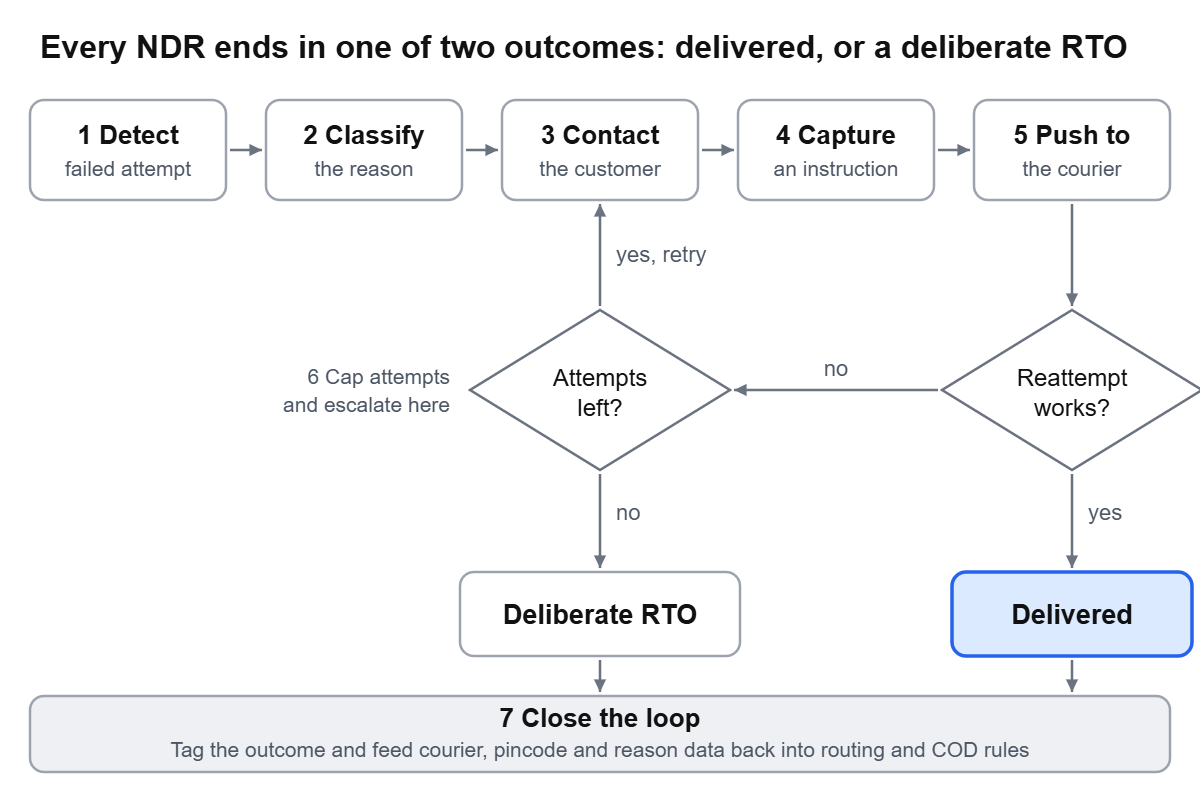
- Detect failed attempts in real time. Bring courier status events into one view through APIs instead of waiting for an end-of-day report. Set a target for first action in hours, not days.
- Classify the reason. Map each courier’s codes into your own categories: customer unavailable, address issue, refused, reschedule, courier fault. Each category needs a different response.
- Contact the customer where they answer. Use WhatsApp or SMS first, and an automated voice call for COD and high-value orders. Keep the message short with one clear action: confirm the address, pick a date, or cancel.
- Capture a structured instruction. Record the reattempt date, corrected address, alternate phone number or a cancel request. Buttons, links and call outcomes beat free-text replies, which get lost.
- Push the instruction to the courier. Send it by API or bulk file and confirm that the courier acknowledged it. An instruction that stays in your CRM never reaches the rider.
- Set attempt limits and escalate. Cap reattempts, escalate high-value and repeat-failure orders to your ops team, and decide deliberately when to RTO instead of letting the courier’s default rule decide.
- Close the loop and learn. Tag every outcome, then feed courier, pincode and reason data back into routing and COD rules.
A customer message that gets replies
Hi Riya, your order #1042 from [Brand] could not be delivered today because [reason]. Tap to confirm your address or pick a new delivery date: [link]. Your parcel is held for reattempt until [date].
Keep it to three lines, name the order, and ask for one action.
A worked example of NDR management in India (hypothetical)
A skincare brand ships a COD order to a customer in a Tier 2 town. At 11:40 a.m. the courier marks the first attempt as failed because the customer was unavailable. The NDR is detected within minutes and classified as “customer unavailable”. A WhatsApp message goes out offering two slots for the next day. The customer taps the 11 a.m. slot, the instruction is pushed to the courier, and the parcel is delivered the next morning. Without a workflow, the same order might have waited in a spreadsheet until the end of the day, and the courier’s default rule could have sent it back.
Reattempt rules for NDR management in India
Effective NDR management in India means a different first move for each failure. Use this table as a starting rulebook and adjust it with your own data.
| NDR reason | First action | Best channel | Escalate when |
|---|---|---|---|
| Customer not available | Offer two reattempt slots | WhatsApp or SMS | The customer misses the second slot |
| Incomplete or wrong address | Ask for a corrected address and landmark | WhatsApp form link or voice call | The address stays unverified after one contact |
| Phone unreachable | Try the alternate number and a second channel | SMS plus email, then a voice call | There is no response on any channel |
| COD refusal | Confirm intent and offer a prepaid payment link | Voice call or WhatsApp | The customer confirms cancellation, so you RTO deliberately |
| Reschedule request | Capture the date and push it to the courier | Self-serve link | The date falls outside your reattempt window |
| Hard-to-serve area | Check courier coverage and switch courier if possible | Internal ops action | The pincode fails repeatedly, so you drop that courier for it |
| Courier-side issue | Raise an escalation with the courier | Courier account manager | A pattern repeats, so you reroute volume |
Work the highest-value NDRs first
NDR management in India works best when you tier the queue, because not every NDR deserves the same effort. Sort it so scarce agent time goes where the money is:
- Tier 1: high-value or prepaid orders. Personal outreach and the fastest response.
- Tier 2: standard COD orders. Automated messaging and voice follow-ups, with agents stepping in when there is no response.
- Tier 3: repeat refusers and unreachable customers. One automated attempt, then a deliberate RTO.
Review the tiers every month as your data improves.
Manual vs automated NDR management in India
Most brands begin with a spreadsheet and a team that calls customers. Manual NDR management in India works at low volume and breaks at peak. The same Bain–Flipkart report notes that festive sales bring nearly triple the usual daily traffic and account for around one in four new shoppers, so your busiest weeks are also the weeks your NDR queue is longest.
| Dimension | Manual (sheets and calls) | Automated (workflow and messaging) |
|---|---|---|
| Speed of first action | Depends on who checks the sheet and when | Starts the moment the courier raises the NDR |
| Customer outreach | Agents call one customer at a time | WhatsApp, SMS or AI voice follow-ups go out automatically |
| Instruction to courier | Copied by hand into courier portals | Pushed by API or bulk upload |
| Reason tracking | Free-text notes that differ by agent | Standard reason categories across all couriers |
| Festive-peak capacity | Needs more agents | Same workflow, higher volume |
| Visibility | End-of-day report | Live view by courier, pincode and reason |
Automating NDR management in India does not replace your team. It handles the routine cases so your agents can focus on high-value orders, repeat failures and escalations. For a deeper look at the AI side, read our guide on AI in NDR management.
What to look for in NDR automation software
Before you pick a tool, check that it can:
- Pull NDR events from every courier you use, not just one.
- Normalize reason codes into your own categories.
- Message customers on the channels they use: WhatsApp, SMS, email and voice.
- Capture structured responses and push them to the courier.
- Support bulk actions for peak days.
- Keep a clear audit trail of every message and courier instruction.
- Report NDR and RTO rates by courier, pincode and payment mode.
A tool that misses any of these pushes work back onto your team, which defeats the purpose of automating.
Prevent NDRs before dispatch: smarter NDR management in India
The cheapest NDR is the one that never happens. Seven checks before a parcel leaves your warehouse make NDR management in India easier:
- Validate addresses at checkout. Match pincode to city, prompt for a landmark, and flag incomplete addresses before the label is printed.
- Confirm COD orders. Send an automated WhatsApp or voice confirmation and hold orders the customer has not confirmed.
- Move buyers toward digital payment. The Bain–Flipkart report points to a shift from cash on delivery to UPI at delivery. Offering UPI or prepaid options reduces the “cash not ready” failure.
- Choose couriers by pincode performance. Route using your own delivery and NDR history, not just the rate card.
- Show a realistic delivery date. An accurate expected delivery date sets the right expectation, so customers are available when the rider comes.
- Pack and label for the rider. A clear label with a working phone number and the COD amount avoids confusion at the door.
- Tag repeat refusers. Restrict COD or ask for prepayment from customers who have refused parcels more than once.
Prevention shrinks the NDR pile, and the workflow above completes your NDR management in India.
Five mistakes that hurt NDR management in India
Even teams with a process stumble in the same places. Check your own operation against this list:
- Waiting for the courier to fix it. The courier knows the attempt failed. Only you can reach the customer with context about the order.
- Sending generic messages. A message without the order name and one clear action gets ignored.
- Treating every reason the same. An unreachable phone and a wrong address need different fixes, so classify before you contact.
- Skipping the courier acknowledgement. An instruction that was sent but never confirmed may never reach the rider.
- Tracking only the RTO rate. RTO is the last step. Watch NDR resolution rate and time to first action to catch problems earlier.
KPIs to track for NDR management in India
NDR management in India improves only when you measure it. Start with these seven KPIs.
| KPI | Formula | Why it matters |
|---|---|---|
| NDR rate | NDR shipments ÷ shipments dispatched | Shows how often delivery attempts fail |
| NDR resolution rate | NDRs that end delivered ÷ total NDRs | Measures how well your workflow recovers failed deliveries |
| First-attempt delivery rate | Delivered on first attempt ÷ shipments dispatched | Reflects address quality and courier choice |
| RTO rate by payment mode | RTO shipments ÷ shipped, split COD vs prepaid | Shows where the risk concentrates |
| Time to first action | Time from NDR raised to instruction sent | Faster action leaves the customer still waiting for the parcel |
| Cost per RTO | Forward + reverse shipping + handling + damage | Converts operations into rupees |
| Courier-wise NDR rate | NDRs by courier and pincode cluster | Feeds routing decisions |
Review these weekly and slice them by courier, pincode cluster, product category and payment mode. Set your own targets from a four-week baseline instead of copying a published average. Rates vary widely by category, payment mode and city tier, so your own trend is the fairest benchmark.
How eShipz helps you manage NDRs at scale
eShipz is an AI-powered logistics automation platform that connects to your existing courier accounts, so you keep your own carrier rates and relationships. For NDR management in India, it gives your team:
- One NDR dashboard that brings failed shipments from every courier into a single view, with single and bulk NDR actions. Bulk actions use a pre-filled file with AWB numbers and carrier details.
- Automated customer outreach through WhatsApp, SMS and email alerts, plus an NDR AI voice agent that follows up on failed deliveries.
- Branded tracking pages that keep customers informed between attempts.
- Carrier performance analytics that show which couriers and pincodes fail most, so you can route smarter.
If you want to see this workflow running on your own shipments, explore the eShipz logistics automation platform and talk to the team.
Conclusion: NDR management in India saves sales you would otherwise lose
A failed delivery is not the end of an order. It is a short window in which a fast, clear conversation with the customer can turn a likely return into a delivered parcel. Brands that win here do three things: they prevent avoidable failures before dispatch, they act on every NDR within hours, and they measure outcomes by courier, pincode and payment mode.
Start small with NDR management in India. Pick one KPI, build a baseline over four weeks, and run the 7-step workflow on your highest-value orders first. Then let automation take over the routine cases so your team can focus on the exceptions.
Ready to put this into practice? See how eShipz brings NDR management in India, carrier analytics and customer communication into one platform.
Frequently asked questions about NDR management in India
1. What is the full form of NDR in courier and ecommerce?
NDR stands for Non-Delivery Report. It is the status a courier raises when a delivery attempt fails and the parcel cannot be handed to the customer.
2. What is the difference between NDR and RTO?
An NDR is the failed attempt itself. RTO (Return to Origin) is what happens when the failure is not resolved and the parcel is sent back to your warehouse. Good NDR management in India reduces how many NDRs become RTOs.
3. How quickly should I act on an NDR?
As quickly as you can, ideally on the same day the attempt fails. The sooner the customer hears from you, the more likely they are still expecting the parcel and able to receive it. Track “time to first action” as a KPI in your NDR management in India reports.
4. How many delivery attempts do couriers make?
It differs by courier and service type. Many couriers allow a limited number of attempts before they return the shipment automatically. Check the terms in your courier agreement and build your reattempt rules around them.
5. Can NDR management in India be automated?
Yes. Detecting NDRs, classifying reasons, messaging customers on WhatsApp or SMS, calling them with an AI voice agent, and pushing instructions to couriers can all run automatically. Your team then handles exceptions such as high-value orders and repeat failures.
6. Does moving customers to prepaid reduce NDRs?
It removes the cash-related failures, such as refusal at the door or cash not being ready. Address problems and customer unavailability still cause NDRs on prepaid orders, so you still need an NDR management in India workflow.
7. Do I need my own courier accounts to use eShipz?
Yes. eShipz is a logistics automation platform that integrates with your existing courier partner accounts. It does not provide its own shipping services or rates, so you keep control of your carrier relationships and pricing.