









India’s online retail market reached about $65–66 billion in gross merchandise value in 2025, and its seller base tripled over five years, according to the Bain & Company and Flipkart report How India Shops Online 2026. That growth means more parcels, more couriers and more weighing points between your warehouse and your customer.
Every one of those weighing points can disagree with your booking, and weight discrepancy in shipping is where that disagreement turns into money. A few hundred grams on one parcel looks harmless. Repeated across thousands of orders, it becomes a steady leak in your freight budget.
This guide explains what weight discrepancy in shipping is, why it happens, what it can cost, and how to catch, dispute and prevent it. It is written for Indian D2C and ecommerce teams that ship through more than one courier.
What Is Weight Discrepancy in Shipping?
Weight discrepancy in shipping is the gap between the weight you declare when you book a parcel and the weight the courier records at its hub. When the courier’s number is higher, the extra freight appears as an additional charge on your invoice, often days after the parcel has left your warehouse.
Couriers do not bill on what a parcel physically weighs. They bill on chargeable weight, which is the higher of two numbers: the dead weight on the scale and the volumetric weight worked out from the box dimensions. A mismatch in either number creates the gap.
The Three Weights Behind Every Freight Bill
Understanding weight discrepancy in shipping starts with three terms. Every courier invoice in India is built on them.
| Weight type | What it measures | Who decides it |
|---|---|---|
| Dead weight | Physical weight of the packed parcel, including box, tape and filler | Seller at booking, courier at the hub |
| Volumetric weight | Weight calculated from the parcel’s outer dimensions | Courier’s formula, applied automatically |
| Chargeable weight | The higher of dead weight and volumetric weight | Used for the final freight bill |
Volumetric weight exists because a large, light parcel takes up as much space in a vehicle as a heavy one. Most domestic couriers in India use this formula: length × breadth × height in centimeters, divided by 5000. Some partners use a different constant, and Delhivery’s help page, for example, refers to a courier constant of 4000 or 5000.
A Worked Example
Take an 800-gram t-shirt packed in a 30 × 25 × 20 cm box. The volume is 15,000, and 15,000 divided by 5000 gives 3 kg. The courier bills 3 kg even though the parcel weighs 0.8 kg.
That is not a billing error. It is the formula working as designed. The real weight discrepancy in shipping appears when your booking said something different, such as 0.8 kg with no dimensions, and the invoice arrives at 3 kg.
Why Weight Discrepancy in Shipping Happens
Most cases trace back to a small set of causes. Shiprocket’s guidance names incorrect volumetric calculation as the most common one, and iThink Logistics lists packed-weight mistakes, oversized boxes, uncalibrated scales and multiple weighing points.
| Cause | What goes wrong | Typical result |
|---|---|---|
| Product weight declared, not packed weight | Box, tape and filler are left out of the booking | Billed weight is higher than declared |
| Oversized or inconsistent boxes | The same SKU is packed in different sizes | Volumetric weight jumps above dead weight |
| Missing or default dimensions | Booking uses saved placeholder values | Volumetric weight is under-declared |
| Uncalibrated scales | Seller or hub equipment drifts over time | Small errors repeat across many parcels |
| Several weighing points | Pickup, origin hub and sorting centre each measure | Each point may record a different figure |
| Different divisors by courier | One partner uses 4000, another 5000 | Same box, different chargeable weight |
Different Divisors Across Partners
When two couriers use different constants, the same box produces two different chargeable weights. A brand that compares partners on per-kg rate alone can pick the cheaper rate and still pay more, because weight discrepancy in shipping inflates the weight that rate is multiplied by. Compare the chargeable cost of a typical parcel, not just the rate card.
Declared Weight Versus Packed Weight
Sellers often weigh the item alone and forget what gets added before dispatch. Bubble wrap, tape, a mailer and an invoice slip can each add grams, and the courier weighs the finished parcel. Weight discrepancy in shipping starts here more often than most teams expect.
Packaging That Changes From Order to Order
When one SKU goes out in three different boxes, its volumetric weight changes with every box. Packers choose whatever is nearby, especially during sale periods. The result is a freight cost that nobody can predict at booking.
Automated Measurement at the Hub
Large couriers now measure parcels automatically. Delhivery’s help page says its hubs use conveyor-based sorting machines that capture weight and dimensions through image scanning, and that its algorithms also validate readings against product descriptions and shipment history. A manual tape measure at your desk is unlikely to match a machine reading unless you measure the final parcel carefully.
What Weight Discrepancy in Shipping Costs Your Brand
Weight discrepancy in shipping rarely arrives as one large bill. It arrives as small extra charges that are easy to accept and hard to notice, which is why they compound.
To see the scale, take a hypothetical brand that ships 3,000 parcels a month. Assume the courier flags a share of those parcels and that each flagged parcel adds an average of ₹40 in extra freight. These are illustrative assumptions, not benchmarks, so replace them with your own invoice data.
Yearly loss at different flag rates (illustrative)
Assumes 3,000 parcels a month and an average extra charge of ₹40 per flagged parcel.
5% flagged
₹72,000
10% flagged
₹1,44,000
15% flagged
₹2,16,000
20% flagged
₹2,88,000
At a 5% flag rate this brand loses about ₹72,000 a year, and at 20% it loses about ₹2,88,000. The exact figure matters less than the pattern. Loss grows in direct proportion to how often parcels are flagged, so lowering the flag rate is the fastest lever.
There are indirect costs as well. Finance teams spend hours reconciling invoices, support teams field questions about charges, and prepaid accounts can see balances adjusted after the fact. Delhivery’s help page notes that for prepaid clients the first deduction happens at manifestation, and the amount is revised if a mismatch is found in transit or at delivery.
A useful habit is to calculate your own leakage once a quarter. Pull every flagged parcel, subtract declared weight from billed weight, and multiply the extra weight by the rate difference. The result tells you whether weight discrepancy in shipping deserves a dedicated owner on your team.
Step-by-Step Workflow to Fix Weight Discrepancy in Shipping
The workflow below has six steps. The first three prevent a mismatch, and the last three catch and recover one.
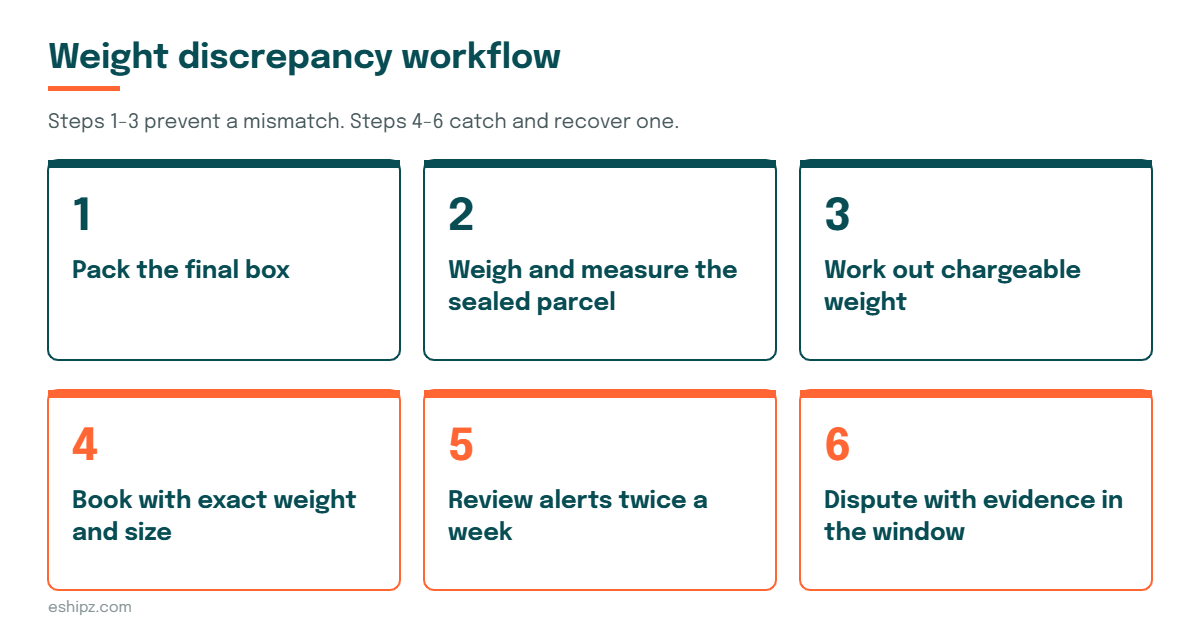
Step 1: Pack the Parcel in Its Final Form
Measure only after the parcel is sealed, because every layer counts. Use the box size that fits the product, not the one closest to hand. Avoid extra void space, since empty volume raises volumetric weight without adding anything useful.
Step 2: Weigh and Measure After Packing
Place the sealed parcel on a scale and record the weight in grams. Measure length, breadth and height with a tape, including bulges at the corners. Photograph the parcel on the scale with the label visible, and photograph the tape against each side.
Step 3: Work Out Chargeable Weight Before You Book
Apply the formula for the courier you plan to use: length × breadth × height ÷ divisor. Compare the result with dead weight and take the higher number. If you ship through several partners, calculate it for each, because the divisor can change the answer.
Step 4: Book With Exact Weight and Dimensions
Enter weight and all three dimensions at booking, not just weight. Delhivery’s guidance asks sellers to give correct weight and dimensions when manifesting an order and to add accurate product descriptions. Placeholder dimensions are one of the easiest ways to create weight discrepancy in shipping on paper before the parcel even moves.
Step 5: Review Weight Discrepancy in Shipping Alerts on a Fixed Schedule
Do not wait for the monthly invoice. Check flagged shipments twice a week so you can act while evidence is fresh and the dispute window is still open. Log declared weight against billed weight for every flagged parcel so patterns by SKU, courier or packer become visible.
Step 6: Dispute With Evidence Inside the Window
Windows are short and differ by platform. Shiprocket’s guidance says disputes must typically be raised within seven days of the notification, and Delhivery’s raise-a-claim option is available for delivered shipments only. Check the rule for each partner you use, and keep the evidence below ready before you file.
| Evidence | Why it matters | How to capture it |
|---|---|---|
| Photo of parcel on scale | Proves dead weight at dispatch | Label visible, display readable |
| Photos of dimensions | Needed to contest volumetric weight | Tape against length, breadth and height |
| Declared weight and dimensions at booking | Shows what you told the courier | Export from your booking record |
| Pattern log for the same SKU | Turns a one-off complaint into a systemic issue | Spreadsheet or dashboard of flagged parcels |
A consolidated dispute covering several parcels with the same cause is harder to dismiss than separate one-line complaints. Keep the tone factual, attach everything in a single submission, and escalate through your account manager if a valid claim is rejected.
Manual Tracking vs Automated Audit for Weight Discrepancy in Shipping
Small brands can start with a spreadsheet. As courier count and order volume grow, manual checking stops scaling, and discrepancies slip past the dispute window.
| Approach | Effort | Catches issues early | Dispute proof | Best for |
|---|---|---|---|---|
| Spreadsheet and courier portals | High, per courier | Only if someone checks daily | Scattered across email and folders | One or two couriers, low volume |
| Aggregator discrepancy dashboard | Medium | Alerts per aggregator | Image upload per case | Brands shipping mostly through one aggregator |
| Automated freight audit across carriers | Low once set up | Flags mismatches against contract rates | Audit trail per invoice line | Multi-carrier brands with rising volume |
The right choice depends on volume and carrier mix. Ask how any tool handles different divisors, how quickly it surfaces flagged parcels, and whether it keeps evidence in one place.
Prevention Checklist for Weight Discrepancy in Shipping
Prevention is cheaper than dispute. Use this checklist as a standing operating routine rather than a one-off clean-up.
- Standardise a box size for every SKU and record it in your catalogue.
- Weigh the sealed parcel after packing, never the bare product.
- Capture length, breadth and height at the packing bench.
- Confirm the volumetric divisor with each courier and write it down.
- Calculate chargeable weight before booking, not after the invoice.
- Calibrate scales on a regular schedule, at your warehouse and by request with partners.
- Photograph the scale and the tape for high-value or bulky parcels.
- Review discrepancy alerts twice a week.
- Raise disputes inside the courier’s window, with evidence attached.
- Review the top flagged SKUs every month and fix their packaging first.
Teams that make this routine spend less time disputing charges, because fewer charges are wrong in the first place. Weight discrepancy in shipping drops fastest when the packing bench owns the process, not finance.
Run a short packing-bench audit each month. Pick ten random parcels, weigh and measure them, and compare the results with what was booked. Any gap shows where weight discrepancy in shipping will appear next.
Common Mistakes That Make Weight Discrepancy in Shipping Worse
Even careful teams repeat a few avoidable errors. Watch for these.
Weighing Before Packing Is Complete
Weighing the product and adding a guessed packaging weight is the fastest route to a mismatch. Packaging varies by order, so the guess is wrong often enough to matter.
Using One Divisor for Every Courier
If you assume 5000 everywhere, a partner using 4000 will produce a higher volumetric weight than you expected. Confirm the constant with each partner before building your rate comparison.
Leaving Default Dimensions in the System
Saved placeholder dimensions make every booking look light. The courier’s machine then measures the real box and the gap appears on the invoice.
Missing the Dispute Window
A valid claim filed late is usually a lost claim. Because windows can be as short as a few days, a weekly review is too slow.
Disputing Without Proof
A dispute that rests on opinion rarely succeeds. Photos, dimensions and the original booking record decide the outcome, so capture them at the time of packing.
Treating Every Charge as a Billing Error
Sometimes the courier is right. If volumetric weight exceeds dead weight, the charge is correct, and the fix is better packaging rather than a dispute.
KPIs to Track Weight Discrepancy in Shipping Every Month
You cannot reduce what you do not measure. These indicators keep weight discrepancy in shipping visible to both logistics and finance.
| KPI | How to calculate it | What it tells you |
|---|---|---|
| Discrepancy rate | Flagged parcels ÷ total parcels shipped | How often your booking and the courier disagree |
| Cost leakage | Extra freight billed due to weight ÷ total freight billed | How much margin the gap consumes |
| Average extra weight | Total extra grams ÷ flagged parcels | Whether the issue is small drift or large packaging errors |
| Dispute win rate | Disputes resolved in your favour ÷ disputes raised | Quality of your evidence |
| Window hit rate | Disputes filed inside the window ÷ flagged parcels | Whether alerts reach the right person in time |
| SKU concentration | Share of flagged parcels from your top five SKUs | Where packaging fixes pay off first |
Review the table monthly with both teams in the room. If a few SKUs drive most flags, fix those boxes first and watch the discrepancy rate fall.
How eShipz Helps You Control Weight Discrepancy in Shipping
Brands that ship through several couriers need one place to see what was booked, what was billed and where the two diverge. eShipz is a logistics automation platform that connects ecommerce channels, OMS, WMS, TMS, ERP and 500+ carriers, so shipment and billing data do not sit in separate tools.
On the billing side, the eShipz homepage describes its freight audit module as checking every invoice against contracted rates and flagging overcharges, duplicate billings and rate mismatches. That matters because a weight-based overcharge is one of the most common reasons invoices and contracts disagree. For a deeper look at the process, read our guide to freight invoice auditing automation.
Used alongside the habits in this guide, a platform like eShipz shortens the time between a billing mismatch and a decision about it. If your team still tracks flagged parcels in spreadsheets, a demo of the eShipz logistics platform is a sensible next step.
Conclusion
Weight discrepancy in shipping is not a mystery charge. It is the predictable result of declared weight, packed weight and courier measurement disagreeing, and each source of disagreement is something your team can control.
Start with the basics: pack in a fixed box, weigh and measure the sealed parcel, book with exact weight and dimensions, and keep photographic proof. Then watch the KPIs, review alerts twice a week and dispute inside the window. As volume grows, move from spreadsheets to an automated audit so that weight discrepancy in shipping stays a small, visible number instead of a hidden drain on margin.
Frequently Asked Questions About Weight Discrepancy in Shipping
1. What is weight discrepancy in shipping?
Weight discrepancy in shipping is the difference between the weight declared at booking and the chargeable weight the courier records at its hub. When the recorded weight is higher, the courier bills the difference as extra freight.
2. How is volumetric weight calculated for Indian couriers?
Multiply length, breadth and height in centimetres, then divide by the courier’s constant, which is commonly 5000. Some partners use other values such as 4000, so confirm the divisor with each courier. The higher of volumetric and dead weight becomes the chargeable weight.
3. How do I dispute a weight discrepancy?
Gather a photo of the parcel on the scale, photos of the dimensions and your booking record, then file the claim on your courier or aggregator dashboard. Attach all evidence in one submission. If a valid claim is rejected, ask for a second-level review through your account manager.
4. How long do I have to raise a weight dispute?
It varies by courier and platform. Shiprocket’s guidance says disputes must typically be raised within seven days of notification, and Delhivery allows claims on delivered shipments only. Check the policy of every partner you use.
5. Can weight discrepancy in shipping be removed completely?
Not entirely, because couriers measure parcels with their own equipment and may use different constants. You can reduce it sharply by standardising boxes, weighing the sealed parcel and booking with exact dimensions. Disputes then handle the genuine exceptions.
6. Do all couriers use the same volumetric divisor?
No. Many domestic couriers use 5000, but some use 4000 or other values depending on mode and shipment type. Always confirm the constant before you compare rates across partners.
7. What evidence wins a weight discrepancy in shipping dispute?
Clear photos of the sealed parcel on a scale with the label visible, recorded dimensions, your original booking weight and a pattern log for repeat SKUs. Evidence captured at packing time carries more weight than anything rebuilt after the invoice arrives.