







RedSeer data, reported by Livemint, showed the cash-on-delivery share of India’s e-commerce shipments falling from 41% before COVID to 28% in August and September 2020 (RedSeer). That drop proved something useful: shoppers will pay upfront when checkout feels safe and the reward is clear. Yet many Indian D2C brands still ship a large share of orders on cash and absorb the cost when those parcels come back.
COD to prepaid conversion is the practice of moving buyers from pay-on-delivery to paying online at checkout or after the order is placed. It is one of the few levers that lowers return-to-origin (RTO) losses, speeds up cash flow and cuts reconciliation work at the same time. This guide shows how to plan COD to prepaid conversion, what it costs, which tactics work and which numbers to track.
What Is COD to Prepaid Conversion?
COD to prepaid conversion means turning a cash-on-delivery order into an online-paid order before the parcel ships. The shift can happen at checkout, through a post-order payment link, or during a confirmation call or WhatsApp message.
The goal is not to remove COD. Many shoppers in smaller cities still want the option, and removing it can cost you the sale. A good COD to prepaid conversion programme keeps COD available but makes prepaid the easier, cheaper or safer choice.
The three places conversion can happen
Brands usually run COD to prepaid conversion at three points: on the payment page, right after the order is placed, and during order confirmation. Each point suits a different buyer. Early nudges work for confident shoppers, while a later follow-up catches buyers who hesitated at checkout.
How conversion differs from simply blocking COD
Blocking COD on risky pincodes or order values is a filter. COD to prepaid conversion is an offer. The filter protects margin but loses orders, while the offer tries to keep the order and change the payment method.
Why COD Orders Fail More Often
A COD parcel carries a promise the buyer has not yet paid for. If the buyer changes their mind, is not home or does not have cash ready, the courier returns the parcel and the brand pays both legs of freight. Prepaid orders still fail, but the buyer has already committed money, so the order is harder to abandon.
The table below lists the usual causes of failed COD deliveries and how COD to prepaid conversion addresses each one. These are qualitative patterns, not statistics.
| Cause of COD failure | What happens | How COD to prepaid conversion helps |
|---|---|---|
| Buyer changes their mind | Refuses the parcel at the door | Money already paid raises commitment |
| Impulse or low-intent order | Order placed on a whim, never confirmed | Payment step filters casual orders |
| Cash not ready | Delivery attempt fails | No cash needed at the door |
| Wrong or vague address | Courier cannot locate the buyer | Payment link prompts a final address check |
| Fake or prank orders | Parcel is shipped to nobody | Online payment filters out many prank orders |
| Long delivery promise | Buyer loses interest while waiting | Prepaid buyers tend to expect and track the parcel |
Each cause links to a different fix, which is why this switch works best alongside address checks and delivery follow-ups. Our guide on COD remittance reconciliation covers the cash-flow side of the same problem.
Which COD Orders to Target First
Not every COD buyer needs the same offer. Some will switch for a small nudge, while others will never pay online. Sorting orders into segments lets you spend incentive money only where it changes the outcome.
| Segment | Typical signals | Suggested approach |
|---|---|---|
| First-time buyer, high basket value | No order history, value above your average | Strong prepaid incentive plus a confirmation message |
| Repeat buyer with clean history | Earlier orders delivered without issues | Light nudge, keep COD open |
| Past refuser | Earlier order refused or returned | Prepaid only, or an advance payment link |
| High-risk pincode | Pincodes with a poor return record in your own data | Prepaid offer plus an address check |
| Low-value impulse order | Small basket, placed late at night | Free-shipping nudge, no cash discount |
Build these segments from your own order history rather than from a generic benchmark. A pincode that returns badly for one brand may behave well for another because of product type, price and courier. Review the segments every month, since buyer behaviour shifts with seasons and sales.
Start with the first-time, high-value segment and the past-refuser segment. They carry the largest loss per failed order, so they repay the effort fastest. Low-value orders can wait, because a small incentive may cost more than the freight you save.
What COD to Prepaid Conversion Costs and Saves
The cost of a failed COD order is easy to underestimate. You pay forward freight, return freight and handling, and the unit sits in transit instead of selling. A conversion offer, such as a small discount, costs money too, so the numbers need to work before you launch.
The model below is illustrative, not real eShipz or customer data. It uses 1,000 monthly orders that all start as COD, and it shows how the monthly cost changes as more buyers switch to prepaid.
Assumptions behind the illustrative model
| Assumption | Illustrative value |
|---|---|
| Monthly orders (all start as COD) | 1,000 |
| Loss per RTO order (forward ₹90 + return ₹90 + handling ₹30) | ₹210 |
| RTO rate on COD orders | 25% |
| RTO rate on prepaid orders | 7% |
| Average conversion incentive per converted order | ₹15 |
These values are hypothetical. Replace them with your own freight rates, RTO rates and incentive cost before you act on the result. The point of the model is the shape of the curve, not the exact rupee figures.
What the model shows
At 0% conversion, the model puts RTO cost at ₹52,500 a month. At 60% conversion, RTO losses fall and the incentive cost rises, but the combined monthly cost drops to ₹38,820. Every extra 20 points of conversion trims the net cost, though the saving shrinks if your incentive per order grows.
The model also leaves out gains that are harder to price, such as faster payment, fewer reconciliation disputes and fewer support calls. Those make the programme look better than the chart suggests, but you should add them only when you can measure them.
A 6-Step COD to Prepaid Conversion Workflow
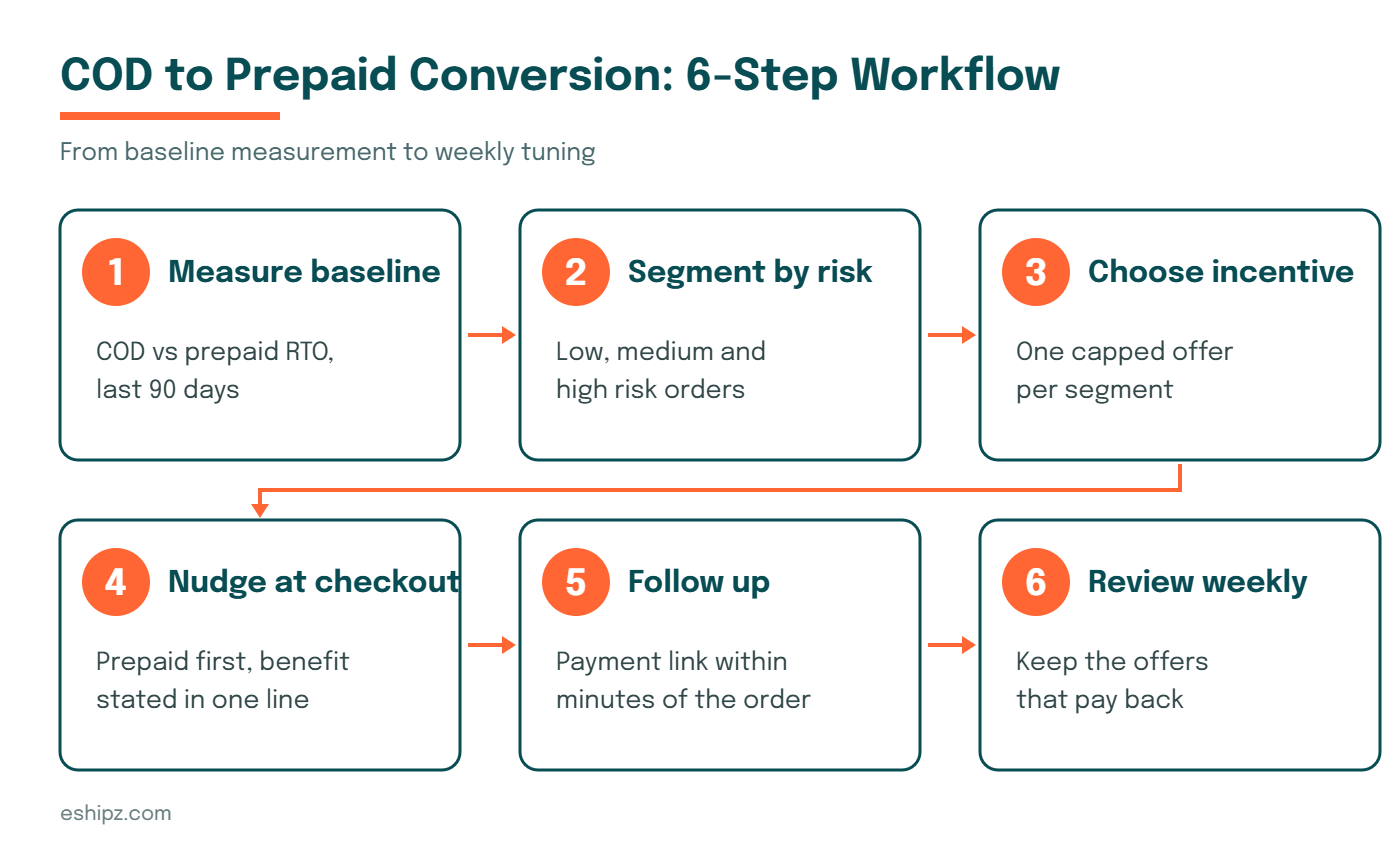
A repeatable workflow keeps the programme from becoming a one-off discount campaign. The six steps below move from measuring your baseline to tuning offers every month.
Step 1: Measure your COD baseline
Pull the last 90 days of orders and split them by payment mode, pincode and order value. Record the RTO rate for COD and for prepaid separately. Without this baseline you cannot tell whether the programme is working.
Step 2: Segment orders by risk
Group COD orders into low, medium and high risk using signals you already have. Useful signals include first-time buyer status, past refusals, pincode history, order value and address quality. Offers should be strongest for the high-risk group.
Step 3: Choose the incentive
Pick one incentive per segment and keep it simple. Options include a flat discount on prepaid, free shipping on prepaid, a small cashback or a gift. Pair each incentive with a cost cap so the incentive never costs more than the RTO loss it prevents.
Step 4: Nudge at checkout
Show the prepaid option first and state the benefit in plain words, such as “Pay online and save ₹50.” Keep COD visible but second. A clear checkout message is the cheapest form of conversion because it needs no follow-up.
Step 5: Follow up after the order
For orders that still select COD, send a confirmation message with a payment link within minutes. Offer the same incentive and a short deadline. This post-order step is where much of the switching happens for hesitant buyers.
Step 6: Review and tune weekly
Compare conversion rate, RTO rate and incentive cost every week. Drop offers that cost more than they save and expand those that work. Treat the programme as an ongoing test, not a fixed policy.
COD to Prepaid Conversion Levers Compared
Brands have several ways to push buyers toward prepaid. The table compares the common levers on effort, cost and risk so you can pick a sensible starting mix.
| Lever | Typical effort | Cost to brand | Risk to conversion rate |
|---|---|---|---|
| Prepaid discount at checkout | Low | Discount on every prepaid order | Low |
| Free shipping on prepaid | Low | Freight absorbed per order | Low |
| Extra fee on COD orders | Low | None, may lower COD volume | Medium: some buyers abandon |
| Post-order payment link | Medium | Messaging cost plus incentive | Low |
| Confirmation call for high-risk orders | High | Agent time | Low |
| COD block on risky pincodes | Low | Lost orders in those areas | High |
Start with the low-effort levers and add the post-order link next. Reserve calls and blocks for the highest-risk segment, where the cost of a failed delivery is greatest. The right mix depends on your margins and your buyers.
Checklist: Setting Up COD to Prepaid Conversion Without Losing Orders
Use this checklist before you switch on any new offer. It protects order volume while you test.
- Export 90 days of orders and record COD and prepaid RTO rates separately.
- Tag each COD order as low, medium or high risk with rules you can explain.
- Set an incentive cap that stays below your average loss per RTO order.
- Keep COD available for buyers who need it, except in segments you have decided to restrict.
- Show the prepaid benefit in one short line at checkout.
- Send a payment link by message within minutes of a COD order.
- Validate the delivery address before dispatch so prepaid orders do not fail on a bad address.
- Review conversion, RTO rate and incentive cost every week.
Run this checklist for one product line first. A narrow test shows whether the change helps your margin before you roll it out to the full catalogue.
Common Mistakes in COD to Prepaid Conversion
Most failed programmes share a handful of errors. Avoid these and the programme is far more likely to pay for itself.
- Removing COD completely. Some shoppers will leave. Restrict COD only where the data supports it.
- Offering the same discount to everyone. Low-risk buyers would have paid online anyway, so you give away margin for nothing.
- Ignoring the address. A prepaid order to a wrong address still comes back, and now you owe a refund.
- Hiding the benefit. If the prepaid advantage sits below the fold, few buyers see it.
- Forgetting refund speed. Slow refunds make buyers distrust prepaid, which undercuts the programme over time.
- Never reviewing the numbers. Incentives drift, and an offer that worked in one season may lose money in the next.
Message Templates for the Payment Nudge
Short, plain wording lifts response better than clever copy. Keep the offer, the deadline and the link in one message, and write it in the language your buyer uses.
- At checkout: “Pay online now and save ₹50 on this order.”
- Right after the order: “Thanks for your order. Pay online in the next 30 minutes to get free shipping. Pay here: [link].”
- Reminder: “Your order is packed and waiting. Complete payment to keep your offer.”
- For high-risk orders: “We need a quick confirmation before dispatch. Reply YES or pay online to confirm.”
Replace the amounts with figures your own model supports. Never promise a benefit you cannot deliver, and honour every offer exactly as written. Trust is what makes buyers willing to pay before they hold the product.
A 30-Day Rollout Plan
A staged launch lowers risk and gives you clean data. The plan below fits a team with one operations lead and basic access to store and payment settings.
Week 1: baseline and segments. Export orders, calculate RTO by payment mode and tag risk segments. Agree the incentive cap with finance.
Week 2: checkout test. Show the prepaid benefit on one product line or one customer group. Keep the rest of the store unchanged so you can compare results.
Week 3: post-order link. Add the payment link message for COD orders in the high-risk segments. Track how many buyers pay within the deadline and how many cancel.
Week 4: review and decide. Compare net saving, drop-off at payment and customer complaints. Expand the offers that pay back, remove those that do not, and write down what you learned for the next quarter.
KPIs to Track for COD to Prepaid Conversion
Track a small set of numbers and review them on a fixed day each week. The table lists the core KPIs, how to calculate them and what they tell you.
| KPI | How to calculate | What it tells you |
|---|---|---|
| Conversion rate | Orders switched to prepaid ÷ COD orders offered the switch | Whether the offer works |
| Prepaid share of orders | Prepaid orders ÷ total orders | Overall payment mix |
| RTO rate by payment mode | RTO orders ÷ shipped orders, split COD and prepaid | The size of the gap you are closing |
| Incentive cost per converted order | Total incentive spend ÷ converted orders | Whether the offer is affordable |
| Net saving per 1,000 orders | RTO loss avoided − incentive spend | The true return on the programme |
| Order drop-off at payment | Abandoned checkouts ÷ checkouts started | Whether the offer hurts sales |
Watch the last two together. A rising conversion rate means little if drop-off at payment also climbs. Good conversion work improves the payment mix without shrinking total orders.
How eShipz Supports COD to Prepaid Conversion
The switch happens at checkout and in messaging, so your store and payment gateway lead the work. The shipping side decides how much the work is worth. eShipz gives you the delivery data that shows which pincodes, couriers and order types lose the most money to RTO.
Based on the eShipz site, the platform lists these relevant capabilities, which you should confirm with the eShipz team for your account:
- COD visibility. The COD management tools track COD collections, support reconciliation and flag discrepancies early.
- NDR and redelivery. ReDelivR uses AI to detect failure reasons and trigger retries, which can reduce RTO on the orders that stay COD.
- Carrier allocation. CarrierSmart AI picks a courier for each order by balancing speed, cost and carrier performance.
- Tracking. Track360 puts every shipment on one dashboard with delay alerts.
- Carrier network. The site mentions 500+ carrier integrations, so you can compare outcomes across couriers.
eShipz does not replace your checkout or payment gateway. Use the eShipz logistics platform to find where RTO costs are highest, then aim your COD to prepaid conversion offers at those segments.
Conclusion
COD to prepaid conversion is a margin and cash-flow tool, not a discount tactic. Start by measuring COD and prepaid RTO rates, segment orders by risk, and test one incentive on one product line. Keep COD available, nudge at checkout, follow up after the order and review the numbers every week.
Run the illustrative model with your own freight, RTO and incentive figures before you scale. If the net saving holds, expand the programme step by step. To see how better delivery data supports that work, explore eShipz and match your COD to prepaid conversion plan to the segments that lose the most.
FAQs
1. What is COD to prepaid conversion?
COD to prepaid conversion is the process of moving a buyer from cash on delivery to online payment before the order ships. It can happen at checkout, through a payment link after the order, or during a confirmation message or call.
2. How does COD to prepaid conversion reduce RTO?
A buyer who has already paid is less likely to refuse the parcel. That lowers the share of orders returned to origin and saves forward and return freight. The size of the saving depends on your own RTO rates.
3. What is a good incentive for COD to prepaid conversion?
Pick an incentive that costs less than your average loss on one RTO order. Common choices are a small prepaid discount, free shipping or cashback. Test one option per risk segment and compare the net saving.
4. Should I remove COD entirely?
Usually not. Removing COD can lose orders from buyers who prefer cash. Keep it available, and use COD to prepaid conversion offers or limits only in segments where the data shows high loss.
5. When should I send a payment link after a COD order?
Send it within minutes of the order, while the buyer is still engaged. Include the incentive and a short deadline. Many brands add a reminder if the link is not used.
6. Which KPIs show that COD to prepaid conversion is working?
Watch the conversion rate, prepaid share of orders, RTO rate by payment mode, incentive cost per converted order and drop-off at payment. Together they show whether you are saving money without losing sales.
7. Can shipping software help with COD to prepaid conversion?
Shipping software does not run your checkout, but it shows which pincodes, couriers and order types lose the most to RTO. That tells you where COD to prepaid conversion offers will pay back first.