









Cash on delivery used to be the default way India shopped online. RedSeer data reported in October 2020 put COD at 28% of e-commerce shipments in August and September 2020, down from 41% in the months before COVID. Even at that lower share, a large slice of every D2C brand’s revenue still sits in a courier’s bank account for days after the customer pays.
That gap between “delivered” and “money received” is where COD remittance reconciliation matters. If you cannot match every rupee a customer handed over to a rupee that reached your account, you are guessing at your own cash flow. This guide explains how COD remittance reconciliation works, where it breaks, what the leakage can cost, and how to build a routine that closes the books every week.
What Is COD Remittance Reconciliation?
COD remittance reconciliation is the process of matching three records for every cash-on-delivery order: what your store says the customer owes, what the courier says it collected, and what the courier actually paid into your bank account. When all three agree, the order is closed. When they do not, you have a discrepancy to chase.
Remittance is the payout. The courier collects cash at the doorstep, holds it for a few days, then transfers it in batches, usually grouped by delivery date, with a statement listing the AWB numbers included. Reconciliation is the check you run on that statement.
A good COD remittance reconciliation process answers four questions for each batch:
- Did every delivered COD shipment appear on a remittance statement?
- Does the amount paid match the order value for each AWB?
- Were any fees, weight charges or penalties deducted, and are they correct?
- Is anything still pending beyond the agreed payout window?
Think of it as the COD version of a bank reconciliation. The data already exists in your order system, your courier dashboard and your bank statement. The work is lining them up reliably.
Why COD Remittance Reconciliation Breaks Down
Most brands do not lose COD money to fraud. They lose it to small mismatches that nobody has time to chase across five courier portals. The table below lists the usual causes.
| Cause | What happens | Where it shows up |
|---|---|---|
| Delivered but not remitted | AWB is marked delivered, cash never appears on a statement | Missing AWB in the remittance file |
| Short payment | Statement amount is lower than the order value | Amount mismatch on a single AWB |
| Deductions netted off | Weight, COD fee or RTO charges are subtracted before payout | Payout lower than the sum of AWB values |
| Timing differences | Courier pays in batches on its own cycle | Orders look “unpaid” though cash is in transit |
| Duplicate or reversed entries | Same AWB appears twice, or a delivery is later reversed | Totals that do not tie to the bank credit |
| Status disputes | Courier shows delivered, store shows NDR or RTO | Order status differs between systems |
Notice that most of these are visible only when you compare records side by side. A courier dashboard on its own looks fine. Your bank statement on its own looks fine. The problem lives in the gap between them.
Multiple couriers make this harder. Each carrier has its own payout cycle, statement format and dispute window, so a brand shipping with four couriers is effectively running four reconciliations in parallel. Our guide to weight discrepancy in shipping explains how one of those deductions, extra chargeable weight, gets netted against COD payouts without a clear line item.
The three-way match
The safest design for COD remittance reconciliation is a three-way match. Your order system provides the expected amount, the courier statement provides the claimed amount, and the bank credit provides the received amount. Any order where the three numbers differ goes into an exception queue.
Two-way matching, store versus courier only, misses cases where the courier reports a payout that never reached your account. Matching against the bank is the step that proves the cash arrived.
A worked example of the three-way match
Take one remittance batch from a single courier. The numbers below are illustrative and only show how the match works.
| AWB (illustrative) | Store expects (₹) | Courier statement (₹) | Result |
|---|---|---|---|
| AWB-1001 | 1,499 | 1,499 | Matched |
| AWB-1002 | 899 | 899 | Matched |
| AWB-1003 | 1,250 | 1,200 | Short by ₹50, raise a dispute |
| AWB-1004 | 2,100 | Not listed | Missing, check proof of delivery |
Here the statement total is ₹3,598 against an expected ₹5,748. Two of four orders match, one is short and one is missing. Without an AWB-level check, you would only see that the batch “looks about right”.
What Poor COD Remittance Reconciliation Costs You
The cost of weak COD remittance reconciliation is rarely one big loss. It is five or six small leaks that add up each month. The model below is illustrative, not benchmark data, so replace the assumptions with your own numbers.
Illustrative assumptions: 10,000 COD orders shipped per month, 7,500 delivered, average order value ₹1,200, so ₹90,00,000 of COD cash collected. Cost of capital 12% a year.
| Leak (illustrative) | Assumption | Monthly cost (₹) |
|---|---|---|
| Delivered but unremitted AWBs | 20 orders × ₹1,200 | 24,000 |
| Short-paid batches | 0.3% of ₹90,00,000 | 27,000 |
| Weight deductions netted from payout | 150 orders × ₹60 | 9,000 |
| COD fee overcharges | 75 orders × ₹25 | 1,875 |
| Cost of delayed cash | 4 extra days at 12% a year on ₹90,00,000 | 11,836 |
| Total | 73,711 |
On these assumptions the brand leaks about ₹73,700 a month, or roughly ₹8.8 lakh a year, without a single fraudulent order. Your numbers will differ, and the point is the shape: small recurring gaps that nobody owns.
The largest items here are the ones that need a person to notice. A short-paid batch or an unremitted AWB does not raise an alert by itself. It only surfaces when somebody compares the statement to the order list, which is exactly what COD remittance reconciliation is for.
The hidden cost of delay
Even correct remittances cost money when they arrive late. Cash that sits with a courier for four extra days cannot fund inventory, ad spend or supplier payments. For a brand running on thin margins, that float is a real financing cost, which the last row of the model captures.
A Step-by-Step COD Remittance Reconciliation Workflow
You can run COD remittance reconciliation weekly in six steps. Each step has a clear input and a clear output, so the process does not depend on one person’s memory.
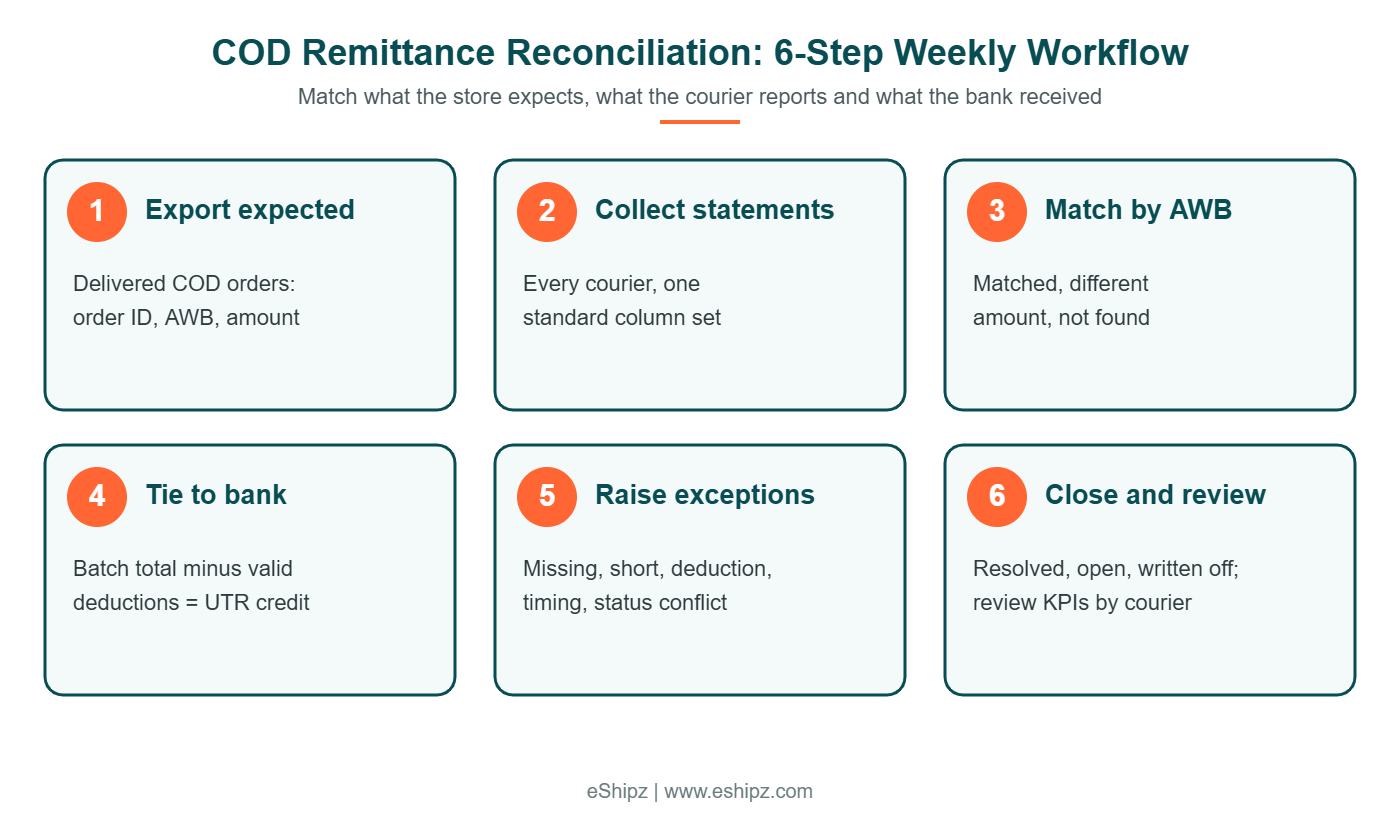
Step 1: Export the expected COD list
Pull every COD order marked delivered in your store or shipping system for the period. Keep order ID, AWB, courier, delivery date and COD amount. This is the “expected” side of the match.
Step 2: Collect every courier remittance statement
Download the statements for the same period from each courier. Standardize them into one sheet with the same columns: AWB, amount remitted, deductions, remittance date and UTR or bank reference. Consistent columns are what make COD remittance reconciliation fast.
Step 3: Match by AWB
Match the expected list to the statements using the AWB as the key. Flag three outcomes: matched in full, matched with a different amount, and not found. Do not match by customer name or order value, because duplicates make those keys unreliable.
Step 4: Tie remittances to the bank
Add the bank credit for each remittance batch using the UTR reference. The sum of AWB amounts, less valid deductions, should equal the bank credit. If it does not, the difference is a batch-level exception.
Step 5: Classify and raise exceptions
Sort each mismatch into a bucket: missing, short, deduction dispute, timing or status conflict. Raise disputes with the courier within its dispute window, attaching proof of delivery and the AWB list. Proof of delivery is the evidence couriers most often ask for.
Step 6: Close the period and review
Record what was resolved, what is still open and what was written off. Review the exception rate and the average days to remittance by courier. This review feeds your next carrier allocation decision.
Who Should Own COD Remittance Reconciliation?
COD remittance reconciliation sits between logistics and finance, which is why it is so often dropped. Logistics knows the couriers and the AWBs. Finance knows the bank and the books.
The cleanest setup gives one named person the weekly routine and a second person the sign-off. Logistics prepares the expected list and the exception queue, and finance confirms the bank credits and approves write-offs. Agree this split in writing, along with a limit on how small a difference you will chase, so effort goes where the money is.
Building a Dispute Evidence Pack
Winning a courier dispute is mostly about evidence. A short, consistent evidence pack saves days of back-and-forth and keeps you inside the dispute window.
For each exception, attach the AWB, the order ID, the delivery date and time from the tracking record, the COD amount on the label and the remittance statement line, or a note that the AWB is missing from it. Add proof of delivery where it exists, such as a signature or delivery photo. Keep the same format every time so couriers can process your claim without questions.
Log each dispute with a date raised, a courier reference and a follow-up date. An open dispute with no follow-up date is how recoverable money turns into a write-off.
Manual vs Automated COD Remittance Reconciliation
Spreadsheets work at 50 orders a day and fall apart at 500. The comparison below shows where the effort goes as volume grows.
| Factor | Manual spreadsheets | Automated matching |
|---|---|---|
| Statement intake | Download and reformat each file | Statements ingested into one format |
| AWB matching | VLOOKUP on thousands of rows | Rule-based match on every AWB |
| Exception detection | Found when someone checks | Flagged as soon as a mismatch appears |
| Courier disputes | Compiled by hand with screenshots | Evidence attached to each exception |
| Audit trail | Scattered across files | One history per order and batch |
| Effort as volume grows | Rises with every courier added | Stays largely flat |
Automation does not remove the need for judgement. Someone still decides which disputes are worth raising and which couriers need a conversation. What it removes is the data wrangling that eats most of the week.
When to Move Beyond Spreadsheets
A spreadsheet is a fine starting point, and many brands run their first year of COD checks on one. The signs that it is time to change are practical rather than technical.
Watch for four signals. The weekly check takes more than half a day, exceptions are found after the dispute window has closed, a new courier means a new template, or only one person understands the formulas. Any one of these means the process depends on effort rather than design.
Before you switch, write down the exact fields you need from every courier: AWB, delivery date, COD amount, amount remitted, deductions, remittance date and bank reference. Any tool you evaluate should deliver those fields without manual reformatting. If it cannot, you have only moved the spreadsheet somewhere else.
COD Remittance Reconciliation Checklist
Use this checklist to keep the routine consistent every cycle. It works equally for a brand reconciling four couriers by hand or one reviewing an automated report.
- Agree the payout window with each courier and write it down.
- Export delivered COD orders on the same day every week.
- Collect every statement before you start, not one at a time.
- Match on AWB, never on customer name or order value.
- Tie each batch to a bank credit using the UTR.
- Check each deduction against the courier’s rate card or contract.
- Raise disputes inside the dispute window, with proof of delivery attached.
- Track every exception to a final status: recovered, written off or open.
- Review courier payout speed and exception rate monthly.
Three habits make the biggest difference: a fixed weekly day, one owner for the process and a single sheet or system that holds every courier’s data.
Common Mistakes in COD Remittance Reconciliation
Even careful teams fall into the same traps. These are the ones to avoid.
Reconciling only against the courier dashboard. The dashboard shows what the courier believes happened. It does not prove money reached your bank.
Ignoring small differences. A ₹40 gap on one order looks trivial. Across thousands of orders and several couriers, it becomes the leak you saw in the cost model.
Missing the dispute window. Couriers set time limits on remittance and weight disputes. A discrepancy found after the window is often unrecoverable, so speed matters.
Mixing delivered and RTO orders. RTO shipments never produce COD cash. Including them in the expected list makes every period look short.
Leaving ownership vague. If finance assumes logistics is checking and logistics assumes finance is, nobody checks. Assign one owner.
KPIs to Track for COD Remittance Reconciliation
You cannot improve what you do not measure. These five metrics tell you whether your COD remittance reconciliation is working.
| KPI | How to calculate | What it tells you |
|---|---|---|
| Reconciliation rate | Orders matched in full ÷ delivered COD orders | How clean your data is |
| Exception rate | Orders with any mismatch ÷ delivered COD orders | Where to focus disputes |
| Days to remittance | Remittance date minus delivery date, by courier | Which couriers hold your cash longest |
| Recovery rate | Value recovered ÷ value disputed | How effective your disputes are |
| Open exceptions aged over 30 days | Count and value of unresolved items | Risk of write-offs |
Review these by courier, not only in aggregate. A healthy overall rate can hide one carrier with a poor payout record, and that insight should feed straight into carrier allocation.
How eShipz Helps With COD Remittance Reconciliation
eShipz is a multi-carrier shipping platform, so COD data from your couriers can sit in one place instead of in separate portals. According to the eShipz platform pages, its Track & Trace gives visibility into COD collections, lets teams track payments, reconcile orders and catch discrepancies early. This is the day-to-day layer of COD remittance reconciliation.
The platform also lists automated freight auditing and reconciliation, which checks carrier bills and flags errors. That matters because weight and fee deductions often arrive netted against COD payouts, so cleaner freight audits make the payout side easier to explain. eShipz also describes integrations with a large number of carriers, which helps when you want one view across couriers rather than a reconciliation per portal.
Whatever tool you use, keep the process the same: expected list, courier statement, bank credit, exception queue. Tools change how fast you get through the steps, not what the steps are. If you are comparing options, start with the data you need from each courier and ask whether the platform can bring it together in the three-way match.
Conclusion: Make COD Remittance Reconciliation a Weekly Habit
Cash on delivery is not going away for many Indian shoppers, so the money trapped between delivery and payout will not disappear either. The brands that stay in control are the ones that treat COD remittance reconciliation as a routine, not a rescue job at quarter-end.
Start small. Pick one day a week, export delivered COD orders, match them to courier statements by AWB and tie each batch to your bank. Track the exception rate for a month and you will quickly see which couriers and which leaks deserve attention.
When volume outgrows spreadsheets, move the matching to a system that gathers every courier’s statements in one place. To see how eShipz fits into that workflow, visit eShipz and explore its tracking, COD visibility and freight audit capabilities.
COD Remittance Reconciliation FAQs
1. What is COD remittance reconciliation?
COD remittance reconciliation is the process of matching the cash-on-delivery amount your store expects, the amount the courier says it collected and the amount that reached your bank. Any difference becomes an exception to investigate or dispute.
2. How often should I run COD remittance reconciliation?
Weekly works for most D2C brands, aligned to your couriers’ payout cycles. High-volume sellers often reconcile daily so exceptions are caught while the dispute window is still open.
3. How long do couriers take to remit COD?
It varies by courier and by contract. Check your agreement for the payout cycle and dispute window, and measure actual days to remittance by courier in your own data.
4. What is the best key to match COD orders?
Use the AWB number. Order IDs and customer details can repeat or change, while an AWB identifies a single shipment, which makes COD remittance reconciliation accurate.
5. Why does my courier payout not match my order total?
Common reasons are deductions for COD fees, weight differences or RTO charges, orders delivered in a different period, and short payments. Compare the statement line by line against your expected list to find the cause.
6. Can I automate COD remittance reconciliation?
Yes. Automation ingests statements, matches by AWB and flags mismatches automatically, which suits brands shipping with several couriers. You still need an owner to review exceptions and raise disputes.
7. What should I do if a delivered order was never remitted?
Check the statements for that AWB first, then confirm delivery with proof of delivery. Raise a dispute with the courier inside its dispute window, attaching the AWB, delivery date and COD amount.