









Festive periods account for around one in four new shoppers in Indian e-retail, according to Bain & Company’s How India Shops Online 2026 report. The same report notes that daily traffic during events such as Flipkart’s Big Billion Days runs at nearly triple business-as-usual levels. Your carriers, warehouse and support desk feel that surge too.
A peak season shipping plan is how you meet that surge on purpose instead of by panic. Most brands start preparing three weeks before the sale, when carrier capacity is already allocated and packaging is on backorder. By then, the cheapest fixes are gone.
This guide gives you a 90-day peak season shipping plan built for Indian D2C brands. You will get a cost model, a six-step workflow, a week-by-week checklist and a KPI table you can copy into your own tracker.
What Is a Peak Season Shipping Plan?
A peak season shipping plan is a written, time-boxed schedule that sets how many orders you expect, which carriers will move them, and who acts when something breaks. It covers forecasting, carrier capacity, packaging, warehouse labor, customer communication and returns. It ends with a review after the sale so next year’s plan starts from real data.
It is different from a general logistics strategy. A strategy describes how you ship all year, while a peak season shipping plan describes how you ship during the few weeks when volume, carrier stress and customer expectations all rise together. Think of it as a runbook with owners and dates.
A good plan answers five questions in plain language:
- How many orders will we ship each day, and on which days will we peak?
- Which carriers handle which pin codes, and what is the backup for each?
- What is the daily order cut-off, and who approves exceptions?
- Which customer messages go out automatically, and when?
- What triggers an escalation, and who gets the call?
Why Peak Season Breaks Shipping Operations
Peak season rarely breaks one thing. It stresses every handoff at once: the warehouse, the pickup, the line-haul, the last mile and the customer inbox. A weakness that costs you two percent of orders in March can cost far more in October.
The table below maps the common failure points to what they cause and how a peak season shipping plan addresses each.
| Failure point | What happens at peak | What the plan does |
|---|---|---|
| Carrier capacity | Couriers cap daily pickups or slow down in busy pin codes | Reserve volume early and assign a backup carrier per zone |
| Pickup delays | Parcels sit at the warehouse past the cut-off | Set fixed pickup windows and track missed pickups daily |
| Address quality | Wrong or incomplete addresses fail more delivery attempts | Validate addresses at checkout and confirm COD orders |
| Failed deliveries | Customers are unreachable and NDRs pile up | Pre-write NDR responses and staff the follow-up queue |
| Support load | Customers ask where their order is | Send proactive tracking updates before they ask |
| Returns surge | Returned parcels arrive after the sale ends | Plan return lanes, inspection space and refund timing |
Notice that most rows are process problems, not technology problems. You can fix a missed pickup with a clear schedule and a daily check. That is why the plan matters more than any single tool.
What a Missing Peak Season Shipping Plan Costs
Brands usually measure peak season by revenue, but shipping losses hide inside many small line items. Extra return shipments, express upgrades, support tickets and canceled orders each look minor. Together they can erase the margin from your best sales week.
The model below is illustrative. It uses a hypothetical brand shipping 1,000 peak-week orders and shows how much leakage appears when there is no peak season shipping plan. Every figure is an assumption for demonstration, not an industry benchmark.
The assumptions behind the bars are shown in the next table, so you can swap in your own numbers.
| Leakage source | Orders affected (per 1,000) | Cost per order (₹) | Total (₹) |
|---|---|---|---|
| Extra RTO from unrecovered failed deliveries | 30 | 180 | 5,400 |
| Support tickets about order status | 120 | 35 | 4,200 |
| Express upgrades after missed cut-offs | 40 | 60 | 2,400 |
| Orders canceled after late dispatch | 15 | 100 | 1,500 |
| Billing disputes on weight or charges | 25 | 45 | 1,125 |
| Total leakage per 1,000 orders | 14,625 |
The RTO cost of ₹180 assumes ₹80 for the forward shipment, ₹80 for the return and ₹20 for repacking. At 10,000 peak orders, the same assumptions would put leakage near ₹1.46 lakh. Even if your real numbers are half of that, the case for a peak season shipping plan is clear.
Peak Season Shipping Plan: 6 Steps in 90 Days
The workflow below counts backward from your first sale day. Day 90 is the starting line, and day 0 is the day the sale goes live. Each step has one owner and one output, so nothing depends on memory.
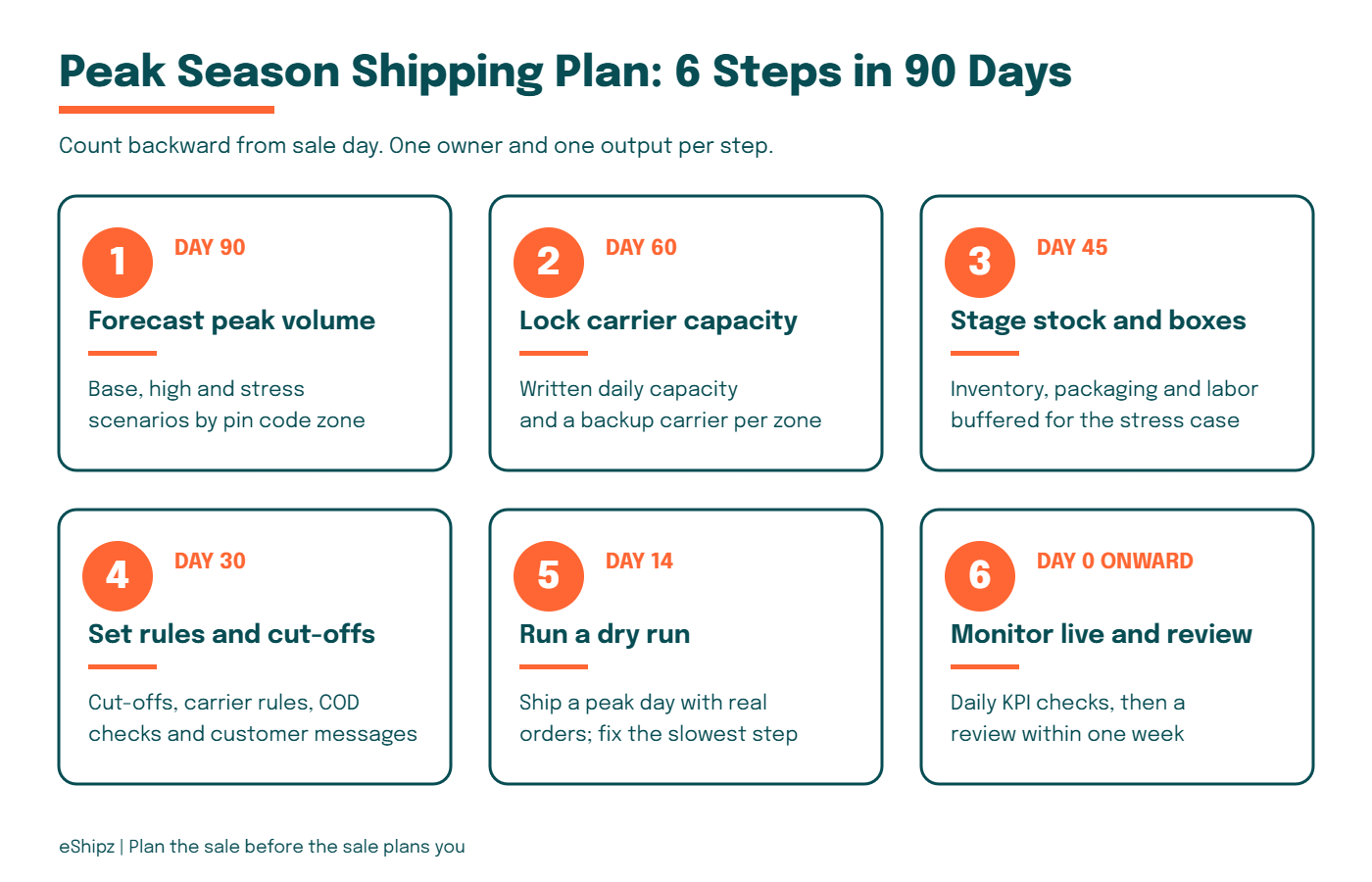
Step 1: Forecast Peak Volume (Day 90)
Start with last year’s order data by day, then adjust for this year’s marketing calendar and any new channels. Build three scenarios: base, high and stress. A common approach is to set the stress case well above your high case, because carrier contracts and staffing depend on the number you plan for, not the number you hope for.
Forecast by pin code zone, not only by total orders. A surge in tier-2 and tier-3 cities needs different carriers than a surge in metros. Bain’s report notes that tier-2 and smaller cities contribute a large share of incremental e-retail orders, so zone-level forecasts matter.
Step 2: Lock Carrier Capacity (Day 60)
Share your three forecast scenarios with each carrier account manager and ask for written daily capacity by zone. Agree on peak surcharges, weight slab rules and pickup windows before the rush, because negotiating during a sale means accepting whatever is offered.
Set a peak budget alongside your peak season shipping plan, covering surcharges, extra pickups and expedited shipping for orders that cannot wait. A number agreed in advance prevents arguments during the sale. Keep at least two carriers for every major zone. Review each partner against a scorecard so allocation follows performance, not habit; our courier performance scorecard guide shows how to build one.
Step 3: Stage Inventory and Packaging (Day 45)
Move fast-selling stock closer to the packing line and confirm that boxes, tape, labels and fillers cover the stress scenario with a buffer. Packaging shortages are one of the most avoidable causes of delayed dispatch. Order early, because suppliers face the same demand you do.
Label and test every box size against your carrier’s weight slabs. Wrong dimensions at peak create billing disputes weeks later, when your finance team has no time to chase them.
Step 4: Configure Rules and Cut-offs (Day 30)
Write down your shipping rules in a format your team can read in ten seconds. Include the daily order cut-off, which carrier gets which pin codes, how COD orders are verified and what happens when a carrier’s pickup is missed. A rule that lives in one person’s head will fail on the busiest day.
Set up customer messages at the same time. Order confirmation, dispatch, out-for-delivery and failed-delivery updates should send automatically, so your support team handles exceptions instead of status questions.
Step 5: Run a Dry Run (Day 14)
Simulate a peak day with real orders. Ship a day’s volume through the packing line, hand it to carriers and track it through the first delivery attempt. You are looking for the step that slows first, whether that is label printing, pickup, sorting or tracking updates.
Fix what the dry run exposes and run it again for the weakest step. Record how long each task took, because those timings become the capacity numbers in your peak season shipping plan. A two-hour rehearsal two weeks out is worth more than a long meeting the night before.
Step 6: Monitor Live and Review (Day 0 Onward)
During the sale, check a short dashboard at fixed times each day. Track orders shipped against forecast, pickups completed, first-attempt delivery and open failed deliveries. When a number crosses its limit, the plan names who acts.
After the sale, hold a review within one week. Compare actual results to your forecast, update the carrier scorecard and write down three changes for next year’s peak season shipping plan.
Peak Season Shipping Plan Checklist by Week
Use this table as a master tracker. Each row has an owner column you can fill in, so responsibility is visible to everyone.
| When | Task | Output | Owner |
|---|---|---|---|
| Day 90 | Build base, high and stress forecasts by zone | Forecast sheet | Operations lead |
| Day 75 | Share forecasts with carriers and request capacity | Written capacity by zone | Logistics manager |
| Day 60 | Sign peak rate and pickup terms | Signed rate cards | Logistics manager |
| Day 45 | Order packaging for the stress case plus buffer | Purchase orders confirmed | Warehouse lead |
| Day 30 | Finalize cut-offs, carrier rules and COD checks | Rulebook | Operations lead |
| Day 30 | Set up automated customer messages | Message templates live | Customer experience lead |
| Day 21 | Hire and train seasonal staff | Trained shift roster | Warehouse lead |
| Day 14 | Run a full dry run with real orders | Dry-run report | Operations lead |
| Day 7 | Freeze rule changes except for emergencies | Change log | Operations lead |
| Day 0 | Start live monitoring at fixed times | Daily dashboard | Logistics manager |
| Day +7 | Review results and update the plan | Post-peak report | Leadership team |
Treat the freeze at day seven seriously. Last-minute rule changes cause more mistakes than they prevent.
Who Owns the Peak Season Shipping Plan?
A plan without an owner is a document nobody opens. Name one person who owns the peak season shipping plan end to end, usually the head of operations or logistics. Give that person authority to approve cut-off exceptions and to move volume between carriers.
Then assign a lead for each area: warehouse, carrier relations, customer experience and finance. Hold a fifteen-minute standup each morning of the sale. Each lead reports one number and one risk, and the owner decides what changes today.
Finance deserves a seat too. Peak surcharges, extra labor and expedited shipping hit the budget quickly, so agree on a spending ceiling in advance. When the limit is close, the owner decides whether to pause a promotion or absorb the cost.
Reactive Shipping vs. a Peak Season Shipping Plan
Many teams believe they already handle peak well because they survive it. Survival and control are different. The table compares how the two approaches behave on the same busy week.
| Area | Reactive approach | With a peak season shipping plan |
|---|---|---|
| Forecasting | One total number from last year | Three scenarios by zone |
| Carrier allocation | Default carrier until it fails | Primary and backup carriers by pin code |
| Cut-off time | Moves daily as backlog grows | Fixed and announced in advance |
| Customer updates | Sent after complaints rise | Automated at each shipment milestone |
| Escalation | Whoever notices first | Named owner and trigger limits |
| Post-peak learning | Informal comments | Written review with next-year actions |
The plan costs time upfront and saves far more during the sale. Teams that adopt a peak season shipping plan also find that new hires ramp faster, because the rules are written down.
Common Mistakes in a Peak Season Shipping Plan
Even good teams repeat the same errors. Watch for these five.
Planning Only for the Average Day
Peak orders do not arrive evenly. They spike on the first day, around payday weekends and at the end of the sale. If your plan uses an average, your busiest day will exceed it.
Relying on One Carrier
One carrier is simple until its network congests in your top pin codes. A backup carrier with agreed rates gives you somewhere to move volume without emergency negotiations.
Ignoring Returns
Returns follow sales with a delay. If your return lane, inspection space and refund process are not ready, returned stock stays unsellable and customers wait for money.
Leaving Customer Updates for Later
When customers cannot see where their order is, they contact support. Proactive messages cost far less than a support queue, and they protect your brand during a stressful week.
Skipping the Review
A plan that is never reviewed repeats the same mistakes every year. Schedule the post-peak review before the sale starts, so it does not disappear when the rush ends.
KPIs to Track in Your Peak Season Shipping Plan
You cannot manage what you do not measure. Choose a short list of metrics, define each one in writing and check them at fixed times. The table below suggests a starting set; targets are yours to set from your own history.
| KPI | How to measure | Why it matters |
|---|---|---|
| Order-to-dispatch time | Hours between order and handover to the carrier | Shows warehouse and cut-off discipline |
| Pickup completion rate | Pickups completed divided by pickups scheduled | Flags carrier capacity problems early |
| First-attempt delivery rate | Orders delivered on first attempt divided by orders attempted | Signals address quality and carrier performance |
| NDR resolution time | Time from failed attempt to the next action | Reduces RTO |
| RTO rate | Returned-to-origin orders divided by orders shipped | Shows the cost of failed deliveries |
| Support tickets per 100 orders | Status tickets divided by orders, times 100 | Tests how well proactive updates work |
| Billing dispute rate | Disputed invoices divided by invoices | Reveals weight and rate errors |
Pick a baseline from your last non-peak month and set the peak target relative to it. Review the list daily during the sale and weekly afterward.
How eShipz Supports Your Peak Season Shipping Plan
A written plan still needs tools to carry it out. According to the eShipz website, the platform connects to 500+ carrier integrations, so you can spread volume across carriers instead of depending on one. Its allocation engine, CarrierSmart AI, compares carriers on speed, cost and performance to choose a courier for each order.
For daily operations, the AutoShip Hub handles label generation and courier sync, and Track360 provides real-time tracking with delay alerts. ReDelivR uses AI to detect failure reasons and trigger smart retries, which supports your NDR queue during busy weeks. FreightGuard AI checks carrier invoices against contracted rates, so billing disputes surface after the rush instead of staying hidden.
If you are comparing options, start with a multi-carrier shipping platform that supports your channels and carriers, then map each feature to a step in your plan. Match tools to the six steps rather than buying features you will not use.
Conclusion
A peak season shipping plan turns a stressful sales period into a managed project. Start 90 days out, forecast three scenarios by zone, lock carrier capacity in writing and rehearse with real orders. Then watch a short set of KPIs live and review the results within a week.
You do not need a perfect plan. You need a written one with owners, dates and triggers that your whole team can follow. Copy the checklist above, assign names and begin this week. To see how a shipping automation platform can support each step, visit eShipz.
Peak Season Shipping Plan FAQs
1. What is a peak season shipping plan?
A peak season shipping plan is a written schedule that covers forecasting, carrier capacity, packaging, staffing, customer updates and returns for your busiest sales weeks. It names owners, dates and escalation triggers. It also includes a post-sale review.
2. When should I start my peak season shipping plan?
Start about 90 days before your first major sale. That gives you time to negotiate carrier capacity, order packaging and run a dry run before volume arrives. Starting later is possible, but you will have fewer options and higher costs.
3. How do I forecast order volume for peak season?
Use last year’s daily orders as the base, then adjust for this year’s marketing calendar and new channels. Build a base, a high and a stress scenario, and forecast by pin code zone. Plan staffing and carrier capacity against the stress case.
4. How many carriers do I need during peak season?
Keep at least two carriers for each major zone: one primary and one backup. The exact number depends on your volume and geography. The goal is to move shipments quickly when one network slows down.
5. What should be in a peak season shipping plan checklist?
Include forecasts, signed carrier terms, packaging orders, cut-off rules, COD verification, automated customer messages, staff training, a dry run, a rule freeze and a post-peak review. Assign each task an owner and a date. Track completion weekly.
6. Which KPIs matter most during peak season?
Track order-to-dispatch time, pickup completion rate, first-attempt delivery rate, NDR resolution time, RTO rate, support tickets per 100 orders and billing dispute rate. Set targets from your own baseline. Check them at fixed times each day.
7. Can small brands use a peak season shipping plan?
Yes. A small brand can use the same six steps with fewer carriers and a shorter checklist. The discipline of forecasting, setting cut-offs and reviewing results matters at any size.