









India’s online shopper base reached nearly 290–300 million in 2025, with Tier-2 and smaller cities contributing around 65% of new shoppers, according to the IBEF e-commerce industry report. Every one of those shoppers expects a parcel that arrives on time and at a fair delivery charge. For a seller, that charge starts with a number most teams never check: the weight the courier actually bills.
That number often comes from volumetric weight calculation, not from your weighing scale. A light but bulky parcel can be billed like a heavy one, and the gap shows up later as a surprise line on the invoice. Sellers who master volumetric weight calculation early can fix the cause at the packing table instead of arguing about it after dispatch.
This guide explains volumetric weight calculation in plain terms. You will see the formula, a step-by-step method, worked examples, a cost comparison, a prevention checklist and the KPIs worth tracking. Every rupee figure and carton size in this article is illustrative, so replace it with your own rate card and measurements before you act.
What Is Volumetric Weight Calculation?
Volumetric weight calculation converts the space a parcel occupies into a weight figure. Carriers do this because a delivery van, a sorting belt and an aircraft hold limited space as well as limited load. A box of pillows takes the same room as a box of books, but it weighs far less.
The carrier compares two numbers: the actual (dead) weight from a scale and the volumetric weight from the box dimensions. The higher of the two becomes the chargeable weight. That chargeable weight, not the scale reading, sets your freight price.
In practice, volumetric weight calculation is simple arithmetic. The difficulty is doing it consistently for every SKU, every carton size and every carrier. Teams that skip it lose margin quietly, one parcel at a time.
Volumetric Weight Calculation Formula
The standard formula multiplies length, breadth and height in centimeters, then divides by a carrier divisor. The result is in kilograms.
The divisor is set by each carrier and can differ by service, so never assume one value fits every shipment. This guide uses 5,000 as an illustrative divisor to keep the examples easy to follow. Confirm the real divisor in your own rate card or contract before you build a calculator around it.
Key terms in volumetric weight calculation
The table below defines the five terms you will meet on every rate card and invoice.
| Term | Meaning | Where to find it |
|---|---|---|
| Actual weight | Weight of the packed parcel on a scale | Your packing station scale |
| Volumetric weight | Space-based weight from length × breadth × height ÷ divisor | Your own calculation |
| Chargeable weight | The higher of actual and volumetric weight, rounded to a slab | Courier invoice |
| Divisor | The number a carrier uses to convert cubic centimeters into kilograms | Rate card or contract |
| Weight slab | The billing step, such as every 500 g | Rate card |
Why Volumetric Weight Calculation Matters for Your Margins
Freight is usually one of the largest variable costs for an online seller, and it grows with every order you add. Small errors that look harmless on one parcel become large when multiplied by thousands of parcels a month. When the billed weight is higher than you expected, the extra cost lands on your margin or on your customer. Neither outcome is good for repeat orders.
Light, bulky products suffer most. Pillows, apparel, plush toys, lampshades and empty bottles all fill a lot of space and add little weight. For these items, the carton volume decides the freight bill far more than the scale does.
Most billing gaps trace back to a handful of causes, shown below. Each one is fixable once you know where to look.
| Cause | What happens | Quick fix |
|---|---|---|
| Oversized carton | Empty space raises the volume you pay for | Move to right-sized cartons |
| Missing SKU dimensions | Rates are quoted on guessed sizes | Store length, breadth and height per SKU |
| Weight-only rate quote | You quote on actual weight but the carrier bills on volume | Quote on chargeable weight |
| Wrong divisor in your sheet | Your estimate differs from the invoice | Match the divisor to each carrier |
| Padding added after measuring | The parcel grows after the check | Re-measure the packed parcel |
When these gaps reach the invoice, they appear as weight disputes. Our guide on weight discrepancy in shipping explains how to challenge them with evidence. Accurate weight checks before dispatch make most of those disputes unnecessary.
Step-by-Step Volumetric Weight Calculation
A repeatable process keeps every packer and every carrier on the same page. The five steps below work for a single parcel or for a full day’s dispatch.
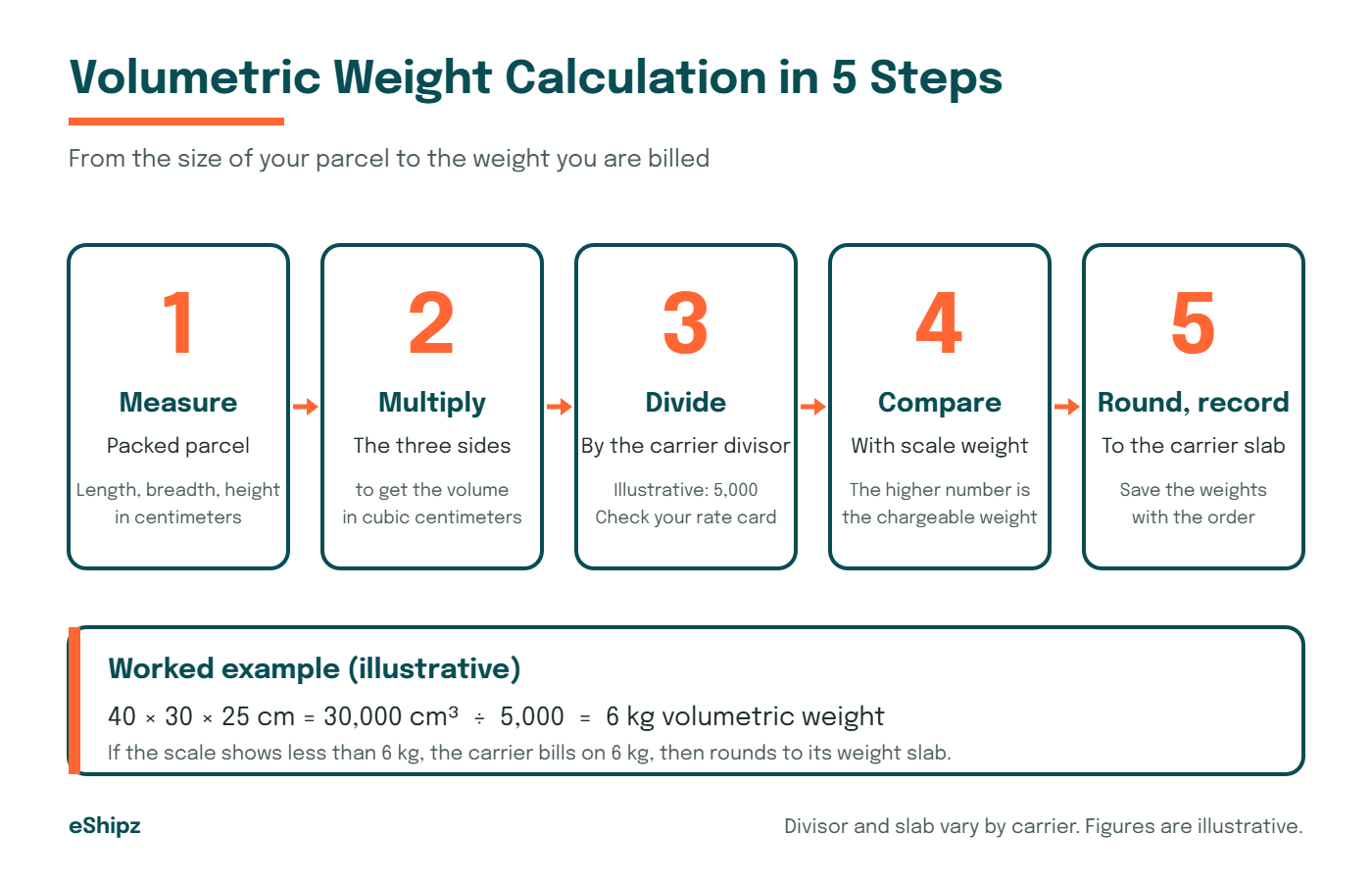
Step 1: Measure the packed parcel
Measure the parcel after it is sealed, not the empty carton. Padding, tape and bulging corners all add centimeters. Record length, breadth and height to the nearest centimeter, using the same tape for every parcel. A simple measuring jig fixed to the packing table keeps readings consistent between shifts.
Step 2: Multiply and divide for volumetric weight calculation
Multiply the three dimensions to get the volume in cubic centimeters. Divide that volume by the carrier divisor. The result is your volumetric weight in kilograms.
For example, a carton of 40 × 30 × 25 cm holds 30,000 cubic centimeters. With the illustrative divisor of 5,000, the volumetric weight is 6 kg.
Step 3: Compare with actual weight
Weigh the packed parcel on a calibrated scale. Place the actual weight next to the volumetric weight. The higher number is the chargeable weight.
Step 4: Round to the carrier slab
Carriers bill in slabs, such as 500 g steps. A chargeable weight of 1.4 kg is therefore billed as 1.5 kg if the slab is 500 g. Always check your own rate card for the slab size and rounding rule.
Step 5: Record and review the volumetric weight calculation
Save the dimensions, the actual weight and the chargeable weight against the order. When the invoice arrives, compare it with your record. Any difference gives you a starting point for a dispute or a packaging fix.
Volumetric Weight Calculation Examples (Illustrative)
Examples make the rule easier to remember. The table uses the illustrative divisor of 5,000, and the products are typical items that sellers ship every day.
| Product | Box size (cm) | Actual weight (kg) | Volumetric weight (kg) | Chargeable weight (kg) |
|---|---|---|---|---|
| Pair of pillows | 50 × 40 × 25 | 1.5 | 10.0 | 10.0 |
| Set of books | 30 × 20 × 15 | 4.0 | 1.8 | 4.0 |
| T-shirt bundle | 35 × 25 × 8 | 0.5 | 1.4 | 1.4 |
| Ceramic mug set | 25 × 25 × 20 | 2.0 | 2.5 | 2.5 |
| Phone case | 18 × 12 × 4 | 0.2 | 0.17 | 0.2 |
The pillows show the extreme case. They weigh 1.5 kg on the scale but are billed as 10 kg, nearly seven times more. The books show the opposite: they are dense, so the actual weight wins.
Notice that the t-shirt bundle and the mug set sit in the middle. A small change in carton size could flip which number wins. That is why this rule belongs in your packaging decisions, not only in your billing checks.
The Cost of Ignoring Volumetric Weight Calculation
Consider one product that weighs 1 kg when packed. You can ship it in three different cartons, and each carton changes the chargeable weight. The comparison below uses an illustrative rate of ₹50 per 500 g slab for the same destination zone.
Carton A (30 × 25 × 20 cm) gives 3.0 kg volumetric weight, so you pay for 3.0 kg, or six slabs. Carton B (25 × 20 × 15 cm) gives 1.5 kg, or three slabs. Carton C (20 × 15 × 12 cm) gives 0.72 kg, so the 1 kg actual weight wins and you pay for two slabs.
Now scale the difference. If you ship 10,000 parcels a month, moving from Carton A to Carton C saves ₹200 per parcel, or ₹20,00,000 a month in this illustration. Real savings depend on your rates, your zones, your cash-on-delivery mix and the protection each product needs. Smaller cartons can also lower your packing material spend, although the extra effort of choosing the right size has a cost of its own. Carton C only works if the product stays safe inside it.
This is why volumetric weight calculation deserves a place in your cost reviews. A few centimeters on each side can double the freight bill without changing the product at all.
Prevention Checklist for Accurate Volumetric Weight Calculation
Use this checklist to build good habits across your warehouse and your catalog. Each item is small, and together they prevent most surprises.
- Store length, breadth, height and packed weight for every SKU in your catalog or order system.
- Keep a short list of standard carton sizes so packers do not improvise.
- Match each product to the smallest carton that still protects it.
- Confirm the divisor and the weight slab for each carrier in writing.
- Use a calibrated scale and a fixed measuring tape at every packing station.
- Re-measure after padding, taping or bundling, since these add volume.
- Quote customers and compare carriers on chargeable weight, not actual weight.
- Review a sample of invoices against your own records every week.
Who Owns This Process Inside Your Business
Weight billing touches several teams, and gaps appear when each team assumes another one is watching. Assigning a clear owner for each task keeps the data clean from catalog to invoice.
- Catalog or merchandising team: records length, breadth, height and packed weight when a product is added.
- Warehouse team: picks the right carton, measures the sealed parcel and flags any mismatch before handover.
- Logistics or shipping team: confirms divisors and slabs with each carrier and updates them when a rate card changes.
- Finance team: compares invoices with stored records and raises disputes with evidence.
A shared record matters more than any single tool. When all four teams read the same dimensions, the weight on the label, the weight in the quote and the weight on the invoice start to agree.
How Carriers Check Dimensions
Carriers do not simply trust the weight you declare. Depending on the carrier and the hub, a parcel may be measured by hand or passed through an automated scanner. If the measured size differs from your declared size, the carrier may revise the billed weight and send an adjustment.
You cannot control the carrier’s measurement, but you can control your own evidence. Photograph a sample of sealed parcels with a tape measure in the frame, and store the photo with the order. Clear records turn an argument about opinions into a comparison of facts.
Keep one more habit in mind. Declare dimensions truthfully, because under-declaring only moves the cost from the quote to a later adjustment, and it can damage your relationship with the carrier.
A 30-Day Plan to Fix Your Weight Data
You do not need a large project to improve. A focused month is enough to see real change.
- Week 1: Export your top 50 SKUs by order volume and record their packed dimensions and weight.
- Week 2: Collect the divisor, slab size and rounding rule from every carrier agreement.
- Week 3: Test smaller cartons for your five bulkiest products and compare the chargeable weight.
- Week 4: Audit a sample of recent invoices against your records and list every difference.
At the end of the month, review what you found. The list of differences shows exactly where to focus next, whether that is packaging, catalog data or a carrier conversation.
Packaging Options Compared
Packaging is the biggest lever you control. The table compares four common options by their effect on volumetric weight and on product protection.
| Packaging option | Effect on volumetric weight | Protection level | Best for |
|---|---|---|---|
| Standard oversized carton | High, because of unused space | High | Rare mixed loads, not routine dispatch |
| Right-sized carton | Low | High | Most everyday SKUs |
| Poly mailer | Lowest | Low | Soft goods such as apparel |
| Custom-cut insert box | Low | Very high | Fragile or high-value items |
Right-sizing is rarely a one-time project. As your catalog changes, revisit carton sizes every quarter and test new options on a small batch before rolling them out.
Common Mistakes in Volumetric Weight Calculation
Even careful teams repeat a few errors. Knowing them in advance saves weeks of dispute emails.
- Using one divisor for every carrier. Each carrier sets its own divisor, so one shared formula produces wrong estimates.
- Measuring the empty carton. The packed parcel is usually larger once padding and tape are added.
- Ignoring rounding. A slab can add a full step to the bill, even when the raw number looks small.
- Quoting customers on actual weight. The carrier bills on chargeable weight, so your margin takes the difference.
- Skipping dimensions in the catalog. Without stored sizes, the calculation becomes guesswork at the packing table.
- Never auditing invoices. If you do not compare invoices with your records, errors repeat month after month.
KPIs to Track for Volumetric Weight Calculation
What you measure improves. The five KPIs below show whether your weighing process is working.
| KPI | How to calculate | Why it matters |
|---|---|---|
| Weight variance % | (Billed weight − declared weight) ÷ declared weight × 100 | Shows how far invoices drift from your records |
| Volumetric share of shipments | Parcels billed on volumetric weight ÷ total parcels | Reveals how much of your volume is bulky |
| Average chargeable weight per order | Total chargeable weight ÷ number of orders | Tracks the effect of packaging changes |
| Freight cost per order | Total freight spend ÷ number of orders | Links weight decisions to margin |
| Disputes won % | Disputes accepted ÷ disputes raised | Measures the quality of your evidence |
Review these KPIs monthly and break them down by carrier and by product category. Share the results with the warehouse and finance teams together, so packaging fixes and invoice checks happen in the same conversation. Patterns appear quickly. A single product that always bills on volume is a clear candidate for new packaging.
How eShipz Helps With Volumetric Weight Calculation
Manual spreadsheets work for a few dozen parcels a day, but they break down at scale. A multi-carrier shipping platform like eShipz is built to bring order, rate comparison and automation to the dispatch process. Check the current feature list on the site to confirm what fits your workflow.
In a typical setup, you store product dimensions once and reuse them on every order. You compare carrier rates on the chargeable weight instead of guessing. You also generate labels and manifests from the same order record, so the data your packer sees matches the data your carrier receives.
When invoices arrive, a consistent record makes freight audit and dispute handling faster. Explore how eShipz shipping automation can fit into your volumetric weight calculation process, and ask the team how it handles dimensions and weight checks for your carriers.
Conclusion
Volumetric weight calculation is simple, yet it quietly shapes the freight bill for every bulky parcel you ship. The formula takes seconds, but the habits around it, such as storing dimensions, right-sizing cartons and comparing invoices, protect your margin. Start with your five highest-volume SKUs and measure what each one really costs to ship.
Then confirm the divisor and slab for each carrier, update your packaging list and track the KPIs above every month. If you want help turning these steps into an automated workflow, talk to the eShipz team about your carriers and volumes. Better volumetric weight calculation means fewer disputes, lower freight and happier customers.
Frequently Asked Questions About Volumetric Weight Calculation
What is volumetric weight calculation in shipping?
Volumetric weight calculation converts the space a parcel takes into a weight value. The carrier multiplies length, breadth and height, then divides by its divisor. It then bills the higher of the volumetric and actual weight.
How do I do a volumetric weight calculation for one parcel?
Measure the packed parcel in centimeters and multiply the three dimensions. Divide the result by your carrier’s divisor to get kilograms. Compare it with the scale weight, and the higher number is your chargeable weight.
Which divisor should I use for volumetric weight calculation?
Use the divisor written in your carrier’s rate card or contract. Different carriers and services can use different values. This guide uses 5,000 only as an illustrative number.
Why does my courier bill more than the weight on my scale?
The courier probably used the volumetric weight because it was higher than the actual weight. This happens often with light, bulky items. Check the box dimensions and the divisor against the invoice. If the numbers do not match, raise it with your carrier and share your stored measurements.
Can better packaging reduce volumetric weight?
Yes. Smaller cartons that still protect the product reduce volume and therefore volumetric weight. Right-sizing is the most direct way to lower the billed weight. Test any new carton on a small batch first, so protection does not suffer.
How can I check volumetric weight calculation on invoices?
Compare the dimensions and weight on each invoice line with your own records. Look for parcels where the billed weight is higher than your chargeable weight. Raise a dispute with the measurements you stored.
Does volumetric weight calculation apply to all shipments?
It applies to most courier, air and express shipments, but the rules differ by carrier and service. Some carriers may bill differently for certain products or lanes. Always confirm the rule in your agreement. If the wording is unclear, ask your carrier contact to explain it with a worked example.