








Fuel is the biggest cost line for the fleets that move your parcels. The ICRA research note on road logistics (June 2026) says fuel forms 50-60% of operating costs for fleet operators, and that a roughly 8% diesel and CNG price increase in May 2026 is expected to squeeze industry margins. That pressure does not stay with the carrier for long.
It reaches your invoice as a line called the fuel surcharge. Understanding fuel surcharge in shipping is the difference between a freight bill you can forecast and one that surprises you every month.
This guide explains fuel surcharge in shipping in plain terms: what it is, how couriers calculate it, what it costs a growing brand, and how to control it. Every rupee figure in the worked examples is illustrative, so replace it with your own rate card before you act.
What Is Fuel Surcharge in Shipping?
Fuel surcharge in shipping is an extra charge that a courier adds on top of base freight to cover changes in fuel costs. It is usually shown as a percentage of the base freight, and it is revised by the carrier from time to time. When fuel prices rise, the percentage tends to rise. When they ease, it may fall.
The surcharge exists because carriers sign rate cards that stay fixed for months, while diesel prices move much faster. Instead of renegotiating every rate each time fuel moves, the carrier keeps the base rate steady and adjusts one variable line. That is why the charge looks small on one parcel and large across a month of orders.
Three points are worth remembering from the start:
The surcharge is separate from the base freight, so a low headline rate does not mean a low final cost. It is often charged on the base freight only, but some contracts apply it to other charges too. And the percentage can change during your contract unless your agreement says otherwise.
How Fuel Surcharge in Shipping Is Calculated
Most couriers calculate fuel surcharge in shipping as a percentage multiplied by a charge base. The percentage comes from the carrier’s own notice or rate card. The charge base is usually base freight, though your contract may add other components.
Here is the simple formula used in the worked example below:
Fuel surcharge = Base freight × Surcharge percentage. Total freight = Base freight + Fuel surcharge + Other charges.
Take an illustrative parcel with a base freight of ₹60 and a surcharge of 15%. The surcharge is ₹9, so the freight before other charges is ₹69. Across 10,000 parcels in a month, that is ₹90,000 of surcharge alone.
| Element | What it means | Where to find it |
|---|---|---|
| Base freight | The weight- and zone-based charge for moving the parcel | Your courier rate card |
| Surcharge percentage | The rate applied to the charge base, revised by the carrier | Carrier notice, rate card or contract |
| Charge base | The amount the percentage is applied to, often base freight only | Contract terms |
| Revision frequency | How often the percentage can change | Contract clause or carrier policy |
| Other charges | COD, RTO, handling and similar fees added separately | Rate card and invoice |
Ask each courier one question before you sign: what exactly is the charge base for the fuel surcharge? A surcharge applied to a larger base grows faster than the headline percentage suggests. Our courier rate negotiation playbook covers how to raise this in a negotiation.
Why Carriers Revise Fuel Surcharge in Shipping
Carriers revise fuel surcharge in shipping when the cost of running vehicles moves enough to hurt their margins. Fuel is the largest piece of the cost base, so even a modest price change matters. The ICRA note linked above shows how heavily fleets depend on it.
Several other forces sit behind a revision. The table below lists the common ones and how each reaches your invoice.
| Driver | How it affects surcharge | What you can do |
|---|---|---|
| Diesel and CNG price changes | Raise the carrier’s running cost and push the percentage up | Track notices and update your cost model |
| Long routes and remote zones | Use more fuel per parcel, so costs concentrate there | Review zone mix and pickup clustering |
| Low load factors | Half-empty vehicles burn more fuel per parcel | Consolidate pickups and ship in batches |
| Failed deliveries and reattempts | Add extra kilometres per parcel | Improve address quality and delivery success |
| Contract structure | Fixed or capped surcharge clauses shift the risk | Negotiate caps and notice periods |
Notice that three of the five drivers are partly within your control. Fuel prices are not, but route mix, load and delivery success are.
What Fuel Surcharge in Shipping Costs Your Brand
The cost of fuel surcharge in shipping scales with volume and with the percentage in force. A brand shipping 500 parcels a month may barely notice it. A brand shipping 10,000 parcels a month feels every extra point.
The chart below uses illustrative numbers only: 10,000 parcels a month and a base freight of ₹60 per parcel. Each five-point rise in the surcharge adds ₹30,000 to the monthly bill.
Seen this way, a five-point change equals the cost of thousands of parcels. It also compounds with other charges such as cash-on-delivery fees and return-to-origin freight, which are billed on top.
Finance teams should model the surcharge as a range, not a single number. Build a low, expected and high case, and see how each changes your cost per order. This turns a monthly surprise into a planned variance.
Step-by-Step: How to Control Fuel Surcharge in Shipping
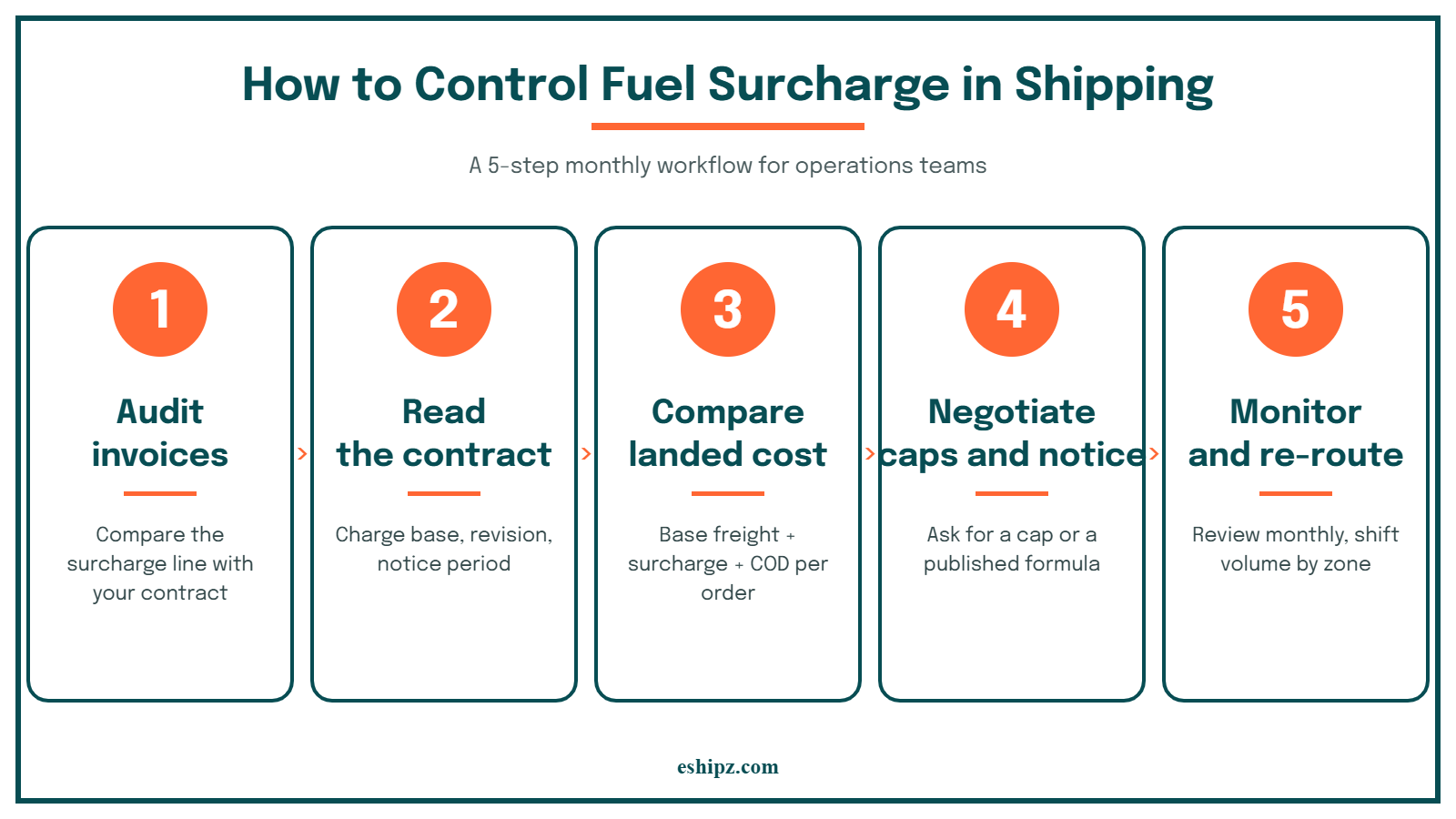
You cannot set the price of diesel, but you can control how much of it reaches your margin. The five steps below form a workflow that any operations team can run each month. The infographic summarizes them.
Step 1: Audit your current fuel surcharge in shipping
Start with last month’s invoices from every courier. Pull the surcharge line for each shipment and calculate the effective percentage against base freight. Compare it with what the contract says.
Differences are common, and they are usually caused by the wrong charge base or an outdated percentage. Catching them early is the cheapest saving available.
Step 2: Read the contract language
Check how each carrier defines the charge base, the revision frequency and the notice period. A contract that allows changes without notice leaves you exposed. A contract with a cap or a published formula gives you something to plan around.
Step 3: Compare carriers on landed cost
Never compare couriers on base freight alone. Compare total landed cost per shipment, including the surcharge, COD fees and other add-ons, for your real zone and weight mix. The cheapest base rate is often not the cheapest invoice.
Step 4: Negotiate caps, notice and a transparent formula
Use your volume as leverage. Ask for a cap, a minimum notice period before any revision, or a formula tied to a public fuel index. Even a partial concession reduces your uncertainty.
Step 5: Monitor monthly and re-route
Review the effective surcharge every month. If one carrier’s cost rises faster than the others, shift volume for the zones where it hurts most. Treat fuel surcharge in shipping as a metric, not a footnote.
A Worked Example: Two Carriers, Same Parcel
A short example shows why the headline rate misleads. Imagine two couriers quoting for the same 500 g parcel on the same zone. Every number here is illustrative, so use it only to learn the method.
| Item | Carrier A (illustrative) | Carrier B (illustrative) |
|---|---|---|
| Base freight | ₹55 | ₹60 |
| Surcharge percentage | 20% | 12% |
| Surcharge amount | ₹11 | ₹7.20 |
| COD fee | ₹20 | ₹18 |
| Landed cost per parcel | ₹86 | ₹85.20 |
Carrier A looks cheaper on base freight by five rupees. Once the surcharge and COD fee are added, Carrier B wins by eighty paise. Across 10,000 parcels, that gap is ₹8,000 a month, and it reverses again if either surcharge percentage moves.
The lesson is to rebuild this table each time a carrier revises its percentage. Five minutes of arithmetic keeps your routing rules honest. It also gives you a clear, numeric argument when you negotiate.
How Zones, Weight and Pickup Patterns Change the Surcharge
The surcharge percentage may be the same for every parcel, yet its rupee value is not. Heavier parcels and farther zones carry a higher base freight, so the same percentage produces a larger surcharge. A brand that ships mostly heavy parcels to distant zones feels the surcharge more than one that ships light parcels locally.
Pickup patterns matter as well. Several small pickups a day force vehicles to run partly empty, which raises the carrier’s cost per parcel. Where possible, schedule fewer, larger pickups and give the carrier a predictable manifest.
Packaging is a quieter lever. Smaller, lighter boxes reduce chargeable weight, and chargeable weight drives the base freight that the surcharge is applied to. Trimming a few grams per parcel can lower both lines at once.
Fuel Surcharge in Shipping for Small, Growing and Large Brands
The right response depends on scale. A new seller has little bargaining power, while a large shipper can ask for caps and formulas. Match your tactics to your stage.
For small sellers, fuel surcharge in shipping is best handled through carrier choice. Compare landed cost across a few couriers, and use an aggregator or multi-carrier tool so that you are not tied to one rate card. Keep the process simple and repeat it monthly.
For growing brands, fuel surcharge in shipping becomes a negotiation topic. Once you ship thousands of parcels a month, you can ask for notice periods and caps, and you can show your own invoice data as evidence. This is also the stage to start tracking the KPIs in this guide.
For large shippers, fuel surcharge in shipping is a treasury and planning issue. Finance teams should model the surcharge across scenarios, set budgets with ranges and agree formulas with carriers. Quarterly reviews with each courier keep surprises low.
Whatever your size, write the decision down. A one-page note that records your carriers, charge bases, notice periods and review dates saves hours when a new notice arrives.
Comparing Surcharge Structures Before You Sign
Carriers structure the surcharge in different ways. Knowing the structure helps you read a quote correctly. The table below compares the common models in general terms.
| Structure | How it works | Advantage | Risk |
|---|---|---|---|
| Floating percentage | Percentage changes as the carrier revises it | Reflects real fuel movement | Hard to forecast |
| Fixed percentage | Percentage stays constant for the contract term | Easy to budget | Carrier may price in a buffer |
| Capped percentage | Floats up to a maximum you agree | Limits worst-case cost | Cap may be set high |
| Built into base rate | No separate line; cost is folded into freight | Simple invoice | Less visibility into fuel effect |
A fixed or capped model gives finance teams stability, while a floating model gives the carrier flexibility. Neither is automatically better. The right choice depends on how much volatility your margins can absorb.
When you compare quotes, convert every structure into a cost per order using your own volumes. That one number makes quotes with different structures comparable and keeps the surcharge visible during the decision.
Prevention Checklist for Fuel Surcharge in Shipping
Use this checklist each quarter. It keeps the surcharge from drifting out of view between contract renewals.
| Check | Why it matters | Owner |
|---|---|---|
| Effective surcharge percentage per courier | Reveals invoice versus contract gaps | Operations |
| Charge base confirmed in writing | Prevents surcharge on unintended charges | Procurement |
| Notice period for revisions | Gives time to adjust pricing or routing | Procurement |
| Landed cost per order by zone | Shows the true cheapest carrier | Finance |
| Monthly surcharge variance report | Turns surprises into forecasts | Finance |
Assign an owner to each line and review the table in your monthly operations meeting. A checklist without owners is just a list.
Common Mistakes With Fuel Surcharge in Shipping
The first mistake is comparing couriers on base rate alone. The surcharge, COD fees and other add-ons can reverse the ranking. Always compare landed cost.
The second mistake is assuming the percentage is fixed. Many contracts let the carrier revise it, so a quote from three months ago may not describe today’s cost. Check the current notice.
The third mistake is ignoring the charge base. If the surcharge applies to a bigger base than you expected, the effective rate is higher than the headline. This is where careful reading of contract clauses pays back.
The fourth mistake is leaving the invoice unchecked. Without a monthly audit, errors in the surcharge line go unnoticed and repeat. A simple spreadsheet or an automated freight audit tool can catch them.
The fifth mistake is passing the surcharge to customers without testing the effect on conversion. Raising shipping fees can cost orders, so test changes carefully and measure the result.
Passing the Cost Through to Customers Without Losing Orders
Some brands recover part of the surcharge through shipping fees or minimum order values. This can work, but it needs testing. A flat shipping fee that rises with every carrier notice confuses buyers and can lift cart abandonment.
A calmer approach is to fold the expected surcharge into your product margin or into a stable shipping fee reviewed each quarter. Use your low, expected and high cost cases to pick a fee that protects margin in most months. Then watch conversion before and after the change.
Free-shipping thresholds deserve the same care. If surcharge rates climb, the threshold you set a year ago may no longer cover freight on small baskets. Recalculate it using your current landed cost per order.
Finally, be honest with customers when you adjust fees. A short line at checkout that explains a change builds more trust than a silent increase, and it costs nothing to add.
KPIs to Track for Fuel Surcharge in Shipping
What you measure, you can manage. Track the five metrics below, and review them alongside your delivery performance data.
| KPI | How to calculate | What a rising trend means |
|---|---|---|
| Effective surcharge rate | Surcharge paid ÷ base freight | Carrier revisions or a bigger charge base |
| Surcharge per order | Total surcharge ÷ orders shipped | Cost pressure on every parcel |
| Surcharge share of freight | Surcharge ÷ total freight bill | Fuel is taking a larger slice of spend |
| Landed cost per order | Total freight ÷ orders shipped | Overall shipping cost is climbing |
| Invoice variance | Invoiced surcharge − expected surcharge | Billing errors or contract drift |
Plot these monthly and mark every carrier notice on the same timeline. Patterns appear quickly, and they make negotiations easier because you can show the carrier your own data.
How eShipz Helps You Manage Fuel Surcharge in Shipping
A multi-carrier platform makes landed-cost comparison practical. Instead of checking each courier’s rate card by hand, you can compare options in one place and route each order to the carrier that suits its zone and weight. You can explore the platform at eShipz.
eShipz connects shippers with multiple courier partners, so the effect of fuel surcharge in shipping can be compared across carriers rather than accepted from one. Rate comparison and carrier allocation help brands see the total cost of each shipment before it is booked. Freight invoice checks also help teams spot surcharge differences against contracted rates.
If you are building a more disciplined shipping cost process, start from the eShipz homepage to see how the modules fit together. Please confirm the exact features available on your plan with the eShipz team.
Conclusion
Fuel surcharge in shipping is not a hidden fee, but it is easy to overlook. It follows fuel prices, it applies to a charge base set by your contract, and it can move during the year. The ICRA data shows how much fleets depend on fuel, which is why the pressure keeps returning.
The practical answer is a routine: audit, read the contract, compare landed cost, negotiate caps and monitor monthly. Brands that follow it treat fuel surcharge in shipping as a managed variable instead of a monthly surprise. Start with last month’s invoices today.
Frequently Asked Questions About Fuel Surcharge in Shipping
What is fuel surcharge in shipping?
Fuel surcharge in shipping is an additional charge a courier adds to base freight to cover changes in fuel costs. It is normally shown as a percentage and may be revised by the carrier.
How is fuel surcharge calculated?
Most carriers multiply the surcharge percentage by a charge base, usually the base freight. Your contract states the exact base and the percentage in force.
Why does the surcharge change over time?
Carriers revise it when fuel prices or running costs move. Fuel is a major part of fleet operating cost, so price changes reach the surcharge quickly.
Can I negotiate fuel surcharge in shipping?
Yes, shippers with steady volume can ask for a cap, a notice period or a published formula. Even partial concessions improve cost certainty.
Is the surcharge applied to COD or return charges?
That depends on the contract. Ask each carrier in writing whether the percentage applies only to base freight or to other charges as well.
How can I check if my invoice is correct?
Compare the surcharge line on each invoice with the contracted percentage and charge base. A monthly audit, manual or automated, catches differences early.
Does a multi-carrier setup reduce the impact?
It can help, because you can compare landed cost across carriers and route orders accordingly. The effect then becomes one factor in carrier choice, not a fixed cost.