







India’s express parcel market handled 8 to 9 billion shipments in FY2024, and e-commerce was the largest segment with more than half of that volume, according to Redseer Strategy Consultants. That scale is why carriers fight for brands that ship every day. Yet most D2C founders still accept the first rate card they are handed.
Courier rate negotiation is the fix. It is the structured process of using your own shipment data to agree better rates, fairer surcharges and clearer penalties with every carrier you use. This guide shows you how to run courier rate negotiation step by step, what to ask for, and how to keep the savings after the contract is signed.
You will get a ready-to-use data checklist, five tables you can copy into your own files, an illustrative savings model and a seven-question FAQ. Every number in the worked example is labeled illustrative, so swap in your own figures.
What Is Courier Rate Negotiation?
Courier rate negotiation is a planned discussion with a courier company, or with a shipping platform that resells carrier capacity, to change the commercial terms of your contract. It covers the base rate, but it also covers the charges that quietly inflate your bill: fuel surcharge, cash-on-delivery fees, return-to-origin charges, weight rounding and remote-area fees.
Think of it as a pricing review, not a haggle. You bring evidence, the carrier brings capacity, and both sides agree on terms that match the shipments you actually send.
Who needs courier rate negotiation?
Any brand shipping a few hundred parcels a month already has something to trade. Courier rate negotiation matters most when your volume is growing, when your return-to-origin rate is rising, or when your freight invoices keep surprising your finance team.
Why Carriers Move on Rates
Carriers do not discount out of kindness. They discount when you make their network cheaper to run. A brand that ships predictable volumes, hands over clean parcels and pays on time lowers the carrier’s cost per shipment.
The same Redseer Strategy Consultants report projects express parcel volumes of 24 to 29 billion shipments by FY2030. More volume means more carriers, more competition and more room for a prepared shipper to negotiate.
The five levers you actually hold
| Lever | What you bring | What to ask for |
|---|---|---|
| Volume | Average daily shipments and a six-month growth trend | Slab-based discount that improves as volume grows |
| Predictability | Pickup schedule and cut-off time you can keep | Lower base rate or waived pickup fee |
| Parcel quality | Low damage rate and correct declared weights | Reduced weight-dispute penalties |
| Zone mix | Share of metro, tier-2 and remote orders | Zone-wise rates instead of one blended rate |
| Alternatives | Quotes and performance data from other carriers | Match or beat the best competing quote |
The last lever is the strongest. A carrier negotiates differently when it knows you can move volume next week.
Know Your Rate Card Before You Negotiate
You cannot run courier rate negotiation on a rate card you do not fully understand. Most disputes start with a charge nobody asked about. Break the card into its parts and decide which ones are worth fighting for.
Common rate card components
| Component | What it means | Negotiation angle |
|---|---|---|
| Base freight | Rate per weight slab and zone | Ask for lower slabs and a smaller first-slab minimum |
| Additional weight rate | Charge for each extra 500 grams | Ask for a lower step and a clear rounding rule |
| Fuel surcharge | Percentage added to freight | Cap it, or link it to a published index |
| COD fee | Flat fee or percentage of order value | Ask for the lower of flat and percentage, with a cap |
| RTO charge | Fee for returning an undelivered parcel | Ask for a discount to forward rates, not the full forward charge |
| Remote-area fee | Extra charge for out-of-delivery-area pincodes | Ask for a published pincode list and a lower fee |
| Insurance and fragile fees | Charge for declared value cover | Ask for a waiver under a declared value |
Many brands only negotiate the first row. The other six rows often hold more money than the base rate.
Check how weight is charged
Carriers bill the higher of actual weight and volumetric weight. Ask for the exact formula, the rounding rule and the slab boundaries in writing. A small rounding difference repeated across thousands of parcels turns into a large monthly line item.
Step 1: Build Your Data Pack for Courier Rate Negotiation
Strong courier rate negotiation starts a week before the meeting. Pull three to six months of shipment data and sort it so a carrier can see your business in one page.
- Shipments per day, by month, with the growth trend.
- Split by payment mode: prepaid versus cash on delivery.
- Split by zone and by the top 20 destination pincodes.
- Average declared weight versus billed weight.
- Delivery rate, return-to-origin rate and damage rate for each carrier.
- Your last three freight invoices, with every surcharge line.
If you already track a courier performance scorecard, use it here. It gives you a fair, repeatable way to show which carriers deserve more volume and which ones need to improve first.
Clean the data first
Fix duplicate orders, test shipments and cancelled pickups before you share any numbers. Dirty data gives the carrier an easy reason to doubt your volume. It also hides your real cost per delivered order.
Step 2: Benchmark Rates Across Carriers
Request quotes from at least three carriers for the same lanes, the same weight slabs and the same payment mix. Ask every carrier to quote the full structure, not just the base rate.
Then compare the total cost per delivered order. A low base rate with a high COD fee and a harsh RTO charge can cost more than a higher base rate with fair add-ons.
Illustrative rate comparison
The table below uses made-up numbers to show how a quote that looks cheaper can cost more once surcharges are added. Replace the figures with your own quotes.
| Cost item (illustrative, Rs. per shipment) | Carrier A | Carrier B | Carrier C |
|---|---|---|---|
| Base freight, 500 g, Zone C | 52 | 48 | 55 |
| Fuel surcharge | 6 | 8 | 4 |
| COD fee (on a Rs. 1,200 order) | 30 | 36 | 24 |
| Expected RTO cost per shipment (at the carrier’s stated RTO charge) | 9 | 12 | 7 |
| Total expected cost | 97 | 104 | 90 |
Carrier B has the lowest base freight and the highest total. This is the pattern that a rate-only conversation misses, and it is why you should quote the full structure.
Step 3: Prepare Your Ask for Courier Rate Negotiation
Write your courier rate negotiation ask on one page before you speak to anyone. A written ask keeps the meeting focused and gives you a record of what was agreed.
Set three numbers for every line
- Target: the rate you want to reach.
- Acceptable: the rate you will sign today.
- Walk-away: the rate at which you move volume elsewhere.
Do this for the base rate, the fuel surcharge, the COD fee and the RTO charge. If you only prepare a base rate target, the carrier will concede it and take the savings back through add-ons.
Trade, do not just ask
Offer something in return for each concession: a monthly volume commitment, a fixed pickup window, a bank-verified COD remittance cycle or a longer contract term. Carriers value certainty. Give it in exchange for price.
Step 4: Run the Negotiation Meeting
Open with your data, not your demand. Show the carrier your volume, your zone mix and your delivery performance, then present your ask as the natural result.
Keep the conversation on total cost per delivered order. If the carrier offers a lower base rate, ask what changes in the surcharges. If they refuse to move on price, ask for service terms instead.
What to say when the carrier says no
Ask which part of your ask they cannot meet and why. Often the objection is about a single line, such as a COD cap. Solve that line and the rest follows.
Non-price terms worth asking for
- A named account manager and an escalation contact.
- A delivery time commitment by zone, with a credit when it is missed.
- A fixed window to raise weight disputes, with photo evidence on both sides.
- Faster COD remittance and a clear reconciliation file.
- A notice period before any rate or surcharge change.
Special Cases: COD, RTO and Peak Season
Three areas deserve their own preparation because they hide the most money. Each one needs data from your own account, not general claims.
Cash on delivery
COD fees are usually the most negotiable add-on because they are a percentage or flat fee that carriers set to cover cash handling. Ask for the lower of a flat fee and a percentage, add a cap for high-value orders, and agree a remittance cycle with a penalty for late payment. If you are pushing customers toward prepaid, tell the carrier. A falling COD share changes what a fair fee looks like.
Return to origin
RTO charges hurt twice: you pay the forward trip and the return trip, and you lose the sale. Share your RTO rate by carrier and ask for a reduced return rate instead of a full forward charge. Carriers with a strong delivery record in your top pincodes should earn more volume, and that is a trade you can offer.
Peak season
Many carriers add peak surcharges or restrict capacity during festive weeks. Raise this in your courier rate negotiation meeting at least two months early. Ask for the surcharge dates, the cap and any guaranteed capacity in writing, so a sudden notice does not break your margin during your busiest weeks.
Direct Carriers or Aggregators: Where Should You Negotiate?
You can negotiate directly with each carrier, or you can use a shipping aggregator that has already agreed rates with many carriers. Both routes work, and many brands use a mix.
Direct contracts give you the most control over rates and service terms, but they need volume, time and finance support to manage. Aggregator rates are easier to start with and let small shippers reach several carriers at once, but you should still compare the total cost per delivered order, including COD and RTO fees, with a direct quote.
A sensible path is to start on an aggregator while your volume is small, collect performance data by carrier, then use that data to open direct courier rate negotiation with the two or three carriers that perform best in your zones.
Contract Terms to Lock In
A good courier rate negotiation outcome is only as strong as the contract that records it. Verbal promises disappear when the account manager changes. Put every agreed term in writing and check the clauses below.
| Clause | What to check | Why it matters |
|---|---|---|
| Validity period | Start date, end date and renewal terms | Prevents silent auto-renewal at a higher rate |
| Rate change notice | Minimum notice, such as 30 days | Gives you time to compare alternatives |
| Weight dispute process | Time limit, evidence needed, resolution time | Stops unexplained weight charges |
| COD remittance cycle | Days to remit and penalty for delay | Protects your working capital |
| Lost and damaged shipments | Liability cap and claim timeline | Defines what you recover when a parcel fails |
| Service levels | Delivery time by zone and the remedy for misses | Turns promises into enforceable terms |
Ask your finance or legal team to read the final draft. A single unclear clause can undo hours of good negotiation.
What Courier Rate Negotiation Can Save: An Illustrative Model
Here is a worked example with assumed numbers. A D2C brand ships 10,000 parcels a month. Its total freight spend, including surcharges and return charges, is Rs. 18,00,000. These figures are illustrative and not industry benchmarks.
After a structured round of courier rate negotiation, the brand wins gains across five levers. The chart shows how the savings split.
In this model the base rate discount is the biggest single lever, but the other four add up to more than the base rate alone. That is the main lesson: negotiate the whole card, not just the headline rate.
Savings of this size only hold if you check invoices every month. Without checks, weight rounding and surcharge creep slowly erase the gain.
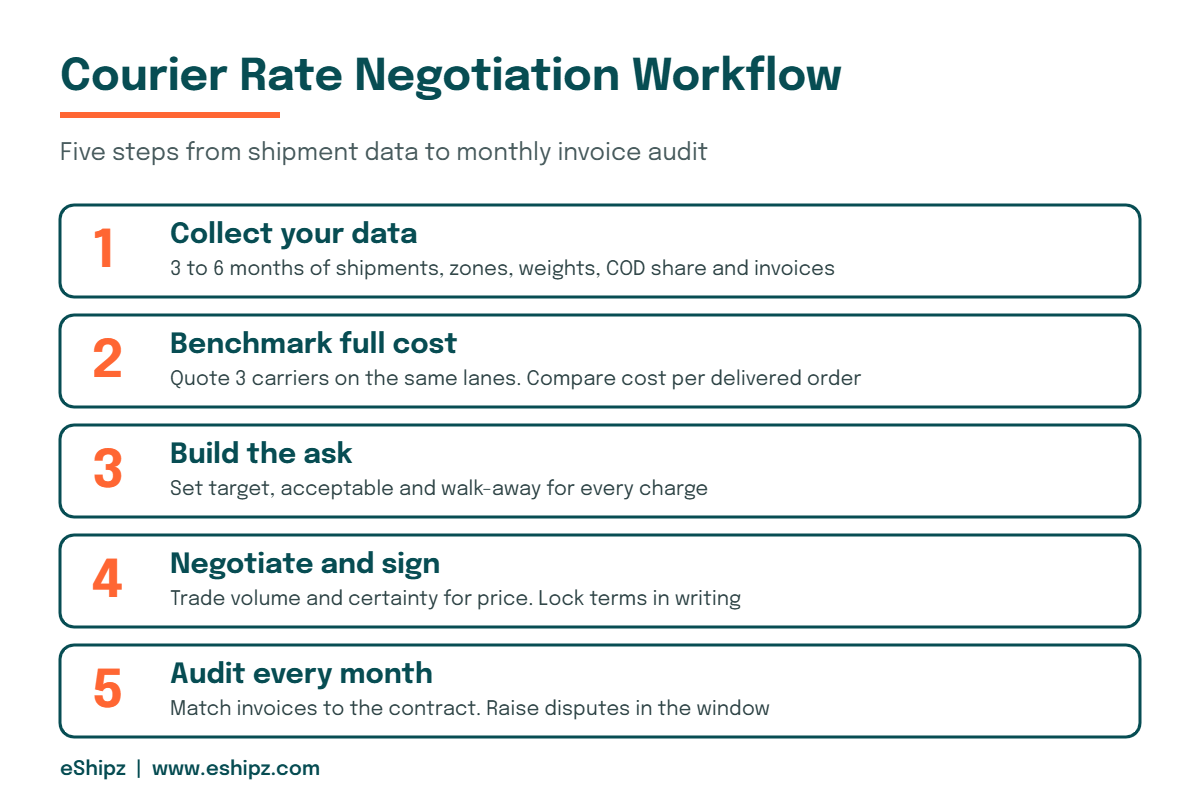
The Courier Rate Negotiation Workflow at a Glance
The infographic below summarizes the five-step courier rate negotiation workflow. Print it and keep it next to your carrier contracts.
Prevention Checklist: Keep Your Rates Honest After Signing
Courier rate negotiation does not end at signature. Use this checklist every month to make sure the agreed terms show up on the invoice.
- Match each invoice line to the agreed rate card.
- Check the fuel surcharge percentage against the contract.
- Compare billed weight with your declared weight for a sample of parcels.
- Confirm COD remittance dates against the agreed cycle.
- Flag duplicate charges and raise them within the dispute window.
- Review carrier performance every quarter and re-allocate volume.
Brands with a lot of shipments should automate this. Manual spot checks catch only a small share of billing errors.
Common Courier Rate Negotiation Mistakes
Most failed negotiations repeat the same few errors. Avoid these and you are already ahead of most shippers.
- Negotiating only the base rate and ignoring surcharges.
- Using a single carrier quote as your benchmark.
- Promising volume you cannot deliver, then losing credibility at renewal.
- Accepting a verbal commitment with no written clause.
- Skipping the weight and rounding rules.
- Never auditing invoices after the contract starts.
- Treating the first meeting as the last chance, instead of a yearly review.
KPIs to Track After Courier Rate Negotiation
Measure the result with a small set of numbers. Review them monthly and bring them to every renewal discussion.
| KPI | How to calculate it | What a good trend looks like |
|---|---|---|
| Cost per delivered order | Total freight spend divided by delivered orders | Falling month over month |
| Effective rate versus rate card | Billed freight divided by contracted freight | Close to 1.00 |
| Weight dispute rate | Disputed parcels divided by total parcels | Falling |
| RTO rate by carrier | Returned parcels divided by shipped parcels | Stable or falling |
| COD remittance days | Average days from delivery to remittance | At or below the contract |
| Surcharge share of freight | Surcharges divided by total freight | Stable or falling |
How eShipz Helps With Courier Rate Negotiation
Courier rate negotiation depends on clean, comparable data across carriers. That is the hardest part when each carrier sends a different report in a different format. The eShipz logistics platform brings shipments from many carriers into one place so you can compare them on the same measures.
According to eShipz, the platform connects 500+ carrier integrations and includes CarrierSmart AI, which compares carriers on delivery speed, shipping cost and performance. Track360 provides real-time tracking and delay alerts, and FreightGuard AI flags overcharges, duplicate billings and rate mismatches.
In practice, that means you can walk into a courier rate negotiation meeting with delivery performance and cost data for each carrier. After the contract is signed, you can check invoices against the agreed rates. Learn more about these tools on the eShipz website.
Conclusion
Courier rate negotiation is a repeatable process, not a one-time favor. Build your data pack, benchmark the full cost, write your ask, trade volume for terms and lock everything into the contract.
Then keep the savings by auditing invoices and reviewing carrier performance every quarter. If you want one place to compare carriers and monitor billing, explore eShipz at www.eshipz.com and start your next courier rate negotiation round with evidence.
Start small if the process feels heavy. Pick your busiest carrier, pull three months of invoices and compare each line with the contract. Even this one check usually shows where money is leaking, and it gives you the first real evidence to take into the next conversation.
Frequently Asked Questions About Courier Rate Negotiation
What is courier rate negotiation?
Courier rate negotiation is the process of agreeing better rates, surcharges and service terms with a courier using your own shipment data. It covers the base rate and also fuel, COD, RTO and weight rules.
How many shipments do I need before I can negotiate?
There is no fixed minimum. A brand with steady daily volume and clean data has leverage even at a few hundred parcels a month, and the discount usually improves as volume grows.
Which charges should I focus on first in courier rate negotiation?
Start with the lines that repeat on every invoice: base freight, fuel surcharge, COD fee and RTO charge. Then check weight rounding and remote-area fees.
How often should I renegotiate courier rates?
Review rates at least once a year and before any peak season. Also reopen talks when your volume, zone mix or RTO rate changes in a big way.
Should I use one carrier or several?
Most growing brands use several. Multiple carriers give you a benchmark, a fallback and a credible alternative when you negotiate.
Can an aggregator replace direct courier rate negotiation?
An aggregator can give access to pre-negotiated rates and save time, but high-volume brands often negotiate direct rates with some carriers too. Compare the total cost per delivered order for both options.
How do I know the agreed rates are being charged?
Audit every invoice against the contract. Match rates, surcharges and weights, and raise disputes inside the agreed window. Automated freight audit tools make this faster.