






Most Indian sellers assume a courier will repay the full price of a parcel it loses. The law says otherwise. Under the Carriage by Road Act, 2007, a road carrier’s liability for loss or damage is limited, and the rules cap compensation for a total loss at ten times the freight paid, never above the declared value.
That gap is where shipping insurance for ecommerce earns its place. In the illustrative example used in this guide, a ₹50 freight charge produces a ₹500 payout on a ₹700 order. The seller absorbs the rest, plus an unhappy customer.
This guide explains shipping insurance for ecommerce in plain terms. You will see what carriers owe by default, what insurance changes, what it can cost in a worked example, and how to file a claim that gets paid. You will also get a decision checklist, a KPI table and seven answers to common questions. Visit eShipz to see how shipping workflows connect.
What Is Shipping Insurance for Ecommerce?
Shipping insurance for ecommerce is cover that reimburses a seller when a parcel is lost, stolen or damaged in transit. It pays against the declared value of the goods, not only the freight you paid. That is the key difference from default carrier liability.
You can buy cover in a few ways. Some couriers offer it as an add-on at booking. Specialist insurers sell policies that cover a seller’s shipment volume. Some sellers also self-insure by setting aside a loss reserve.
Shipping insurance for ecommerce does not prevent losses. It only changes who pays for them. Better packing, clean addresses and disciplined carrier management still reduce the number of claims you need to file.
Most policies are built around three events:
- Loss: the parcel never reaches the buyer and cannot be traced.
- Theft or pilferage: the parcel arrives opened or with contents missing.
- Damage: the goods are crushed, broken or soaked in transit.
Policies also carry exclusions, such as poor packing, prohibited goods or an understated declared value. Read the exclusions before you rely on any policy.
What Carriers Owe You Without Shipping Insurance for Ecommerce
Before you buy shipping insurance for ecommerce, know the baseline you already have. For road carriage, the Carriage by Road Act, 2007 sets that baseline. Section 10 limits a common carrier’s liability to an amount set by rules.
Under Rule 12(1) of the Carriage by Road Rules, 2011, liability for a total loss is limited to ten times the freight paid or payable. The amount cannot exceed the value declared in the goods forwarding note. The Act also lets a carrier fix a higher risk rate under Section 11, which a consignor can pay for more cover.
Courier and aggregator contracts can differ from this baseline. Always read your own carrier terms. The table below compares the default position with insured value.
| Situation | Default carrier position | With insured value |
|---|---|---|
| Total loss of a parcel | Limited to ten times the freight, and not above the declared value | Reimbursed up to the insured value, subject to policy terms |
| Delay within an agreed period | Where the period is recorded in the goods forwarding note, liability is limited to the freight charges | Depends on the policy wording |
| Higher risk consignment | Carrier may agree a higher risk rate in return for extra payment | The extra rate works as paid cover |
| Carrier proves no fault or neglect | Carrier is not liable under the Act | Many policies pay without proof of carrier fault, subject to exclusions |
Why Parcels Get Lost or Damaged
You cannot judge the value of shipping insurance for ecommerce until you know where your losses come from. Most claims trace back to a handful of causes. Each one has a prevention step that costs far less than a claim.
| Cause | What happens | Prevention step |
|---|---|---|
| Weak packaging | Boxes crush, puncture or leak under stacking | Use the right box size, filler and double seals |
| Mis-sorting at hubs | A parcel is routed to the wrong city | Print clear labels with a scannable barcode |
| Theft or pilferage | Contents are removed in transit | Use tamper-evident tape and discreet outer labels |
| Address errors | The courier cannot deliver and the parcel stalls | Validate the address and pincode before dispatch |
| Weather and rough handling | Water or drops damage the goods | Add water-resistant liners and corner protection |
| Tracking gaps | Scans stop and no one owns the parcel | Watch for stalled scans and escalate early |
Notice that four of the six causes sit inside your own packing and data process. Insurance covers the leftover risk. It does not excuse weak operations.
Packing Rules That Keep Claims Low
Good packing is the cheapest protection you can buy. It also protects your claim, because insurers and carriers often reject damage claims when the packing looks weak. Treat every parcel as if someone will inspect it later.
Follow these practical rules for every category:
- Fit the box to the product. Leave room for cushioning on all sides, but avoid empty space that lets the item move.
- Cushion fragile goods individually. Wrap each item separately, then fill gaps with paper, foam or air pillows.
- Seal with strong tape. Close the box with tape across every seam, and use the same method on every parcel.
- Keep liquids upright and leak-proof. Use sealed bags and absorbent material inside the box.
- Hide the contents. Avoid brand names or product images on the outer box for expensive goods.
A packing standard also makes training easier. Photograph one correctly packed parcel per category and keep it at the packing bench.
A word on cash on delivery: when a COD parcel is lost, you lose the goods and you also never collect the payment. Insurance reimburses the goods value, but it does not recover the sales opportunity. That makes prevention even more important for COD-heavy catalogs.
What Shipping Insurance for Ecommerce Costs: An Illustrative Model
Premium rates and loss rates differ by seller, category and carrier. So this model uses illustrative numbers, not market data. Replace them with your own figures before you decide.
Assume 1,000 parcels. Of these, 800 are low-value orders and 200 are high-value orders. The loss and damage rate is 0.8%, so about 6.4 small and 1.6 large parcels go wrong. The premium is 0.6% of declared value.
| Assumption (illustrative) | Low-value orders | High-value orders |
|---|---|---|
| Parcels per 1,000 | 800 | 200 |
| Order value | ₹700 | ₹6,000 |
| Freight per parcel | ₹50 | ₹80 |
| Carrier cap (ten times freight) | ₹500 | ₹800 |
| Loss and damage rate | 0.8% | 0.8% |
| Premium (share of declared value) | 0.6% | 0.6% |
Now compare three strategies. With no cover, you lose the goods value plus freight, minus the carrier cap. That totals ₹10,048 per 1,000 parcels. Covering every parcel costs ₹11,008, because premiums on low-value orders exceed the gap they close.
Covering only high-value orders costs ₹8,928 in this model. The premium on large orders is worth paying, while the small-order gap is cheap to absorb. The chart below shows the three totals.
The lesson is not that insurance always saves money. The lesson is that shipping insurance for ecommerce pays best when it targets the orders where the carrier cap leaves the widest gap. Run the same sums with your own order mix.
How to Claim on Shipping Insurance for Ecommerce: Six Steps
A policy only pays when the claim is filed correctly. Most rejected claims fail on evidence or timing, not on the loss itself. Follow this six-step workflow for every claim under shipping insurance for ecommerce.
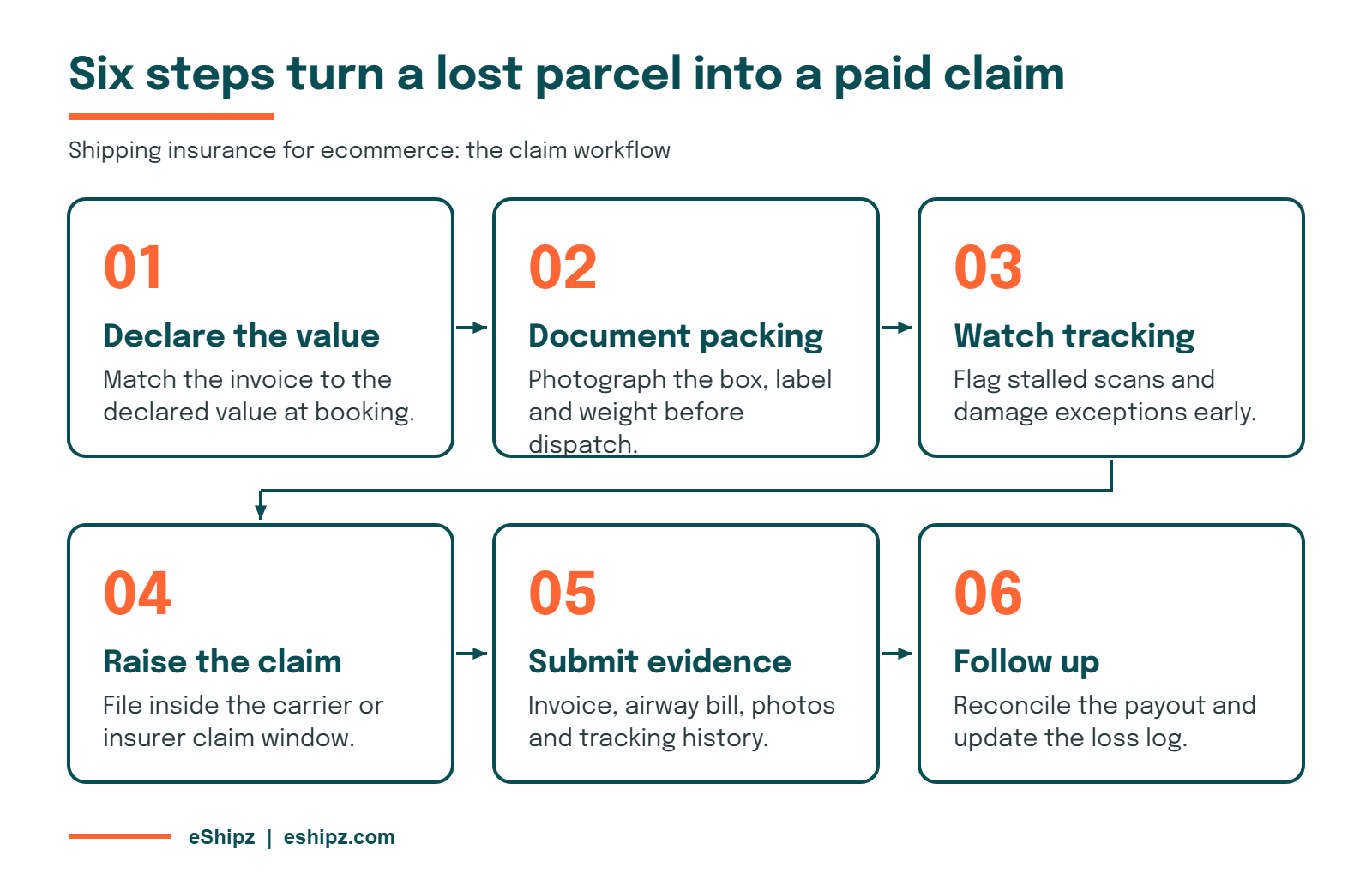
Step 1: Declare the correct value at booking
Declare the true goods value when you book each shipment. An understated value shrinks any payout. An overstated value can void the claim. Keep the invoice that matches the declared figure.
Step 2: Document the packing
Photograph the packed parcel before it leaves. Capture the box, the label and the weight on the scale. These images prove the goods left in good condition.
Step 3: Watch tracking for exceptions
Do not wait for the buyer to complain. Flag parcels whose scans have stalled or that show a damage exception. Early flags protect your claim window.
Step 4: Raise the claim inside the window
Every carrier and insurer sets a time limit for claims. Check yours at the start, not at the end. File as soon as a parcel is confirmed lost or arrives damaged.
Step 5: Submit complete evidence
Send the invoice, the airway bill, packing photos, tracking history and delivery exception notes. For damage, add photos of the opened parcel and the outer box. Keep the damaged goods and packaging until the claim closes, because an inspector may ask to see them. Complete files get paid faster than partial ones. For a deeper walkthrough, read the eShipz guide to the lost shipment claim process.
Step 6: Follow up and reconcile
Track each claim until the credit lands. Match the payout to the order and update your loss log. Unpaid claims should be escalated with the full evidence file attached.
Use the loss log to spot patterns. If one carrier, one route or one product keeps appearing, fix the cause. A pattern you can name is a loss you can prevent.
Choosing Between Carrier Liability, Courier Cover and Third-Party Policies
Shipping insurance for ecommerce comes in several forms, and each suits a different seller. The right choice depends on your order values, volume and appetite for risk. Use the table to compare the options at a glance.
| Option | How it works | Best for | Watch out for |
|---|---|---|---|
| Default carrier liability | Compensation limited by law or contract | Low-value parcels | Large gap on expensive goods |
| Courier add-on cover | Insured value added at booking | Sellers who want simple, per-parcel cover | Terms and exclusions vary by courier |
| Third-party policy | Separate insurer covers your shipment volume | Growing sellers with high-value orders | Premium cost and claim process |
| Self-insurance reserve | You set aside money for expected losses | Sellers with steady, low loss rates | One bad month can exceed the reserve |
Many sellers combine two options. They self-insure low-value orders and buy cover for expensive ones. That mirrors the result of the cost model above.
Which Orders Deserve Cover First
If you cannot cover every parcel, rank your orders by the gap between goods value and the carrier cap. The bigger the gap, the stronger the case for cover. Freight is only a small part of the equation, so a heavy, cheap parcel may need less cover than a light, expensive one.
Start with these groups, in roughly this order:
- High-value electronics and accessories. They are attractive to thieves and costly to replace.
- Fragile goods. Glassware, ceramics, cosmetics and decor break easily, even with good packing.
- Gifting and festive orders. A failed delivery on a gift is a lost customer, not only a lost order.
- First orders from new customers. A bad first experience rarely brings a second purchase.
- Bulk or B2B consignments. One lost carton can erase the margin on a whole shipment.
Low-cost commodity items usually belong in the self-insured pool. Review the split every quarter, because your catalog and loss data will change.
A Checklist for Buying Shipping Insurance for Ecommerce
Use this list before you sign any policy or switch on courier cover. Each item takes a few minutes and prevents an expensive surprise later.
- Know your average order value and your top ten percent of orders by value.
- Calculate your loss and damage rate from the last twelve months of data.
- Compare premium cost against the gap left by the carrier cap.
- Read the exclusions for packing, prohibited goods and delivery delays.
- Confirm whether cover includes theft, damage and total loss.
- Check the claim window and the evidence the insurer requires.
- Ask how fast claims are paid and how disputes are handled.
- Decide whether to cover all parcels or only those above a value threshold.
- Test the process with one small claim before volumes grow.
A short written policy for your team also helps. It should state who declares value, who files claims and who chases payments.
Common Mistakes With Shipping Insurance for Ecommerce
Sellers lose money on shipping insurance for ecommerce in predictable ways. Most mistakes come from assumptions, not from the policy itself. Avoid these five.
Assuming the courier pays full value. As the baseline table shows, default liability is capped. Do not plan your margins around full reimbursement.
Understating declared value. Sellers do this to save on premium. It backfires when a payout covers only the declared amount.
Skipping packing photos. Without proof of condition at dispatch, a damage claim becomes your word against the carrier’s.
Missing the claim window. A valid claim filed late is often a rejected claim. Put deadlines in your workflow, not in someone’s memory.
Insuring everything blindly. As the model shows, cover on low-value orders can cost more than the gap it closes. Match cover to the order value.
KPIs to Track for Shipping Insurance for Ecommerce
You cannot manage what you do not measure. Track these indicators monthly. They show whether shipping insurance for ecommerce is paying for itself.
| KPI | What it measures | How to calculate | Why it matters |
|---|---|---|---|
| Loss and damage rate | Share of parcels lost or damaged | Lost and damaged parcels ÷ shipped parcels | Sets your risk level and premium budget |
| Claim filing rate | Share of eligible losses actually claimed | Claims filed ÷ eligible losses | Shows missed recovery |
| Claim approval rate | Share of claims accepted | Approved claims ÷ filed claims | Flags weak evidence |
| Average days to payout | Speed of reimbursement | Payout date minus filing date | Affects cash flow |
| Net insurance cost | Premium minus recovered value | Premiums paid − claims paid | Shows if cover is worth it |
Review the numbers every quarter. Raise or lower your cover threshold as the data changes.
How eShipz Helps With Shipping Insurance for Ecommerce
eShipz does not replace an insurance policy. According to the eShipz homepage, it connects sellers to multiple carriers and offers tools for tracking, proof of delivery, courier allocation and freight audit. Those tools support the operational side of shipping insurance for ecommerce.
Real-time tracking surfaces stalled parcels before a customer complains. Digital proof of delivery gives you signatures, photos and OTP records that strengthen a claim. Courier allocation helps send each order with a carrier suited to its profile.
A single dashboard also keeps shipment history in one place. When you must file a claim, the evidence trail is already organized. Confirm current feature details with the eShipz team before you plan around them.
Conclusion: Make Shipping Insurance for Ecommerce a Deliberate Choice
Default carrier liability is limited by law, and the gap grows with order value. Shipping insurance for ecommerce closes that gap, but only where the gap is large enough to justify the premium. The illustrative model shows that targeted cover can beat both no cover and blanket cover.
Start with your own data. Measure your loss rate, find the orders with the widest gap and compare premiums against it. Pair that decision with strong packing, clean addresses and a repeatable claim workflow.
Revisit the decision each quarter. Order values, carriers and loss patterns shift, and the best mix of cover shifts with them. Sellers who review shipping insurance for ecommerce on a schedule recover more, argue less and protect their margins when a parcel goes missing. To see how a connected shipping workflow supports that routine, explore the eShipz shipping platform.
Frequently Asked Questions About Shipping Insurance for Ecommerce
1. What is shipping insurance for ecommerce?
Shipping insurance for ecommerce is cover that reimburses a seller for parcels that are lost, stolen or damaged in transit. It pays against the declared value of the goods. This differs from default carrier liability, which is limited.
2. Does the courier already insure my parcel?
Not fully. Under the Carriage by Road Act, 2007 and its rules, a road carrier’s liability for total loss is limited to ten times the freight, and not above the declared value. Courier contracts can differ, so read your own terms.
3. Is shipping insurance for ecommerce worth the cost?
It depends on your order values and loss rate. The illustrative model in this guide shows that cover on high-value orders paid off, while cover on every low-value parcel cost more than the loss. Run the sums with your own figures.
4. What does shipping insurance for ecommerce usually cover?
Most policies cover loss, theft and damage in transit. Many exclude poor packing, prohibited goods and wrong declared values. Check whether delay is covered, because that depends on the policy.
5. How do I file a claim?
Declare the correct value, keep packing photos, watch tracking and file inside the window. Submit the invoice, airway bill, photos and tracking history together. The six-step workflow above covers each stage.
6. Should I insure every order?
Usually not. Compare the premium on each order band against the gap left by the carrier cap. Many sellers cover only orders above a value threshold and self-insure the rest.
7. Can software reduce my need for shipping insurance for ecommerce?
Software cannot remove risk, but it lowers the number of claims. Tracking alerts, proof of delivery and carrier performance data help you prevent losses and document the ones that happen. The eShipz section above lists the tools that support this.