









India’s online retail market reached $65–$66 billion in gross merchandise value in 2025, according to Bain & Company’s How India Shops Online 2026 report. Shoppers there have doubled in five years to 290–300 million, and sellers have tripled. More sellers and more shoppers mean more parcels on the road, and a share of them will never arrive.
When a parcel goes missing, the money does not come back by itself. You have to ask for it, with the right evidence, inside the right window. A clear lost shipment claim process turns a painful write-off into a recovered payment.
This guide walks Indian sellers through the lost shipment claim process from the first missed scan to the final credit note. You will see why shipments go missing, what a lost parcel really costs, and the six steps that get claims paid. You will also get an evidence checklist, a KPI table and seven answers to the questions sellers ask most.
What Is a Lost Shipment Claim Process?
A lost shipment claim process is the set of steps a seller follows to prove that a parcel did not reach the buyer and to recover its value from the courier. It starts when tracking stalls and ends when compensation reaches your account or wallet.
Think of the lost shipment claim process as an insurance workflow you run yourself. The courier holds the parcel, so the courier carries the burden of explaining where it went. Your job is to show the loss clearly, with documents they cannot dispute.
A good lost shipment claim process has four parts: a rule for when a parcel counts as lost, a standard evidence pack, a filing routine with deadlines, and a review loop that feeds results back into carrier selection.
Lost, damaged, and short-delivered claims
Sellers often treat every problem as one kind of claim. Couriers do not. A lost claim means the parcel never reached the buyer. A damaged claim means it arrived but the contents were unusable. A short-delivery claim means part of the order, or the wrong item, arrived.
Each type needs different proof. A lost parcel needs tracking history and a failed-delivery trail. A damaged parcel needs photos of the box and the product. Mixing them up is the fastest way to get a rejection.
Why Shipments Go Missing: Causes and First Warning Signs
Most losses leave a trail before they become final. Learning to spot that trail lets you start the lost shipment claim process early, while evidence is still fresh and the courier can still search. The table below pairs the common causes with the first signal you will see.
| Cause of loss | First warning sign | What to check first |
|---|---|---|
| Misrouted at a hub | Tracking jumps to a wrong city or hub | Last scan location versus destination pincode |
| Missed handover between carriers | No scan for several days after a hub scan | Linehaul and last-mile partner handover |
| Theft or pilferage in transit | Parcel scanned in, never scanned out | Hub exit scan and seal status |
| Wrong delivery or fake “delivered” scan | Status says delivered, buyer says no | Delivery location, proof of delivery and time |
| Label damage or label swap | Parcel scanned with a different order ID | Label photo at pickup and AWB match |
| Vehicle or hub incident | Several parcels stall at the same hub together | Carrier hub advisories and batch pattern |
Notice that four of the six causes show up as a gap in scans. That is why scan gaps, not buyer complaints, should trigger your claim clock. Waiting for a customer to complain adds days you may not have.
The Real Cost of an Unclaimed Lost Shipment
A lost parcel costs more than its product value. You pay for the original freight, then pay again to ship a replacement, and your team spends time on tickets. If the loss is never claimed, all of that stays with you.
The chart below uses a hypothetical order to show how the pieces add up. The numbers are illustrative, not benchmarks. They assume a ₹1,500 order with a landed product cost of ₹900.
In this illustrative example, an unclaimed loss costs about ₹1,110 against a ₹1,500 sale. You lose the sale, and you spend most of its value just to keep the customer. Multiply that by even a handful of lost orders each month and the leak becomes visible in your profit and loss statement.
A filed claim changes the math. Compensation rules differ by courier and by the value you declared at booking, so check your contract for the exact terms. What never changes is that an unfiled claim recovers nothing.
Hidden costs beyond the replacement
Three costs rarely appear on the chart. The first is the customer who leaves after a bad experience. The second is the review that mentions a missing order. The third is the cash tied up in stock that was neither sold nor returned. A prompt lost shipment claim process limits all three by closing the case quickly.
Lost Shipment Claim Process: 6 Steps to Get Paid
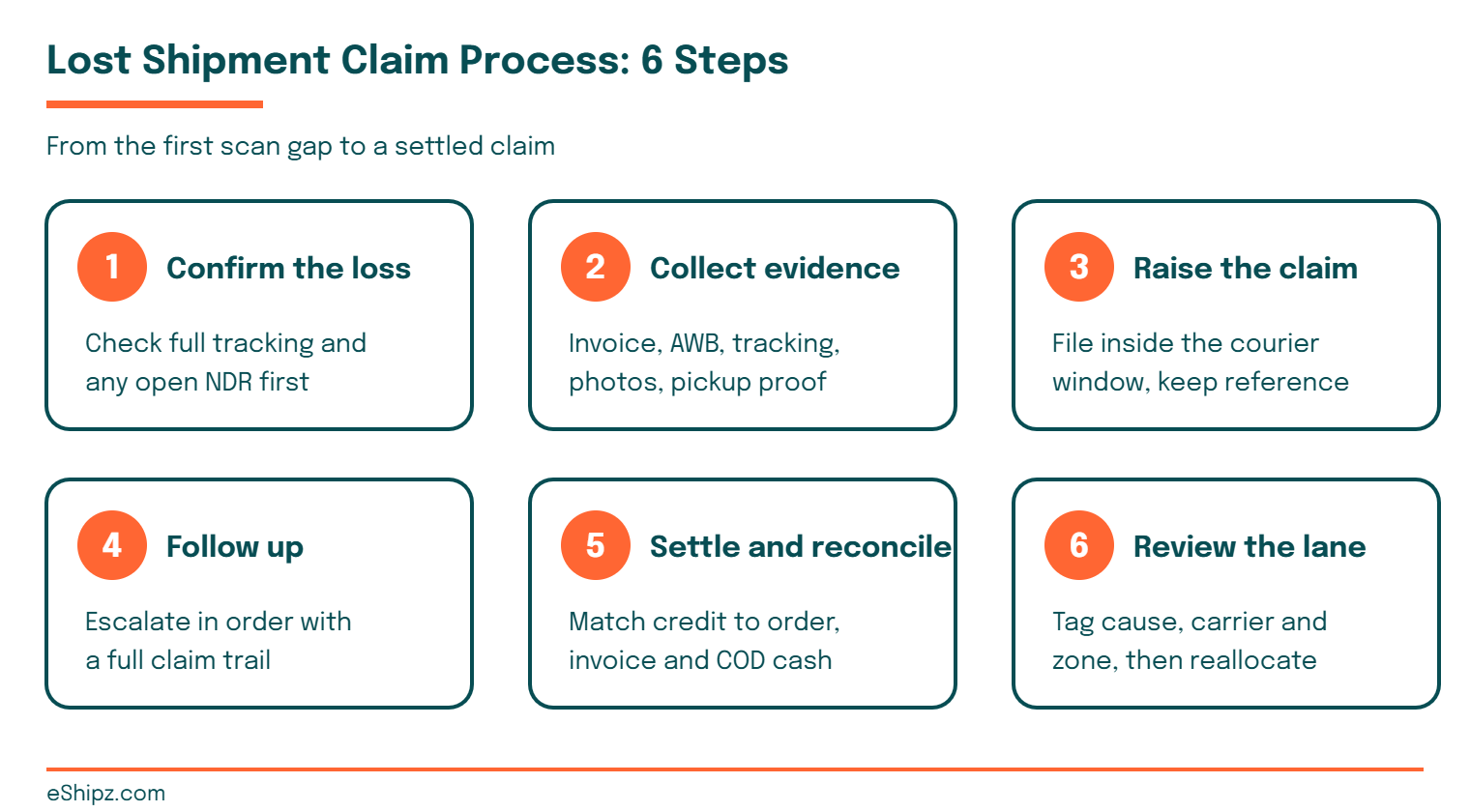
The workflow below applies to most domestic couriers in India. Exact forms and portals differ, so treat the steps as a skeleton and fill in each courier’s own rules. The infographic summarizes the flow before we walk through it.
Step 1: Confirm the shipment is truly lost
Do not start the lost shipment claim process the moment a scan is late. Check the full tracking history, the delivery attempt log and any open delivery exception first. A parcel that is stuck in a failed-delivery loop is not lost, and it may need an NDR action rather than a claim.
Set a clear internal rule for when a parcel is declared lost. For example, you might declare a parcel lost after a fixed number of days without any scan, adjusted by zone. The rule is yours to choose, but it must be written down so every team member applies it the same way.
Step 2: Collect the evidence pack
Gather documents before you contact the courier in the lost shipment claim process. A complete pack makes the lost shipment claim process faster, because the courier cannot ask for more. The next table lists what each claim type needs.
| Claim type | Evidence to attach | Common reason for rejection |
|---|---|---|
| Lost in transit | Invoice, AWB, tracking history, pickup proof | Missing or mismatched invoice value |
| Damaged on arrival | Photos of box and product, invoice, AWB | No outer-box photos or late reporting |
| Short or wrong item | Packing photo, invoice, buyer photo | No packing-time proof of contents |
| Fake delivered scan | Buyer statement, delivery proof, tracking | Weak statement with no location detail |
| COD parcel lost | All of the above plus COD order details | Cash flow not reconciled to the order |
Photograph packed parcels before dispatch, and store images against the order ID. That single habit removes the most common rejection reason across claim types.
Step 3: Raise the claim within the window
Every courier sets its own deadline for reporting a loss. Some count from booking, others from the expected delivery date. Read your carrier agreement and write the window into your process, because a late claim is usually a rejected claim.
File through the courier’s portal, account manager or email route, and keep a reference number for every submission. If you ship through an aggregator, raise the claim in the platform so the aggregator can pursue it for you.
Step 4: Follow up and escalate
Claims rarely close on the first reply. Set follow-up reminders at fixed intervals and log each response. If the courier asks for more evidence, send it the same day so the clock does not restart.
When a claim stalls, escalate in order: the courier’s support desk, your account manager, then the regional operations contact. Attach the reference number, the original claim date and every earlier reply. A tidy trail often matters more than a loud complaint, and it keeps the lost shipment claim process fair and fast for both sides.
Step 5: Settle, credit and reconcile
Once the courier agrees, record the amount against the right order. Compensation may arrive as a credit note, a freight adjustment or a bank transfer. Match it to the original invoice so your books show the loss and the recovery side by side.
For COD orders, check that the remittance side agrees as well. A lost COD parcel can create a mismatch between the order, the cash due and the compensation received. Reconcile all three before you close the case, so the lost shipment claim process ends with clean books and no open questions.
Step 6: Review the carrier and the lane
Every settled claim is data. Tag it with the carrier, the origin and destination zones, the product category and the cause of loss. Patterns show up quickly: one carrier on one lane may account for most of your cases.
Feed those patterns into allocation rules. If a lane keeps producing losses, shift volume to a better carrier or add stricter packing. The aim of a mature lost shipment claim process is fewer claims over time, not just faster ones.
Claim Filing Options Compared
You can run claims manually, through your courier’s portal, or through a shipping platform that tracks everything in one place. The table compares the three options on the factors that matter most to sellers. It reflects general workflow differences, not measured results.
| Factor | Manual email and spreadsheet | Courier portal only | Shipping platform with claim tracking |
|---|---|---|---|
| Setup effort | Low | Low | Medium |
| Tracking across several couriers | Manual | One courier at a time | Single view |
| Evidence storage | Scattered across inboxes | Per courier | Linked to each order |
| Deadline reminders | Rely on memory | Limited | Automated alerts possible |
| Reporting on loss by carrier | Hard to build | Not available | Built from order data |
| Fit for growing sellers | Weak | Moderate | Strong |
Manual tracking works at very low volume. Once you use more than one courier, the evidence and deadlines scatter and claims slip through. A platform that links tracking, orders and claims keeps the lost shipment claim process consistent as you scale.
How to Prevent Losses Before You Need a Claim
Claims recover money, but prevention protects the customer relationship. A few controls in your daily routine cut the number of parcels that ever reach the claim stage. Prevention is the cheapest part of the lost shipment claim process, because a parcel that arrives needs no claim. Use this checklist as a weekly routine.
- Validate addresses and pincodes at checkout so parcels do not enter the wrong lane.
- Photograph every packed parcel and keep the image against the order ID.
- Declare the correct invoice value at booking so any compensation matches the real value.
- Use sturdy packaging and tamper-evident seals for high-value or fragile items.
- Review tracking daily for scan gaps and hub-to-hub delays, not only for delivered statuses.
- Compare carrier performance monthly and move volume away from weak lanes.
- Keep a written courier contract summary with claim windows and compensation terms.
For a related loss that eats margin quietly, see our guide to weight discrepancy in shipping, which explains how mismatched weights inflate freight bills and how to stop them.
Common Mistakes in the Lost Shipment Claim Process
Even careful sellers lose claims to avoidable errors. These are the ones that appear most often.
Filing the claim too late or too early
Filing too late breaks the carrier’s window. Filing too early, before a parcel is truly stuck, can close a case that would have delivered on its own. Your written rule for declaring a loss protects you from both.
Submitting incomplete or inconsistent documents
A claim with an invoice that shows one value and an order record that shows another invites rejection. Check that the invoice, AWB, declared value and order record match before you submit.
Ignoring small claims
Low-value claims feel not worth the effort. Yet they add up, and a standard process makes each one quick to file. A lost shipment claim process that only handles large cases leaves steady money on the table.
Failing to learn from closed claims
Many sellers settle a claim and move on. The real value is in the pattern across claims, which tells you which carrier, lane or packaging needs attention.
Who Should Own the Lost Shipment Claim Process?
A claim process without an owner stalls. Name one person who owns the lost shipment claim process, even if the work is part time. That owner keeps the loss rule, the evidence checklist and the deadline calendar.
Small teams can give the role to the operations lead. Larger teams often split it: customer support raises the flag, the logistics team files the claim, and finance reconciles the payout. Whatever the split, write it down so no claim waits for someone to notice it.
A simple weekly rhythm
Review open claims once a week. Check which cases need follow-up, which are close to the courier’s deadline and which have settled. A short weekly review keeps the lost shipment claim process moving without a big time commitment.
At month end, share the KPI table with the whole team. When everyone sees the loss rate by carrier, the case for changing a carrier or lane becomes a fact, not an opinion.
KPIs to Track Your Claim Performance
You cannot improve what you do not measure. Track the metrics below monthly, and review them by carrier and zone. All formulas use your own order data, so no outside benchmark is needed.
| KPI | Formula | Why it matters |
|---|---|---|
| Loss rate | Lost shipments ÷ total shipments | Shows overall exposure to loss |
| Claim filing rate | Claims filed ÷ lost shipments | Reveals unclaimed losses |
| Claim settlement rate | Claims paid ÷ claims filed | Tests evidence quality |
| Average days to settle | Settlement date − filing date, averaged | Shows cash tied up in claims |
| Recovery ratio | Amount recovered ÷ value of lost goods | Measures how much you win back |
| Loss rate by carrier | Lost shipments ÷ shipments, per carrier | Guides carrier allocation |
If your claim filing rate sits below 100%, you are leaving recoverable value unclaimed. If your settlement rate is low, look at the evidence pack first. The numbers tell you where to act.
How eShipz Helps With the Lost Shipment Claim Process
eShipz is a multi-carrier shipping and logistics platform. Running every courier from one place makes the early steps of the lost shipment claim process much easier, because tracking, order data and carrier history sit together instead of in separate portals.
With one view of shipments across carriers, your team can spot scan gaps sooner and see which parcels need action today. Exception alerts and carrier performance reporting help you move from reacting to losses toward preventing them. You can explore the eShipz shipping platform to see how these workflows fit your operation.
Linking each order to its tracking history also gives you a ready evidence trail when you file. Instead of searching inboxes for invoices and scan logs, you start from a single order record. That saves time on every claim and raises the odds that each one is accepted.
Conclusion: Make the Lost Shipment Claim Process a Habit
Lost parcels are a cost of doing business in a market that keeps growing. Unclaimed losses, however, are a choice. A written rule for declaring a loss, a standard evidence pack, firm deadlines and a monthly review turn the lost shipment claim process into a routine instead of a scramble.
Start small. Write down your loss rule, collect the evidence checklist, and track the six KPIs for one month. Then use the results to choose better carriers and lanes. To bring your carriers and orders together in one place, visit eShipz and see how a single shipping workspace can support your claims.
Frequently Asked Questions About the Lost Shipment Claim Process
1. What is the lost shipment claim process?
The lost shipment claim process is the set of steps a seller uses to prove a parcel never reached the buyer and recover its value from the courier. It covers declaring the loss, collecting evidence, filing within the window, escalating and reconciling the payment.
2. When should I file a lost shipment claim?
File once your written loss rule is met and tracking shows no genuine movement. Check the courier’s reporting window in your agreement, because deadlines differ by carrier and some count from booking.
3. What documents do I need to file a claim?
You typically need the invoice, the AWB, the tracking history and proof of pickup. Damaged or short-delivered claims also need photos, and fake-delivery claims need a buyer statement with delivery details.
4. How much compensation will I receive?
Compensation depends on your courier contract and the value declared at booking. Read the compensation clause for each carrier and declare the correct invoice value so any payout reflects the true value.
5. Can I run the lost shipment claim process for COD orders?
Yes. Treat it like any other claim, then reconcile the COD side as well. Make sure the order, the cash due and the compensation received all agree before you close the case.
6. What if the courier rejects my claim?
Read the rejection reason, then fix the gap and resubmit if the window allows. If the evidence was strong, escalate through your account manager with the reference number and your full claim trail.
7. How can I reduce the number of lost shipments?
Validate addresses, photograph every pack, declare correct values and watch tracking for scan gaps. Review carrier and lane performance monthly and shift volume away from weak routes.