








Carrier SLA management decides whether a courier promise is a real commitment or just a line on a rate card. When a parcel arrives late, your customer blames your brand, not the carrier.
McKinsey’s article on what consumers want from e-commerce deliveries found that shoppers rank on-time delivery above speedy delivery when judging satisfaction. The same article reports that last-mile on-time rates sat at 85 to 90 percent before the pandemic, dropped to about 72 percent in May 2020, and have not fully recovered. The survey covers US consumers, but the lesson travels: reliability beats raw speed.
Most Indian ecommerce teams sign carrier contracts, then never measure the promises inside them. This guide shows how carrier SLA management works in practice, from the clauses to write, to the metrics to track, to the review rhythm that keeps couriers honest.
What Is Carrier SLA Management?
A service level agreement (SLA) is a written promise from a carrier about how it will perform. It usually covers pickup time, transit time, delivery attempts, status updates, claim handling and payout timelines.
Carrier SLA management is the ongoing work of defining those promises, measuring actual performance against them, and acting on the gaps. It turns a contract into a feedback loop. Without that loop, an SLA is just a PDF in a shared drive.
Good carrier SLA management has three parts: clear terms, reliable measurement, and consequences. If any one is missing, the other two stop working.
Why Carrier SLA Management Matters for Ecommerce Brands
Delivery is the one part of the customer experience you do not control directly. Carrier SLA management gives you a lever over it.
It protects customer trust, because fewer late parcels mean fewer angry messages. It protects margin, because late shipments create support tickets, reships and returns to origin. It also gives you negotiating power, because you can show a carrier its own numbers instead of an opinion.
The benefit compounds when you ship with several couriers. Once you compare partners on the same SLA yardstick, weak lanes become visible and strong lanes can win more volume.
The Core SLA Clauses Every Carrier Contract Should Define
Before you can manage an SLA, you need terms that can be measured. Vague wording such as “prompt delivery” cannot be audited.
The table below lists the clauses worth defining in any carrier SLA. The target values are illustrative examples only, so replace them with figures that match your lanes and your contract.
| Clause | What it measures | Illustrative target |
|---|---|---|
| Pickup time | Time from scheduled slot to actual pickup | Within the booked slot, 95% of orders |
| Transit time (TAT) | Days from pickup to delivery by lane | Within the quoted TAT, 90% of orders |
| Delivery attempts | Number of tries before return to origin | At least 3 attempts, with reason codes |
| Status updates | Gap between scans on the tracking feed | No scan gap beyond 24 hours |
| Claim settlement | Days to resolve lost or damaged claims | Decision within 15 days |
| Remittance cycle | Days to pay out collected COD cash | Within the agreed D+ cycle |
Write each clause with a number, a unit and a measurement window. If the carrier cannot agree to a number, that tells you something about the service you will get.
Common Reasons Carriers Miss Their SLAs
Not every miss is the courier’s fault, and treating all of them as carrier failures damages the relationship. Good carrier SLA management separates the causes so you can fix your own side first.
| Cause | Typical owner | How to spot it |
|---|---|---|
| Slow handover at pickup | Brand or warehouse | Pickup scans arrive after the cut-off |
| Incorrect weight or address data | Brand | Reattempts and weight disputes cluster on certain SKUs |
| Hub congestion and linehaul delay | Carrier | Scan gaps between hubs on the same lane |
| Failed delivery attempts | Shared | High non-delivery reports on one pincode group |
| Weak last-mile staffing | Carrier | Late deliveries concentrated in a few cities |
Tag every breach with a likely owner before you raise it. A carrier that sees fair classification is far more likely to engage with your data.
What Does an SLA Breach Cost You? (Illustrative Model)
Teams often underestimate the cost of late delivery because it is spread across several departments. Carrier SLA management becomes easier to justify once you add those costs together.
The model below is hypothetical. It assumes 10,000 shipments a month, 8% of them late, and the unit costs shown in the table. Replace each assumption with your own data.
| Assumption (illustrative) | Value |
|---|---|
| Monthly shipments | 10,000 |
| Late shipments (8%) | 800 |
| Share of late shipments that raise a support ticket | 40% |
| Support cost per ticket | ₹40 |
| Share of late shipments that end in return to origin | 5% |
| Loss per return to origin | ₹250 |
| Manual follow-up cost per late shipment | ₹15 |
| Goodwill credit on 3% of late shipments | ₹100 each |
Under these assumptions, 800 late shipments cost about ₹37,200 a month before counting lost repeat purchases. The real figure is usually higher, because unhappy customers also buy less often.
A Step-by-Step Carrier SLA Management Workflow
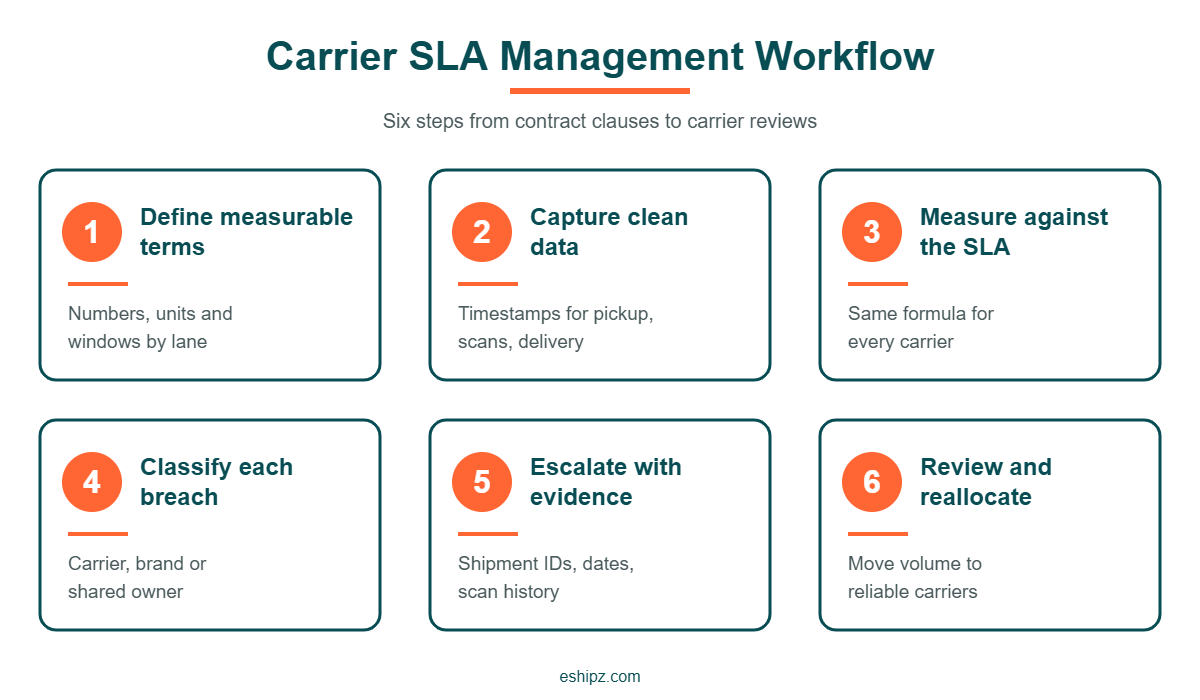
A repeatable workflow keeps carrier SLA management from turning into a monthly fire drill. The six steps below fit most teams, whether you ship a few hundred or a few hundred thousand parcels a month.
Step 1: Define Measurable Terms
Start with the clauses from the table above. Agree each number with the carrier in writing, by lane group, and record the date the terms take effect.
Step 2: Capture Clean Shipment Data
Every metric depends on timestamps: order ready, pickup, each tracking scan and delivery. Pull them into one place instead of reading each carrier portal separately.
Fix your own data first. Wrong pincodes and weights create misses that no courier can avoid.
Step 3: Measure Against the SLA
Compare actual performance with the promised terms every week. Use the same formula for every carrier so results are comparable.
Step 4: Classify Each Breach
Label each breach as carrier-owned, brand-owned or shared. This keeps your carrier SLA management fair and keeps conversations short.
Step 5: Escalate With Evidence
Send the carrier a short breach report with shipment IDs, promised dates, actual dates and scan history. Ask for a root cause and a fix date, not an apology.
Step 6: Review and Reallocate
Hold a monthly or quarterly review. Move volume toward carriers that meet their terms and away from lanes that keep missing, then record what changed.
How to Set SLA Targets by Lane
One national target rarely fits every route. A metro-to-metro parcel moves through busy, well-staffed hubs, while a parcel to a remote pincode may cross several handovers.
Group your lanes into tiers such as metro, tier-2 and remote, then set a separate transit target for each tier. Use your last ninety days of shipment data as a starting point, and ask the carrier to justify any target that is much slower than your history.
Revisit the tiers each quarter. Lanes improve and decline as carriers add hubs, change partners or hit seasonal volume.
Writing Penalties and Service Credits Into the Contract
A penalty clause only works if it is specific and provable. State which breach triggers it, how it is calculated and how long you have to claim it.
Many carriers resist hard penalties but accept service credits against future freight. Whichever route you take, make sure the credit is tied to the same data you track internally, so there is no argument about what happened.
Keep the tone commercial rather than punitive. Your goal is better delivery, and a carrier that feels trapped will not invest in your lanes.
Running a Monthly Carrier Review
A short, structured meeting does more than a long, general one. Send the report two days ahead so the carrier arrives prepared.
- Open with the headline metrics for the month and the change from the previous month.
- Walk through the three worst lanes, with shipment IDs and scan history.
- Share the brand-owned causes you have already fixed, to show good faith.
- Agree on actions, owners and dates, and write them down.
- Close by confirming the next review date and the metrics that will be checked.
Reading One Month of Carrier Data (Illustrative Example)
Imagine two carriers handle the same lane group. Carrier A delivers 93 percent of parcels within the quoted transit time, and Carrier B delivers 84 percent. These figures are hypothetical and exist only to show the method.
At first glance, Carrier A wins. But when you tag the breaches, you find that half of Carrier B’s misses come from wrong addresses on your side. After you fix address quality, the two carriers sit much closer together.
This is why classification matters in carrier SLA management. It stops you from punishing a carrier for your own errors and points your effort at the real gap.
Handling COD and Return Pickups Inside an SLA
Delivery speed is only part of the picture for cash-on-delivery orders. The remittance cycle, meaning how fast the carrier pays you the collected cash, affects your working capital directly.
Reverse pickups deserve their own clause too. Define how soon the carrier must collect a return after the request, and how many pickup attempts it will make before closing the ticket.
Escalation Ladder When a Carrier Keeps Missing Targets
Decide your escalation steps before a crisis, not during one. A clear ladder keeps responses proportionate and gives the carrier a fair chance to fix the issue.
| Stage | Trigger | Action |
|---|---|---|
| Notice | One lane misses target for two weeks | Send a breach report to the account manager |
| Review | Same lane misses for a month | Hold a call with the regional head and agree a fix date |
| Reduce | No improvement after the fix date | Shift part of the volume to a backup carrier |
| Reassess | Pattern across several lanes | Reopen the contract terms or exit the lane |
Informal, Contractual and Monitored SLAs Compared
Teams usually sit at one of three maturity levels. The comparison below shows why monitoring is the stage that actually changes carrier behavior.
| Approach | How it works | Main weakness |
|---|---|---|
| Informal | Verbal promises and rate-card TAT | Nothing to enforce |
| Contractual | Written clauses and penalties | Breaches go unnoticed without data |
| Monitored | Contract plus weekly measurement and reviews | Needs clean data and a review habit |
Moving from contractual to monitored is the biggest single step in carrier SLA management. The contract only starts working when someone checks it.
Metrics to Track in Carrier SLA Management
Pick a small set of metrics and track them consistently. A dozen well-defined metrics beat fifty loosely defined ones.
| Metric | Formula | Why it matters |
|---|---|---|
| On-time delivery rate | Deliveries within promised date ÷ total deliveries | Shows the core promise kept |
| First-attempt delivery rate | Delivered on first attempt ÷ total dispatched | Reveals last-mile quality |
| Pickup adherence | Pickups within slot ÷ total pickups | Flags handover delays |
| Average transit days by lane | Sum of transit days ÷ deliveries | Shows lane-level speed |
| Return-to-origin rate | Returned orders ÷ total dispatched | Links delivery quality to cost |
| Claim resolution time | Days from claim to settlement | Tests the carrier’s service |
Track each metric by carrier, by lane and by week. Averages across all carriers hide the problem lanes that need attention.
If you want a ready way to rank couriers, see our guide to the courier performance scorecard. It pairs well with SLA data because it turns raw numbers into a ranking.
Data and Tools That Make SLA Tracking Easier
Spreadsheets work for the first month. After that, manual copying from carrier portals becomes the bottleneck, and errors creep in.
Look for a setup that pulls tracking events from every carrier through APIs, stores each scan with a timestamp, and calculates your metrics automatically. The same setup should let you filter by carrier, lane, pincode group and date range.
Good tooling also lowers the effort of carrier SLA management for a small team. Instead of building reports by hand, you spend the time on the conversation with the carrier.
Planning SLAs for Peak Seasons
Festive sales and flash campaigns stretch every carrier network. Transit times lengthen, pickups slip and scan gaps widen.
Agree on peak-season terms ahead of time. Ask each carrier for a capacity commitment, a revised transit table for busy weeks, and a named escalation contact.
Then adjust your own side as well. Share volume forecasts early, stagger dispatch across days and keep a backup carrier warm for the busiest lanes.
Communicating With Customers When an SLA Slips
Even with strong carrier SLA management, some parcels will run late. The way you communicate decides whether the delay becomes a complaint.
Send a proactive message as soon as a shipment misses its expected date, with the new estimate and a tracking link. Customers forgive a delay they were told about far more readily than one they discovered themselves.
Feed those messages back into your data. Every delay notice you send is also a record of a breach that belongs in the next carrier review.
Prevention Checklist for Fewer SLA Breaches
Some breaches can be prevented before the parcel leaves your dock. Use this checklist as part of your carrier SLA management routine.
- Validate pincodes and phone numbers at checkout so addresses are deliverable.
- Record accurate weight and dimensions to avoid reattempts and disputes.
- Book pickups in fixed slots and hand over parcels before the cut-off.
- Choose carriers by lane performance, not by headline rate alone.
- Keep a backup carrier ready for lanes that miss targets repeatedly.
- Send proactive delivery updates so customers can respond to failed attempts.
Mistakes to Avoid in Carrier SLA Management
Even well-run teams slip into a few predictable habits. Watch for these.
Writing Targets Without Measurement Windows
A target of 95 percent on-time means little without a period. State whether it is measured weekly or monthly, and by lane or overall.
Judging Carriers on Averages Alone
A courier can look fine nationally and still fail badly in two metros. Lane-level data keeps carrier SLA management honest.
Escalating Without Evidence
Complaints without shipment IDs get ignored. Evidence gets answers.
Ignoring Your Own Data Quality
If a third of breaches trace back to bad addresses, the fix starts inside your business. Clean inputs make every later conversation easier.
How eShipz Supports Carrier SLA Management
Carrier SLA management is far easier when shipping data lives in one place. eShipz is a shipping automation platform that brings multiple carriers together, so tracking events from different couriers can be reviewed side by side.
With consolidated tracking, non-delivery handling and analytics, teams can compare carriers on the same measures and spot weak lanes sooner. They can also act on the findings by shifting volume between partners. Please confirm exact feature availability for your plan with the eShipz team before you rely on it.
To see how a single dashboard could replace carrier portals for your team, explore the eShipz shipping automation platform.
Conclusion
Carrier SLA management turns courier promises into numbers you can check and act on. Write measurable terms, collect clean data, classify breaches fairly, escalate with evidence and reallocate volume.
Treat the first quarter as a learning period. Your early targets will be imperfect, and that is fine, because each review shows which clauses need tightening and which lanes deserve more volume. Over time, steady carrier SLA management builds a shared language between your team and every courier you work with.
Start small. Pick three metrics, review them weekly for a month, and bring the first report to your top carrier. You will learn more from that single meeting than from another year of unchecked contracts.
Frequently Asked Questions About Carrier SLA Management
1. What is carrier SLA management?
Carrier SLA management is the process of defining courier performance promises, measuring actual results against them, and acting on the gaps. It covers pickup, transit time, delivery attempts, tracking updates and claim handling.
2. What should a carrier SLA include?
A strong carrier SLA names each metric with a number, a unit and a measurement window. Common clauses cover pickup adherence, transit time by lane, delivery attempts, scan frequency, claim settlement and remittance cycle.
3. How often should I review carrier SLA performance?
Review performance weekly for operations and monthly or quarterly for commercial discussions. Weekly checks catch problems early, and the longer reviews give you evidence for contract talks.
4. Which metrics matter most for carrier SLA management?
Start with on-time delivery rate, first-attempt delivery rate, pickup adherence, return-to-origin rate and claim resolution time. Track them by carrier and by lane, not only as a national average.
5. Can I enforce penalties for SLA breaches?
Only if the contract defines the penalty and you can prove the breach with shipment data. Many brands focus on volume reallocation instead, since moving shipments away from a weak carrier is often more effective.
6. How do I tell carrier failures from my own errors?
Tag each breach with a likely owner by checking the cause. Slow handover, wrong addresses and wrong weights are usually brand-owned, while hub delays and scan gaps are usually carrier-owned.
7. Do small brands need carrier SLA management?
Yes, though a lighter version works. Even a weekly spreadsheet of on-time rate by carrier gives a small brand useful leverage and shows when to add a backup courier.