








Every parcel your customer receives starts with a pickup. If the courier rider never arrives, nothing else in your shipping stack matters, because the order simply sits on your shelf. Good courier pickup management is the discipline that stops that from happening.
The stakes are rising with volume. A RedSeer Express Logistics in Motion report projects that India’s express logistics market could reach up to 29 billion shipments by FY 2030, growing at a 19-23% CAGR. More shipments mean more pickups to schedule, confirm and chase every single day.
This guide explains how courier pickup management works, why pickups fail, what a missed pickup costs, and the exact workflow high-performing sellers use. It also covers a prevention checklist, common mistakes and the KPIs worth tracking.
What Is Courier Pickup Management?
Courier pickup management is the process of planning, scheduling, confirming and monitoring the collection of packed shipments from your warehouse or store by courier partners. It covers everything between “order packed” and “first scan by the carrier”.
Strong courier pickup management has four parts: a fixed dispatch cut-off, accurate manifests and labels, confirmed pickup slots with each carrier, and a clear escalation path when a pickup fails. Without all four, you rely on luck and phone calls.
Many teams treat pickups as a carrier problem. In practice, a large share of failures start on the seller side, from late label generation to unreadable barcodes. That is why courier pickup management belongs to your operations team, not only to your courier account manager.
Why Courier Pickup Management Breaks Down: Common Causes
Before fixing courier pickup management, you need to know where it fails. Most missed pickups trace back to a short list of causes, and each has a different owner. The table below separates seller-side causes from carrier-side causes so you can assign the right fix.
| Cause | Typical owner | How it shows up | First fix |
|---|---|---|---|
| Rider did not arrive | Carrier | Pickup status stays “scheduled” past the slot | Escalate to the carrier hub and rebook |
| Parcels not ready at the slot | Seller | Rider waits, leaves, marks “not ready” | Set a packing cut-off before the slot |
| Late label or manifest | Seller | Shipment created after the rider has left | Generate labels in batches before cut-off |
| Vehicle capacity shortfall | Carrier | Rider takes part of the load only | Share expected volume a day ahead |
| Wrong pickup address or contact | Seller | Rider cannot find or reach the warehouse | Verify pickup location details monthly |
| Pincode not serviced for pickup | Carrier | Booking accepted, no rider assigned | Check pickup serviceability before allocation |
Notice how many of these are preventable with simple rules. A cut-off time and batch label generation alone remove two of the six causes. The rest need carrier-level visibility and a quick escalation habit.
The Real Cost of Poor Courier Pickup Management
A missed pickup rarely looks expensive in isolation. The cost shows up in support tickets, cancelled orders, rushed reshipping and staff hours spent rescheduling. Across a month, those small leaks add up to a meaningful number.
The chart below uses a hypothetical example. It is illustrative only, and your own numbers will differ. Assumptions: 30,000 orders per month, 3% of orders hit a missed pickup (900 orders), a support contact costing ₹25, 5% of affected orders cancelled at an average margin of ₹300, 10% needing upgraded service at ₹60 extra, and 5 minutes of staff time per order at ₹200 per hour.
The model leaves out several costs that are real but hard to price. A late pickup can push a delivery past the date promised at checkout, which lowers trust and repeat purchase intent. It can also break cash flow for COD orders, because remittance cannot start until the parcel moves.
Even this modest model shows over ₹56,000 a month in avoidable cost, before counting lost repeat purchases. Better courier pickup management attacks every bar in the chart at the same time. Fewer missed pickups mean fewer tickets, fewer cancellations and less rework.
A Six-Step Courier Pickup Management Workflow
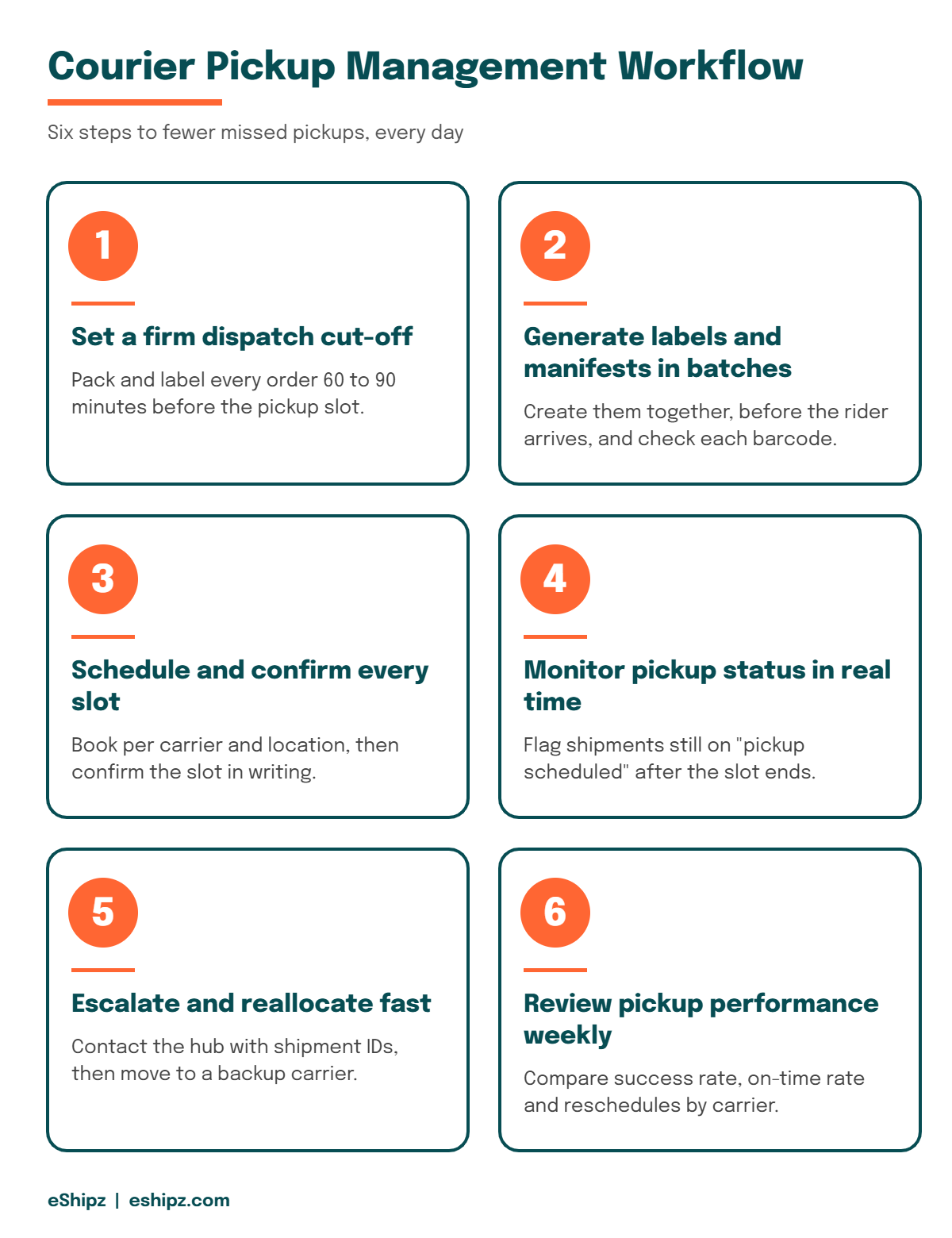
The workflow below turns courier pickup management into a repeatable daily routine. It works for a single warehouse or ten, and it scales because each step has a clear trigger and owner.
Step 1: Set a firm dispatch cut-off
Pick a daily time by which every order for that day must be packed and labeled. Share it with the warehouse team and with every carrier. A cut-off that sits 60 to 90 minutes before the pickup slot gives buffer for late packing.
Step 2: Generate labels and manifests in batches
Create labels and manifests together, ahead of the rider’s arrival. Batch generation avoids the “label created after the rider left” problem. Check that each barcode scans cleanly before the box is sealed.
Step 3: Schedule and confirm every pickup slot
Book a pickup per carrier and per location, then confirm the slot in writing or in your dashboard. A confirmed slot gives you something to measure against. An unconfirmed slot is only a hope.
Step 4: Monitor pickup status in real time
Watch for shipments still in “pickup scheduled” after the slot ends. These are your exceptions. The earlier you see them, the more options you have, including a second attempt on the same day.
Step 5: Escalate and reallocate fast
When a pickup misses, escalate to the carrier hub with the shipment IDs and the slot time. If the carrier cannot recover it that day, move the order to another carrier that serves the pincode. Good courier pickup management always has a backup carrier.
Step 6: Review pickup performance every week
Compare carriers on pickup success rate, on-time pickup and rescheduling frequency. Share the numbers with your carrier managers. The same scorecard thinking applies here as in a courier performance scorecard.
How to Choose the Right Cut-Off and Pickup Slot
A pickup slot only works when it matches how your warehouse actually runs. Start by looking at when orders arrive during the day. If most orders land between noon and 6 PM, a morning slot will always collect yesterday’s orders and delay every new one by a full day.
Next, measure how long picking and packing really take. Time a sample of fifty orders from the moment they enter the queue to the moment the box is sealed. Add a buffer of at least thirty minutes for exceptions such as stock mismatches, gift wrapping or fragile items that need extra care.
Finally, align the slot with the carrier’s own route plan. Riders usually cover a fixed area in a fixed sequence, so asking for a slot that breaks their route makes delays more likely. Ask your carrier manager which windows are most reliable for your pincode and book those first.
Review the timing every quarter. Order patterns shift with seasons, campaigns and new sales channels, and a slot that worked in March may fail by October.
Pickup Models Compared: Which Fits Your Operation?
Not every seller needs the same setup. The right model depends on daily volume, number of locations and the carrier mix you use. The comparison below summarizes the common options for courier pickup management.
| Model | Best for | Strength | Watch out for |
|---|---|---|---|
| Carrier rider pickup | Daily steady volume | No transport cost on your side | Rider delays and capacity limits |
| Self-drop at carrier hub | Low volume or urgent misses | Full control over timing | Staff time and travel cost |
| Consolidated pickup by one carrier | Single-carrier sellers | Simple coordination | Single point of failure |
| Multi-carrier scheduled pickups | Growing multi-location sellers | Backup if one carrier fails | Needs a central view of all slots |
| Third-party pickup network or 3PL | Large or seasonal volume | Scales without more staff | Less direct control, extra fee |
Most growing brands end up on the fourth model, because it protects them from a single carrier’s bad day. It also demands better tooling, since several carriers mean several pickup statuses to watch.
Courier Pickup Management Checklist: Prevent Misses Before They Happen
Prevention is cheaper than recovery. Use the checklist in Table 3 as a daily and weekly routine for your courier pickup management process.
| Frequency | Action | Owner |
|---|---|---|
| Daily | Confirm cut-off was met and all labels are printed | Warehouse lead |
| Daily | Check that every scheduled slot shows as confirmed | Operations |
| Daily | Review shipments still pending pickup after the slot | Operations |
| Weekly | Compare carrier pickup success rates | Logistics manager |
| Weekly | Verify pickup address, contact number and working hours | Warehouse lead |
| Monthly | Review carrier mix by pincode and reallocate weak lanes | Logistics manager |
| Quarterly | Revisit slot timing and cut-off against actual order patterns | Head of operations |
Keep the checklist short enough that people actually use it. A one-page version taped near the packing station often works better than a long document in a shared drive.
A Playbook for Handling Pickup Exceptions
Even the best process hits exceptions. What separates calm teams from stressed ones is a written playbook that tells everyone what to do in the first hour. The steps below keep the response consistent no matter who is on shift.
- Identify the exception early. Pull a list of shipments still showing “pickup scheduled” thirty minutes after the slot ends.
- Classify the cause. Decide whether the rider did not arrive, the parcels were not ready or the details were wrong.
- Contact the carrier with specifics. Share shipment IDs, the pickup address and the slot, instead of a general complaint.
- Set a recovery deadline. If the carrier cannot confirm a same-day pickup within two hours, move to the backup option.
- Execute the backup. Reassign to another carrier, or have a team member drop the parcels at the nearest hub.
- Update the customer where needed. Priority orders, prepaid orders and high-value orders deserve a proactive message.
- Log the cause. A simple record of every exception shows which carrier, location or process step causes the most trouble.
The log in the last step is the most valuable part. After a month, it turns anecdotes into data and gives you a factual basis for carrier reviews.
Preparing for Peak Season Pickups
Festive sales and campaign weeks put the heaviest load on pickups. Carriers run short of riders and vehicles, and a normal slot can slip by several hours. Planning ahead is the only reliable defense.
Share a volume forecast with every carrier at least a week before a major sale. Include expected daily orders, the busiest days and the pickup locations. Carriers can then allocate extra riders, but only if they know the number early.
Add a second pickup slot on peak days so that orders packed in the afternoon do not wait until the next morning. Keep extra packing capacity ready, because a faster carrier is useless if parcels are not sealed on time. Finally, pre-agree your backup carriers and the escalation contacts at each hub, so nobody searches for phone numbers in the middle of a rush.
Managing Pickups Across Multiple Warehouses
Sellers with several warehouses face a coordination problem. Each location has its own cut-off, its own carrier slots and its own local staff. Without a shared view, the head office cannot tell which location is struggling until customers complain.
Give every location the same process, the same naming for statuses and the same KPIs. Then compare locations side by side every week. A warehouse with a low cut-off adherence needs a packing fix, while one with a low pickup success rate needs a conversation with the local carrier hub.
Also keep location data accurate. Gate numbers, landmarks, working hours and the name of the person who hands over parcels all change over time. A five-minute monthly verification prevents many avoidable misses.
Common Mistakes in Courier Pickup Management
Even experienced teams repeat a handful of errors. Avoiding these gives you quick wins in courier pickup management without new software.
- Treating the pickup slot as a promise. A slot is a window the carrier aims for. Always verify completion before the day ends.
- Relying on a single carrier. One carrier outage can stall every order. Keep at least one backup active for each major pincode cluster.
- Chasing by phone and email. Manual follow-ups do not scale past a few dozen exceptions a day. Use status-based alerts instead.
- Ignoring seller-side delays. If parcels are not ready, the carrier gets blamed for a problem you created. Track your own cut-off adherence.
- Skipping address and contact checks. A changed warehouse gate or phone number can cause days of missed pickups.
- Not measuring pickup performance. Without numbers, carrier conversations become opinions instead of evidence.
KPIs for Courier Pickup Management
You cannot improve what you do not measure. Track the metrics in Table 4 for each carrier and each pickup location. Targets here are examples to adapt, not industry benchmarks.
| KPI | Formula | What it tells you |
|---|---|---|
| Pickup success rate | Shipments picked up on the scheduled day / shipments scheduled | Overall carrier reliability |
| On-time pickup rate | Pickups completed within the slot / total pickups | Slot discipline of each carrier |
| Missed pickup rate | Shipments not picked up on the scheduled day / shipments scheduled | Size of the problem |
| Average pickup delay | Total hours between slot end and actual pickup / delayed pickups | Severity of delays |
| Reschedule rate | Pickups rebooked / total pickups | Planning accuracy on both sides |
| Cut-off adherence | Orders labeled before cut-off / total orders for the day | Your own warehouse discipline |
Review these weekly and share the carrier-level view with each partner. Over a few cycles, patterns appear, such as a carrier that struggles on Mondays or a location with late packing.
How eShipz Supports Courier Pickup Management
Running courier pickup management across several carriers is hard when each one has its own portal. A central platform brings those statuses into one view, so your team sees every pickup exception in one place.
eShipz is a shipping automation platform that connects sellers to multiple carriers. It supports automated carrier allocation, label and manifest generation, and shipment tracking, which are the building blocks of the workflow described above. You can explore the full platform at eshipz.com.
With allocation rules based on pincode and carrier performance, a shipment can move to a backup carrier when a lane keeps missing pickups. Tracking updates also let your support team answer “has my order been picked up?” without calling anyone. Please confirm the exact features available on your plan with the eShipz team.
Conclusion
Pickups are the first mile of every delivery, and they set the tone for everything after. Reliable courier pickup management comes down to a firm cut-off, batch labels, confirmed slots, real-time monitoring, fast escalation and weekly review.
Remember that every improvement compounds. A cleaner first mile means fewer failed deliveries downstream, lighter support queues and more predictable cash flow. That is why sellers who invest early in courier pickup management usually see benefits well beyond the warehouse door.
Start small. Set your cut-off, confirm every slot and track pickup success rate for one month. Then add a backup carrier and automate the alerts. If you want one place to coordinate carriers and pickups, see how eShipz shipping automation can fit into your operation.
Frequently Asked Questions About Courier Pickup Management
1. What is courier pickup management?
Courier pickup management is the process of scheduling, confirming and monitoring carrier collections of packed shipments from your warehouse. It includes cut-offs, labels, manifests, slot confirmation and escalation when a pickup fails.
2. Why do couriers miss scheduled pickups?
Common reasons include rider unavailability, vehicle capacity limits, late labels, parcels not being ready and wrong pickup details. Some causes sit with the carrier and some with the seller, so the fix depends on the cause.
3. What should I do when a courier pickup is missed?
First check the shipment status and the slot time. Then escalate to the carrier with the shipment IDs, and if it cannot be recovered the same day, reallocate to another carrier or drop the parcel at the nearest hub.
4. How does a dispatch cut-off improve courier pickup management?
A cut-off ensures all orders are packed, labeled and manifested before the rider arrives. It removes the most common seller-side cause of missed pickups and gives the warehouse a clear daily target.
5. Which KPIs matter most for courier pickup management?
Start with pickup success rate, on-time pickup rate and missed pickup rate for each carrier. Add average pickup delay, reschedule rate and your own cut-off adherence for a fuller picture.
6. Is it worth using more than one carrier for pickups?
Usually yes, once volume grows. A second carrier gives you a backup when the first misses a pickup, and it lets you compare pickup performance by carrier and pincode.
7. Can software automate courier pickup management?
Software can automate label generation, carrier allocation, pickup scheduling and status alerts. It cannot replace a clear process, so define your cut-off and escalation rules first and then automate them.