






Baymard Institute’s tracker of 50 published studies puts the average online cart abandonment rate at 70.22%. In the same research, “extra costs too high (shipping, tax, fees)” appears as a reason shoppers leave, at 40%. A well-set free shipping threshold is one of the few levers that attacks both problems at once.
It removes the unpleasant surprise at checkout, and it gives shoppers a reason to add one more item. But a threshold set by gut feel can quietly eat your margin. Set it too low and you subsidize small orders. Set it too high and shoppers give up before they reach it.
This guide shows how to choose a threshold with simple math instead of guesswork. You will see the cost model, a six-step workflow, a comparison of free shipping models, a launch checklist and the KPIs to watch. All rupee figures in the examples are illustrative, so replace them with your own numbers.
What Is a Free Shipping Threshold?
A threshold is the minimum cart value at which a store stops charging for delivery. A shopper who spends below the line pays a shipping fee. A shopper who crosses it ships free.
The idea is simple, but the threshold does three jobs at the same time. It is a pricing lever, a basket-building tool and a conversion tool. Each job pulls the number in a different direction, which is why a single “right” figure rarely exists for every store.
Threshold vs. free shipping on everything
Free shipping on every order is easy to explain, but you pay for every parcel, including the tiny ones. A threshold shares the cost with the customer on small baskets and rewards larger ones. The trade-off is that the shopper must do a little math, so the offer has to be visible on every page.
Where the threshold fits in your shipping strategy
Your threshold sits on top of your carrier rates, your packaging and your returns policy. If those costs move, the right free shipping threshold moves with them. That is why it should be reviewed on a schedule, not set once and forgotten.
Why a Free Shipping Threshold Matters for Ecommerce Profit
Shipping charges are one of the most visible costs in the buying journey. When a fee appears for the first time at checkout, it feels like a penalty. A clear free shipping threshold shown earlier turns the same fee into a goal.
The table below shows the problems a threshold addresses and where it can go wrong.
| Shopper or business problem | What a free shipping threshold does | Where it can backfire |
|---|---|---|
| Fee shock at checkout | Shows the free delivery goal earlier in the journey | The fee below the line may still feel high |
| Small, low-margin baskets | Pushes shoppers to add an item or accept a fee | A line set too high can stall conversion |
| Pressure to match competitors | Gives a clear offer without free shipping on everything | Copying a rival ignores your own cost and margin |
| Rising carrier rates and surcharges | Shares delivery cost on small orders | A fixed number goes stale as rates change |
| Weak repeat purchase | Gives returning shoppers a reason to combine orders | Can encourage bracketing and extra returns |
Notice that the threshold does not fix every problem. If your products are overpriced or your delivery is slow, a threshold will not rescue conversion. It works best when the rest of the experience is already sound.
The two behaviors a threshold changes
The first is checkout surprise. Showing the free shipping threshold in the header or on the product page lets shoppers plan their cart before they see the final total.
The second is basket size. A shopper who is a few rupees short of free delivery will often add a small item rather than pay a fee. That extra item is where the margin on your threshold comes from.
How Much Does a Free Shipping Threshold Cost You?
Every order that crosses the line costs you the shipping charge you no longer collect. To see the real cost, you need three numbers: your blended shipping cost per order, your gross margin and your average order value.
For the examples in this post, assume a hypothetical store with 1,000 orders a month. Assume a blended shipping cost of ₹70 per order, a 30% gross margin and an average order value of ₹900. These are illustrative assumptions for a model, not benchmarks.
Cost at different threshold levels
The chart below shows how much shipping cost your store would absorb per 1,000 orders at five thresholds. The share of orders that qualify is also illustrative. Lower thresholds make more orders free, so the absorbed cost rises quickly.
The model is deliberately simple. It ignores the extra items shoppers add to reach the line, and it ignores orders that would have paid shipping anyway. In real life, the basket uplift partly offsets the cost, which is exactly why you should measure it after launch.
Break-even basket value for your threshold
A useful floor for any free shipping threshold is the basket value at which your gross margin pays for the shipping. The formula is shipping cost divided by gross margin percentage. At ₹70 shipping and a 30% margin, that is about ₹233.
Your threshold should sit well above this floor. The table shows how the floor changes with margin, using the same illustrative ₹70 shipping cost.
| Gross margin | Break-even basket (₹70 ÷ margin) | What it means |
|---|---|---|
| 20% | ₹350 | Orders under this lose money once shipping is free |
| 30% | ₹233 | Illustrative base case used in this post |
| 40% | ₹175 | More room to set a lower threshold |
| 50% | ₹140 | Floor is low, but conversion goals may still set the line |
Low-margin categories have a much higher floor. If your margin is 20%, an order below ₹350 loses money once you give away shipping, before you count packaging or payment fees.
How to Set Your Free Shipping Threshold: A Step-by-Step Workflow
Use the workflow below to set your first free shipping threshold, or to reset an old one. Each step needs data you already have in your order and courier reports.
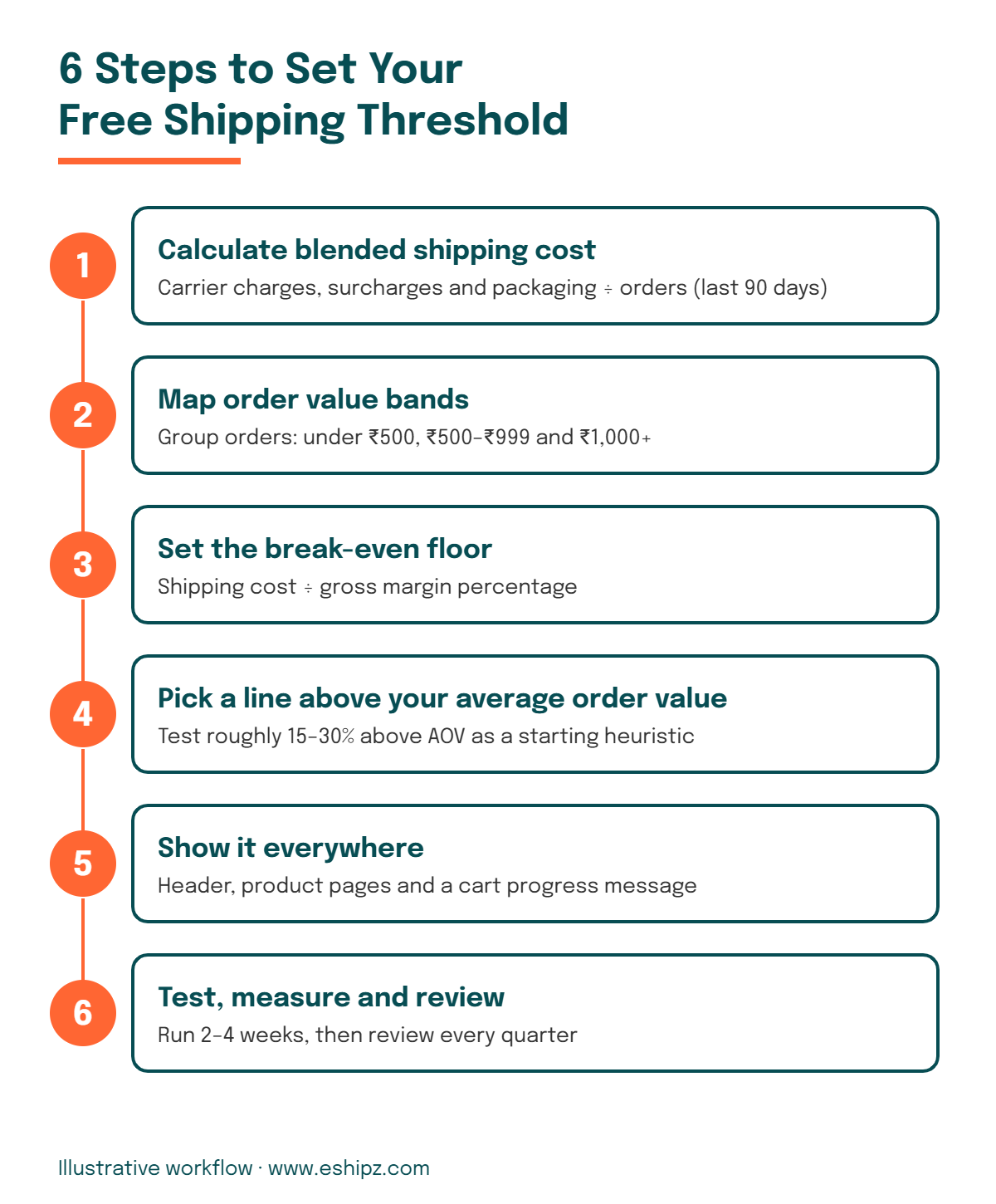
Step 1: Calculate your blended shipping cost
Pull the last 90 days of shipments and divide total carrier charges by the number of orders. Include fuel surcharges, packaging and any return freight you pay. A threshold built on the base rate alone will understate the true cost.
Step 2: Find your average order value and basket distribution
Average order value is a good starting point, but the spread matters more. Group your orders into bands, such as under ₹500, ₹500 to ₹999 and ₹1,000 and above. The band where most orders sit tells you how many shoppers a given free shipping threshold will reach.
Step 3: Set the break-even floor
Apply the shipping cost divided by margin formula for each product category. Your threshold cannot sensibly sit below the floor of your lowest-margin bestseller. If categories differ a lot, consider separate thresholds by category or zone.
Step 4: Choose the free shipping threshold above your average order value
A common starting heuristic is to set the threshold roughly 15% to 30% above your current average order value. This is a rule of thumb, not a research finding, so treat it as a first test. The gap should be small enough that one extra item gets shoppers over the line.
Step 5: Show the offer everywhere
Place the offer in the site header, on product pages and in the cart. Add a progress message such as “Add ₹180 more for free shipping” in the cart. A threshold that shoppers discover only at checkout has lost most of its power.
Step 6: Test, measure and review
Run the new free shipping threshold for at least two to four weeks before judging it. Compare average order value, conversion rate and shipping cost per order against the previous period. Then review the figure every quarter, or whenever carrier rates change.
Free Shipping Models Compared
A threshold is only one way to handle delivery charges. Depending on your margins and customers, another model may suit a product line better. The table compares the main options.
| Model | How it works | Best for | Main risk |
|---|---|---|---|
| Free shipping on all orders | Every order ships free | High-margin or high-value products | Small parcels can lose money |
| Free shipping threshold | Free delivery above a set cart value | Stores with mixed basket sizes | Wrong number hurts margin or conversion |
| Flat-rate shipping | One fee for every order | Simple catalogs with similar parcel weights | Feels expensive on small orders |
| Tiered or zone-based | Fee varies by weight or distance | Wide geographic coverage | Harder for shoppers to understand |
| Free for members | Free delivery for loyalty or subscription members | Brands with strong repeat buyers | Needs a membership program to run |
| Free on prepaid orders | Free delivery only when paid online | Stores with high cash on delivery volume | Can reduce conversion among cash buyers |
Many stores combine models. For example, you might offer a free shipping threshold for standard delivery and charge a flat fee for express. The key is that the rule is easy to read in one sentence.
Should cash on delivery orders qualify?
Cash on delivery orders carry extra risk, because they can come back as return-to-origin shipments and you pay the freight both ways. Some brands exclude cash on delivery from the threshold, or encourage prepaid payment with it. If you do this, state the rule plainly so shoppers are not surprised.
Should the threshold differ by zone?
Shipping cost depends heavily on distance and weight. A single national free shipping threshold is simple, but it may overpay on remote pin codes. If you serve distant zones, check whether a higher threshold there protects margin without hurting conversion.
Free Shipping Threshold Checklist Before You Go Live
Run through this list before you announce the offer. Each item takes a few minutes and prevents an expensive surprise.
- Confirm your blended shipping cost from the last 90 days, including surcharges and packaging.
- Calculate the break-even floor for your lowest-margin category.
- Set the threshold above the floor and above your average order value.
- Decide which orders are excluded, such as heavy items, bulk orders or cash on delivery.
- Add a threshold banner to the header, product pages and cart.
- Add a live “amount left for free shipping” message in the cart.
- Check that discount codes do not push a cart below the threshold at checkout.
- Define whether the threshold is calculated before or after discounts and taxes.
- Brief your support team on the exact rule so answers are consistent.
- Pick a review date and the KPIs you will compare.
Make the discount rule explicit
The most common support complaint about a threshold is a cart that qualified, then lost free shipping after a coupon. Decide in advance whether the threshold uses the pre-discount or post-discount value, and say so in the cart. Clear wording prevents disputes and abandoned checkouts.
Common Free Shipping Threshold Mistakes
Most problems with a threshold come from a handful of repeat errors. Check your setup against this list.
- Setting the threshold without knowing your cost. If you do not know your blended shipping cost, the threshold is a guess.
- Choosing a round number only. A number that looks neat may sit far from your actual basket distribution.
- Placing it too far above average order value. A big gap feels unreachable, so shoppers pay the fee or leave.
- Hiding it until checkout. The free shipping threshold only changes behavior if it is seen early.
- Ignoring returns. If free shipping encourages bracketing, where shoppers order several sizes to return some, return freight can erase the gain.
- Never reviewing it. Carrier rates, fuel surcharges and product mix change, and the threshold must follow.
- Letting coupons break it. Stacking discounts can drop a cart under the line and surprise the shopper.
Watch for the margin trap
A threshold looks successful when conversion rises, but conversion alone can hide a loss. Always compare contribution margin per order before and after the change. If orders grew but profit per order fell, the threshold is too generous.
KPIs to Track After You Set a Free Shipping Threshold
Treat the first month as an experiment. The table lists the metrics that tell you whether the threshold is working, and what each one means.
| KPI | How to calculate it | Healthy signal |
|---|---|---|
| Average order value | Revenue ÷ number of orders | Rises after launch |
| Conversion rate | Orders ÷ sessions | Stable or rising |
| Cart abandonment rate | Abandoned carts ÷ carts created | Falls, especially at the shipping step |
| Share of orders above the line | Orders at or above the threshold ÷ all orders | Grows without a cost spike |
| Shipping cost per order | Carrier charges ÷ orders | Stable or lower |
| Contribution margin per order | (Gross profit − shipping absorbed) ÷ orders | Flat or higher |
| Return rate | Returned orders ÷ delivered orders | No spike after launch |
| Units per order | Items sold ÷ orders | Rises modestly |
Track these by week, and compare against the same period before the change. Seasonality can distort a simple before-and-after view, so avoid launching a new free shipping threshold the week before a major sale.
Segment the data
Look at new versus returning customers, and at each shipping zone. A threshold may lift basket size for repeat buyers while doing little for first-time visitors. Segmenting shows where to adjust.
How eShipz Helps You Manage a Free Shipping Threshold
A threshold is only as good as the shipping data behind it. The eShipz platform brings carrier data together so you can see what each shipment really costs. That makes the break-even math in this guide much easier to run.
According to the eShipz website, the platform offers multi-carrier shipping with 500+ carrier integrations. It also describes CarrierSmart AI, which compares carriers on speed, cost and performance to pick a carrier for each order. Choosing a cheaper carrier per order lowers the cost your threshold has to absorb.
The same site describes Track360 for real-time tracking and delay alerts, and ReDelivR for failed-delivery handling. Fewer failed deliveries mean fewer wasted freight charges on free-shipping orders. AutoShip Hub covers label generation and courier sync, which reduces manual errors in each shipment.
To go deeper on cost control, read the eShipz guide on how to reduce shipping costs and boost profit. You can also explore the eShipz shipping platform to see how the features fit your stack.
Conclusion
A free shipping threshold is a pricing decision, not a marketing decoration. The right figure comes from your blended shipping cost, your margin and the shape of your order values. Start above your average order value, keep it visible and test it for a few weeks.
Then review it every quarter. When carrier rates, fuel surcharges or product mix change, your threshold should change too. With clean shipping data and a clear rule, it becomes one of the most reliable ways to protect margin and lift basket size at once.
FAQs About Free Shipping Threshold
1. What is a good free shipping threshold for an Indian ecommerce store?
There is no universal number. A good free shipping threshold sits above your break-even floor and roughly 15% to 30% above your average order value as a starting heuristic. Test it for several weeks, then adjust using your own conversion and margin data.
2. How do I calculate my free shipping threshold?
Divide your blended shipping cost by your gross margin percentage to find the break-even basket value. Then compare that floor with your order value distribution. Pick a figure above both, and confirm it with a short live test.
3. Does a free shipping threshold increase average order value?
It often nudges shoppers to add an item to reach the line, but the effect varies by store. The only reliable way to know is to compare average order value before and after the change. Segment the result by new and returning customers.
4. Should I offer free shipping on all orders instead of a free shipping threshold?
Free shipping on every order is simple, but you pay for small parcels that may lose money. It can suit high-margin or high-value products. For most stores with mixed baskets, a threshold protects margin better.
5. How often should I change my free shipping threshold?
Review it every quarter, and whenever carrier rates, fuel surcharges or your product mix shift. Avoid changing it in the middle of a sale, because the result will be hard to read. Keep a log of each change and its date.
6. How do discounts affect a free shipping threshold?
Decide whether the threshold uses the cart value before or after discounts, and state it clearly in the cart. If the post-discount value counts, a coupon can drop a cart below the line. That surprise is a common cause of abandoned checkouts.
7. Can software help me manage a free shipping threshold?
Yes. A shipping platform that shows real cost per shipment, carrier performance and failed deliveries gives you the inputs for the break-even math. Multi-carrier platforms such as eShipz can also help you choose lower-cost carriers per order, which reduces what each free shipment costs you.