




The search for the best shipping platform India is becoming increasingly important as ecommerce expands beyond metro cities. India had more than 270 million online shoppers in 2024, with the number expected to reach 420–440 million by 2030. More than half of online shoppers already come from Tier 2 and Tier 3 cities, making Pan-India shipping and reliable shipping to Tier 2 cities India and shipping to Tier 3 cities India a key priority for growing D2C and ecommerce brands. For businesses looking to scale beyond their immediate markets, the right ecommerce shipping platform India needs to support different delivery models without adding operational complexity.
At the same time, India’s express parcel market is expected to grow from around 10–11 billion shipments in FY25 to 24–29 billion by FY30. Faster delivery is also becoming a major customer expectation, with India’s quick-commerce market estimated at $7–8 billion in FY25 and projected to reach $65–70 billion by 2030. For ecommerce businesses, this means managing everything from same day delivery India and same day delivery for ecommerce to standard national deliveries at scale. A same day delivery platform India can help businesses meet local delivery expectations, while a broader last mile delivery platform India can support deliveries across different regions and service levels.
This is where hyperlocal delivery India becomes important. Hyperlocal delivery means delivering an order within a limited geographic area, usually from a nearby store, warehouse, dark store, or fulfilment centre to a customer in the same city or surrounding area. A Bengaluru customer might receive an order the same day from a nearby store, while another order travels from Bengaluru to Mumbai and a third goes to a Tier 3 pincode. For the business, they’re all orders, but they require completely different shipping decisions. This makes hyperlocal shipping for ecommerce particularly important for brands that operate both local fulfilment points and national distribution networks.
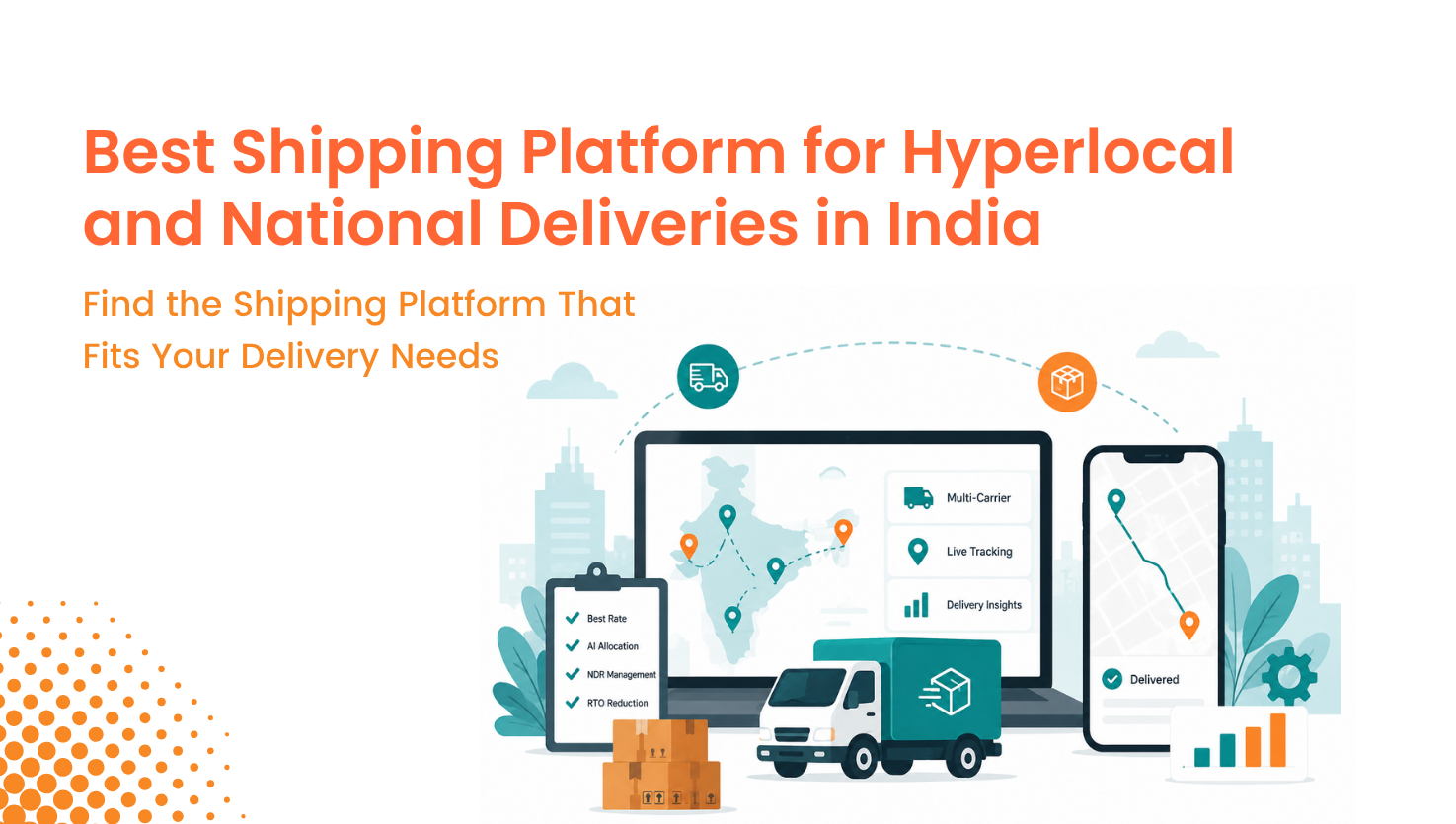
That is why businesses need more than a basic shipping aggregator India or courier aggregator India. A modern shipping software India or ecommerce shipping software should support hyperlocal delivery platform India requirements alongside national fulfilment. It should also enable multi courier shipping platform capabilities, multi carrier shipping platform connectivity, automated courier allocation, AI courier allocation, shipping rate comparison, courier rate comparison India, multi courier tracking, NDR management, and RTO reduction.
For brands shipping across multiple regions, these capabilities can also help with courier selection by pincode, automated courier selection, and better control over shipping costs. Instead of assigning every order to the same courier, businesses can evaluate serviceability, delivery timelines, cost, historical performance, and destination before deciding how an order should move. This becomes especially valuable for businesses looking to reduce ecommerce shipping costs or reduce RTO with courier allocation while maintaining customer experience.
In this guide, we’ll explore the leading platforms, compare their capabilities, and look at what makes the best shipping platform for D2C brands, the best shipping platform for online sellers, and the best shipping aggregator for ecommerce businesses in India. We’ll also look at use cases such as best shipping platform for Shopify India, Pan-India delivery for D2C brands, hyperlocal fulfilment, and national multi-carrier shipping.
Best Shipping Platform for Hyperlocal and National Deliveries in India
Businesses searching for the best shipping platform India, best shipping aggregator India, or best shipping platform for D2C brands will find several established platforms, including eShipz, Shiprocket, NimbusPost, Pickrr, iThink Logistics, Shipway, and ClickPost. While they all support ecommerce shipping India, their strengths differ. Some focus primarily on courier aggregator India services and multi-carrier connectivity, while others offer deeper shipping automation, tracking, carrier intelligence, customer experience, and enterprise logistics orchestration.
For businesses evaluating an ecommerce shipping platform India, the key is to look beyond courier count. A useful comparison should consider whether the platform can support hyperlocal delivery India, Pan-India shipping, same day delivery India, multi courier shipping, courier allocation software, automated courier allocation, shipping rate comparison, multi courier tracking, NDR management, and RTO reduction.
It is also worth considering how the platform handles different business models. A brand selling through Shopify may prioritise a best shipping platform for Shopify India, while a larger D2C business may need best multi courier platform India capabilities, automated carrier selection, and broader logistics visibility. Similarly, businesses expanding into smaller cities may need strong serviceability and shipping to Tier 2 cities India and shipping to Tier 3 cities India, while local-first brands may place greater emphasis on same day delivery for ecommerce and hyperlocal fulfilment.
Ultimately, the right platform should help businesses make better shipping decisions at every stage, from choosing the right courier and comparing rates to tracking shipments, managing delivery exceptions, reducing NDRs, and improving RTO performance. As ecommerce becomes increasingly distributed across cities, the best shipping platform India will not simply be the one with the largest courier network, but the one that can intelligently manage different delivery requirements across hyperlocal, regional, and Pan-India shipping operations.
| Platform | Broad positioning | Relevant use cases |
|---|---|---|
| eShipz | Multi-carrier shipping automation and logistics orchestration | B2B, ecommerce, SMB and enterprise shipping |
| Shiprocket | Ecommerce shipping and courier aggregation | Online sellers and businesses |
| NimbusPost | Shipping aggregation and logistics management | Ecommerce sellers |
| Pickrr | Ecommerce shipping and fulfilment technology | D2C and online sellers |
| iThink Logistics | Multi-carrier shipping and logistics automation | Ecommerce and D2C brands |
| Shipway | Shipping, tracking and customer experience | Ecommerce brands |
| ClickPost | Logistics intelligence and delivery experience | Enterprise ecommerce operations |
eShipz
Broad positioning: Multi-carrier shipping automation and logistics orchestration
Relevant use cases: D2C, ecommerce, SMB and enterprise shipping
eShipz is a multi-carrier shipping platform built around shipping automation and logistics orchestration. It helps businesses manage their shipping operations across multiple courier and logistics partners from a single platform.
Rather than requiring businesses to work separately with every courier partner, eShipz brings multi-carrier integration, shipping automation, carrier allocation, shipment tracking, delivery intelligence, NDR management and returns management into one connected logistics layer.
This makes the platform relevant for businesses that have moved beyond basic courier booking and need greater control over their ecommerce shipping, D2C shipping, B2B logistics and enterprise shipping operations.
One of the key areas where eShipz focuses is automated carrier allocation. Instead of assigning every order to the same courier, businesses can create shipping rules based on factors such as destination, pincode serviceability, shipping cost, delivery speed, SLA and historical carrier performance. This allows businesses to make more informed carrier decisions as their shipment volumes and delivery requirements increase.
Key eShipz Features
- Multi-carrier shipping integration: eShipz allows businesses to connect multiple courier and logistics partners through one shipping platform. Instead of maintaining separate systems and operational processes for every carrier, businesses can manage their carrier network through a centralised layer. This is particularly useful for ecommerce and D2C businesses that want flexibility across different delivery zones, service levels and shipping requirements.
- Automated carrier allocation: eShipz helps businesses automate the process of deciding which carrier should handle a particular shipment. Carrier selection can take into account factors such as destination, pincode, serviceability, cost, delivery speed, SLA and carrier performance. This helps businesses move away from fixed courier allocation and toward more dynamic, data-driven shipping decisions.
- AI-powered carrier selection: Through CarrierSmart AI, eShipz can help businesses make smarter courier allocation decisions by evaluating factors such as cost, speed and carrier performance. This is particularly valuable for businesses operating with multiple logistics partners, where the best carrier for one location or shipment type may not necessarily be the best carrier for another.
- Ecommerce shipping automation: For ecommerce and D2C brands, eShipz can act as a central shipping automation layer connecting orders with the appropriate carrier and delivery workflow. This allows businesses to streamline the journey from order processing to dispatch and delivery while maintaining visibility across multiple logistics partners.
- Hyperlocal and national shipping: eShipz can support businesses managing different delivery models, including hyperlocal delivery, regional shipping and national shipping. A same-city order may require a faster local delivery network, while a shipment moving between Bengaluru and Delhi may require a national carrier based on serviceability, cost and expected delivery time. Businesses can apply different shipping and carrier rules depending on the shipment requirement.
- Real-time shipment tracking: eShipz brings tracking information from multiple carriers into a unified view. Instead of operations teams checking different courier portals individually, they can monitor shipment movement and delivery status from a centralised platform. This becomes increasingly important for businesses handling thousands of shipments across multiple carriers.
- ETA prediction and delivery visibility: eShipz’s PredictShip capability is designed to provide estimated delivery dates and ETAs. Better delivery predictability can help businesses understand whether shipments are likely to arrive within the expected SLA and identify potential delivery delays earlier.
- NDR and delivery management: eShipz helps businesses manage Non-Delivery Reports (NDR) and failed delivery attempts through structured workflows. This can help operations teams identify delivery issues, take corrective action and improve the likelihood of successful delivery, which is especially important for D2C brands and businesses with significant COD volumes.
- Returns and reverse logistics: eShipz also supports the reverse side of the shipping journey. Businesses can manage and track return shipments alongside forward logistics, giving teams greater visibility into the complete order lifecycle. This is useful for ecommerce brands where returns and reverse logistics can have a significant impact on operational costs and customer experience.
- Enterprise logistics integrations: For larger businesses, shipping needs to connect with the wider supply chain. eShipz can integrate with systems such as ERP, TMS and WMS, allowing shipping workflows to work alongside enterprise resource planning, transportation management and warehouse management systems.
- Centralised logistics visibility: When a business works with several courier partners, logistics data can become fragmented. eShipz provides a centralised view across carriers, making it easier for operations teams to monitor shipments, identify exceptions and understand overall shipping performance.
Where eShipz Fits Best
eShipz becomes particularly relevant when shipping becomes more complex than simply booking a courier.
A small business with limited shipments may be able to manually select a courier. But as an ecommerce or D2C business starts shipping across multiple cities, using multiple carriers, managing different SLAs, handling COD and prepaid orders, and supporting both hyperlocal and national delivery, manual carrier selection becomes difficult to scale.
This is where logistics orchestration becomes important.
For example, one carrier may perform better for deliveries within Bengaluru, another may have stronger coverage across South India, while another may provide better serviceability for remote national pincodes. Instead of applying one courier rule to every order, eShipz can help businesses automate carrier selection based on the requirements of each shipment.
The result is a more flexible multi-carrier shipping operation where businesses can manage different delivery requirements through a single shipping automation platform.
Shiprocket
Broad positioning: Ecommerce shipping and courier aggregation
Relevant use cases: Online sellers and D2C businesses
Shiprocket is an ecommerce shipping platform focused on simplifying shipping for online sellers and D2C businesses. It brings multiple courier options into one platform and provides tools covering shipping, order management, tracking, returns and other ecommerce logistics activities.
Its primary value is courier aggregation, giving online sellers access to multiple shipping partners without requiring them to build individual courier integrations.
Key Features
- Multi-courier shipping: Allows online sellers to access multiple courier partners through one platform, giving ecommerce businesses more options for fulfilling orders across different locations.
- Order management: Helps businesses manage orders and connect ecommerce orders with their shipping workflows.
- Shipment tracking: Provides visibility into shipment status so sellers and customers can monitor delivery progress.
- Courier selection: Helps businesses select an appropriate courier for shipments based on available delivery options.
- Returns management: Supports ecommerce returns and reverse shipping workflows.
- NDR management: Helps sellers manage failed delivery attempts and follow up on shipments that could not be delivered.
- Ecommerce integrations: Connects with ecommerce channels and online selling platforms, helping businesses bring orders into their shipping workflow.
- Shipping analytics: Provides data and reporting around shipping operations and delivery performance.
- International shipping: Supports businesses looking beyond domestic ecommerce shipping and managing international orders.
Where Shiprocket Fits
Shiprocket is well suited to online sellers, D2C brands and ecommerce businesses looking for an accessible courier aggregation and ecommerce shipping platform.
NimbusPost
Broad positioning: Shipping aggregation and logistics management
Relevant use cases: Ecommerce sellers
NimbusPost focuses on ecommerce shipping aggregation and logistics management, helping online sellers connect with multiple courier partners and automate key parts of their shipping workflow. The platform is particularly relevant to ecommerce businesses looking to simplify dispatch, tracking, courier allocation and delivery operations as their order volumes grow.
Key Features
- Multi-courier integration: Connects ecommerce businesses with multiple logistics providers through one shipping platform.
- Automated shipping: Helps reduce manual work involved in creating and processing ecommerce shipments.
- Courier allocation: Supports the process of selecting and assigning courier partners to shipments.
- Order management: Helps businesses manage orders as they move through the shipping process.
- Shipment tracking: Provides visibility into shipments after dispatch.
- NDR management: Helps businesses manage failed delivery attempts and delivery exceptions.
- Returns management: Supports reverse logistics and ecommerce returns.
- Ecommerce integrations: Connects shipping operations with ecommerce channels and platforms.
- Shipping analytics: Provides insights into logistics and delivery performance.
Where NimbusPost Fits
NimbusPost is primarily relevant to ecommerce sellers and growing online businesses that want to centralise their courier operations and simplify multi-carrier shipping.
Pickrr
Broad positioning: Ecommerce shipping and fulfilment technology
Relevant use cases: D2C and online sellers
Pickrr focuses on simplifying ecommerce shipping and fulfilment for online businesses. Its platform helps sellers manage shipments through multiple logistics partners while reducing manual effort across dispatch, delivery and fulfilment operations.
Key Features
- Multi-carrier shipping: Gives businesses access to multiple logistics partners for ecommerce order fulfilment.
- Ecommerce integrations: Connects online selling channels with shipping and fulfilment workflows.
- Order management: Helps businesses manage orders through different stages of the shipping process.
- Shipment tracking: Provides visibility into delivery progress.
- Automated shipping workflows: Reduces repetitive manual work involved in processing and dispatching orders.
- Returns management: Supports ecommerce returns and reverse logistics.
- COD-related workflows: Helps online sellers manage shipping processes associated with cash-on-delivery orders.
- Fulfilment support: Helps businesses streamline activities involved in getting ecommerce orders from fulfilment to delivery.
- Shipping analytics: Provides operational visibility into shipping and fulfilment performance.
Where Pickrr Fits
Pickrr is particularly relevant for D2C brands and online sellers looking for a technology layer that can simplify ecommerce fulfilment and multi-carrier shipping.
iThink Logistics
Broad positioning: Multi-carrier shipping and logistics automation
Relevant use cases: Ecommerce and D2C brands
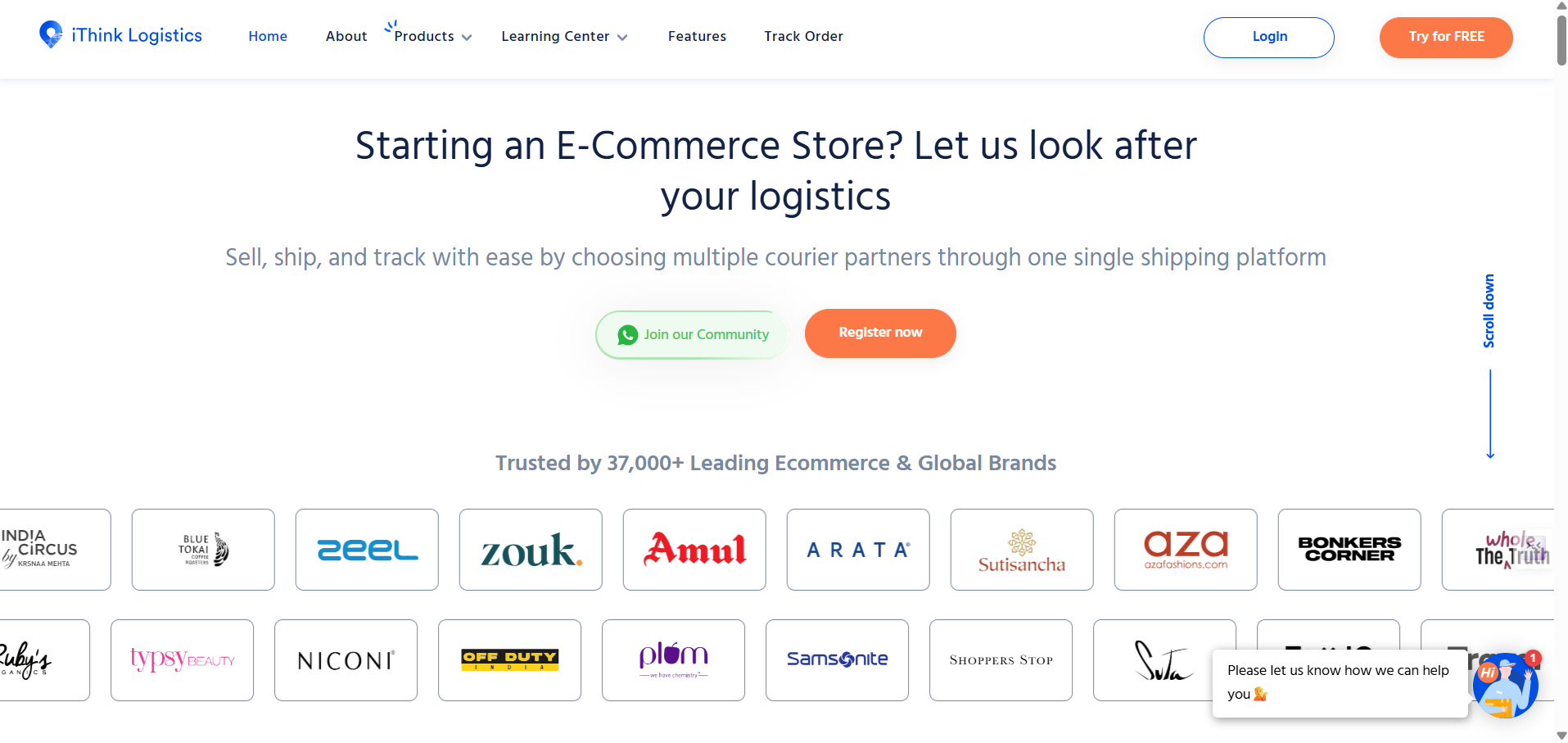
iThink Logistics focuses on ecommerce logistics automation and multi-carrier shipping, helping D2C and ecommerce businesses manage courier operations and improve shipment visibility.
Key Features
- Multi-carrier shipping: Helps ecommerce businesses manage shipments across multiple logistics providers.
- Courier allocation: Supports the process of assigning shipments to suitable courier partners.
- Order processing: Helps businesses move ecommerce orders into the shipping workflow efficiently.
- Shipment tracking: Provides visibility into delivery progress across shipments.
- NDR management: Helps businesses manage failed delivery attempts and improve delivery success.
- Returns management: Supports reverse logistics and ecommerce returns.
- Delivery analytics: Provides businesses with visibility into delivery performance and shipping operations.
- Ecommerce integrations: Connects ecommerce channels with logistics workflows.
- Automated shipping workflows: Helps reduce manual intervention across shipment processing and dispatch.
Where iThink Logistics Fits
iThink Logistics is particularly relevant for ecommerce and D2C brands looking to automate shipping operations while working with multiple logistics providers.
Shipway
Broad positioning: Shipping, tracking and customer experience
Relevant use cases: Ecommerce brands
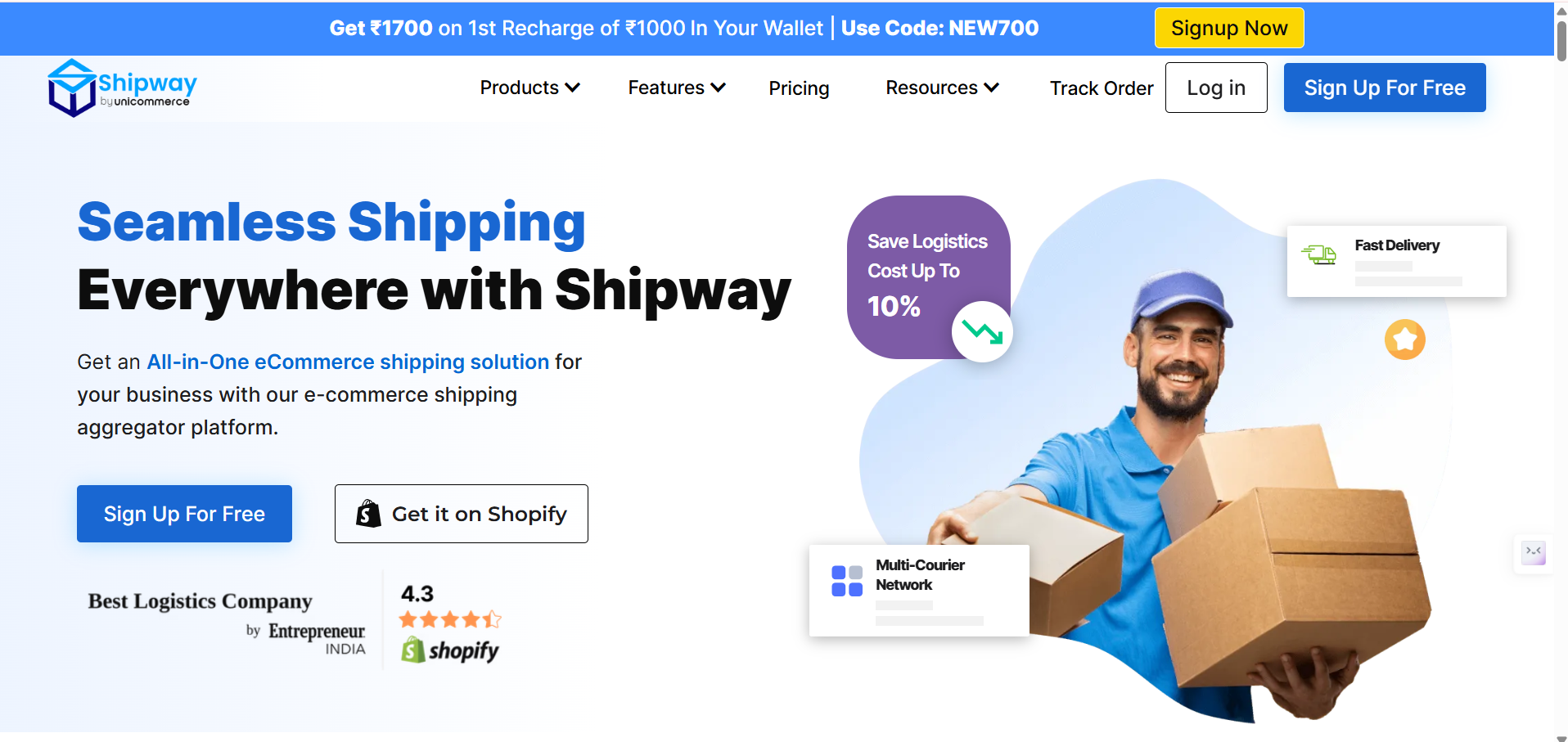
Shipway takes a somewhat different approach, with a strong focus on shipment tracking, post-purchase experience and customer engagement.
Rather than focusing only on the operational side of shipping, the platform places significant emphasis on what happens after the customer places an order.
Key Features
- Shipment tracking: Gives customers and businesses visibility into shipment movement.
- Order tracking pages: Provides branded tracking experiences where customers can monitor their orders.
- Customer notifications: Keeps customers updated about important shipment and delivery events.
- Delivery updates: Helps brands communicate changes in shipment status and delivery progress.
- NDR management: Supports workflows around failed delivery attempts.
- Returns management: Helps businesses manage customer returns and reverse shipments.
- Post-purchase communication: Allows brands to maintain customer communication after an order has been placed.
- Customer engagement: Helps ecommerce brands use the delivery journey as an opportunity to maintain customer engagement.
- Delivery analytics: Provides insights into tracking and delivery performance.
Where Shipway Fits
Shipway is particularly relevant for ecommerce brands focused on shipment visibility, post-purchase communication and delivery experience.
ClickPost
Broad positioning: Logistics intelligence and delivery experience
Relevant use cases: Enterprise ecommerce operations
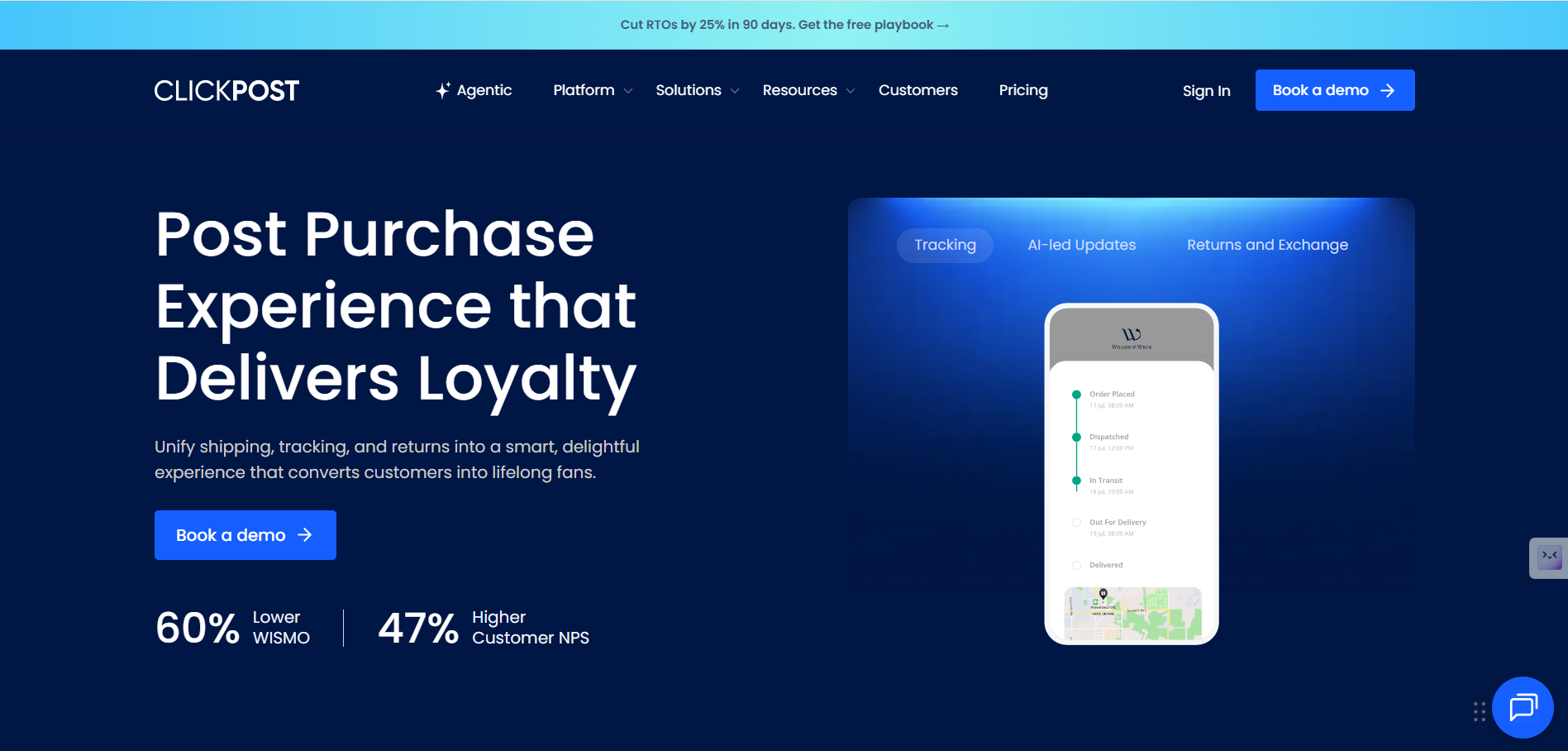
ClickPost is positioned more strongly around enterprise logistics management, logistics intelligence, carrier management and delivery experience.
Its focus is particularly relevant to larger ecommerce organisations managing complex carrier networks and looking to improve the post-purchase delivery journey.
Key Features
- Multi-carrier management: Helps enterprises manage relationships and operations across multiple logistics and courier partners.
- Carrier allocation: Supports intelligent carrier selection based on shipment requirements and logistics performance.
- Shipment tracking: Provides visibility across shipments and carriers.
- Delivery intelligence: Helps businesses use logistics data to understand and improve delivery performance.
- NDR management: Supports the management of failed deliveries and delivery exceptions.
- Returns management: Helps enterprises manage reverse logistics and customer returns.
- Customer communication: Keeps customers informed throughout the delivery journey.
- Delivery experience: Focuses on improving the customer’s post-purchase and delivery experience.
- Logistics analytics: Provides data and insights into carrier and delivery performance.
- Enterprise integrations: Supports integration with broader enterprise technology environments.
Where ClickPost Fits
ClickPost is particularly relevant to larger ecommerce enterprises that need sophisticated logistics visibility, carrier management, delivery intelligence and post-purchase experience capabilities.

Shipping Platform for National Delivery in India: Which One Fits Your Business?
National shipping in India can quickly become complex as businesses expand across cities, states and thousands of pincodes. A shipment moving from Bengaluru to Mumbai may require a very different carrier strategy from one moving from Bengaluru to a remote location in Northeast India. Shipping cost, pincode serviceability, delivery SLA, carrier performance, COD, RTO risk and expected delivery time can all influence how the shipment should be handled. For growing ecommerce businesses and D2C brands, reliable Pan-India shipping is essential, particularly when expanding into Tier 2 and Tier 3 cities.
This is where a national shipping platform India becomes useful. Instead of managing every courier separately, businesses can use multi-carrier shipping, shipping automation, automated carrier allocation, AI courier allocation, real-time multi courier tracking, shipping rate comparison, ETA prediction, NDR management and RTO reduction to streamline national deliveries. A modern ecommerce shipping platform India or shipping software India can also support courier allocation software, automated courier selection, and courier selection by pincode to help businesses choose the right carrier based on cost, serviceability, delivery speed and performance.
The platforms below serve different needs, from ecommerce shipping India and courier aggregator India services to D2C shipping, fulfilment, delivery experience and enterprise logistics intelligence. For businesses comparing the best shipping platform India, best shipping aggregator India, or best shipping platform for D2C brands, the right choice depends on how well a platform can support national delivery requirements while helping businesses reduce ecommerce shipping costs, manage exceptions and reduce RTO with courier allocation.
| Platform | Broad positioning | Key capabilities | Best fit for national delivery |
|---|---|---|---|
| eShipz | Multi-carrier shipping automation & logistics orchestration | Multi-carrier integration, AI-powered carrier allocation, shipping automation, real-time tracking, ETA prediction, NDR, returns, B2B/B2C and ERP/TMS/WMS integrations | D2C, ecommerce, SMBs and enterprises managing high-volume national shipping across multiple carriers and pincodes |
| Shiprocket | Ecommerce shipping & courier aggregation | Multi-courier shipping, order management, tracking, returns, NDR, ecommerce integrations and analytics | D2C brands and online sellers looking to simplify national ecommerce shipping |
| NimbusPost | Shipping aggregation & logistics management | Multi-carrier integration, automated shipping, courier allocation, tracking, NDR, returns and analytics | Ecommerce sellers managing national shipments across multiple courier partners |
| Pickrr | Ecommerce shipping & fulfilment technology | Multi-carrier shipping, order management, tracking, automated workflows, returns and fulfilment | D2C and online sellers scaling national ecommerce fulfilment |
| iThink Logistics | Multi-carrier shipping & logistics automation | Courier allocation, multi-carrier shipping, tracking, NDR, returns, order processing and analytics | Ecommerce and D2C brands looking to automate national shipping operations |
| Shipway | Shipping, tracking & customer experience | Shipment tracking, customer notifications, delivery updates, NDR, returns and post-purchase communication | Ecommerce brands prioritising national delivery visibility and customer experience |
| ClickPost | Logistics intelligence & delivery experience | Multi-carrier management, carrier allocation, tracking, delivery intelligence, NDR, returns, analytics and enterprise integrations | Enterprise ecommerce businesses managing complex national carrier networks and delivery experience |
For national shipping in India, the right platform depends on how complex the business’s logistics operation is. While courier aggregators can help businesses access multiple carriers, growing brands may need deeper shipping automation, carrier allocation, shipment tracking, delivery intelligence and logistics orchestration. eShipz is positioned for businesses that need to manage these processes across multiple carriers and shipping models, rather than simply booking a national shipment.
Shipping Platforms for National Delivery in India: Which One Fits Your Business?
National shipping in India can quickly become complex as businesses expand across cities, states and thousands of pincodes. A shipment moving from Bengaluru to Mumbai may require a very different carrier strategy from one moving from Bengaluru to a remote location in Northeast India. Shipping cost, pincode serviceability, delivery SLA, carrier performance, COD, RTO risk and expected delivery time can all influence how the shipment should be handled. For growing ecommerce and D2C businesses, reliable Pan-India shipping, including shipping to Tier 2 cities India and shipping to Tier 3 cities India, is becoming increasingly important.
This is where a shipping platform India becomes useful. Instead of managing every courier separately, businesses can use multi-carrier shipping, multi courier shipping, shipping automation, automated courier allocation, AI courier allocation, real-time multi courier tracking, ETA prediction, NDR management, returns management and RTO reduction to streamline national deliveries. The platforms below serve different needs, from ecommerce shipping India and courier aggregator India services to D2C shipping, fulfilment, delivery experience and enterprise logistics intelligence.
Managing Multiple Courier Partners Across India
A multi courier shipping platform gives businesses access to multiple delivery partners, but simply having more courier options is not enough. The real value comes from deciding which courier is best for each shipment. This is where courier allocation software, automated courier allocation, and AI courier allocation India can help businesses evaluate destination, pincode, weight, shipping cost, serviceability, COD, delivery SLA and historical courier performance.
For businesses comparing the best shipping platform India, best shipping aggregator India, or best multi courier platform India, intelligent courier selection can make a significant difference. Instead of manually deciding which courier should handle every order, businesses can use automated courier selection based on predefined shipping rules and real-time operational requirements.
Comparing Shipping Rates Without Compromising Delivery
Shipping cost is an important consideration for every ecommerce business, but the lowest courier rate does not always mean the lowest overall shipping cost. A carrier with a lower initial rate may have higher failed delivery attempts, NDRs or RTOs, increasing the actual cost of fulfilment.
This is where shipping rate comparison and courier rate comparison India become useful. Businesses can compare courier options based on cost, delivery SLA, serviceability, COD charges, weight slabs, zones and historical performance. This can help businesses reduce ecommerce shipping costs without automatically compromising delivery quality.
Pincode-Level Shipping and Pan-India Coverage
India’s ecommerce market spans metro cities, Tier 2 cities, Tier 3 cities and remote locations, making pincode-level intelligence an important part of national shipping. A good ecommerce shipping platform India should help businesses evaluate serviceability and use courier selection by pincode when deciding how an order should be shipped.
This becomes particularly useful for businesses focused on shipping to Tier 2 cities India, shipping to Tier 3 cities India, and Pan-India delivery for D2C brands. The right carrier for Bengaluru may not be the right carrier for a remote pincode, which is why destination-level courier decisions can improve both delivery performance and operational efficiency.
Multi-Courier Tracking and Delivery Visibility
Once an order has been shipped, businesses need visibility across every carrier they use. A modern shipping platform in India with multi-courier tracking can bring shipment information into a single operational view, allowing teams to monitor delivery status, identify delays and track exceptions without checking individual courier portals.
For growing brands, this makes shipping software in India more than a shipment-booking tool. An effective ecommerce shipping software solution can connect order processing, carrier selection, shipment tracking and delivery management into one workflow. This becomes particularly valuable for businesses managing multiple courier partners and shipping orders across different regions and pincodes.
NDR Management and RTO Reduction
Shipping does not end when a parcel leaves the warehouse. Failed delivery attempts can result in NDRs (Non-Delivery Reports) and eventually become RTOs if they are not resolved. This makes NDR management an important part of a modern shipping platform in India.
Businesses can analyse NDR patterns by courier, pincode, order type and customer behaviour. The same data can support RTO reduction by identifying carriers or locations where delivery failures are more common. For brands specifically looking to reduce RTO with courier allocation, connecting carrier selection with post-shipment performance can help improve future carrier allocation decisions.
This is where a shipping platform moves beyond basic courier booking. By connecting carrier allocation, shipment tracking, NDR management and delivery performance, businesses can use post-shipment data to make better shipping decisions for future orders.
Supporting Hyperlocal and Same-Day Delivery
National shipping does not always mean every order should follow the same delivery model. A D2C or retail business may need hyperlocal delivery in India for orders within a city while using national carriers for customers elsewhere.
For example, an order placed close to a store or fulfilment centre could be fulfilled through a hyperlocal delivery platform in India and delivered through same-day delivery in India. Businesses focused on faster ecommerce fulfilment may also use a same-day delivery platform in India to support same-day delivery for ecommerce while continuing to use their national carrier network for longer-distance shipments.
This makes hyperlocal shipping for ecommerce an important capability for brands that operate both local and national fulfilment models. A flexible shipping platform in India can help businesses manage these different delivery requirements while applying different carrier, SLA and allocation rules based on the shipment’s destination and delivery needs.
For businesses comparing shipping platforms in India, the key is therefore not simply whether a platform offers multiple courier partners. It is whether the platform can connect multi-carrier shipping, automated courier allocation, tracking, NDR management, RTO reduction, hyperlocal delivery, same-day delivery and national shipping into a single, scalable shipping workflow.
Choosing a Platform That Fits Your Ecommerce Business
The right shipping platform ultimately depends on your business model, shipping volume, delivery geography, and how much control you need over your logistics operations. A small online seller may primarily need reliable courier access, order processing and tracking, while a growing D2C brand may require Pan-India shipping, multi-carrier automation, AI courier allocation India, pincode-level courier selection, rate comparison and stronger NDR management. Larger enterprises, meanwhile, may need deeper carrier intelligence, integrations, analytics and a robust last mile delivery platform India to manage complex logistics networks.
Businesses selling through Shopify may look for the best shipping platform for Shopify India, while brands expanding across cities and states may prioritise a multi courier shipping platform that can support both national and hyperlocal delivery India. Similarly, businesses focused on improving profitability may place greater emphasis on shipping rate comparison, automated courier selection, RTO reduction and the ability to reduce ecommerce shipping costs through smarter carrier decisions.
For businesses whose shipping operations are becoming more complex, a platform such as eShipz can act as a central logistics layer rather than simply another courier booking system. By connecting multiple carriers and bringing together automated courier allocation, carrier selection, shipment tracking, ETA visibility, NDR management, returns and logistics analytics, it can help businesses make more informed shipping decisions across different locations and delivery models. This can be particularly useful for brands managing both Pan-India delivery for D2C brands and local fulfilment requirements from the same operation.
Ultimately, there is no single best shipping platform India for every business. The best shipping platform for D2C brands, best shipping platform for online sellers, or best shipping aggregator for ecommerce will depend on what your business actually needs today and where it expects to scale next. The right platform should make it easier to manage multiple carriers, choose the right courier for each shipment, compare rates, track deliveries, handle NDRs and reduce RTOs, while giving the business enough flexibility to grow from simple ecommerce shipping into a more automated and intelligent logistics operation.