






If you have ever had an order cancelled because a courier could not deliver to a customer’s address, you have already run into the problem of pincode serviceability. In simple terms, pincode serviceability tells you whether a courier can actually pick up or deliver a shipment to a specific pincode, and it is one of the most overlooked factors in courier selection. According to IBEF, Tier 2 and beyond cities now contribute around 65% of India’s incremental online shoppers, which means more and more orders are heading to pincodes that were barely on any courier’s radar a few years ago. For a business shipping across the country, understanding serviceability is not optional. It is the difference between an order that reaches the customer and one that bounces back as a failed delivery.
This guide breaks down what pincode serviceability really means, why it matters for your business, and how to choose a courier based on pincode serviceability rather than guesswork or brand reputation alone.
What Is Pincode Serviceability in Courier Delivery?
Pincode serviceability is simply whether a courier partner can deliver to, or pick up from, a particular destination pincode. It sounds straightforward, but the details matter a lot more than most sellers realise.
Just because a pincode exists does not mean every courier can deliver to it. A courier might have a hub in a nearby city but no local delivery network for a specific pincode. Another courier might cover the same pincode only through a third-party tie-up, which usually means longer transit times and less control if something goes wrong.
Serviceability also is not a single yes-or-no answer. It can differ by shipment type. A pincode may support prepaid delivery but not cash on delivery, because COD requires the courier to have staff on the ground who can collect payment and remit it back. Some pincodes have restrictions based on shipment weight or dimensions, and others are only served for standard delivery, not express. Delhivery, for instance, is known to show separate serviceability results for prepaid, COD and other shipment conditions on the same pincode, because the operational requirements for each are different.
So when you run a serviceability check, you are really checking a combination of three things: whether the courier reaches that location at all, what type of shipment it can handle there, and how reliably it can do so.
Why Is Pincode Serviceability Essential for Your Business?
Checking serviceability before you ship, rather than after a customer complains, changes how your business runs in a few concrete ways.
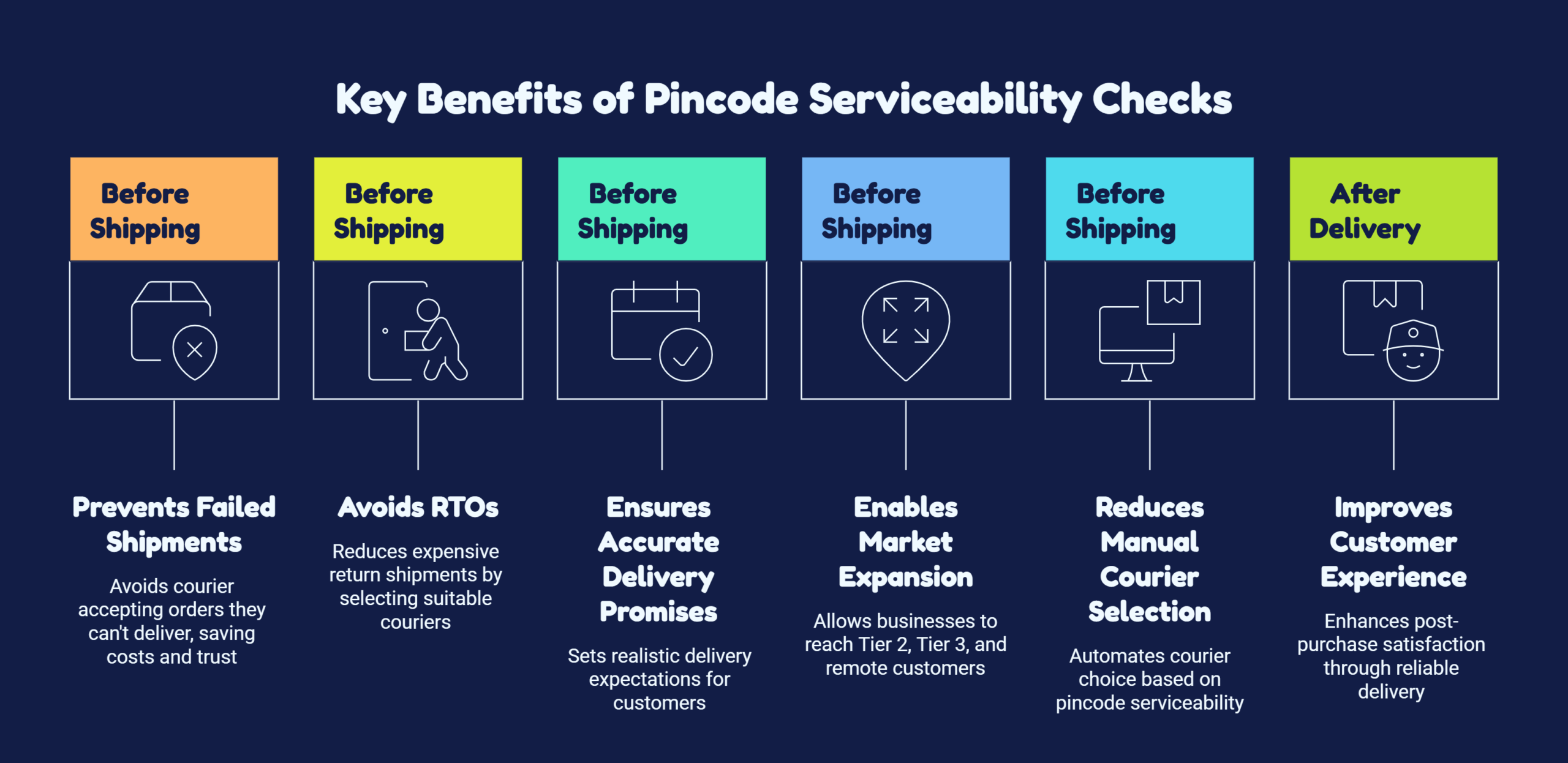
It prevents failed or cancelled shipments. When a courier accepts an order without confirming it can actually reach the pincode, the shipment either gets stuck in transit or is cancelled at the last mile. Both outcomes cost you money and damage trust.
It helps avoid unnecessary RTOs. Return to origin shipments are expensive. They mean you pay for the forward leg, the return leg, and often a repackaging cost, and if it was a COD order, you also lose the sale entirely. A large share of RTOs trace back to a courier that was never a good fit for that location in the first place.
It ensures customers get accurate delivery promises. Nothing frustrates a buyer more than being shown an estimated delivery date that the courier can never meet because the pincode falls outside its reliable network. Checking serviceability upfront lets you set expectations that you can actually keep.
It helps businesses expand into Tier 2, Tier 3 and remote markets. As shown earlier, a growing share of new online shoppers are coming from smaller cities and towns. If your courier strategy only accounts for metro coverage, you are shutting the door on a large part of your addressable market.
It reduces manual courier selection. Once you know which courier serves which pincode well, you stop relying on guesswork or a single default courier for every order.
It improves the overall customer experience. Reliable delivery, accurate timelines, and fewer failed attempts all add up to a better post-purchase experience, which is often what determines whether a customer orders from you again.
The key point here is simple. Coverage should be confirmed before shipping, not discovered after an order has already been placed and a customer is waiting.
What Does the Current Logistics Market Tell Us About Pincode Serviceability?
The logistics landscape in India has shifted quite a bit over the last few years, and that shift is exactly why this kind of location-level coverage check has become such an important part of courier strategy.
E-commerce is expanding well beyond the major metro cities. Businesses now routinely ship to Tier 2, Tier 3 and rural pincodes that would have been considered niche a decade ago. This spread means a single courier, no matter how strong its brand name, rarely performs equally well across every geography. A courier might have an excellent network in Delhi NCR and Mumbai but a thin, partner-dependent network in smaller towns in the Northeast or interior parts of the country.
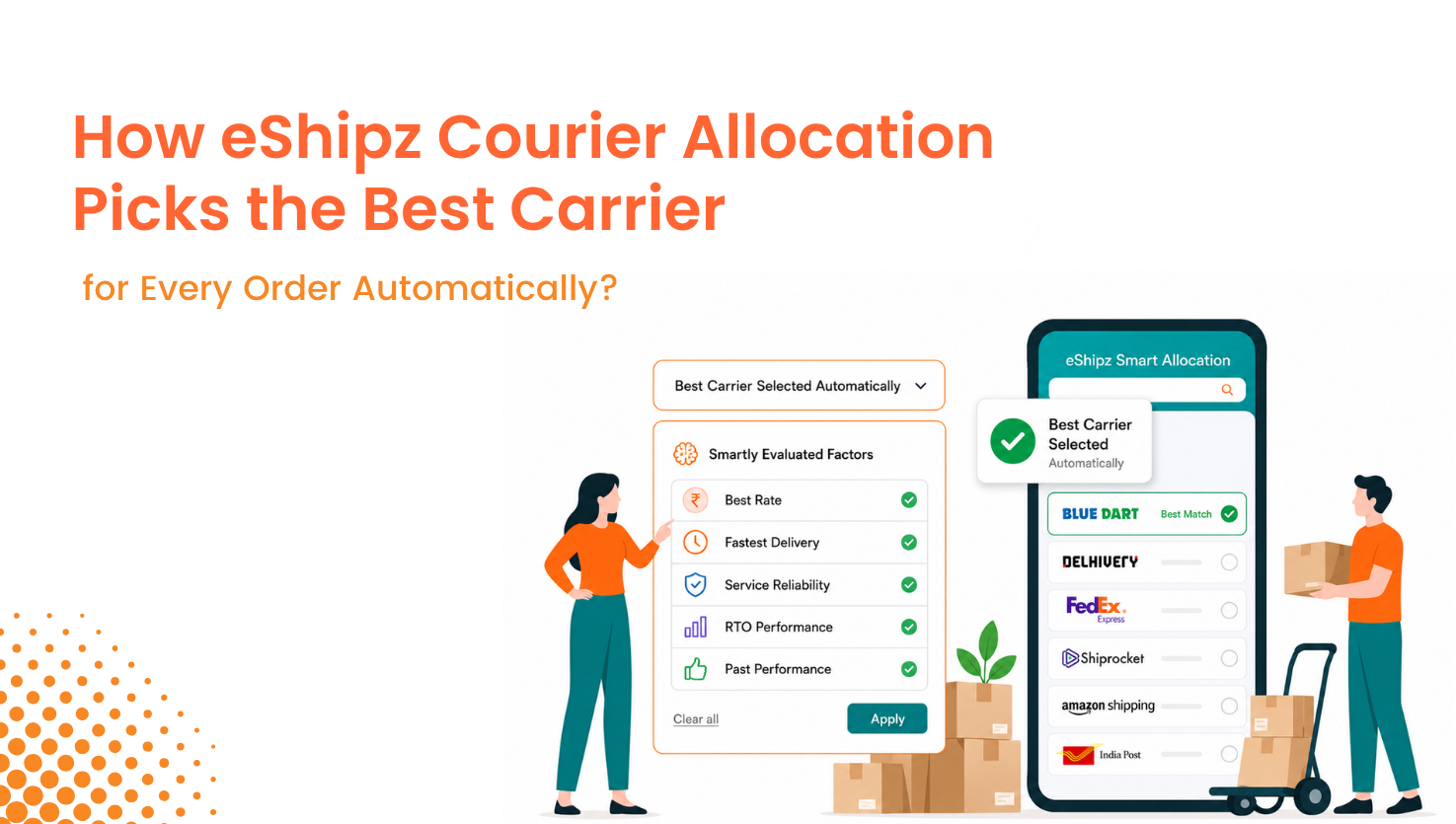
This is exactly why multi-courier and aggregator models have become common. These platforms let a business select different courier partners based on serviceability, cost and past delivery performance for each specific route, instead of locking into one carrier for every shipment. Shiprocket, for example, has said that its courier recommendation considers serviceability, shipping cost, and historical delivery performance, and its platform gives sellers access to multiple courier partners through one dashboard rather than one relationship.
Technology is increasingly being used to automate this decision instead of leaving it to manual judgment. Instead of a warehouse team picking a courier out of habit, serviceability and performance data are used to recommend the right partner for each order.
This brings us to a stronger insight for any business shipping at scale: the question is no longer simply “which courier is the best?” It is “which courier is best for this particular pincode and this particular shipment?” That reframing is at the heart of how to choose a courier based on pincode serviceability, and it is a mindset shift that pays off quickly once you start applying it. If you are evaluating platforms that support this kind of decision-making at scale, this comparison of shipping platforms built for national delivery in India is a useful next read.
Who Benefits From Pincode-Based Courier Selection?
Pincode-based courier selection is not just an operations detail. It touches almost everyone involved in the order fulfilment chain.
E-commerce sellers
- Reach more customers by not being limited to a courier’s core coverage area
- Reduce failed deliveries by matching each order with a courier that actually services that pincode well
- Select the right courier partner for different regions instead of forcing every shipment through one network
D2C brands
- Improve delivery reliability as they expand into new cities and states
- Manage multiple courier partners from a single platform instead of juggling separate logins and processes
Small and growing businesses
- Avoid becoming entirely dependent on one courier’s performance
- Compare rates and coverage before committing to a shipment, which matters a lot when margins are tight
Customers
- Get more reliable delivery with fewer surprises
- Have access to cash on delivery in locations where it is actually supported
- Receive delivery timelines that reflect reality rather than a generic promise
Logistics teams
- Spend less time manually deciding which courier to assign to each order
- Automate courier selection based on predefined rules like cost, speed, and pincode coverage
How Does Pincode Serviceability Benefit Your Business?
Beyond who benefits, it is worth looking directly at the business impact of taking this seriously.
Wider customer reach. You can confidently accept orders from locations you might otherwise have avoided, simply because you know which courier can actually deliver there.
Fewer failed deliveries. Matching the right courier to the right pincode reduces the number of shipments that go undelivered on the first attempt.
Lower RTO risk. Since RTOs are often tied to serviceability gaps, checking coverage in advance directly reduces how often shipments come back to you unsold.
Better delivery experience. Accurate delivery estimates and fewer failed attempts translate into happier customers and better reviews.
More efficient courier allocation. Rather than defaulting to one courier for every order, your team or your platform can allocate shipments intelligently, which saves time and money.
It is also worth remembering that delivery timelines and shipping costs can vary quite a bit based on the combination of destination pincode, courier, and service type. The same courier might be fast and affordable on one route and slow or expensive on another.
What Factors Should You Consider When Choosing a Courier?
Pincode coverage is the starting point, but it is not the only thing that determines whether a courier is right for your business. A complete evaluation should look at:
- Pincode coverage: does the courier actually service your customers’ locations, directly or through a partner?
- COD availability: is cash on delivery supported at that specific pincode, not just in general?
- Delivery timelines (TAT): what is the realistic turnaround time for that route?
- Shipping rates: how does the cost compare once surcharges and extra fees are included?
- RTO performance: how often do shipments on this route come back undelivered?
- NDR management: how quickly and effectively does the courier handle failed delivery attempts?
- Weight and size restrictions: does the courier have limits that affect your product category?
- Tracking capabilities: can customers see real-time, scan-level updates?
- Pickup availability: does the courier offer reliable pickup slots in your area?
- Reverse logistics: how smooth is the return pickup process when a customer sends something back?
- Customer support: how responsive is the courier when something goes wrong?
- Performance on your specific routes: past data on your own shipments often tells you more than any sales pitch.
It is worth repeating a point that gets missed often. The cheapest courier is not necessarily the best courier. A slightly higher shipping charge can be well worth it if that courier delivers more successfully and generates fewer RTOs, because a single avoided return often costs more than the price difference across several shipments.
How to Check Pincode Serviceability Before Shipping?
Running this check does not need to be complicated. Most shipping platforms follow a similar flow:
Step 1: Enter the pickup pincode. This tells the system where the shipment originates.
Step 2: Enter the customer’s delivery pincode. This is the destination you need to confirm coverage for.
Step 3: Check which courier partners serve the destination. Not every courier connected to your account will service every pincode.
Step 4: Check whether COD or prepaid delivery is supported. As mentioned earlier, a pincode might allow one but not the other.
Step 5: Compare shipping rates and estimated TAT. Different couriers may quote different costs and delivery windows for the same route.
Step 6: Select the courier that offers the best combination of coverage, cost and reliability. This is where a courier serviceability check by pincode becomes genuinely useful, since it turns a guess into a data-backed decision.
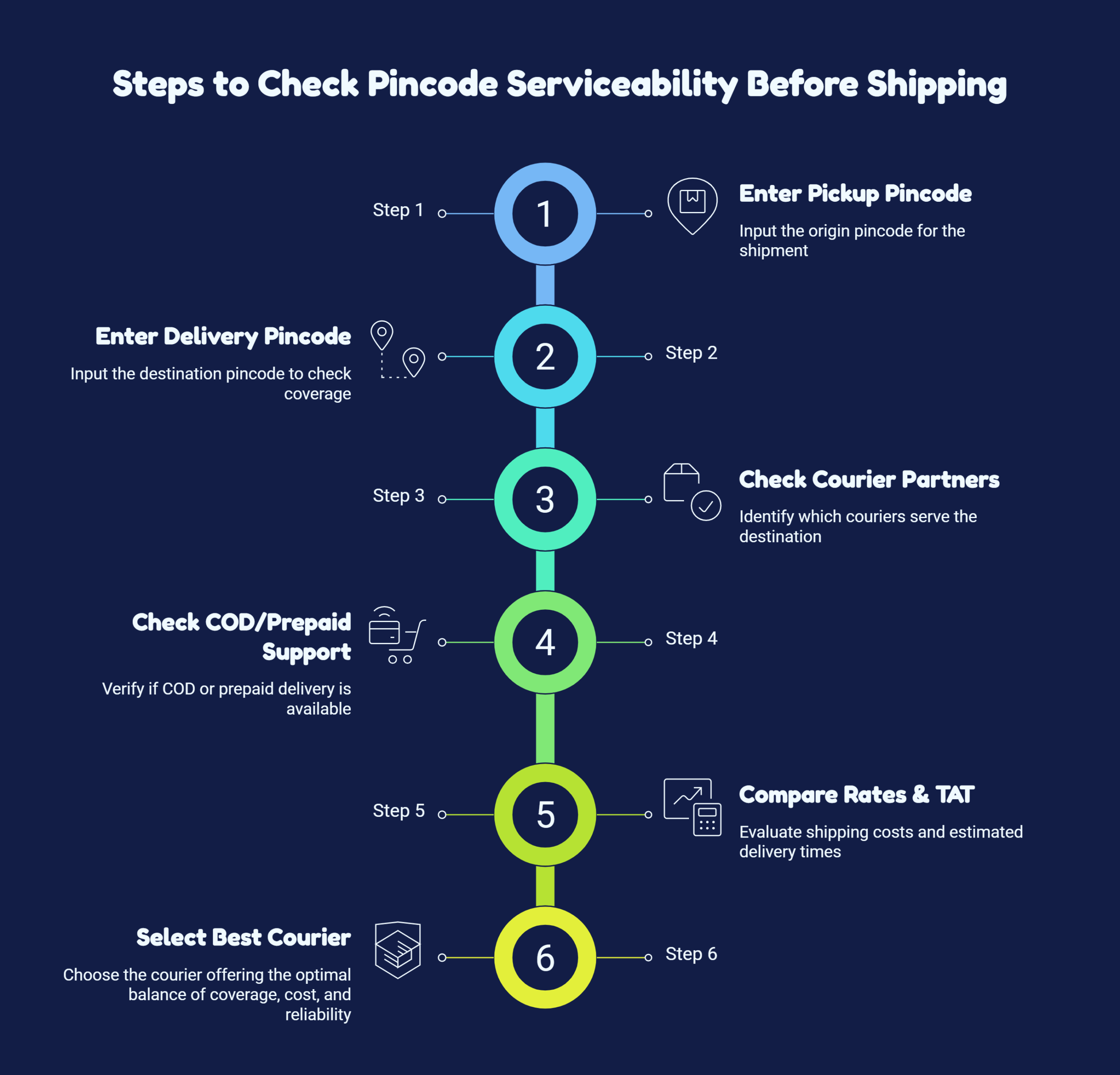
Most shipping platforms will show the available courier partners and estimated delivery windows the moment you enter the pickup and delivery pincodes, which makes this a quick check to build into your order processing routine rather than an occasional audit.
How to Choose the Best Courier for Your Pincode?
Once you understand serviceability, the next step is turning that knowledge into a decision. Here is a simple framework for how to choose a courier based on pincode serviceability, depending on what matters most for a given shipment.
| Your priority | What to look for |
| Lowest shipping cost | Compare courier rates for that specific route |
| Wider coverage | Check coverage across multiple couriers |
| COD orders | Confirm COD availability at the destination pincode |
| Faster delivery | Compare TAT for that particular pincode, not a national average |
| Remote locations | Check Tier 3, Tier 4 and rural coverage specifically |
| Fewer RTOs | Review the courier’s past RTO and delivery performance on similar routes |
| Growing business | Consider a multi-courier platform instead of a single carrier |
| Automated shipping | Look for tools that recommend a courier automatically based on serviceability data |
This table is a useful starting point, but the underlying idea is what matters. Courier selection works best when it is treated as a per-shipment decision rather than a single choice you make once and never revisit.
Single Courier vs Multi-Courier: Which Is Better?
This is a question almost every growing business runs into eventually, and the honest answer is that it depends on your shipping volume and how spread out your customers are.
Single courier
- Simpler to manage, with one integration and one point of contact
- Can lead to more consistent day-to-day operations
- The major downside is that you are limited by that one courier’s coverage and performance gaps, wherever they happen to be
Multi-courier
- Offers wider pincode coverage since different couriers are strong in different regions
- Gives you flexibility to compare rates for the same shipment
- Lets you select a different courier for different destinations based on actual serviceability and performance data
For a business shipping mostly within a single city or state, one reliable courier might be enough. But as soon as orders start coming from a wider spread of pincodes, especially Tier 2 and Tier 3 markets, a multi-courier approach tends to perform better. Current courier aggregator platforms are largely built around this idea, positioning multi-carrier selection as the practical way to widen coverage while still choosing partners based on cost and serviceability for each specific order. This guide to optimizing carrier allocation with multi-carrier shipping software explains how AI-based allocation takes this a step further by learning which courier performs best on which route over time.

Conclusion: Make Pincode Serviceability Part of Your Courier Strategy
The right courier is not necessarily the one with the lowest rate or the biggest name. It is the one that can reliably deliver to your customer’s pincode at the right cost, speed and service level. That is the entire idea behind pincode serviceability, and it is why it deserves a permanent place in how you plan shipping, not just a one-time check when you sign up with a new courier.
As your business grows into new regions, revisit your serviceability data regularly. Coverage changes, courier performance shifts, and what worked for your first hundred orders may not work as well once you are shipping to a few thousand different pincodes. Treating courier selection as a location-specific decision, rather than a one-size-fits-all choice, is what separates businesses with consistent delivery experiences from those that are constantly firefighting failed orders.
Frequently Asked Questions
- What is pincode serviceability in simple terms?
Pincode serviceability tells you whether a courier can pick up from or deliver to a specific pincode, and under what conditions, such as prepaid only or COD supported. It is the first thing to check before assigning a courier to an order. - How do I check courier serviceability by pincode?
Most shipping platforms let you enter the pickup and delivery pincodes to instantly see which courier partners service that route, along with estimated delivery time and COD availability. This courier serviceability check by pincode should be done before an order is shipped, not after. - Why does a courier show different serviceability for COD and prepaid orders on the same pincode?
COD requires the courier to have staff on the ground to collect and remit payment, which not every local network can support. A pincode may therefore be fully serviceable for prepaid orders but restricted or unavailable for COD. - Does pincode serviceability affect delivery timelines?
Yes. Delivery timelines can vary significantly by pincode, even within the same courier’s network, depending on how close the destination is to a hub and how the last-mile delivery is handled in that area. - Should I use one courier or multiple couriers for better pincode coverage?
It depends on your order volume and how spread out your customers are. A single courier can work well for concentrated, local shipping, but businesses selling across many states usually get better coverage and reliability from a multi-courier setup. - How does pincode serviceability help reduce RTO?
When a courier is not genuinely capable of serving a pincode, delivery attempts often fail, leading to a return to origin. Checking serviceability in advance ensures shipments are only assigned to couriers that can realistically complete the delivery, which reduces avoidable RTOs. - What is the best way to choose a courier based on pincode serviceability?
Compare coverage, COD support, delivery timelines, and past performance data for each courier on the specific pincode you are shipping to, rather than relying on brand reputation alone. This route-level comparison is the most reliable way to choose a courier based on pincode serviceability for any given order.