







Parcel prices in India do not depend on weight alone. They depend on how far the parcel travels, and couriers measure that distance in zones. If you do not understand shipping zones in India, you cannot read a rate card, forecast a margin, or choose the right courier for each order.
The stakes are rising. Bain & Company’s How India Shops Online 2026 report puts online retail at $65 to $66 billion in gross merchandise value in 2025, with 290 to 300 million online shoppers. The same report says tier 2 and smaller cities contributed roughly half of incremental e-retail orders in 2025. More of your parcels will cross zone borders every year.
This guide explains how zones work, why they change your cost per order, and how to manage them. You will get an illustrative cost model, a workflow, and a checklist. Every rupee figure below is illustrative and must be replaced with your own rate card.
What Are Shipping Zones in India?
Shipping zones in India are distance bands that couriers use to price a parcel. The origin pincode and the destination pincode decide the zone. The zone then decides the rate per slab of weight.
Most national couriers and aggregators group shipping zones in India into five bands, often labeled A to E. The labels and the boundaries differ by courier. Always confirm the exact definitions in your own contract.
| Zone | Typical meaning | Typical parcel journey |
|---|---|---|
| Zone A | Within the same city | Local van or bike transfer |
| Zone B | Within the same state or region | Surface road network |
| Zone C | Metro to metro | Air or fast surface lanes |
| Zone D | Rest of India | Longer road or air movement |
| Zone E | North East, Jammu and Kashmir, and remote areas | Long hauls and special handling |
Treat that table as a starting model. A courier may place a hill town or an island in a different band than you expect. The rate card is the only source of truth.
Why Shipping Zones in India Matter for Your Margin
Zones are the biggest driver of freight cost after weight. A parcel that moves from Zone A to Zone D can cost several times more than a local one. Your product price, free shipping threshold and discount strategy all depend on that spread.
Zones also affect delivery promises. Longer zones mean longer transit and more handoffs. Each handoff is another chance for a delay, a damaged parcel or a failed delivery.
Many sellers quote one flat shipping fee and lose money on far zones. Others charge too much on near zones and lose orders at checkout. Understanding shipping zones in India lets you price each lane with intent.
How Shipping Zones in India Are Calculated
The courier maps every pincode to a hub and a region. The pair of pickup and delivery pincodes then returns a zone code. Your rate card turns that code into a price.
The inputs that decide a zone
Four inputs decide the final price once the zone is known. Together they explain why two parcels of the same weight can cost very different amounts.
| Input | What it changes | Where to check it |
|---|---|---|
| Origin pincode | Which hub the parcel starts from | Your pickup address and warehouse list |
| Destination pincode | Zone band and serviceability | Courier pincode serviceability file |
| Chargeable weight | The weight slab used for billing | Higher of dead weight and volumetric weight |
| Service type | Surface, express or air speed | Your courier contract |
Dead weight, volumetric weight and zones
Couriers bill the higher of dead weight and volumetric weight. The zone then multiplies that weight into a price. A bulky, light box on a long zone is the most expensive combination you can ship.
Measure and photograph every product pack before you upload dimensions. Wrong dimensions create billing disputes later, and long zones magnify each mistake.
How Shipping Zones in India Change Your Cost Per Order
The chart below shows how an illustrative rate card might climb from the nearest zone to the farthest. The numbers are hypothetical and exist only to show the shape of the curve. Replace them with figures from your own contract.
Zone E can cost more than two and a half times Zone A in this model. If twenty percent of your orders go to the far zones, they can consume far more than twenty percent of your freight budget.
Illustrative margin model
Assume a product sells for ₹799 with a ₹300 cost of goods. These assumptions are illustrative. The table shows how the same order earns a different margin by zone after freight alone.
| Zone | Illustrative freight (₹) | Margin after goods and freight (₹) | Margin share of price |
|---|---|---|---|
| Zone A | 38 | 461 | 57.7% |
| Zone B | 46 | 453 | 56.7% |
| Zone C | 58 | 441 | 55.2% |
| Zone D | 72 | 427 | 53.4% |
| Zone E | 98 | 401 | 50.2% |
The gap looks small on a single order. Over thousands of orders per month, it becomes a meaningful line item. Add return freight and cash on delivery fees, and the far zones can turn unprofitable.
Step-by-Step: Manage Shipping Zones in India Like a Pro
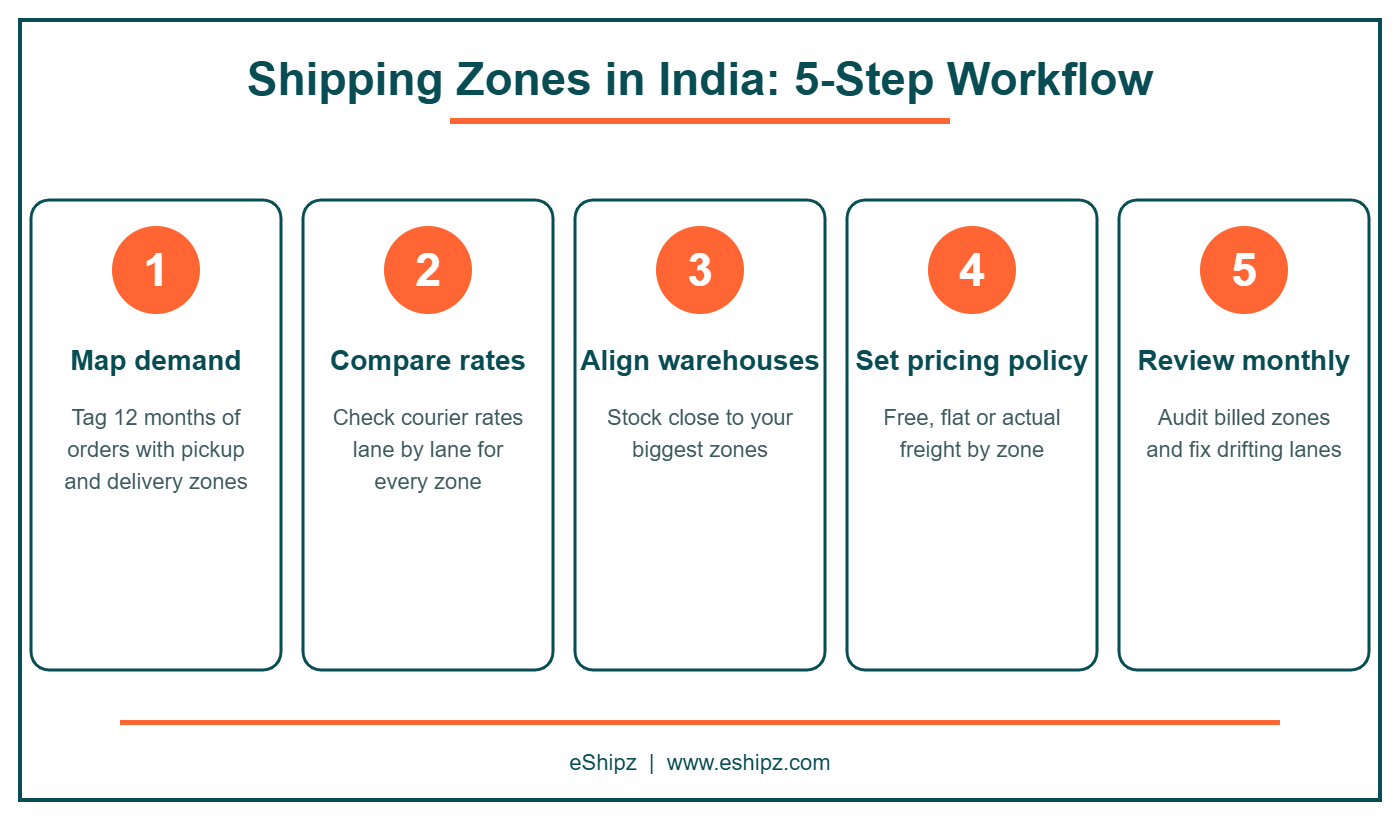
Follow this five-step workflow to bring order to shipping zones in India. The infographic below summarizes it.
Step 1: Map your order demand by zone
Export twelve months of orders with the origin and destination pincodes. Tag each order with a zone using your courier rate card. You will see how much volume sits in each band.
Step 2: Compare courier rates per zone
No courier is cheapest on every lane. One partner may be strong in metro lanes while another is better in the North East. Build a simple lane-by-lane comparison before you commit volume.
Step 3: Align warehouses with demand
Stock close to your largest zones. Moving inventory to a second warehouse turns many Zone D parcels into Zone B parcels. Do the math on storage cost before you move.
Step 4: Set a zone-aware pricing policy
Decide where you offer free shipping, where you charge a flat fee and where you pass on actual freight. Keep the rules simple enough for shoppers to understand.
Step 5: Review every month
Zone mix changes with campaigns, seasons and new markets. Review shipping zones in India every month against your freight invoices and fix any lane that drifts.
Zone-Based Rates vs Flat Rates
Sellers choose between flat, zone-based and hybrid shipping fees. Each model has trade-offs for conversion and margin.
| Model | Best for | Main risk |
|---|---|---|
| Flat rate | Simple catalogs with compact products | Losses on far zones |
| Zone-based rate | Heavy or bulky products | Checkout friction and confusion |
| Free shipping above a threshold | Raising average order value | Margin pressure on far zones |
| Hybrid (free near, paid far) | Mixed catalogs across many regions | Needs good rules and clear messaging |
Most growing brands end up with a hybrid. They keep shipping free or cheap where freight is low, and they price far zones honestly.
Pincode Serviceability and Zone Exceptions
A zone label is only useful if the courier can actually deliver to the pincode. Serviceability files list which pincodes accept prepaid orders, cash on delivery, pickups and returns. Check them before you promise a delivery date.
Some pincodes carry surcharges or extra transit days. Remote villages, hill regions and island areas often sit in this group. These exceptions are a hidden part of shipping zones in India, because they sit outside the headline rate.
Ask every courier for a written list of out-of-delivery-area pincodes and surcharge rules. Store that list next to your rate card so your support team can answer customers quickly.
Why exceptions hurt more than you expect
A surcharge of a few rupees looks harmless on one parcel. On a campaign with thousands of orders to the same remote region, it adds up fast. The same region may also have slower delivery and a higher return rate.
How Zones Interact With COD, RTO and Returns
Zones do not only change the forward freight. They also change what happens when a parcel fails. A return from a far zone pays the long journey a second time.
Cash on delivery adds a handling fee and a risk of refusal. When a cash on delivery order in a far zone is refused, you pay forward freight, return freight and the lost sale. That is why teams that study shipping zones in India usually look at order value and payment mode together.
| Scenario | Cost components | Why the zone matters |
|---|---|---|
| Prepaid delivery, near zone | Forward freight only | Lowest cost and fastest transit |
| Prepaid delivery, far zone | Higher forward freight | Cost climbs with distance |
| COD delivered, far zone | Freight plus COD fee | Fees stack on a higher base |
| COD refused, far zone | Forward plus return freight plus lost sale | The most expensive outcome |
| Customer return, far zone | Reverse freight plus handling | Return cost can match the forward cost |
You can reduce this risk without hurting sales. Offer a prepaid discount on far-zone orders, confirm addresses before dispatch and set a minimum order value for cash on delivery in remote regions.
Peak Season, Campaigns and Zone Mix
Your zone mix is not fixed. A festival campaign, an influencer launch or a new marketplace listing can shift thousands of orders to a new region within days. The rate card does not change, but your average freight cost does.
Before every campaign, estimate the likely zone split. If you expect more orders from far zones, adjust your free shipping threshold and your courier mix in advance. Reviewing shipping zones in India before the sale is cheaper than explaining a freight overrun after it.
Questions to ask before a campaign
Ask where the audience lives, which couriers have capacity in those regions and what the delivery promise will be. Ask which pincodes are out of area. Then agree on a fallback courier for each major lane.
How to Negotiate Better Zone Rates
Couriers price zones by cost and by competition. Your negotiating strength comes from clean data on volume, weight and lane mix. Present your top lanes and ask for lane-specific rates instead of one blended discount.
Ask whether the courier uses a rate card with fixed zone definitions or a custom matrix. Ask how often zones are reviewed and how disputes are handled. Put the answers in the contract, because verbal promises about shipping zones in India are hard to enforce later.
| Negotiation point | What to ask for |
|---|---|
| Zone definitions | A written pincode-to-zone mapping |
| Weight slabs | Clear slab size and rounding rules |
| Surcharges | A full list of fuel, remote area and COD charges |
| Disputes | A defined process and response time |
| Lane pricing | Better rates on your top three lanes |
Auditing Freight Invoices by Zone
Even a good rate card can be billed wrongly. Pickup pincodes can be recorded incorrectly. A parcel can be billed in a higher zone than the one in your contract.
Build a monthly audit. Compare billed zone, billed weight and billed charges against the rate card for a sample of shipments. Escalate every mismatch with the airway bill number and the pincode proof.
Over a year, systematic invoice checks can recover meaningful money. They also create a record that strengthens your next renewal, because your team can show exactly where shipping zones in India were misapplied.
Tools and Data You Need
You do not need a complex system to start. A spreadsheet with order pincodes, courier rates and delivery outcomes is enough for the first review. As volume grows, manual work becomes slow and error-prone.
A multi-carrier platform can store rate cards, apply the right zone to each parcel and recommend a courier for each lane. It can also keep tracking and delivery data in one place, so zone analysis is not a monthly spreadsheet project. Teams that manage shipping zones in India across several couriers benefit most from this.
A Regional Playbook for Shipping Zones in India
Treat each region as its own lane with its own rules. Metro lanes usually reward speed and reliable first attempts. Tier 2 and tier 3 lanes often reward careful address checks and clear delivery communication.
For the North East and other remote areas, set realistic delivery promises and keep a higher safety margin in your pricing. Customers accept a longer wait when you tell them upfront. They do not accept a surprise delay after payment.
Write a one-page lane guide for your team. List the preferred courier, the expected transit days and the main risk for each region. A simple guide makes shipping zones in India easier for support, warehouse and finance teams to manage together.
Metro lanes
Compete on speed and reliable tracking. Use faster service types only where the extra cost improves conversion.
Remote lanes
Protect margin with clear fees, prepaid incentives and address confirmation. Review the return rate of these lanes every month. Good control of shipping zones in India matters most on these long routes.
A Prevention Checklist for Zone Cost Leaks
Use this checklist each month to protect your freight budget. Each item addresses a common leak in shipping zones in India.
| Check | Why it matters |
|---|---|
| Rate card zone definitions match your invoices | Prevents silent zone upgrades |
| Product weights and dimensions are verified | Stops weight disputes on long zones |
| Pincode serviceability is current | Avoids failed bookings |
| Return lanes are priced separately | Reverse freight often costs more |
| Far-zone COD orders are reviewed | COD adds fees and returns risk |
| Courier mix is reviewed per lane | No single carrier wins everywhere |
Common Mistakes With Shipping Zones in India
The first mistake is trusting the zone label on a quote without reading the definition. Two couriers can place the same pincode in different zones.
The second mistake is ignoring return lanes. A parcel that returns from Zone E pays freight twice, and the margin vanishes.
The third mistake is using one courier for every lane. Single-carrier shipping makes it easy to overpay on lanes where another partner is stronger.
The fourth mistake is never auditing invoices. Billed zones can differ from expected zones, and unchecked errors compound every month.
KPIs to Track for Shipping Zones in India
Track a small set of numbers every month. They show whether your zone strategy works.
| KPI | What it tells you |
|---|---|
| Freight cost per order by zone | Where margin leaks |
| Share of orders by zone | How your demand is spread |
| Delivery time by zone | Whether promises match reality |
| RTO rate by zone | Which lanes lose parcels |
| Billed zone vs expected zone mismatch | Invoice errors to dispute |
If you want a structured way to bring these numbers to your next contract talk, read the eShipz courier rate negotiation playbook. It shows how to use lane data when you negotiate.
How eShipz Helps With Shipping Zones in India
eShipz is a multi-carrier shipping platform for Indian sellers. A single dashboard lets you compare couriers, allocate shipments and track parcels across lanes.
Multi-carrier allocation lets you route each parcel to a courier that suits its lane, instead of locking every order to one partner. Shipment tracking and reporting help you see cost and delivery patterns by region.
Please confirm current feature availability with the eShipz team before you plan a rollout. You can book a walkthrough on the eShipz website.
Conclusion
Shipping zones in India shape every freight bill you pay. Once you map your demand, compare lanes and price each zone with intent, the cost curve stops being a surprise.
Start with a twelve-month export of orders and tag each one with its zone. Then build the lane comparison and review it every month. Better control of shipping zones in India is one of the fastest ways to protect margin as your order volume grows.
To put these steps into practice, explore eShipz and see how multi-carrier shipping can simplify your lane decisions.
Frequently Asked Questions About Shipping Zones in India
What are shipping zones in India?
They are distance-based bands that couriers use to price parcels. The pickup and delivery pincodes decide the zone, and the zone decides the rate.
How many shipping zones are there in India?
Many couriers use five bands, often labeled A to E. The number and boundaries depend on the courier, so check your contract.
How do I find the zone for a pincode?
Use the courier rate calculator or the serviceability file from your courier or shipping platform. Enter the pickup and delivery pincodes.
Why is my billed zone different from my quote?
The courier may map a pincode differently from your expectation, or the pickup address may differ. Raise a dispute with proof of the pincodes.
Do shipping zones affect delivery time?
Yes. Longer zones usually mean more handoffs and longer transit. Expect the longest times to remote and far-zone destinations.
How can I reduce zone-based shipping costs?
Stock near demand, compare couriers per lane, correct weights and dimensions, and review your zone mix every month.
Should I use flat or zone-based shipping fees?
It depends on your catalog. Compact products often suit flat rates, while heavy products suit zone-based or hybrid fees.