






Proof of Delivery is an important part of modern logistics because it confirms whether a shipment has reached its intended recipient and provides a record of the delivery. From ecommerce parcels and retail orders to bulk shipments and business-to-business (B2B) consignments, businesses need reliable evidence that goods have been delivered as expected. Proof of Delivery in logistics helps businesses verify completed orders, resolve disputes, process invoices, and maintain accurate shipment records. Without clear delivery confirmation, these activities can become difficult, particularly when businesses manage high shipment volumes across multiple locations and transportation partners.
Traditionally, delivery confirmation relied on paper documents, handwritten signatures, and physical delivery receipts. However, these methods can create challenges when businesses handle large shipment volumes. A 2025 study by Microlise found that 62% of surveyed transport managers had faced customer disputes over delivery conditions without a reliable way to establish responsibility. More than 40% had also lost a paper proof of delivery document, contributing to costly disputes. These findings highlight why accurate, accessible delivery records matter and why businesses are exploring digital alternatives.
Electronic proof of delivery, commonly known as ePOD, offers a more streamlined approach to delivery confirmation. It allows delivery personnel to capture information digitally, including recipient signatures, delivery photographs, timestamps, GPS coordinates, and details of delivery discrepancies. With suitable integrations, ePOD software can help businesses manage delivery records, reduce dependence on paper documents, and make proof of delivery information easier for authorised teams to access. POD software can also connect delivery confirmation with shipment tracking and operational workflows, depending on the solution’s capabilities.
Technology is also changing how businesses manage delivery evidence. AI proof of delivery solutions, also referred to as AI POD solutions, can help analyse delivery records, flag missing information, and identify inconsistencies that may require review. AI-powered proof of delivery tools can support selected verification tasks, while AI POD verification may help assess delivery photographs, extract document information, and check whether required fields have been completed. These capabilities depend on the system and should complement appropriate human review rather than replace reliable evidence standards.
As supply chains become more connected, understanding the types, benefits, and best practices of Proof of Delivery is essential for businesses seeking better delivery visibility, stronger accountability, and more efficient logistics operations. This guide explains how POD works, how electronic delivery confirmation supports logistics teams, and how businesses can use digital tools to improve delivery processes in 2027.
What Is Proof of Delivery in Logistics?
Proof of Delivery (POD) is a document, digital record, or set of evidence confirming that a shipment reached its intended recipient or designated delivery location. It records when the delivery was completed, what was received, and who accepted the shipment if that information was captured.
In logistics, POD gives the carrier, sender, and recipient a record they can check. It helps businesses verify that goods arrived, document shortages or damage, investigate disputes, and handle invoicing or order closure. Say an ecommerce company ships a customer an order with multiple products. At handover, the delivery associate may collect a signature, take a photograph, record the delivery time, or request an OTP confirmation. If the customer later says the order never arrived, the business can use that POD proof of delivery record to investigate what happened during the final delivery stage.
What goes into a POD depends on the shipment type, customer requirements, carrier procedures, and applicable regulations. Some deliveries need only a status and timestamp; others require signatures, item-level quantities, photographs, recipient identification, or a record of discrepancies. Businesses may keep POD as a physical document or capture it through electronic proof of delivery systems. Digital records make delivery evidence easier to find when multiple teams, carriers, and locations need access.
What Does POD Stand for in Logistics?
POD stands for Proof of Delivery: evidence that goods reached their intended destination and that the delivery was recorded. Ecommerce companies, courier partners, freight operators, distributors, retailers, manufacturers, and third-party logistics providers use the term. A POD might include a signed receipt, digital signature, photograph, OTP confirmation, or a combination of these. While POD proof of delivery is often tied to the final handover, the record is useful afterward for customer service investigations, delivery performance reporting, invoice verification, and dispute resolution. A delivery status isn’t the same as the evidence behind it. If a shipment is marked as delivered, the carrier’s system has recorded a completed delivery, but the evidence determines how thoroughly someone can investigate it later. An ePOD process helps businesses collect that evidence consistently and find it when questions come up.
Proof of Delivery vs. Proof of Shipment
Proof of shipment and Proof of Delivery answer different questions. Proof of shipment confirms that goods were handed over for transportation or dispatched from a facility. Proof of Delivery confirms that the shipment reached the recipient or designated delivery point. A dispatch scan, for example, may show that an order left a warehouse, but it doesn’t prove the customer received it.
A completed delivery record provides evidence of the final handover, depending on the type and reliability of the information collected. An electronic proof of delivery record may include a signature, photograph, timestamp, or other information supporting the delivery status. Both records help businesses see where a shipment is throughout its journey. Connecting dispatch information, tracking updates, and delivery confirmation lets businesses follow it from origin to final destination and investigate gaps faster.
Why Is Proof of Delivery Important?
Proof of delivery gives businesses a record of what happened at the final stage of a shipment. Teams can use it to confirm deliveries and investigate discrepancies. That record becomes more useful as order volumes grow, carriers multiply, and delivery requirements become more complex.
- Confirms Successful Delivery
A status marked “completed” may not answer a customer’s question about an order. A proof of delivery record can show the recipient’s signature, a delivery photograph, a timestamp, or the confirmation method. Teams can check that evidence when a customer, sender, and carrier give different accounts of the delivery. If ePOD is integrated with shipment tracking, the confirmation can appear alongside other shipment events.
- Helps Resolve Delivery Disputes
Customers may report a missing package, the wrong quantity, damaged products, or delivery to the wrong location. A detailed POD record lets teams review what was documented at the time. For B2B shipments containing several cartons or high-value goods, it’s particularly important to record shortages and visible damage. Businesses using electronic proof of delivery should set clear rules for documenting discrepancies instead of marking every shipment as received without qualification.
- Supports Invoice Processing
In many logistics and distribution workflows, delivery confirmation helps verify that an order was fulfilled. Businesses may check POD information against purchase orders, delivery notes, invoices, and other documents while processing payments or reconciling transactions. Keeping the delivery record complete and accessible can prevent delays caused by missing documentation. Whether POD alone can trigger payment depends on contractual terms and the business’s financial controls.
- Improves Operational Accountability
A reliable delivery record shows whether teams followed delivery procedures. It can show when a delivery happened, which delivery associate completed it, and whether they recorded the required confirmation. Operations managers can use that information to spot process gaps, investigate unusual delivery patterns, and improve training where needed. Digital POD software can make records easier to organise and review.
- Strengthens Customer Experience
Customers want to know their orders have arrived. Connecting delivery records to tracking systems and customer communications helps businesses give more reliable updates and answer questions with greater confidence. For ecommerce businesses, that can reduce uncertainty after dispatch and improve the post-purchase experience. An accessible proof of delivery record also gives support teams relevant information without making them rely entirely on manual requests to carriers.
Types of Proof of Delivery
Businesses capture proof of delivery in different ways. The right method depends on the value of the goods, the delivery environment, customer requirements, available technology, and the evidence needed. Some businesses use paper-based POD, others use electronic proof of delivery, and many use both for different deliveries.
- Paper-Based Proof of Delivery
With paper-based POD, the recipient signs a physical receipt or delivery document to confirm that the goods arrived. The delivery associate returns the signed document to the carrier or sender for recordkeeping. Paper remains part of established processes in some freight, distribution, and B2B operations. Paper records can be misplaced or damaged, and submitting them can take time. Finding a particular receipt may mean searching through physical files. As delivery volumes grow, that work becomes harder to manage. Businesses that still use paper should keep filing procedures consistent and digitise records where appropriate.
- Electronic Proof of Delivery (ePOD)
Electronic proof of delivery records delivery confirmation through a mobile app, handheld device, or connected delivery management system. Depending on the workflow, the delivery associate may capture a recipient’s signature, photograph, timestamp, GPS location, OTP verification, or delivery remarks. The record can then be uploaded for authorised teams to access. An ePOD process cuts paper handling and makes records easier to find. It can also support faster shipment status updates, especially for businesses with high delivery volumes, multiple carriers, or teams spread across locations. With suitable integrations, ePOD software connects delivery evidence to order information and tracking events.
The record is only as useful as the information captured. Businesses need to specify which fields are mandatory, how associates should record failed delivery attempts, and what happens when a submission is incomplete.
- Signature-Based Proof of Delivery
Signature-based POD records the recipient’s acknowledgement on paper or as a digital signature on a device. Senders and recipients often use it when they need confirmation that an authorised person received the goods. The record may also include a name, timestamp, shipment reference, and other relevant details. A signature alone doesn’t confirm everything about a delivery. It may not establish the package’s exact contents or the signer’s identity. For shipments that need stronger evidence, businesses should pair it with another verification method. An electronic proof of delivery workflow can link the signature to the relevant shipment record.
- Photo Proof of Delivery
Photo-based POD uses images to document what happened at delivery. An associate might photograph a parcel at the doorstep, the goods received, a designated drop-off point, or visible damage. Photos are useful for contactless deliveries and situations where a signature isn’t practical. They can also help establish whether a parcel was left in the right place. Businesses should set rules for what photos must show, when associates should take them, and how to store them. They also need to consider privacy if an image includes people, private spaces, or sensitive information. AI proof of delivery tools may flag blurry or incomplete photos, but teams should review those results in light of the system’s reliability and the circumstances of the delivery.
- GPS-Enabled Proof of Delivery
GPS-enabled POD links delivery confirmation to location data from a mobile device or delivery system. Businesses can use it to check whether an associate recorded a delivery near the intended destination. It can also help investigate a disputed delivery location. GPS coordinates are supporting evidence, not conclusive proof on their own. Signal conditions, device settings, and the surrounding environment can affect accuracy. A timestamp, photo, signature, or other evidence alongside the location data gives a fuller picture of the delivery.
- OTP-Based Proof of Delivery
An OTP-based process requires the recipient to provide a one-time password or code before the associate confirms delivery. The code may arrive through an approved communication channel, then be entered into the delivery app. This extra check can reduce the risk of a package being handed over without the required acknowledgement. OTP verification is useful for selected ecommerce orders, high-value shipments, and deliveries that require additional confirmation. The process also needs safeguards for delayed messages, recipients who can’t access the code, and intended recipients who aren’t available. Associates should record unsuccessful attempts accurately rather than bypassing verification.
- Document-Based Proof of Delivery
Some business shipments require signed delivery notes, goods receipt records, invoices, or other supporting documents. In those cases, POD includes collecting and keeping the paperwork as delivery evidence. This is common in manufacturing, wholesale distribution, retail replenishment, and other B2B operations where recipients may need to check quantities or record discrepancies.
Digitised documents are easier to retrieve and share. They can also be reconciled with shipment and order information. Depending on its capabilities, POD software may support uploads, record matching, and structured storage. AI-powered proof of delivery solutions may extract information from scans, but teams should validate those details before using them for important operational or financial decisions.

What Information Should a Proof of Delivery Include?
A useful Proof of Delivery record should contain enough information to identify the shipment and establish what happened during the delivery process. The required fields will vary depending on the shipment and the business’s operating procedures. An ePOD workflow should make these requirements clear to delivery associates and help ensure that mandatory information is captured consistently.
| Information | Why it matters |
| Shipment or order number | Connects the POD to the correct order or consignment. |
| Recipient name | Identifies the person recorded as receiving the shipment. |
| Delivery address | Records the intended or recorded delivery location. |
| Delivery date and time | Establishes when the delivery was recorded. |
| Signature or OTP confirmation | Provides evidence of acknowledgement or verification, where required. |
| Delivery photograph | Supports visual confirmation of the delivery or the condition of the goods. |
| GPS location | Helps validate the recorded delivery location. |
| Quantity delivered | Records the goods or quantities received, particularly for B2B shipments. |
| Exceptions or remarks | Documents shortages, damage, refusals, or other delivery discrepancies. |
| Delivery associate details | Helps identify who recorded the delivery event. |
A POD does not need every field for every shipment. Businesses should define minimum data requirements for each delivery type and make sure that mandatory information is captured consistently. Where electronic proof of delivery is used, validation rules can help flag missing fields before a record is submitted. Any automated checks should be designed to identify incomplete information without incorrectly treating a completed form as conclusive evidence that a delivery occurred.
Key Benefits of Electronic Proof of Delivery
Moving from manual documentation to electronic proof of delivery can improve the speed, accessibility, and consistency of delivery confirmation. Its value is not limited to replacing paper; it also helps businesses connect delivery evidence with broader logistics processes. The benefits depend on how well the ePOD workflow fits the organisation’s delivery operations and how reliably users capture the required information.
Faster Access to Delivery Records
With paper-based processes, delivery receipts may need to be returned, sorted, scanned, and filed before the relevant team can access them. Digital POD records can be made available soon after submission, depending on connectivity and system configuration. This allows customer service, operations, and finance teams to retrieve delivery evidence without waiting for physical documents to reach the office.
Reduced Manual Documentation
Electronic delivery confirmation can reduce repetitive data entry and physical record handling. Instead of manually updating several spreadsheets or systems, delivery associates can capture information through a mobile workflow. When ePOD software is integrated with shipment management systems, selected delivery details can be transferred automatically to the relevant records. This can reduce duplication and the risk of transcription errors.
Better Shipment Visibility
POD records provide a clearer view of the final stage of the delivery journey. When linked to shipment tracking, they help businesses distinguish between shipments that are in transit, out for delivery, delivered, or awaiting confirmation. This is especially useful for teams handling multiple carriers, regions, and delivery networks. Electronic proof of delivery can make it easier to connect final delivery evidence with the shipment’s earlier tracking events.
More Efficient Dispute Resolution
A centralised electronic record can make it easier to investigate claims involving missing shipments, incorrect delivery locations, damaged products, or quantity discrepancies. Instead of contacting several people to reconstruct the delivery event, authorised employees can review the available evidence and follow a defined investigation process. Where records are incomplete or disputed, businesses should examine all relevant information instead of relying on a single field.
Improved Reporting and Performance Monitoring
Digital delivery records can support reporting on delivery completion, missing confirmations, exception rates, and the time taken to submit POD information. These insights help operations teams identify recurring process issues and understand where additional training, workflow changes, or carrier coordination may be required. Businesses can use this information to improve the quality of delivery confirmation across locations and transportation partners.
Stronger Coordination Between Teams
When delivery evidence is available to relevant departments, customer service, finance, warehouse operations, and logistics teams can work from a more consistent set of records. For example, customer service can use delivery information to investigate a complaint, while finance can review the same record as part of its order reconciliation process. A connected electronic proof of delivery workflow helps reduce the need for separate manual requests and duplicated records.
What Is ePOD Software and How Does It Work?
ePOD software is a digital solution used to capture, manage, and retrieve Proof of Delivery records. It enables delivery associates to record delivery confirmation electronically and helps businesses maintain those records within a structured workflow. Depending on the product, POD software may include mobile data capture, digital signatures, photo uploads, GPS information, OTP verification, delivery remarks, exception reporting, and integrations with order or shipment management platforms.
The purpose of ePOD software is to make delivery confirmation more consistent and accessible. Rather than relying entirely on paper documents or manual follow-ups, businesses can capture required information through a digital workflow and associate it with the relevant shipment. Before selecting a solution, businesses should verify which features are included, whether integrations are supported, and how the system handles incomplete records and connectivity issues.
How the ePOD Process Works
Step 1: Assign the shipment. The order or shipment is assigned to a carrier or delivery associate. Relevant information, such as the shipment reference, destination, and delivery instructions, is made available through the delivery workflow.
Step 2: Attempt the delivery. The delivery associate reaches the destination and follows the required delivery procedure. If the recipient is unavailable or an issue arises, the associate records the appropriate outcome rather than incorrectly marking the shipment as delivered.
Step 3: Capture delivery evidence. The associate records the required information, which may include a signature, OTP, photograph, timestamp, location, delivered quantity, or exception remarks.
Step 4: Submit the POD record. The information is saved through the mobile application or delivery system. If network connectivity is unavailable, the application may support temporary offline capture and later synchronisation, provided this functionality is available.
Step 5: Update shipment records. The POD information is connected to the relevant shipment or order record. Depending on the integration, the delivery status can be updated and the evidence made available to authorised teams.
Step 6: Review and resolve exceptions. If required evidence is missing, a discrepancy is reported, or the record appears inconsistent, the relevant team investigates the issue and takes the necessary action.
What Should Businesses Look for in POD Software?
When evaluating POD software, businesses should consider how well the solution supports their actual delivery processes. Flexible evidence capture is important because different shipments may require signatures, photos, timestamps, location data, OTPs, or delivery remarks. Integration capabilities also matter because connections with carrier systems, order management platforms, shipment tracking tools, and other business applications can reduce duplicate data entry.
A suitable solution should provide a clear way to record failed delivery attempts, shortages, damages, refusals, and incomplete confirmations. Centralised records should be easy to retrieve by order number, shipment ID, recipient, or date. Businesses should also assess access controls, reporting, scalability, and ease of use. The best POD software is one that fits the organisation’s existing processes and makes delivery confirmation more reliable without adding unnecessary steps for delivery associates.
How AI Proof of Delivery and AI POD Verification Improve Logistics
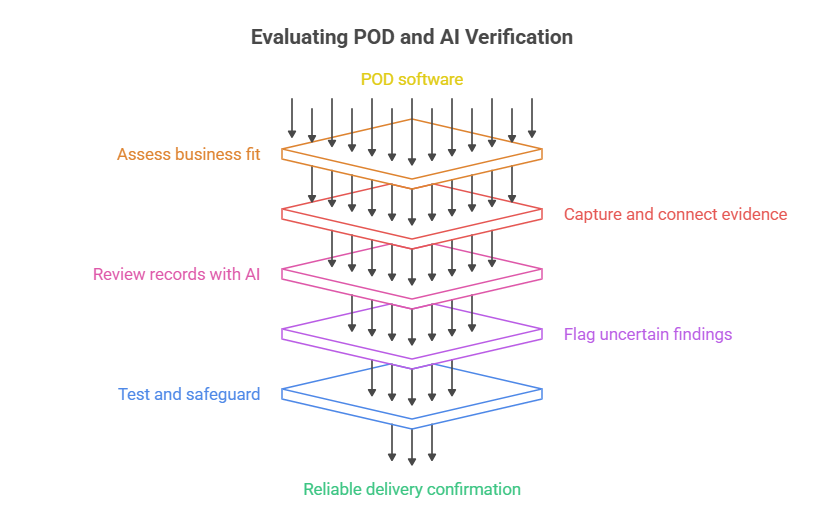
AI can help logistics teams review delivery evidence without checking every routine record by hand. AI proof of delivery tools can check whether records are complete, examine photographs, extract information from documents, and flag unusual submissions. But an automated assessment isn’t definitive proof that a delivery took place. People still need to review disputed or uncertain cases.
Automated Review of Delivery Photographs
AI-enabled systems can examine a delivery photograph for a parcel, a delivery location, or another required visual element. They can also flag images that are blurry, incomplete, or unlikely to meet the evidence requirements set for that delivery. If a workflow calls for a photo of a parcel at a designated drop-off point, for example, the system may flag an image showing an unrelated object or too little detail. A reviewer can then check the record.
That can cut repetitive work, but image analysis makes mistakes. Lighting, camera angles, image quality, and unfamiliar delivery environments can all affect the result. Businesses need rules for handling uncertain findings, and human judgement should remain part of disputed cases.
AI POD Verification for Missing or Inconsistent Information
AI POD verification can check captured information against predefined requirements. It may spot a missing field, a shipment reference that doesn’t match the order, or an apparent mismatch between a delivery timestamp and its status. For deliveries documented on paper, AI-powered text recognition can extract information from scanned notes or receipts. Teams can compare that information with order or shipment records, bearing in mind that document quality and recognition accuracy affect the result.
These checks help teams find incomplete or inconsistent records sooner and spend more time on cases that need investigation. Before relying on AI-powered proof of delivery tools, businesses should test them under actual operating conditions and set procedures for correcting mistakes or escalating uncertain findings.
Identifying Unusual Delivery Patterns
AI POD systems can examine historical records for departures from expected delivery patterns. Repeated missing photographs, high numbers of incomplete POD submissions, or recurring exceptions on particular routes may point to a training gap, a workflow problem, or poor data quality. Those patterns give logistics managers somewhere to start looking.
An unusual pattern doesn’t prove fraud or misconduct. Businesses should examine the underlying records, account for differences in delivery conditions, and follow a consistent investigation process before acting.
Reducing Manual Verification Work
Checking every record by hand takes time in a high-volume operation. AI-powered proof of delivery tools can prioritise records based on completeness, consistency, and configured risk indicators. Records that pass the required checks may follow the standard workflow, while incomplete or uncertain submissions go to a human reviewer. How much of that process a business automates depends on its system and risk requirements.
AI is useful for directing reviewers to records that need a closer look. It doesn’t replace evidence collection, operational controls, or a clear way to resolve disputes.
Important Considerations for AI POD
Before relying on AI POD, businesses need to define acceptable evidence and test the system across different delivery conditions. They also need to protect customer information and keep an audit trail of verification results. Customer disputes, financial adjustments, and suspected fraud can have significant consequences, so decisions in those cases need appropriate review and escalation procedures.
AI may make verification more efficient, but sound evidence standards and accountability still matter. Businesses should confirm that a selected product actually supports the AI proof of delivery capability they need and that it suits the intended workflow.
Proof of Delivery Best Practices for Logistics Teams
Setting up a POD process is only the start. Teams need procedures for capturing evidence correctly, storing it securely, and finding it when needed. That applies whether they use paper records, electronic proof of delivery, or both.
- Define Clear POD Requirements
Evidence requirements should reflect the shipment. A low-value parcel left at an authorised drop-off point may need a photograph and timestamp. A high-value B2B consignment may require a recipient’s signature, quantity confirmation, and a record of discrepancies. Define the requirements by shipment type, customer category, and delivery scenario, then tell carriers and delivery associates what they are before dispatch.
- Standardise Delivery Workflows
Delivery associates need to know which fields to complete and which photographs to take. They also need clear instructions for recording a failed delivery or customer refusal. A consistent workflow reduces missing records and makes performance easier to compare across locations and carriers. Update the instructions and provide training whenever requirements change.
- Capture Evidence at the Time of Delivery
Record evidence as close to the handover as possible. Waiting until later raises the risk of missed details, wrong timestamps, and inaccurate descriptions. Where possible, a mobile workflow should guide the delivery associate through the required confirmation steps before marking the shipment complete. An ePOD process can make those steps more consistent and reduce later manual entry.
- Record Exceptions Accurately
Don’t record an incomplete, damaged, short, or refused delivery as a standard successful delivery without the appropriate remarks. Note what happened, including quantities received where relevant, visible damage, a recipient’s refusal, or other discrepancies. Accurate exception records make investigations more reliable and help businesses spot recurring operational problems.
- Integrate POD With Shipment Tracking
Delivery confirmation tells a fuller story when it’s connected to shipment tracking. Teams can then see when a shipment was dispatched, when delivery was attempted, and when confirmation was recorded. Customer support can also retrieve the relevant information without relying entirely on manual requests to carriers.
- Monitor POD Completion and Quality
Track whether POD records arrive on time and contain the required information. Useful measures include POD completion rate, missing evidence rate, average time to record confirmation, and the percentage of records needing correction. Review the results regularly to find gaps by carrier, route, location, or delivery team.
- Protect Delivery Records
POD records can contain names, signatures, photographs, location information, and other sensitive data. Limit access to authorised users and set policies for retention, deletion, and sharing. Protect both the application that captures the evidence and the systems that store it. Data practices must also meet applicable privacy requirements and contractual obligations.
- Train Delivery Associates and Operations Teams
Delivery associates need training in evidence capture, customer verification, exception recording, and privacy expectations. Operations and customer support teams need to know how to find records, assess incomplete evidence, and escalate disputed deliveries. Refresher training helps keep practices consistent when workflows or systems change.
- Establish a Process for Disputed Deliveries
A POD record can help investigate a dispute, but teams need a consistent way to review contested deliveries. Decide who investigates, what evidence they check, how they contact the carrier, and how they document the outcome. Where available, consider the signature, photograph, timestamp, GPS data, shipment history, and recipient communication together rather than relying on one data point.
- Review and Improve the Process Regularly
POD procedures should change as delivery volumes, customer requirements, and technology change. Review recurring exceptions, incomplete submissions, and customer complaints to find weak points. Delivery associates and customer support teams may spot practical problems that system reports miss. Businesses should also check that their electronic proof of delivery workflow still meets the needs of different shipment categories.
Common Proof of Delivery Challenges and How to Overcome Them
Even with a structured process, businesses may encounter problems that affect the quality and accessibility of delivery evidence. These issues can arise from inconsistent carrier practices, incomplete submissions, poor connectivity, or unclear operating procedures.
| Challenge | Potential impact | Recommended approach |
| Missing signatures or photographs | Incomplete evidence and slower dispute resolution | Make required fields clear and validate submissions before completion. |
| Poor-quality photographs | Difficulties verifying the recorded delivery event | Provide image-capture guidelines and flag unclear images for review. |
| Incorrect shipment references | Evidence may be linked to the wrong order | Use shipment identifiers and automated record matching where available. |
| Delayed POD submission | Customer service and finance teams cannot access evidence promptly | Monitor submission timelines and introduce reminders or escalation rules. |
| Inconsistent carrier processes | Different levels of evidence across delivery partners | Standardise minimum requirements and review carrier compliance. |
| Connectivity problems | Delivery evidence may not upload immediately | Consider offline capture with secure synchronisation if supported by the system. |
| Disputed delivery records | Additional investigation and possible financial exposure | Maintain an auditable record and a defined dispute-resolution process. |
| Privacy and access concerns | Unnecessary exposure of customer information | Apply role-based access, retention rules, and appropriate data protection measures. |
A successful POD process addresses both technology and operational discipline. Software can make information easier to capture and retrieve, but businesses must also define acceptable evidence, train users, and establish clear procedures for incomplete or disputed deliveries. AI POD verification may support selected quality checks, but it cannot resolve every issue without accurate source information and appropriate investigation.
Proof of Delivery for Ecommerce, B2B and Last-Mile Logistics
The role of Proof of Delivery varies according to the type of shipment and the expectations of the recipient. Businesses should adapt their processes to the risks and requirements of each delivery environment instead of applying the same confirmation method to every shipment.
Ecommerce Deliveries
Ecommerce businesses typically manage large volumes of individual customer orders across multiple delivery locations. They need timely confirmation that packages have been delivered and accessible evidence when customers report missing orders. Photo-based POD, OTP verification, delivery timestamps, and digital signatures can support these workflows, depending on the delivery model.
When POD is connected with tracking and customer notifications, it can also help customer service teams investigate complaints more efficiently. Electronic proof of delivery can make it easier to access the available evidence without waiting for paper documents from the carrier. Businesses should choose the appropriate confirmation method according to shipment value, customer expectations, and delivery requirements.
B2B and Manufacturing Shipments
B2B deliveries may involve bulk goods, multiple cartons, pallets, or high-value materials. In these environments, a simple delivered status may not be sufficient. Businesses may need to record received quantities, visible damage, shortages, and recipient acknowledgement. POD records can support goods receipt checks, order reconciliation, and communication between suppliers, carriers, and receiving facilities.
Businesses should define procedures for partial deliveries and discrepancies before shipments are dispatched. Where digital systems are used, the delivery record should connect the shipment reference with the relevant order and supporting documents. This helps authorised teams investigate discrepancies and review the available evidence.
Retail Distribution
Retailers often receive replenishment shipments across stores, warehouses, and distribution centres. A structured POD process can help verify delivery completion, document shortages, and maintain a consistent record across locations. Digital records can also help teams investigate discrepancies between dispatch quantities and the goods received at a store or warehouse.
Third-Party Logistics Providers
Third-party logistics providers manage shipments on behalf of multiple customers and may work with different carriers and delivery partners. Centralised POD records can improve access to delivery evidence and help standardise reporting across accounts. Integrating POD with shipment visibility and operational systems can reduce manual document requests and help providers respond more efficiently to customer queries.
Reverse Logistics and Returns
Proof of Delivery principles can also support reverse logistics. When a returned product is collected from a customer or transferred to a return facility, a digital record can document the collection event and any relevant remarks. Although a return pickup record is not the same as proof that the original outbound shipment was delivered, maintaining evidence for both forward and reverse movements helps businesses build a clearer record of the product journey.
How eShipz Supports Delivery Visibility and Logistics Automation
Managing Proof of Delivery becomes more useful when it is part of a connected shipment management process. Businesses need to understand not only whether a shipment has been delivered, but also how it moved through the delivery network, which carrier handled it, and whether any exceptions require attention. eShipz supports shipping and logistics workflows through capabilities such as multi-carrier integration, shipment tracking, delivery visibility, and logistics automation. By connecting relevant shipment information across supported systems and carriers, businesses can reduce the need to check multiple portals and manually consolidate tracking updates.
For businesses managing ecommerce and multi-carrier operations, centralised shipment visibility can help teams monitor delivery progress and identify shipments that require follow-up. When delivery status and supporting information are available through connected workflows, customer service and operations teams can investigate delivery-related queries with better context. Businesses evaluating eShipz for their Proof of Delivery processes should confirm the availability of specific POD capture, document storage, AI verification, and carrier-level integration features against their requirements and the product capabilities available to them.
The right configuration should connect delivery evidence with tracking, exception management, and customer communication while maintaining appropriate controls over sensitive information. The broader objective is to make delivery information more accessible and actionable, helping teams spend less time collecting shipment updates and more time resolving exceptions and improving logistics performance. Businesses can explore eShipz to understand how its shipping automation and shipment visibility capabilities fit their existing delivery workflows.
The Future of Proof of Delivery in 2027
Proof of Delivery is evolving from a final delivery document into a more connected source of operational information. As businesses adopt digital logistics systems, they increasingly expect delivery confirmation to be accessible alongside tracking events, order records, and exception information. The development of electronic proof of delivery and AI-assisted verification may support these expectations, provided businesses implement the technologies according to their operational needs.
Greater Adoption of Digital Evidence
Electronic proof of delivery can help reduce dependence on paper records and make delivery information easier to retrieve. Mobile capture, digital signatures, photographs, and automated record synchronisation can support more consistent workflows across delivery networks. The extent of adoption will vary according to industry requirements, carrier capabilities, customer preferences, and the maturity of existing systems.
More Connected Shipment Data
Integrating POD records with transportation, order management, and customer service systems can create a more complete view of the shipment journey. This makes it easier to connect dispatch, transit, delivery attempts, final confirmation, and exception handling. For businesses working with multiple carriers, standardising how delivery records are captured and shared will remain an important consideration.
Wider Use of AI-Assisted Verification
AI proof of delivery technology may increasingly support tasks such as document extraction, image-quality checks, missing-field detection, and identification of unusual delivery patterns. AI POD verification can help prioritise incomplete or inconsistent records for review, while AI-powered proof of delivery tools may reduce repetitive manual checks in suitable workflows.
However, reliable implementation will depend on appropriate data quality, performance testing, privacy safeguards, and human oversight. AI-generated assessments should be treated according to their confidence and risk, not as unquestionable evidence. Businesses should evaluate AI POD capabilities against actual delivery scenarios before using them in operational decisions.
Stronger Focus on Evidence Quality and Governance
As delivery evidence becomes more digital, businesses will need clear policies for record access, retention, verification, and dispute handling. Maintaining traceable records and ensuring that users understand their responsibilities will be essential to building trust in digital POD processes. In 2027 and beyond, the most useful approach will combine reliable evidence capture, connected logistics systems, appropriate automation, and clear accountability.
Building a More Reliable Delivery Process with Digital Proof of Delivery
As logistics operations continue to evolve, businesses need delivery processes that provide accurate records, timely updates, and clear accountability at every stage. Adopting electronic proof of delivery, standardising evidence collection, and integrating delivery records with shipment tracking can help teams reduce manual work and respond to delivery-related issues more efficiently. By combining reliable POD practices with suitable digital tools, businesses can build a more transparent and organised delivery process.
Proof of Delivery plays an essential role in confirming completed shipments, resolving delivery disputes, maintaining accountability, and improving logistics operations. As businesses manage larger shipment volumes and increasingly complex delivery networks, relying entirely on paper-based confirmation can make delivery records harder to retrieve and maintain. An effective ePOD process provides a structured way to capture, store, and access delivery evidence while helping teams connect final delivery confirmation with the wider shipment journey.
With appropriate integration, ePOD software can connect delivery confirmation with shipment tracking, customer service, and operational reporting. AI POD verification can further support selected checks by identifying missing information and flagging records that require attention, provided suitable validation and human review processes are in place. Businesses should choose technologies that address their actual operational requirements rather than adopting automation without clear processes and evidence standards.
For businesses looking to strengthen delivery operations in 2027, the priority should be to establish clear evidence requirements, standardise workflows, protect delivery records, and connect POD information with the wider logistics process. When implemented thoughtfully, Proof of Delivery becomes more than a final shipment record; it becomes a practical tool for improving visibility, accountability, and the overall delivery experience.
Businesses can take this a step further by connecting delivery confirmation with broader shipping and logistics workflows. eShipz helps businesses streamline shipping operations through multi-carrier integration, shipment tracking, delivery visibility, and logistics automation. By improving access to shipment information and helping teams monitor delivery progress across supported carriers, eShipz can support more connected logistics operations and help businesses manage delivery exceptions more effectively.
Explore eShipz to learn how shipping automation and shipment visibility solutions can help your business build more efficient, transparent, and customer-focused delivery operations.
Frequently Asked Questions About Proof of Delivery
- What is Proof of Delivery in logistics?
Proof of Delivery is a document or digital record confirming that a shipment has been delivered to its intended recipient or designated location. It may include a signature, photograph, timestamp, GPS location, OTP confirmation, or other supporting information. Proof of delivery in logistics helps businesses verify delivery events and investigate discrepancies.
- What does POD stand for?
POD stands for Proof of Delivery. It is used by carriers, shippers, retailers, ecommerce businesses, and logistics providers to record and verify the completion of a delivery. A POD record may be maintained on paper or digitally.
- What is the difference between POD and ePOD?
POD is the general term for evidence confirming delivery. ePOD, or electronic proof of delivery, refers specifically to capturing and managing that evidence digitally through an application or connected system rather than relying solely on paper documents.
- What information should a POD document contain?
A POD record may include the shipment number, recipient name, delivery address, date and time, signature, photograph, location data, delivered quantities, and exception remarks. The exact fields depend on the shipment type and the business’s requirements.
- What is ePOD software?
ePOD software helps delivery associates capture and submit delivery evidence electronically. Depending on the solution, it may support signatures, photographs, GPS coordinates, OTP verification, timestamps, exception reporting, and integrations with shipment management systems.
- How does AI POD verification work?
AI POD verification uses AI-based checks to review selected delivery evidence for completeness or inconsistencies. It may help analyse photographs, extract information from documents, or flag missing fields. Results should be reviewed according to the system’s reliability and the risk involved.
- Can Proof of Delivery help resolve customer disputes?
Yes. POD can provide evidence to help investigate missing packages, incorrect delivery locations, damaged goods, and other disputes. The strength of the evidence depends on what was captured and how reliably the record is linked to the shipment.
- Is Proof of Delivery mandatory for every shipment?
Requirements vary by shipment type, contract, carrier policy, customer requirements, and applicable laws or regulations. Businesses should identify the evidence required for each delivery category instead of assuming that one POD method is suitable for every shipment.
- How can businesses improve their POD process?
Businesses can improve their POD process by standardising evidence requirements, using suitable electronic proof of delivery tools, training delivery associates, integrating delivery records with tracking systems, monitoring missing submissions, and establishing clear procedures for disputes.
- What should businesses consider when choosing POD software?
Businesses should evaluate evidence capture options, integration capabilities, exception handling, centralised record access, reporting, security, scalability, and ease of use. They should also confirm that the solution supports the specific workflows required by their carriers and customers.
- What is the difference between ePOD software and traditional POD software?
Traditional POD processes may depend on paper receipts and manual document handling, while ePOD software captures and manages delivery evidence digitally. Some POD software solutions may offer additional capabilities such as mobile data capture, shipment integrations, reporting, and exception management. Businesses should compare specific product features before choosing a solution.
- Can AI-powered proof of delivery replace manual verification?
AI-powered proof of delivery can assist with tasks such as image checks, document extraction, and identifying missing information. However, it should not automatically replace human review in disputed, uncertain, or high-risk cases. The appropriate level of automation depends on the quality of the evidence and the capabilities of the system.