



Ecommerce Shipping now shapes far more than the journey from a warehouse to a customer’s doorstep. As online shopping expands, customers pay closer attention to delivery speed, shipment visibility, accuracy, convenience, and returns. In India, 47% of urban consumers surveyed by YouGov in 2025 said they shop online at least once a week, while DHL reported that 98% of surveyed Indian shoppers use smartphones for online shopping. More frequent digital purchases put greater pressure on brands to deliver a smooth experience after checkout. Meanwhile, e-commerce brands are handling higher order volumes, multiple sales channels, several courier partners, distributed inventory, and more complex fulfilment operations. That makes ecommerce shipping a central part of both the customer experience and business strategy. What happens after checkout can affect a customer’s impression just as much as the buying process itself. Orders that are processed quickly, packed correctly, assigned to the right carrier, tracked accurately, and delivered within the promised timeframe make shipping part of the brand experience, rather than a back-end task.
Growing complexity and India’s expanding delivery ecosystem are changing ecommerce logistics. India’s e-commerce logistics market was valued at approximately $6.65 billion in 2025 and is projected to reach around $11.14 billion by 2031, according to Mordor Intelligence. Domestic deliveries accounted for more than 90% of the market in 2025, while Tier 3 and smaller cities represented around 40% of the market, showing that online commerce is moving beyond major metropolitan areas. Businesses handling thousands of orders across locations can’t rely entirely on manual workflows and disconnected courier systems. They need clear visibility into inventory, fulfilment, carrier performance, shipment status, delivery exceptions, returns, and logistics costs. This is why shipping technology matters. Modern platforms connect carriers and logistics processes, automate repetitive work, and help businesses make better shipping decisions. As brands prepare for 2027, attention is likely to move further toward intelligent automation, predictive delivery, real-time visibility, distributed fulfilment, sustainable operations, and proactive customer communication.
The next shipping trends involve more than faster delivery. India’s express logistics industry was valued at around $9 billion in FY25, according to KPMG, reflecting the scale of the country’s wider delivery and logistics ecosystem. As the market develops, businesses are assessing how artificial intelligence can support carrier selection, how predictive analytics can improve estimated delivery dates, how logistics automation can cut manual work, and how shipping automation can connect different stages of delivery. logistics technology is also becoming more integrated with order management, inventory, customer communication, and returns. These changes are shaping ecommerce shipping trends around a more connected order journey, where each stage can improve efficiency and customer experience. Brands building their 2027 logistics strategy need to understand these ecommerce logistics trends and identify where technology and process changes will have the biggest impact.
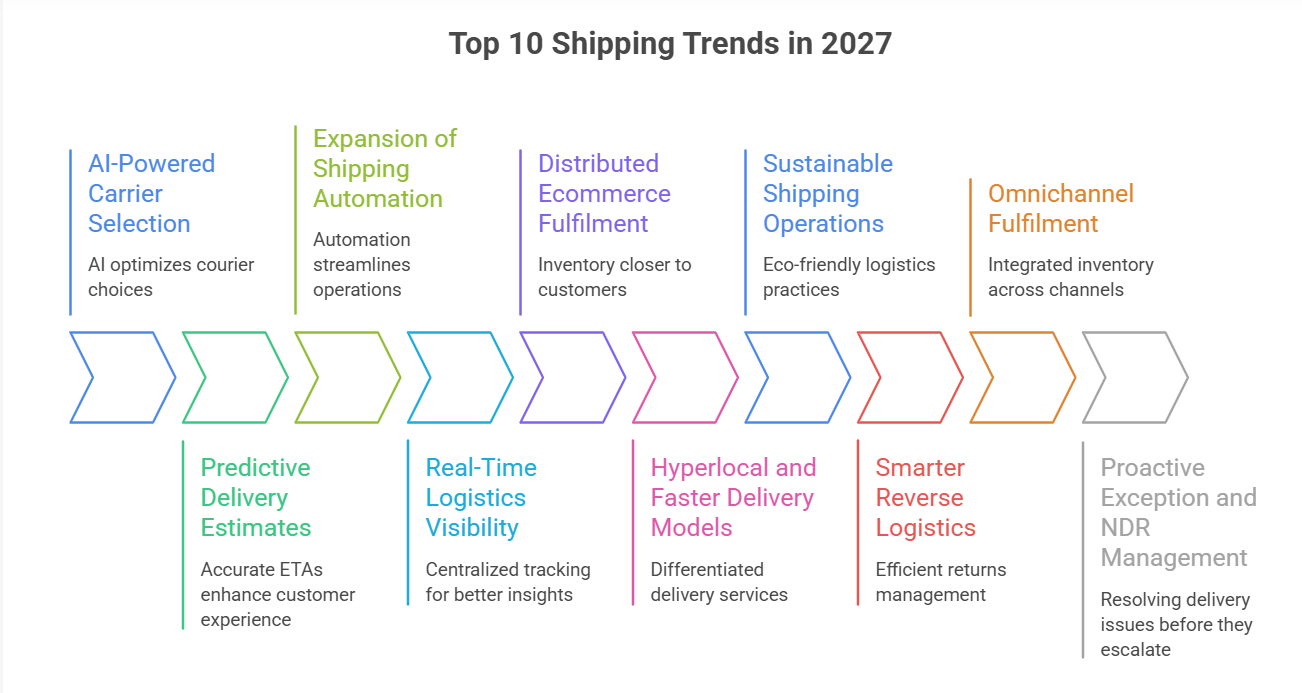
Top 10 Ecommerce Shipping Trends in 2027
The major shipping trends expected to shape 2027 reflect the growing need for intelligent, flexible, and customer-focused logistics operations. While the relevance of each trend will vary by business model, product volume, category, and geography, these developments provide a useful direction for brands planning their logistics strategy.
-
AI-Powered Carrier Selection
Artificial intelligence is expected to play a much bigger role in ecommerce shipping as businesses deal with growing order volumes and increasingly complex carrier networks. Choosing a courier is no longer simply about selecting the lowest available shipping rate. Brands need to consider several factors at the same time, including the delivery location, package dimensions, shipment weight, promised delivery timeline, carrier serviceability, historical performance, available capacity, and overall shipping cost. A carrier that performs well in one region may not necessarily provide the same level of service in another. Similarly, a cheaper shipping rate may result in higher overall costs if it is associated with more delivery delays, failed attempts, or returns.
Key factors AI can consider:
- Destination and serviceability: Identifying carriers that have reliable coverage and delivery performance for specific locations.
- Shipment characteristics: Considering package weight, dimensions, product type, and other shipment requirements before selecting a carrier.
- Carrier performance: Using historical data such as delivery timelines, success rates, delays, and exception patterns to support carrier selection.
- Delivery commitments: Matching shipments with carriers based on the promised delivery timeline and required service level.
- Overall shipping cost: Looking beyond the initial courier rate and considering potential costs associated with delays, failed deliveries, and returns.
AI-enabled shipping technology brings these variables together, helping businesses make better carrier decisions. Rather than applying one carrier rule to every order, an automated system can assess each shipment and choose an appropriate option based on predefined business requirements and available data. As businesses collect more shipment information, historical performance can show which carriers perform better for specific locations, shipment categories, or service types. That makes shipping automation more adaptable as requirements shift.
AI can do more than allocate carriers. It can support demand forecasting, delivery-risk identification, route planning, estimated delivery predictions, and exception management. Logistics technology is moving beyond the basic execution of shipping instructions. It now helps teams make operational decisions, especially when shipment volumes are high. For businesses handling large order volumes, this can create a more scalable ecommerce logistics operation and cut the manual work involved in everyday shipping decisions.
-
Predictive Delivery Estimates
Customers expect clear, accurate updates on when their orders will arrive. Standard carrier transit windows often fall short because delivery times can change due to warehouse processing, regional congestion, carrier capacity, weather, holidays, and other operational factors. Predictive analytics helps businesses analyse past shipment patterns alongside current delivery data to produce more relevant estimated arrival times. That gives customers a better sense of when to expect their order.
Predictive ETAs also help teams act before a delivery issue becomes a support ticket. If a shipment is likely to miss its expected delivery date, the business can send an updated notification while operations investigates the delay or works with the carrier. Tracking becomes an active part of ecommerce shipping management instead of a passive status check. For customer-facing brands, accurate ETAs matter because delivery promises shape the shopping experience. They also support broader ecommerce logistics goals, where visibility and reliability now matter as much as delivery speed.
-
Expansion of Shipping Automation
Shipping automation will see wider adoption across the full shipment lifecycle, making it one of the most important ecommerce shipping trends. It now goes far beyond generating courier labels. Businesses can automate carrier selection, shipment creation, tracking communication, delivery notifications, exception alerts, NDR workflows, and return initiation.
The value becomes clear as order volumes rise. A manual process may work for a few hundred shipments, but it quickly slows down when a business handles thousands of shipments each day. Employees can spend hours checking carrier systems, copying data, updating customers, and chasing routine exceptions. logistics automation handles many of these repetitive tasks consistently. It also reduces reliance on individual employees. Once business rules and workflows are built into the system, processes can keep moving even as order volumes fluctuate. That gives ecommerce logistics a stronger, more scalable base and lets operations teams focus on exceptions and complex decisions instead of routine work.
-
Real-Time Logistics Visibility
As brands work with more carriers, fulfilment centres, warehouses, and sales channels, shipment information can become fragmented. Operations teams may need to check several carrier portals to understand where orders are located or identify shipments that have encountered problems. This can make it difficult to get a complete picture of logistics performance.
Modern logistics technology can bring shipment information into a centralised environment. A logistics control tower can provide visibility into shipment status, carrier performance, transit times, delayed orders, delivery exceptions, and returns. This allows operations teams to monitor their network rather than looking at individual shipments one by one. Real-time visibility is particularly useful for identifying patterns. A business may discover that one carrier has higher delivery delays in a particular region or that certain shipment categories experience more exceptions. These insights can then inform future carrier allocation and fulfilment decisions. As a result, visibility becomes a foundation for better shipping technology and more informed ecommerce logistics.
-
Distributed Ecommerce Fulfilment
Inventory placement matters more as brands work to shorten delivery times without letting shipping costs climb. Products stored far from customers often travel longer distances, adding time and expense. Distributed fulfilment puts inventory closer to major demand centres.
That may mean using regional warehouses, third-party fulfilment centres, micro-fulfilment sites, or selected retail stores. The goal isn’t to add storage locations for the sake of it. Brands need to place inventory based on demand, product availability, transportation costs, and what customers expect from delivery.
Better ecommerce fulfillment directly affects shipping performance. When the right product is available near the customer, the order can be processed and delivered faster. Distributed inventory adds complexity, though, so brands need accurate inventory visibility and connected logistics technology to decide where each order should be fulfilled.
-
Hyperlocal and Faster Delivery Models
Same-day and next-day delivery will continue to influence customer expectations, but not every product needs the same delivery model. Businesses are increasingly likely to differentiate delivery services according to customer location, product category, urgency, and willingness to pay.
Hyperlocal delivery networks can support faster fulfilment by positioning inventory close to customer demand. This can be useful for categories where immediacy has strong value, including grocery, personal care, beauty, food, and selected consumer products. Regional fulfilment can also reduce the distance between products and customers.
However, faster delivery comes with operational costs. Businesses need to consider inventory positioning, warehouse operations, delivery partners, and transportation expenses. This is why the future of ecommerce shipping trends will not simply be about making every delivery faster. It will be about determining the right combination of speed, cost, and convenience for each order.
-
Sustainable Shipping Operations
Sustainability is becoming more closely connected with logistics efficiency as e-commerce businesses look for ways to reduce waste, unnecessary transportation, and resource consumption. Transportation, packaging, warehouse operations, failed delivery attempts, and returns can all contribute to the environmental impact of an e-commerce order. Rather than treating sustainability as a separate initiative, brands can increasingly build it into everyday ecommerce logistics decisions.
Right-sized packaging:
Packaging is one of the most practical areas where businesses can improve efficiency. Oversized boxes may require more packaging material and can increase dimensional or volumetric weight, potentially raising shipping costs. Using packaging that is appropriately sized for the product can help businesses make better use of transportation space while reducing unnecessary material consumption.
Optimised inventory placement:
Where inventory is stored can influence how far products need to travel before reaching customers. By analysing demand patterns and placing frequently ordered products closer to key customer markets, businesses can potentially reduce transportation distances and improve fulfilment efficiency. This makes ecommerce fulfillment an important part of a more sustainable shipping strategy.
Fewer failed delivery attempts:
An unsuccessful delivery can create additional transportation activity when another attempt is required or when a shipment eventually moves through the return process. Improving address accuracy, customer communication, delivery coordination, and NDR management can help reduce avoidable delivery attempts and the associated logistics activity.
Smarter carrier selection:
Carrier selection can also contribute to more efficient logistics operations. Businesses can consider factors such as delivery routes, serviceability, shipment consolidation, and carrier performance when deciding how orders should be transported. Shipping technology can help businesses incorporate these factors into automated shipping decisions.
Data-driven sustainability:
Businesses cannot improve what they cannot measure. Logistics technology can provide data on shipment volumes, transportation patterns, packaging requirements, failed deliveries, returns, and fulfilment locations. By analysing this information, brands can identify areas where unnecessary movement or resource use is occurring and introduce more efficient processes.
These changes show how sustainability can become part of a broader ecommerce logistics strategy rather than being treated as a completely separate initiative. By combining better packaging, inventory planning, delivery accuracy, carrier management, and logistics automation, businesses can work toward more efficient shipping operations while also managing costs and improving the overall delivery experience.
-
Smarter Reverse Logistics
Returns are a core part of e-commerce, especially for fashion, footwear, electronics, beauty, and lifestyle businesses. Every returned item starts a new logistics journey, from pickup and transportation to inspection, inventory updates, and a decision on whether to resell, refurbish, replace, or dispose of it.
Automation can simplify much of that work. Customers can start returns through structured workflows, reverse shipments can be created automatically, tracking can stay current, and returned inventory can connect directly with fulfilment systems. That gives teams a more organised reverse logistics operation.
Return data also shows where problems may be starting. If specific products have unusually high return rates, brands can check product details, sizing, packaging, quality, or customer expectations. Reverse logistics supports broader ecommerce logistics trends by giving businesses information they can use to improve products and internal processes.
-
Omnichannel Fulfilment
E-commerce brands are increasingly selling across websites, marketplaces, social commerce channels, mobile applications, and physical stores. This creates more opportunities to reach customers but also creates greater operational complexity. Inventory needs to remain visible across channels, and businesses need to determine the most appropriate location from which each order should be fulfilled.
Omnichannel fulfilment can allow businesses to use inventory across different locations where appropriate. For example, inventory available in a nearby store could potentially fulfil an online order rather than requiring the product to travel from a distant warehouse. This can support faster fulfilment and potentially reduce transportation requirements. However, successful omnichannel operations depend on accurate inventory information and connected shipping technology. Order management, inventory, warehouse operations, and carriers need to communicate effectively. As more brands adopt omnichannel models, this integration will become a major component of ecommerce fulfillment and modern ecommerce logistics.
-
Proactive Exception and NDR Management
Not every shipment reaches the customer on the first attempt. Customers may be unavailable, addresses may be incomplete, phone numbers may not be reachable, or recipients may request another delivery time. These situations can generate non-delivery reports and increase the risk of return-to-origin shipments.
Traditional processes often require employees to identify the failed delivery and manually contact the customer or carrier. More advanced logistics automation can identify exceptions and trigger workflows based on the reason for the failure. Customers can receive notifications, support teams can be alerted, and another delivery attempt can potentially be initiated. The goal is to move from reactive shipment management toward proactive delivery management. This makes NDR handling an important part of shipping automation and ecommerce shipping because businesses can focus on resolving the underlying delivery problem rather than simply recording that a delivery failed.
How E-Commerce Shipping Is Changing in 2027
Shipping has changed significantly as e-commerce has grown. In the early days of online retail, the goal was simple: get the order delivered. Now customers expect updates at every stage of the delivery process. They want to know when an order is confirmed, packed, dispatched, in transit, and due to arrive. If a delay occurs, they expect to hear about it promptly, not after the original delivery date has already passed. These expectations are forcing brands to rethink ecommerce shipping and invest in systems that offer clearer tracking and more control. Carrier networks have also become more complex. An e-commerce business may work with several courier companies because no single carrier performs equally well in every location. One carrier may cover a certain region more reliably, another may handle heavy shipments better, and another may offer lower rates for specific pin codes. As order volumes grow, managing those choices by hand becomes difficult. Shipping technology and logistics technology help businesses set rules and automate carrier allocation based on their needs, rather than relying on one carrier or choosing a courier manually for every order. That makes them central to modern ecommerce logistics.
Fulfilment is increasingly tied to shipping strategy. Where inventory is stored affects both delivery speed and cost. A business keeping all stock in one location may need to ship products over long distances, while a distributed fulfilment model can place inventory closer to customer demand.
That makes ecommerce fulfillment a major part of shipping planning. Inventory placement, order routing, warehouse capacity, carrier availability, and delivery promises need to align. As brands enter new markets and customers keep expecting faster, more predictable delivery, the connection between fulfilment and shipping will only become stronger.
| Area of ecommerce logistics | Traditional approach | 2027-focused approach |
| Carrier selection | Fixed rules or manual selection | Automated, data-driven allocation |
| Delivery estimates | Standard transit timelines | Predictive and dynamic ETAs |
| Shipment tracking | Basic post-dispatch tracking | Real-time visibility and alerts |
| Fulfilment | Centralised inventory | Distributed and demand-based fulfilment |
| Delivery exceptions | Manual follow-up | Automated exception workflows |
| Returns | Separate reverse process | Connected reverse logistics |
| Customer updates | Reactive notifications | Proactive communication |
| Cost management | Focus on courier rates | Total logistics-cost optimisation |
| Sustainability | Separate initiative | Integrated logistics planning |
| Decision-making | Manual and historical | Data-driven and increasingly AI-supported |
These developments explain why the latest ecommerce logistics trends are focused on creating connected operations instead of isolated logistics activities. A business cannot optimise shipping costs effectively if it does not understand fulfilment costs, packaging, failed deliveries, returns, and carrier performance. Similarly, a brand cannot promise faster delivery without considering inventory positioning and warehouse processing times. The future of ecommerce shipping will therefore depend on how well businesses connect these different processes.
For growing brands, this shift also means that automation is becoming more valuable. Logistics automation can reduce repetitive operational work, while shipping automation can help standardise shipment creation, carrier allocation, tracking, notifications, and exception handling. The goal is not to remove people from the process entirely but to allow technology to handle predictable activities while teams focus on decisions that require judgement and intervention.

Key Areas Brands Should Prioritise Before 2027
The above shipping trends demonstrate that technology will play a growing role in e-commerce operations, but technology alone does not guarantee better performance. Brands need to first understand how their existing shipping and fulfilment processes work, where delays or inefficiencies occur, and which activities still require significant manual effort. This can include areas such as carrier selection, order processing, shipment tracking, delivery exceptions, returns, and customer communication. By identifying these bottlenecks, businesses can determine where automation, better visibility, or data-driven decision-making can create measurable improvements. This approach allows brands to adopt technology with a clear purpose, ensuring that investments in logistics technology support actual operational needs rather than simply adding more tools to an already complex logistics environment.
Carrier performance
Businesses should evaluate carriers based on more than shipping rates. Delivery success rate, transit time, serviceability, exception rates, RTO performance, and regional reliability can all influence the real cost of a carrier. A data-driven carrier strategy can help businesses identify which partners perform best for different shipment requirements.
Fulfilment performance
Brands should understand how long orders take to move from purchase to dispatch and whether inventory is positioned close enough to customer demand. Improving ecommerce fulfillment can have a direct impact on delivery timelines because a shipment cannot reach the customer until the order has been processed and handed over to a carrier.
Automation opportunities
Teams should identify repetitive activities that consume operational time. Carrier allocation, label creation, tracking updates, customer notifications, NDR workflows, and returns are common areas where shipping automation can reduce manual effort.
Delivery experience
Businesses should measure how customers experience delivery. Useful questions include whether delivery promises are accurate, whether tracking information is easy to understand, whether customers receive timely notifications, and whether delivery problems can be resolved without excessive effort.
Logistics data
Businesses should establish clear metrics for their ecommerce logistics operations. Important measures can include shipping cost per order, average transit time, first-attempt delivery rate, RTO rate, exception rate, fulfilment time, carrier performance, and return rate. These metrics can provide a foundation for better decisions.
The Role of Logistics Technology in Modern E-Commerce
Online retail is becoming more complex, making logistics technology a core part of business infrastructure. E-commerce businesses produce large volumes of data across orders, inventory, warehouses, carriers, tracking systems, customer interactions, and returns. The real challenge is using that information to make better decisions.
A connected logistics platform brings these processes together instead of leaving data trapped in separate systems. Order details can flow into fulfilment and shipping workflows, teams can compare carrier options, track shipments, and set automated responses for delivery exceptions. This creates a more consistent way to run operations.
The value of logistics automation comes from linking workflows, rather than automating a single task. A business might start by automating label generation, then add carrier allocation, tracking updates, exception management, and returns. Over time, those workflows can form a broader automated logistics ecosystem. For larger organisations, this approach can support standardisation across regions and business units. Smaller brands can reduce the operational load that comes with rising order volumes. In either case, the goal is a logistics operation that scales without manual work increasing at the same rate as shipments. That’s why shipping technology is becoming a strategic investment. It gives businesses the visibility and automation they need to understand operations and make decisions based on data.
How eShipz Can Help E-Commerce Brands Prepare for 2027
As ecommerce shipping becomes more complex, businesses need a connected platform that can help them manage carriers, automate workflows, track shipments, and respond to delivery exceptions. eShipz provides a logistics technology layer that helps businesses streamline these activities through a connected shipping ecosystem.
Centralised Carrier Management
eShipz helps businesses manage multiple courier partners from a connected platform. Brands can create carrier allocation rules based on factors such as destination, serviceability, shipment requirements, delivery timelines, and business priorities. This reduces the need to manually select a courier for every order and helps create a more consistent shipping process.
Shipping Automation
Growing order volumes can make repetitive shipping activities difficult to manage manually. eShipz can automate key shipping workflows, helping businesses reduce manual intervention in areas such as shipment processing and carrier allocation. This allows operations teams to focus more on exceptions and higher-value activities.
Real-Time Shipment Visibility
eShipz helps businesses monitor shipments across their carrier network from a centralised view. Teams can track orders from dispatch through delivery, identify delays, and gain better visibility into carrier performance without having to repeatedly check separate carrier systems.
NDR and Exception Management
Failed delivery attempts can increase customer frustration and contribute to RTO costs. eShipz can help businesses manage NDRs and delivery exceptions through structured workflows, allowing teams to respond to issues more quickly and improve the chances of successful delivery.
Logistics Analytics
Shipping data can provide valuable insights into operational performance. eShipz can help businesses analyse areas such as carrier performance, delivery outcomes, shipment activity, and exceptions. These insights can support better decisions as brands expand their ecommerce logistics operations.
Scalable Logistics Operations
As businesses grow, managing more orders, carriers, locations, and delivery requirements can increase operational complexity. By bringing carrier management, shipping automation, tracking, analytics, and exception management into a connected workflow, eShipz can help brands build a more structured logistics operation that can scale with their business.
Preparing for the Future of Ecommerce Shipping
The future of ecommerce shipping depends on how technology, customer expectations, fulfilment models, and operational efficiency work together. AI will support more decisions, while automation takes on repetitive tasks. Predictive analytics will improve visibility, and distributed fulfilment will help businesses place inventory closer to demand. Brands shouldn’t adopt technology just because it’s new. Every business has different needs. A D2C brand shipping a few hundred orders a day may prioritise different things than an enterprise managing multiple warehouses and millions of shipments. The right strategy starts with the operational problems that need fixing. Businesses need to identify where delays happen, which tasks demand the most manual work, which carriers perform reliably, where shipping costs are rising, and how customers experience delivery. Once they understand those issues, they can use shipping technology to solve specific problems.
The same applies to logistics automation. It works best when it removes repetitive work, improves consistency, or helps teams respond faster. A badly designed automated process only makes an inefficient process move faster. Businesses need clear workflows and measurable performance goals alongside their technology. Ecommerce logistics trends also point to closer connections between logistics and the rest of the business. Inventory decisions affect delivery performance, fulfilment choices affect shipping costs, and returns can reveal what customers expect from products. Businesses need a connected logistics ecosystem, not a set of isolated tools.
The Road Ahead for E-Commerce Shipping
Shipping trends shaping 2027 show how quickly e-commerce delivery is changing. AI-powered carrier selection, predictive delivery estimates, shipping automation, real-time visibility, distributed fulfilment, hyperlocal delivery, sustainable operations, intelligent returns, omnichannel fulfilment, and proactive NDR management are pushing logistics toward more connected operations.
For e-commerce brands, the goal isn’t only faster delivery. They need to make better decisions across the order journey, from choosing the right carrier and placing inventory to calculating delivery promises and handling exceptions. Businesses also need to keep customers informed when an order changes. This is where ecommerce shipping trends and broader ecommerce logistics trends meet, creating demand for systems that connect each stage of shipping.
Shipping technology will become more important as brands need clearer visibility and tighter control over operations. logistics technology, logistics automation, and shipping automation can reduce repetitive tasks and make daily processes more consistent. That matters most for brands expanding into new regions, adding sales channels, or managing larger carrier networks.
The future of ecommerce logistics depends on how well businesses connect orders, inventory, fulfilment, carriers, tracking, customer communication, returns, and analytics. A connected foundation helps brands scale without losing the ability to respond quickly as customer expectations shift. Platforms such as eShipz can provide the technology layer for multi-carrier shipping, automated workflows, shipment visibility, and delivery exception management in one connected environment.
As 2027 approaches, businesses should look beyond individual delivery services and assess the full logistics journey. The right shipping technology gives brands a clearer view of operations, supports better decisions, cuts repetitive work, and helps teams act quickly when conditions change. With a connected approach to ecommerce shipping, brands can support growth while giving customers a more reliable delivery experience. eShipz brings carrier management, shipping automation, tracking, analytics, and delivery exception management into one logistics ecosystem.