



![The Complete Guide to Returns Automation in eCommerce [2027]](https://www.eshipz.com/wp-content/uploads/2026/10/The-Complete-Guide-to-Returns-Automation-in-eCommerce-2027.png)
Returns automation is changing the way ecommerce businesses handle one of the most complicated stages of the customer journey: what happens after a product has been delivered and the customer decides to send it back. Placing an order can take only a few clicks, but processing a return can involve customer support, order validation, return policies, carrier coordination, pickup scheduling, warehouse operations, inspections, refunds, exchanges, and inventory updates. When every one of these activities is managed manually, even a moderate increase in return volume can create operational bottlenecks. For growing ecommerce brands, returns automation provides a way to connect these activities, reduce repetitive work, improve visibility, and create a more consistent experience for customers.
The scale of the returns challenge makes this increasingly important. According to the National Retail Federation, retailers expect 19.3% of online sales to be returned in 2025, while total retail returns are projected to reach $849.9 billion. The same research found that 82% of consumers consider free returns an important factor when shopping online, and 76% are more likely to choose a return option offering an instant refund or exchange. DHL’s 2025 ecommerce research found that 64% of global shoppers have returned an online purchase, while 79% say they may abandon a cart if their preferred returns option is not available. DHL also reports that 54% of global shoppers have returned an item because it was the wrong size, highlighting how product information and customer expectations can directly influence return volumes.
Returns are therefore no longer simply a customer service issue. They affect logistics costs, warehouse capacity, inventory availability, customer satisfaction, refunds, exchanges, and the overall profitability of an ecommerce operation. This makes returns management an important part of the wider supply chain. With the right returns management software, businesses can bring different stages of the return journey into one connected workflow instead of relying on emails, spreadsheets, manual approvals, and disconnected carrier systems. The shift becomes even more important as businesses expand across products, locations, sales channels, and markets. A return process that works when a company handles a few hundred orders a day can become difficult to manage when order volumes reach thousands. This is where ecommerce returns management, reverse logistics software, and product returns management software can help businesses create a more structured and scalable operation.
In this complete guide, we will explore how returns automation works, why modern returns management needs to go beyond simply accepting a returned product, how returns management software can simplify the customer journey, where reverse logistics software fits into the process, how businesses can recover more value from returned inventory, which metrics they should track, how AI can support returns, and what an effective reverse logistics ecommerce strategy could look like in 2027.
Returns Automation: Why Ecommerce Businesses Are Moving Beyond Manual Returns
Returns automation is not just about making it easier for customers to send products back. It is about connecting the entire returns process, from the moment a customer requests a return to the point where the product is refunded, exchanged, restocked, refurbished, or moved to another destination.
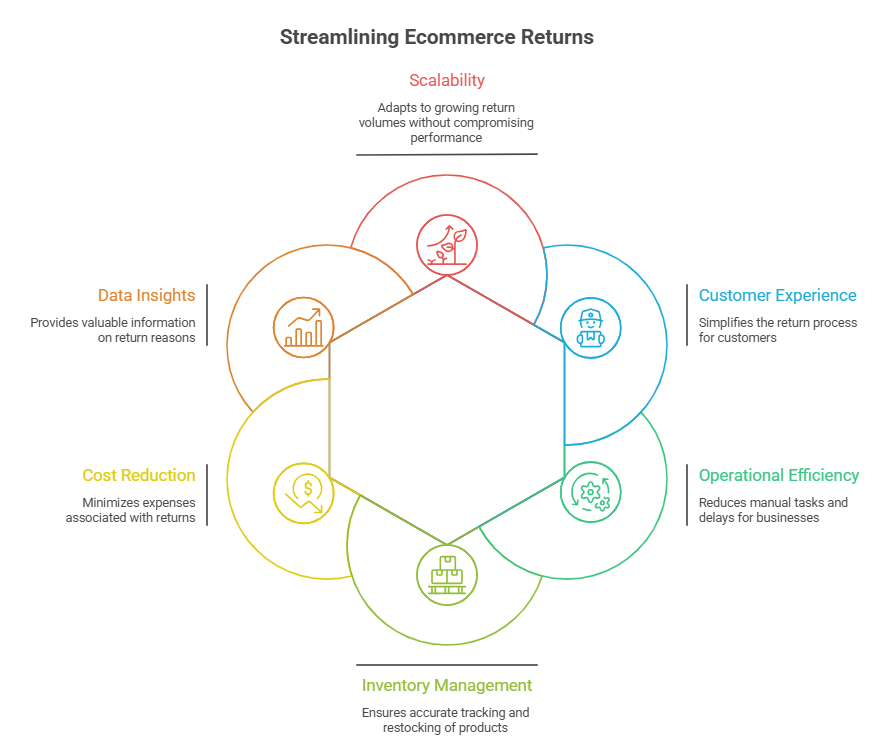
For a growing ecommerce business, a return can involve customer support, order verification, return-policy checks, carrier coordination, pickup scheduling, warehouse teams, product inspection, refunds, inventory updates, and customer communication. When all of these steps are handled manually, even a moderate increase in return volume can create delays and unnecessary operational work.
How the Traditional Returns Process Works:
Consider a customer who orders a pair of shoes online. The customer receives the product but finds that the size is incorrect and decides to return it. In a manual process, the journey may look like this:
Customer contacts support → Support checks the order → Return policy is verified → Return is approved → Pickup is arranged → Shipment is tracked → Product reaches the warehouse → Product is inspected → Refund or exchange is processed → Inventory is updated → Customer is notified
None of these steps is particularly complicated on its own. The problem is that there are many of them, and they often involve different people, systems, and teams. As order volumes increase, small delays begin to compound. A support team may spend time answering basic return questions. Operations teams may manually coordinate pickups. Warehouse teams may not know which returns are arriving. Finance teams may wait for inspection confirmation before processing refunds.
This is where returns automation changes the workflow. Instead of moving information manually between teams, predefined rules and connected systems can handle much of the process automatically.
A typical automated workflow can look like:
Return request → Eligibility check → Automated approval → Pickup scheduling → Shipment tracking → Warehouse receipt → Inspection → Refund/exchange → Inventory update → Customer notification
The customer gets a simpler experience, while the business gets greater visibility and control over what happens after a product leaves the customer’s hands.
Why Returns Automation Matters as Ecommerce Scales:
Returns become more difficult as an ecommerce business grows because the number of possible combinations grows with them.
A business may have:
- Different return windows for different products
- Multiple warehouses
- Several carriers
- Different pickup locations
- Refund and exchange options
- Different return reasons
- Multiple sales channels
- Different rules for damaged or used products
- Products that require inspection before resale
Managing these variations manually can quickly become difficult. Returns automation allows businesses to turn these decisions into predefined workflows. For example, a return request can automatically be checked against the order date, product category, payment status, return reason, and applicable policy before it reaches an operations team. This reduces repetitive work while making the process more consistent.
From Returns Processing to Returns Management:
The bigger shift is that ecommerce businesses are no longer looking at returns simply as an after-sales support activity. Returns management is becoming part of the broader customer experience and supply chain. A slow return can affect customer satisfaction. A delayed inspection can keep inventory unavailable for longer. Poor return routing can increase logistics costs. And limited visibility can make it difficult for businesses to understand why customers are returning products in the first place. That is why modern returns management software focuses on connecting these different parts of the journey rather than automating just one step. The goal is not simply to process more returns. It is to make the entire return journey faster, more visible, more consistent, and easier to manage.
Returns Management Software: Creating a Connected Return Experience
A modern return process needs much more than a simple “Return Product” button. Customers want to know whether their order qualifies for a return, which products can be returned, what options are available, when the product will be collected, when the refund will arrive, and what happens next. At the same time, operations teams need visibility into every return moving through the system. This is where returns management software becomes valuable. Instead of handling every return manually across customer support, logistics, warehouse, finance, and inventory teams, businesses can use a centralized system to connect the entire return lifecycle. This makes ecommerce returns management more structured while giving customers a simpler and more transparent experience.
What Returns Management Software Does
Returns management software helps businesses manage the different stages of the return lifecycle from a single system. Depending on the solution, it can support return request management, automated eligibility checks, return policy configuration, customer self-service, return label generation, pickup scheduling, carrier management, reverse shipment tracking, refund and exchange workflows, warehouse notifications, inventory updates, return reason analytics, customer notifications, reporting, and dashboards. The idea is not to automate one isolated task but to connect the entire process. For example, when a customer submits a return request, the system can check whether the order is eligible, approve the request, arrange a pickup, track the shipment, notify the warehouse, and trigger the next step once the product is received. This is where returns automation becomes more than a simple return portal. It becomes a connected workflow across the business.
Automating Eligibility, Self-Service, and Customer Communication
Return policies often contain several conditions. A product may need to be returned within a specific number of days, certain categories may be excluded, clearance products may have different rules, and some products may qualify for an exchange but not a refund. Checking these conditions manually for every request can quickly become time-consuming. With returns management software, these rules can be built into the workflow. The system can evaluate information such as order date + product category + payment status + return reason + product condition + policy rules. Based on these conditions, a request can be automatically approved, rejected, or sent for manual review. For example, if a customer purchased a product 12 days ago and the product falls within the company’s return policy, the system can approve the request automatically. If the same product is outside the permitted return window, the request can follow a different workflow. This makes returns management more consistent while reducing repetitive work for support teams.
The same principle can be applied to the customer experience. Instead of asking customers to email support and wait for a response, businesses can provide a self-service return journey where customers enter their order details, select the product, choose a return reason, select a refund or exchange, choose a return option, receive instructions, and track the return. Customers get greater control over the process, while support teams spend less time handling routine requests. Communication is equally important. Customers should not have to wonder whether their return has been picked up or whether their refund has been processed.
Automated notifications can keep them informed at important stages, such as Return approved → Pickup scheduled → Product picked up → Return received → Inspection completed → Refund initiated → Refund completed. This is an important part of returns automation because the customer experience does not end when the return request is submitted.
Connecting Returns With Reverse Logistics
A return does not end when the customer hands the package to a carrier. The product still needs to travel through the reverse supply chain. This is where reverse logistics software becomes important. A typical reverse logistics ecommerce journey can look like Customer → Pickup → Carrier → Return location → Warehouse → Inspection → Final disposition. Depending on the product’s condition, value, and business requirements, the returned item may be restocked and sold again, exchanged for another product, refurbished, repaired, repackaged, moved to another warehouse, liquidated, or recycled. A connected system can help businesses determine where a returned product should go next based on factors such as customer location, product category, warehouse capacity, inventory requirements, and carrier availability. For example, a returned product does not always need to travel back to the warehouse from which it was originally shipped. Another location may be better positioned to receive, inspect, refurbish, or restock it. This is where reverse logistics software extends returns automation beyond customer service and into supply chain operations.
Connecting Returns With the Wider Ecommerce Operation
The strongest returns management software does not operate independently. It should connect with the systems already used across the ecommerce operation, including ecommerce platforms, order management systems, warehouse management systems, inventory systems, carrier platforms, payment systems, customer support tools, and finance systems. This creates a connected flow of information. A return request can update the order, an approved request can trigger a carrier pickup, shipment tracking can provide visibility into the return, warehouse teams can be notified when the product arrives, inspection results can determine the next action, a refund can then be initiated, and inventory can be updated based on the final outcome.
For businesses evaluating product returns management software, these integrations are important because returns affect much more than customer service. They can influence inventory availability, warehouse operations, logistics costs, refunds, exchanges, and customer experience. The data generated through this process can also help businesses understand why returns are happening. Teams can identify frequently returned products, common return reasons, delayed pickups, slow refund processing, high-return locations, and products that are successfully recovered. That makes ecommerce returns management not just a way to process products coming back, but also a source of operational insight.
Ultimately, returns automation, returns management software, reverse logistics software, and product returns management software work together to create a more connected return journey, one where customers have visibility, internal teams have control, and returned products can move efficiently through the next stage of the supply chain.
Reverse Logistics Software: Managing the Journey Back to the Warehouse
The customer has returned the product. For the customer, that may feel like the end of the process. For the business, it is often the beginning of another operational journey. The product now has to move through the reverse supply chain, reach the right location, get inspected, and eventually be restocked, repaired, refurbished, exchanged, liquidated, recycled, or otherwise processed. This is where reverse logistics software becomes particularly important.
Forward logistics generally follows a relatively straightforward path:
Warehouse → Carrier → Customer
Reverse logistics follows the opposite direction, but the journey can be much more complex:
Customer → Carrier → Return Location → Warehouse → Inspection → Next Destination
The final destination is not always the original warehouse. Depending on the product, location, condition, and business requirements, a returned item could potentially be routed to:
- Regional return centre
- Warehouse
- Refurbishment facility
- Repair centre
- Seller
- Consolidation hub
- Liquidation partner
- Recycling facility
| Return Destination | Possible Purpose |
| Regional return centre | Consolidate returns closer to customers |
| Warehouse | Inspect, process, and restock products |
| Refurbishment facility | Restore products before resale |
| Repair centre | Repair damaged or defective products |
| Seller | Handle marketplace or seller-specific returns |
| Consolidation hub | Group multiple returns before further movement |
| Liquidation partner | Recover value from products that cannot return to regular inventory |
| Recycling facility | Process products that are no longer suitable for resale |
This is why reverse logistics can become complex. The business is not simply shipping a product back. It needs to determine where the product should go, how it should get there, how quickly it should be processed, and what should happen once it arrives.
Why Reverse Logistics Ecommerce Needs Structure
The challenge becomes more significant when an ecommerce business operates across multiple locations. A business may have:
- Multiple warehouses
- Regional fulfilment centres
- Several carrier partners
- Marketplace orders
- International customers
- Different product categories
- Different return policies
- Multiple return destinations
Without a structured reverse logistics ecommerce process, returned products can take unnecessary routes, remain in transit longer than expected, or require additional manual coordination.
For example, imagine a customer in Bengaluru returning a product that was originally shipped from a warehouse in Delhi. The product does not necessarily need to travel all the way back to Delhi. If another return centre is closer and has the right processing capability, the business may be able to route the product there based on its network and operational rules.
The right destination can depend on:
- Customer location
- Product category
- Product value
- Product condition
- Warehouse capacity
- Inventory demand
- Processing capability
- Carrier availability
- Return volume
- Distance
A high-value electronic product, for example, may need to go to a specialized inspection centre, while a basic apparel return may be routed to a regional warehouse. A damaged item may need to move directly to a repair or refurbishment facility.
This is where reverse logistics software can support a more structured reverse logistics ecommerce operation.
What Reverse Logistics Software Can Manage
A reverse logistics software solution can help businesses coordinate and track the physical movement of returned products while connecting the return journey with the wider logistics operation. Depending on the platform, this can include:
- Carrier selection: Choose suitable carrier services for return pickups.
- Pickup scheduling: Coordinate pickup requests based on location and availability.
- Reverse shipment tracking: Track the product from pickup through delivery.
- Return routing: Direct products to the appropriate return location.
- Destination management: Manage multiple warehouses, return centres, and processing facilities.
- Exception monitoring: Identify delayed pickups, failed deliveries, or other shipment issues.
- Warehouse receipt tracking: Provide visibility when returned products reach a facility.
- Return status management: Keep the status of every return updated.
- Return reason capture: Record why customers are sending products back.
- Inventory visibility: Connect returned products with inventory and stock decisions.
The goal is to make the reverse flow visible and manageable. Without returns automation, teams may need to manually check carrier portals, update spreadsheets, follow up with warehouses, and communicate return statuses. With returns management software, many of these activities can become part of one connected workflow.
For example:
Return request → Eligibility check → Pickup → Tracking → Warehouse receipt → Inspection → Disposition → Refund/Exchange → Inventory update
This connects the customer-facing side of returns management with the physical movement of the product.
Reducing Unnecessary Movement
Every additional movement of a returned product can create additional transportation, handling, and processing requirements.
Consider this journey:
Customer → Carrier → Warehouse A → Warehouse B → Inspection Centre
If the product could have gone directly from the customer to the inspection centre, the additional movements create extra handling and transportation. For businesses processing thousands of returns, these small inefficiencies can add up. A connected reverse logistics ecommerce process can help businesses evaluate routing options based on:
- Distance
- Processing capability
- Warehouse capacity
- Product type
- Return volume
- Inventory requirements
- Carrier availability
This does not mean that the shortest route will always be the right route. A slightly longer route may make more sense if a particular facility has the equipment or capacity needed to inspect or refurbish the product. This is why reverse logistics software should support business-specific routing rules rather than simply moving every product to the nearest location.
What Happens After the Product Reaches the Warehouse?
The physical return is only one part of the process. Once the product reaches a warehouse or return centre, the business needs to determine what happens next.
A simple processing flow can look like:
Product received → Inspection → Condition confirmed → Recovery decision → Final disposition
The product may then be:
- Restocked and sold again
- Exchanged for another product
- Repackaged
- Refurbished
- Repaired
- Moved to another warehouse
- Sent back to a seller
- Liquidated
- Donated
- Recycled
- Disposed of
The decision can depend on:
- Product condition
- Original selling price
- Repair cost
- Refurbishment cost
- Current inventory demand
- Expected resale value
- Product category
- Customer demand
This makes ecommerce returns management closely connected with inventory management and product recovery. For example, a product returned in unused and resalable condition may be able to go back into inventory quickly. A damaged product may need inspection and repair before it can be sold again. Another product may no longer be suitable for regular inventory but could still have recovery value through refurbishment or liquidation.
Connecting Reverse Logistics With Returns Management
A return should not be treated as a separate transportation event. It is part of the wider returns management process. The journey can involve several teams:
- Customer support manages the return request.
- Logistics teams coordinate the carrier.
- Warehouse teams receive and inspect the product.
- Inventory teams determine whether it can return to stock.
- Finance teams process refunds.
- Operations teams monitor the overall process.
Without connected returns management software, information can become fragmented between these teams.
For example, a product may have already reached the warehouse while the customer still sees an outdated return status. The warehouse may have completed an inspection while the finance team is still waiting for confirmation before processing the refund. Returns automation helps connect these events.
A return request can trigger the pickup. The pickup can generate tracking information. The delivery can notify the warehouse. The inspection result can trigger the next action. The final disposition can update inventory and support the refund or exchange process.
This creates a more connected ecommerce returns management workflow. For businesses evaluating product returns management software, this connection is particularly important. The software should not only help customers initiate returns but also provide visibility into what happens to the product after it leaves the customer’s hands.
Reverse Logistics Is More Than Transportation
It is easy to think of reverse logistics as simply “shipping a product back.” In reality, it involves several decisions:
- Where should the product go?
- How should it get there?
- Which carrier should handle the movement?
- What should happen when it arrives?
- How quickly should it be processed?
- Can the product be resold?
- Does it need repair or refurbishment?
- Should it be restocked or exchanged?
- Can the business recover value through liquidation?
- Should the product be recycled or disposed of?
A complete reverse logistics ecommerce strategy needs to consider the entire journey rather than focusing only on transportation. This is also why reverse logistics software works closely with returns management software and returns automation. The customer’s return request and the physical movement of the product are two parts of the same journey.
For an ecommerce business, the objective is not simply to get returned products back to a warehouse. It is to move them through the right path, process them efficiently, and determine the most appropriate next step. That makes reverse logistics an important part of ecommerce returns management, and an increasingly important area for businesses looking at product returns management software to manage the complete returns lifecycle.
Product Returns Management Software: Turning Returns Into Recoverable Value
A returned product is not necessarily a lost product. Depending on its condition, category, value, and demand, it may still have significant commercial value. The challenge is making the right decision quickly. This is where product returns management software becomes valuable beyond simply processing the customer’s request. It can help businesses connect inspection, inventory recovery, exchanges, refurbishment, and other post-return decisions.
What happens when a returned product arrives?
Once a product reaches a warehouse or return centre, the business needs to determine its condition and decide what happens next. A returned product may be:
- Returned to sellable inventory
- Exchanged
- Refurbished
- Repaired
- Repackaged
- Liquidated
- Donated
- Recycled
- Disposed of
The right decision depends on the product’s condition, value, category, and available recovery options.
Product inspection
Inspection is one of the most important parts of returns management. A standardized inspection process can help teams consistently check:
- Product condition
- Original packaging
- Accessories and components
- Visible damage
- Product functionality
- Resale eligibility
- Repair requirements
- Repackaging requirements
Once the condition is confirmed, the product can be directed to the most appropriate next step.
Why speed matters
Consider a product worth ₹5,000. If it is returned today but remains uninspected for 14 days, it effectively remains outside the active inventory cycle during that period. If the product is in high demand, the business may also lose an opportunity to sell it again.
This is why ecommerce returns management should measure more than return volume. Businesses should also track the time between:
Return requested → Return received → Inspection completed → Inventory recovered
The faster this process moves, the sooner the business can determine whether the product can be resold, exchanged, repaired, refurbished, or otherwise recovered.
Return reasons can reveal bigger problems
Every return provides information about the customer experience and the product itself. Product returns management software can help businesses identify patterns across products, categories, locations, carriers, and return reasons.
| Return reason | Possible business insight |
| Wrong size | Sizing information may need improvement |
| Product damaged | Packaging or handling may need attention |
| Product not as expected | Product information or imagery may need improvement |
| Wrong product received | Fulfilment accuracy issue |
| Changed mind | Customer preference |
| Product quality issue | Quality or manufacturing issue |
| Delivery-related issue | Logistics or carrier issue |
These insights can help businesses reduce avoidable returns.
For example:
- Repeated sizing-related returns may point to gaps in the size guide.
- Customers returning products because colours look different online may indicate a need for better product photography or descriptions.
- Products repeatedly arriving damaged may require changes to packaging or fulfilment processes.
- Frequent returns from a particular location may require a closer look at the delivery or handling process.
This turns returns management into a continuous improvement process rather than simply a way to handle products coming back.
Exchanges can change the return journey
A return does not always have to end with a refund.
For a customer who ordered the wrong size, the journey could be:
Wrong size → Return → Refund → New order
Or:
Wrong size → Return → Exchange → Correct size shipped
The second workflow can reduce friction for the customer while helping the business retain the transaction. With returns automation, businesses can connect the return request with the replacement order and make exchanges easier to manage.
Recovering value from returned products
A mature returns operation asks a bigger question:
How much value can we recover from every returned product?
That value may come from:
- Immediate resale
- Exchange
- Refurbishment
- Repair
- Repackaging
- Secondary-market sale
- Liquidation
The faster a business can determine the right path, the faster it can recover value. This is why product returns management software can become part of the wider inventory and supply chain strategy.
When connected with returns management software, reverse logistics software, and returns automation, returned products can move through a more structured recovery process, giving businesses better visibility into where each product goes and what value can still be recovered.
Building a Smarter Ecommerce Returns Management Strategy for 2027
Technology is only one part of a successful returns operation. A business also needs clear policies, well-defined workflows, reliable logistics, useful data, and a process for continuously improving the customer experience. A practical ecommerce returns management strategy brings these elements together so that returns can move smoothly from the first customer request to pickup, inspection, refund, exchange, and inventory recovery.
- Start with a clear return policy
Before introducing returns automation, businesses need clearly defined rules around:
- Return window and eligible products
- Non-returnable products
- Product condition requirements
- Refund and exchange timelines
- Pickup process and return charges
- Damaged product handling
A clear policy gives customers fewer reasons to contact support and gives the automation layer a defined set of rules to follow.
- Make routine returns self-service
Not every return needs a customer support interaction.
A simple self-service journey can look like:
Login → Select order → Select product → Choose reason → Select return option → Confirm → Track
This is one of the practical applications of returns management software. Customers get visibility into their return, while support teams can focus on exceptions and more complex cases.
- Connect the return with logistics
A return is not complete when the customer submits a request. The product still needs to move back through the supply chain.
Carrier selection may depend on:
- Geography
- Product size and weight
- Serviceability
- Cost
- Pickup performance
- Delivery timelines
Connecting multiple carriers to the return workflow makes reverse logistics ecommerce easier to manage. Instead of creating pickup requests manually, the appropriate logistics action can be triggered as part of the return process.
A platform such as eShipz can sit between the ecommerce, warehouse, and carrier ecosystem to help businesses manage these connected shipping workflows without treating returns as a completely separate operation.
- Keep customers updated
Customers should not have to contact support repeatedly to find out where their return is.
A connected workflow can provide updates at important stages:
Return requested → Return approved → Pickup scheduled → Product picked up → Return received → Inspection completed → Refund initiated → Refund completed
These updates improve visibility while reducing repetitive support queries.
- Measure what is happening
A returns management strategy needs measurable outcomes. Instead of looking only at the number of returned orders, businesses should track the entire return journey.
| Metric | What it tells the business |
| Return rate | How frequently products are being returned |
| Return reason | Why customers are sending products back |
| Return processing time | How quickly returns move through the workflow |
| Pickup success rate | How effectively return pickups are completed |
| Refund turnaround time | How quickly customers receive refunds |
| Exchange rate | How often customers choose exchanges |
| Recovery rate | How much value is recovered from returned products |
| Return cost | The operational cost of processing returns |
These metrics can also reveal patterns that are difficult to identify when returns are tracked across spreadsheets, emails, and separate systems.
- Find the problems behind the returns
Not every return means the same thing. Businesses should look for patterns across products, categories, locations, carriers, and return reasons.
For example:
| Product | Return rate | Possible area to investigate |
| Product A | 8% | Within expected range |
| Product B | 18% | Sizing or product information |
| Product C | 6% | Lower return frequency |
If Product B consistently has a higher return rate because customers select the wrong size, the business has a specific problem to investigate rather than treating all returns equally. This is where returns management software and analytics become useful. Data from returns can feed back into product information, packaging, fulfilment, customer experience, and logistics decisions.
- Connect returns with the wider operation
Returns should not operate as an isolated workflow. They need to connect with:
- Ecommerce platforms
- Order management
- Warehouse management
- Inventory
- Customer service
- Carrier systems
- Finance
When these systems communicate, returns automation becomes more useful.
For example, a single return request can trigger the carrier pickup, update the order, notify the warehouse, initiate the appropriate financial workflow, and eventually update inventory. This reduces unnecessary handoffs between teams and creates a more consistent return experience.
The Role of AI in Returns Automation
Traditional automation generally follows predefined rules:
If product is eligible + within return window → approve return.
AI can add another layer by identifying patterns across historical and real-time return data. It can help teams flag:
- Products with unusual return behaviour
- Frequently occurring return reasons
- Potentially avoidable returns
- Carrier-related patterns
- Locations with unusually high return volumes
- Inventory recovery opportunities
For example, if a product suddenly starts receiving significantly more returns than usual, an AI-enabled system can flag the pattern for investigation.
The goal is not to remove people from the process. It is to help teams identify where human attention is most useful.
Combined with returns automation, this can move returns management beyond basic rule-based workflows towards more data-driven decision-making. This is also where platforms such as eShipz can become part of a broader technology ecosystem, connecting shipping data and operational workflows that businesses can use to build a more responsive returns process.
Manual vs. Automated Returns Management
The difference becomes clearer when the two approaches are compared:
| Manual returns management | Automated returns management |
| Requests handled individually | Requests processed through workflows |
| Manual eligibility checks | Automated policy validation |
| Manual carrier coordination | Connected carrier workflows |
| Spreadsheet-based tracking | Centralized return visibility |
| Manual customer notifications | Automated customer updates |
| Delayed inventory updates | Connected inventory workflows |
| Limited return analytics | Centralized return data |
| High repetitive workload | Reduced repetitive work |
| Difficult to scale | Better suited to higher return volumes |
However, automation does not mean every decision needs to be automated.
A practical approach is:
Automate predictable tasks + route exceptions to people.
This allows businesses to reduce repetitive work while keeping human judgement in situations that require investigation, flexibility, or customer support.
What Should Businesses Look for in Returns Management Software?
Choosing returns management software requires looking beyond the customer-facing return page. The right platform should fit into the wider ecommerce and logistics ecosystem, connecting the customer return journey with carriers, warehouses, inventory, refunds, exchanges, and operational workflows.
For businesses evaluating a solution such as eShipz, the focus should be on how well the technology can connect these moving parts and reduce the manual effort involved in returns management. The goal is not simply to create a return request, but to manage what happens before, during, and after the product moves back through the supply chain.
- Self-service returns
Customers should be able to initiate routine returns without unnecessary support interactions. A simple self-service journey can allow customers to select an order, choose a return reason, select a return or exchange option, and track the request. This is one of the core capabilities businesses should look for in returns management software because it can reduce repetitive support work while giving customers greater control over the process.
- Flexible return rules
Every product does not necessarily follow the same return policy. Businesses may have different rules for different categories, locations, order values, products, or customer situations. Good returns management software should allow these rules to be configured within the workflow so that eligible returns can be processed automatically while exceptions can be sent for manual review.
- Carrier connectivity
Returns are also a logistics problem. Once a return is approved, the product needs to be picked up and transported to the appropriate location. This makes carrier connectivity an important part of reverse logistics software.
A platform such as eShipz can help businesses connect multiple carrier workflows and manage return shipments through a more centralized logistics layer. Instead of teams manually coordinating every pickup, carrier actions can become part of the wider returns automation workflow.
- Return tracking and visibility
A return should not disappear into the supply chain after the customer submits the request. Customers and internal teams should be able to see where the return stands, from the initial request through pickup, transit, warehouse receipt, inspection, and final resolution.
This visibility is particularly important for ecommerce returns management because delays can occur at several stages. Centralized tracking helps teams identify where a return is stuck and take action before it becomes a customer-service issue.
- Exchange workflows
Not every customer wants a refund. In many cases, a customer may simply want a different size, colour, or product variant. Returns management software should therefore support exchange workflows alongside standard returns.
With returns automation, an approved exchange can trigger the relevant operational actions, helping businesses reduce unnecessary manual coordination while keeping the customer journey connected.
- Refund workflows
Refunds are another important part of the return lifecycle. Once a returned product has been received and processed, the relevant refund action should be connected to the return workflow.
The objective is to avoid situations where the physical return has been completed but the refund remains pending because teams need to manually update different systems. Connecting returns management with refund workflows can create a more consistent process from return approval to financial completion.
- Analytics and reporting
Returns data can reveal much more than the number of products coming back. Businesses should be able to understand return rates, return reasons, processing times, pickup performance, refund turnaround time, return costs, and product recovery.
For example, if a particular product has a consistently high return rate because of sizing issues, that information can help the business review its product descriptions or size guide. If returns from a particular carrier are frequently delayed, the logistics team can investigate the underlying issue.
This makes returns management software useful not only for processing returns but also for improving the wider operation.
- Integrations across the ecommerce ecosystem
Returns rarely exist within a single system. A return may begin on an ecommerce platform, involve an order management system, trigger a carrier pickup, reach a warehouse, update inventory, and eventually initiate a refund.
The software should therefore integrate with ecommerce platforms, order management, warehouse systems, inventory, customer service, finance, and carrier networks. A connected platform such as eShipz can help bring shipping and carrier workflows into this wider ecosystem, making it easier for businesses to manage forward and reverse logistics through connected processes.
- Automation with exception handling
The purpose of returns automation is not to automate every possible decision. Instead, businesses should be able to automate predictable, repetitive tasks while routing unusual cases to the right team.
For example, a standard return that meets all eligibility rules can move through an automated workflow. A return involving a damaged product, an unusual order condition, or a policy exception can instead be flagged for manual review.
This combination allows businesses to use automation without losing human oversight where it is needed.
- Scalability
Returns management becomes more complex as order volumes increase. A process that works for a few hundred returns a month may become difficult to manage when return volumes reach thousands or more.
Businesses should therefore consider whether the platform can support additional orders, carriers, warehouses, products, locations, and return scenarios without creating the same increase in operational workload.
This is where scalable returns management software and reverse logistics software can make a difference. Instead of adding more manual processes as the business grows, the technology can help standardize and automate recurring workflows.
- End-to-end logistics visibility
Finally, businesses should look at how the returns platform fits into the larger logistics operation. Returns are connected to forward shipments, carrier performance, inventory movement, warehouse operations, and customer experience.
For a business using a logistics platform such as eShipz, this connected approach can help bring shipping and return-related workflows into a broader operational view. Rather than treating reverse logistics ecommerce as a separate process, businesses can connect it with the same logistics infrastructure used across the rest of the order lifecycle.
The ideal returns management software should therefore do more than accept return requests. It should help businesses manage the complete journey, from return initiation and carrier pickup to warehouse processing, refund or exchange, inventory recovery, and reporting.
When combined with returns automation and reverse logistics software, this creates a more connected approach to ecommerce returns management while giving businesses better visibility into both customer experience and operational performance.
The Future of Reverse Logistics Ecommerce
The ecommerce supply chain does not end when a customer receives a product. The return journey is becoming an equally important part of the customer experience, inventory cycle, and logistics operation.
By 2027, businesses need to look at returns as a complete lifecycle:
Purchase → Delivery → Return Request → Approval → Pickup → Reverse Transportation → Inspection → Refund/Exchange → Inventory Recovery
This is why reverse logistics ecommerce needs to be treated as a strategic process rather than simply a warehouse activity. Every stage can affect customer satisfaction, operational cost, inventory availability, and the value recovered from returned products.
Businesses that connect returns automation with returns management software, reverse logistics software, and product returns management software can create better visibility across the entire journey. Platforms such as eShipz can support this connected approach by bringing shipping and carrier workflows into the broader logistics ecosystem.
The focus is therefore shifting from simply processing a return to managing the complete post-purchase journey.
A more connected returns operation can help businesses achieve:
- Lower manual workload
- Faster return processing
- Better customer communication
- Greater inventory visibility
- More efficient carrier coordination
- Improved recovery value
- Better operational decision-making
- Greater control over reverse logistics
As return volumes continue to grow, businesses will need technology that connects the customer-facing return experience with the physical movement of products and the operational systems behind it. That makes returns management an increasingly important part of the overall ecommerce supply chain.
Final Thoughts: Returns Are Part of the Ecommerce Experience
A return is often treated as the end of a transaction, but for the customer, it is still part of their experience with the brand. A complicated return can turn a positive purchase into frustration, while a simple and transparent process can make the experience easier. For businesses, this is where returns automation can reduce repetitive work, while returns management software can connect customer requests with the operational workflows behind them.
Modern ecommerce returns management also needs to look beyond the individual return. Businesses need to understand why products are being returned, where costs are increasing, how quickly returned products are processed, which products generate the most returns, and how much value can be recovered. Reverse logistics software can provide greater visibility into the movement of returned products, while product returns management software can help businesses manage inspection, exchanges, inventory recovery, and other post-return decisions. Together, these capabilities connect returns management with logistics, inventory, fulfilment, finance, and customer experience.
For ecommerce businesses preparing for 2027, the goal should not simply be to process more returns. It should be to build a return operation that is faster, more transparent, data-driven, and connected to the wider supply chain. When returns automation, returns management software, reverse logistics software, and product returns management software work together, businesses can create a more structured journey from the first return request to the final inventory decision. Ultimately, effective ecommerce returns management is about making the journey back as visible, efficient, and connected as the journey out. Businesses looking to bring their shipping, returns, and logistics workflows together can explore how eShipz can support a more connected approach to ecommerce logistics and post-purchase operations.