




AI in logistics is transforming how businesses manage transportation, warehousing, inventory, and deliveries by using data to improve planning, predict disruptions, and make faster operational decisions. As shipment volumes grow and customer expectations for faster, more reliable deliveries increase, businesses are exploring artificial intelligence to reduce inefficiencies and gain better visibility across their logistics networks. India’s logistics costs were estimated at ₹24.01 lakh crore, equivalent to 7.97% of GDP, in 2023–24, according to the government’s assessment published in 2025, highlighting the scale of logistics operations and the importance of improving efficiency.
The adoption of AI in supply chain and logistics operations is also gaining momentum, although many businesses are still working to turn investments into measurable results. A 2026 McKinsey survey found that nearly 90% of surveyed shippers had adopted at least one transportation-related AI use case, while 96% had deployed at least one surveyed AI or digital use case in warehousing. The same research found that 88% of shippers said transportation AI and digital use cases met or exceeded expectations, and 84% reported the same for warehouse applications. These findings indicate that businesses are moving beyond experimentation towards practical applications across logistics functions.
However, adoption does not always translate into financial returns. A Boston Consulting Group (BCG) report published in March 2026 found that around 40% of logistics service providers had moved beyond AI pilots, but only about one in ten had scaled AI across core operations. Nearly 80% of surveyed shippers and logistics providers identified cost reduction and operational efficiency as key drivers of AI adoption. For businesses in India and global markets, these findings reinforce the need to connect AI insights with everyday workflows, reliable data, and measurable business outcomes. From demand forecasting and intelligent route optimisation to predictive shipment tracking and returns management, this article explores 10 practical use cases of AI in logistics, the benefits businesses can expect, and how logistics automation can support smarter, more connected operations.
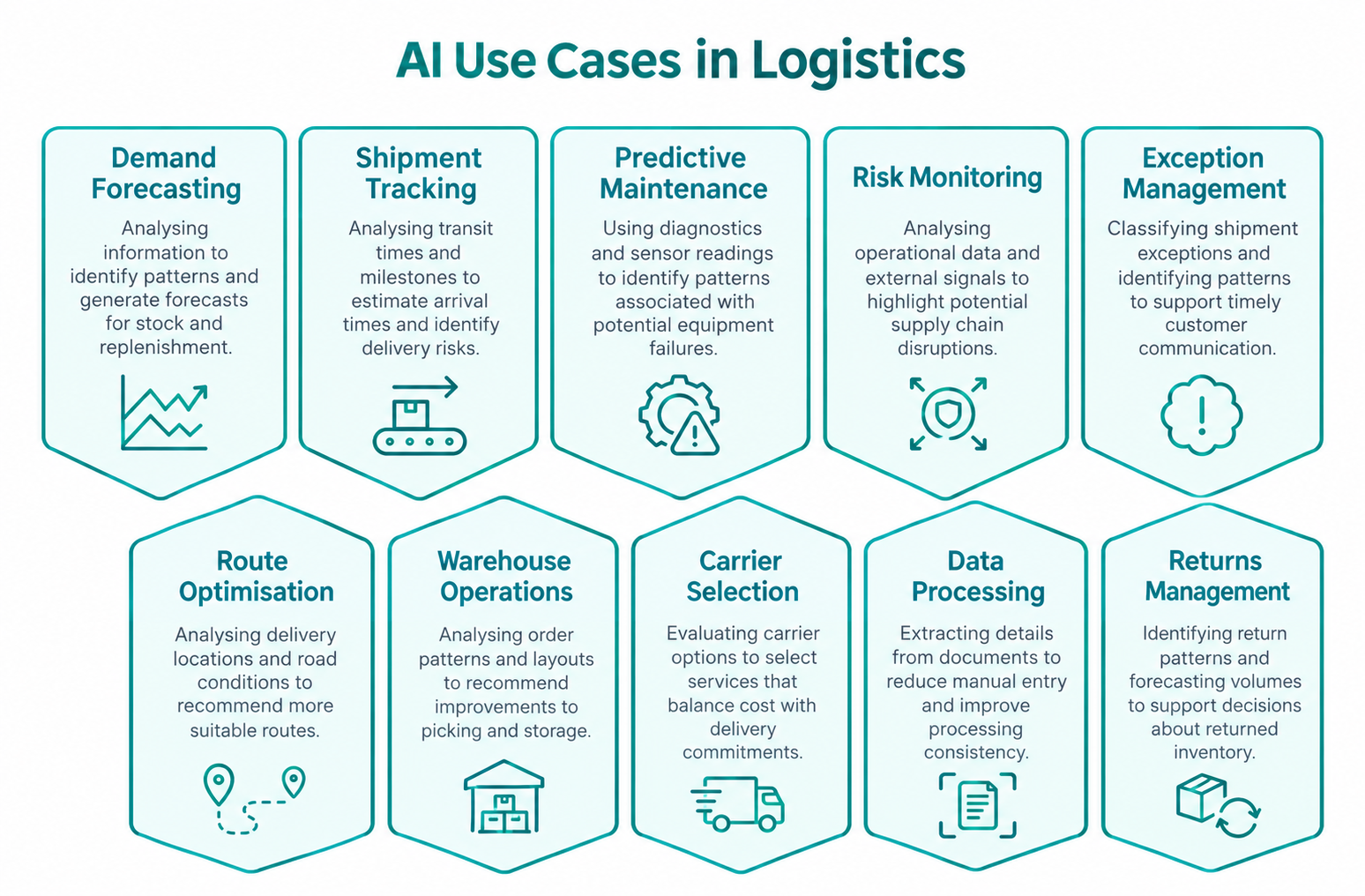
10 Use Cases of AI in Logistics for Smarter Operations
AI can support several logistics activities, from planning and transportation to fulfilment and customer communication. The most suitable use cases depend on shipment volume, operational complexity, data quality, and the business problems that need to be solved. The following applications demonstrate how businesses can use AI to improve logistics performance without treating every process as a candidate for complete automation.
- Demand Forecasting and Inventory Planning
Accurate demand forecasting helps businesses determine how much stock they need, where it should be positioned, and when replenishment should take place. Traditional forecasting often relies heavily on historical sales averages, which may not adequately account for promotions, seasonal changes, regional demand, or sudden shifts in customer behaviour. AI can analyse a wider range of information to identify patterns and generate forecasts that can be updated as new data becomes available.
For example, an ecommerce business preparing for a major sale can use AI to estimate demand across product categories and delivery regions. The forecast can help warehouse teams prepare inventory, allocate stock to suitable fulfilment locations, and anticipate shipping capacity requirements before order volumes increase. This can reduce the likelihood of stockouts, emergency replenishment, excess inventory, and avoidable fulfilment delays.
AI in supply chain planning becomes particularly useful when businesses operate across multiple warehouses, suppliers, and sales channels. Forecasts can support better coordination between purchasing, warehousing, and transportation teams, helping them plan resources based on expected demand rather than relying entirely on past trends. Businesses should regularly compare forecast accuracy with actual outcomes and account for unusual events that may not be adequately represented in historical data.
Key benefits: Better inventory planning, fewer stockouts, improved warehouse readiness, and more informed transportation planning.
- Intelligent Route Optimisation
Route planning directly affects fuel consumption, driver utilisation, delivery speed, and transportation costs. Conventional route planning may struggle to adapt when traffic conditions change, delivery priorities shift, or unexpected disruptions affect planned journeys. AI-driven route optimisation can analyse delivery locations, road conditions, vehicle capacity, delivery time windows, and other relevant factors to recommend more suitable routes.
Consider a delivery fleet handling hundreds of orders across a city. An AI-powered system can help determine which deliveries should be grouped together, how stops should be sequenced, and which routes are likely to meet delivery commitments efficiently. When supported by timely traffic and operational information, the system may also recommend route changes when conditions make the original plan less suitable.
The effectiveness of route optimisation depends on the accuracy of delivery addresses, vehicle information, traffic data, and operational constraints. Businesses must also consider driver schedules, vehicle restrictions, customer delivery windows, and safety requirements rather than optimising solely for distance. When these factors are considered together, AI can help logistics teams make more informed routing decisions and improve fleet productivity.
Key benefits: Better route planning, improved vehicle utilisation, reduced unnecessary travel, and more reliable delivery schedules.
- Predictive Shipment Tracking and Delivery Estimates
Shipment tracking helps businesses understand where orders are and whether they are progressing as expected, but tracking information alone may not explain which deliveries are likely to be delayed. AI can analyse historical transit times, carrier performance, route information, shipment milestones, and available external signals to estimate arrival times and identify potential delivery risks. This allows teams to investigate possible delays before they become customer complaints.
For example, if a shipment has remained at a transit facility longer than expected, an AI model may identify a higher likelihood of missing the original delivery estimate based on similar historical shipments. The system can flag the shipment for review, help teams prioritise follow-up, and support revised delivery estimates when sufficient information is available. Where integrations allow, these insights can be connected to customer notifications and internal exception-management workflows.
AI-powered logistics becomes more valuable when tracking, delivery estimates, and exception handling operate as connected processes. Instead of checking individual carrier portals manually, teams can use a centralised view to identify shipments that need attention and understand which orders may be affected. Predictions should still be treated as estimates rather than guarantees, particularly when carrier updates or real-time operational data are incomplete.
Key benefits: Earlier identification of delivery risks, more useful shipment visibility, better customer communication, and reduced manual tracking effort.
- Warehouse Operations and Intelligent Picking
Warehouse productivity depends on how efficiently goods are received, stored, picked, packed, and dispatched. Poor product placement, unnecessary walking, inaccurate inventory records, and uneven workload distribution can increase processing time and lead to fulfilment errors. AI can analyse order patterns, product movement, warehouse layouts, and staffing requirements to recommend improvements to warehouse operations.
For instance, frequently ordered products may be positioned closer to packing stations, while products commonly purchased together can be placed in locations that simplify picking. AI-supported systems may also help determine the sequence in which orders should be picked, estimate workload requirements, and identify inventory discrepancies that need investigation. In facilities equipped with suitable robotics and computer vision, AI can support automated movement, product identification, and inspection tasks.
These applications can improve coordination between warehouse activities and outbound shipping schedules. If a warehouse expects a surge in orders, forecasts can help managers prepare staff and picking capacity before dispatch volumes peak. Businesses should assess warehouse layout, technology compatibility, safety, and implementation costs before investing in advanced systems, as not every facility requires robotics or fully automated picking.
Key benefits: Faster order processing, improved picking accuracy, better space utilisation, and more consistent dispatch performance.
- Predictive Maintenance for Vehicles and Equipment
Unexpected vehicle breakdowns and equipment failures can disrupt deliveries, increase repair costs, and reduce operational capacity. Predictive maintenance uses information such as vehicle diagnostics, maintenance history, mileage, operating conditions, and sensor readings to identify patterns associated with potential failures. AI models can help estimate when maintenance may be needed so businesses can schedule inspections before a problem causes significant disruption.
For example, a fleet operator may analyse engine data, temperature readings, vibration patterns, and service records to identify vehicles that require inspection. Warehouse operators can apply similar approaches to conveyors, forklifts, sorting equipment, and other machinery to identify signs of deterioration. Maintenance teams can then prioritise checks based on risk, equipment importance, and operational schedules.
Predictive maintenance is not a guarantee that equipment will never fail. Its usefulness depends on the quality and frequency of available data, the reliability of the model, and whether maintenance teams act on the resulting alerts. When implemented alongside established inspection and safety procedures, it can help reduce avoidable downtime and support more reliable logistics operations.
Key benefits: Fewer unexpected breakdowns, better maintenance planning, improved asset availability, and reduced disruption to daily operations.
- Carrier Selection and Transportation Cost Optimisation
Choosing the right carrier involves more than comparing shipping rates. Businesses may need to consider delivery coverage, service levels, transit times, shipment dimensions, historical performance, pickup availability, and destination-specific requirements. AI can analyse these factors to help businesses evaluate carrier options and select services that balance cost with delivery commitments.
For example, a business shipping orders to several regions may find that different carriers perform better for different destinations or shipment types. An AI-supported decision engine can use historical data and current operational conditions to recommend a suitable carrier or service based on predefined business rules. The recommendation may also consider customer delivery promises, the cost of a potential delay, and the reliability of each available service.
AI logistics solutions can support more consistent carrier decisions when they are connected to accurate shipment data and up-to-date carrier information. However, businesses should retain clear rules for restricted destinations, service availability, contractual obligations, and customer-specific requirements. They should also monitor actual carrier performance and update selection criteria when service quality or costs change.
Key benefits: More informed carrier allocation, better visibility into shipping costs, improved service-level decisions, and more consistent shipping workflows.
- Supply Chain Risk Monitoring and Disruption Prediction
Logistics networks can be affected by severe weather, port congestion, supplier delays, geopolitical developments, transport disruptions, and sudden changes in demand. Traditional risk management may depend on manual checks and periodic reports, making it difficult to identify developing issues early. AI can analyse operational data alongside relevant external signals to highlight potential disruptions and help businesses assess their likely impact.
For instance, if a supplier delay threatens the availability of a product required for several customer orders, an AI-supported system can help identify the affected inventory and shipments. Teams can then evaluate alternatives, prioritise important orders, coordinate with suppliers, and adjust fulfilment plans where necessary. Similar approaches can help businesses identify routes, facilities, or suppliers that require closer monitoring during periods of uncertainty.
AI in supply chain risk management is most useful when risk alerts connect to clear response procedures. Businesses should define who reviews an alert, how its severity is assessed, which alternatives are available, and when customers or partners need to be informed. AI can help prioritise risks, but human expertise remains essential when decisions involve uncertain information, commercial trade-offs, or significant financial consequences.
Key benefits: Earlier risk identification, improved contingency planning, better coordination, and greater supply chain resilience.
- Automated Logistics Documentation and Data Processing
Logistics teams handle invoices, shipping labels, delivery records, customs documents, purchase orders, and other information that must be entered or verified across systems. Manual processing can create delays and errors, particularly when documents arrive in different formats or contain inconsistent information. AI technologies such as optical character recognition and natural language processing can help extract relevant details, classify documents, and flag missing or conflicting data for review.
For example, a system may extract shipment references, addresses, product descriptions, and invoice values from a document before transferring the information into an appropriate business application. It can also identify fields that do not match expected formats or flag incomplete records that require human verification. This can reduce repetitive data entry and help teams process documents more consistently.
Documentation automation is especially useful when it complements existing logistics systems rather than creating another disconnected workflow. Businesses should validate extracted information, apply appropriate access controls, and maintain audit trails for important records. Customs declarations, tax information, and regulated documents may require additional verification because errors can lead to compliance issues or shipment delays.
Key benefits: Reduced manual entry, faster document processing, fewer avoidable data errors, and improved operational consistency.
- Delivery Exception Management and Customer Communication
Delivery exceptions can occur when shipments are delayed, addresses are incomplete, customers are unavailable, or delivery attempts fail. If these situations are identified late, businesses may face repeated delivery attempts, additional costs, customer complaints, and avoidable returns. AI can help classify shipment exceptions, identify recurring patterns, prioritise cases, and support more timely communication with customers and operations teams.
For example, a system may detect a pattern of failed delivery attempts in a particular area or identify that a shipment has not progressed within its expected transit window. It can flag the case, recommend a follow-up action, or initiate an approved communication workflow when the required integrations are available. Customer support teams can then focus on cases that require judgement or direct interaction instead of manually checking every shipment.
AI can also help businesses understand why exceptions occur by analysing delivery outcomes, carrier performance, address quality, and customer feedback. These insights may reveal opportunities to improve address validation, delivery instructions, carrier allocation, or notification timing. Automated messages should remain accurate, useful, and aligned with customer communication preferences, with human review available for sensitive or complex cases.
Key benefits: Faster exception identification, better customer communication, reduced manual follow-up, and improved delivery management.
- Returns Management and Reverse Logistics
Returns are an important part of ecommerce logistics because they affect transportation expenses, inventory availability, customer satisfaction, and the cost of processing each order. Managing returns involves receiving requests, validating eligibility, arranging collection, inspecting returned items, processing refunds, and determining whether products can be restocked. AI can help identify return patterns, forecast return volumes, classify reasons, and support decisions about returned inventory.
For example, a retailer may discover that a particular product category has a higher-than-usual return rate or that certain delivery issues are contributing to damaged goods. AI-supported analysis can help identify these patterns and guide investigations into product descriptions, packaging, fulfilment practices, or quality issues. Computer vision may also support product inspection and condition classification in suitable facilities, although important decisions may still require human assessment.
Businesses can use these insights to improve both forward and reverse logistics. Better return forecasts can help warehouses plan staffing and processing capacity, while consistent return workflows can reduce delays in restocking eligible products. AI should support transparent return policies and accurate decisions rather than making it unnecessarily difficult for customers to exercise legitimate return rights.
Key benefits: Better returns forecasting, faster processing, improved inventory recovery, and clearer insight into recurring return problems.
The Benefits of AI in logistics go beyond cutting manual work.
Applied to well-defined operational problems, AI can help businesses plan, make informed decisions, respond to disruptions and provide better service. Results depend on how well it’s implemented, whether reliable data is available and whether employees can act on what it finds.
Operational efficiency is one place to start.
AI can help teams prioritise work, spot repetitive tasks and allocate resources more effectively. Connected to existing logistics systems, it can cut the time spent on manual analysis, leaving people to handle decisions that need human judgement. Businesses can track progress through processing time, order accuracy and workload per shipment.
Costs need a closer look, too.
Transportation, warehousing, inventory and returns all add to logistics expenses. AI can identify inefficient routes, assess carrier performance, forecast resource needs and spot patterns behind unnecessary costs. Businesses should weigh any savings against delivery reliability and customer experience. Spending less isn’t a gain if service suffers.
Planning becomes more informed.
Forecasting models can help businesses anticipate demand, prepare inventory, plan warehouse capacity and estimate transportation needs. That gives teams more time to prepare for seasonal peaks instead of making last-minute decisions. Forecasts still need regular review: unexpected events and shifts in customer behaviour can make them less accurate.
Shipment visibility can improve.
Across a large number of orders, AI can flag unusual shipment patterns, estimate delivery risks and help teams decide which exceptions to handle first. Connected to tracking and carrier systems, that information is more useful to operations and customer support teams. Predictions must remain clearly separate from confirmed tracking events.
Customer experience depends on what happens next.
Customers want accurate delivery information, clear communication and prompt help when something goes wrong. AI-supported delivery estimates and exception alerts can make updates more relevant and reduce uncertainty during shipping. Automated messages work best when they’re accurate and timely, with employees available to resolve complex cases.
Risk management also benefits from earlier warnings.
AI can flag potential disruptions and unusual patterns in transportation, supplier activity, inventory and delivery operations. Earlier alerts give teams more time to assess alternatives and coordinate a response. Organisations still need contingency plans, established escalation procedures and human oversight alongside AI-based monitoring.
Growth puts manual processes under pressure.
As shipment volumes rise, those processes become harder to manage consistently. AI and logistics automation can help businesses standardise selected workflows, process information faster and prioritise tasks according to operational needs. Businesses should scale gradually and check performance before automated decisions affect critical processes.
What Is AI in Logistics?
AI in logistics refers to the use of artificial intelligence technologies, including machine learning, predictive analytics, natural language processing, and computer vision, to improve logistics planning and execution. These technologies analyse information from orders, warehouses, vehicles, carriers, inventory systems, and external data sources to identify patterns, estimate future outcomes, and support operational decisions. Depending on the application, AI can provide recommendations, generate alerts, or trigger predefined actions through connected systems.
For example, a logistics team can use AI to predict shipment delays based on historical delivery performance, current tracking events, weather conditions, and route information. A warehouse may use machine learning to forecast demand and determine where frequently ordered products should be stored, while a transportation team may use optimisation models to plan delivery routes more efficiently. These applications help businesses move from reacting to problems after they occur towards anticipating issues and preparing appropriate responses.
AI in logistics does not necessarily mean replacing existing systems or making every operational decision autonomous. In many cases, it works alongside transportation management systems, warehouse management systems, order management platforms, and carrier integrations to improve the quality of information available to employees. The objective is to help teams make faster, more consistent decisions while retaining human oversight for complex exceptions and high-impact situations.
How AI in Supply Chain Operations Is Changing Logistics
AI in supply chain operations is helping businesses move beyond traditional, manual processes towards more connected, data-driven decision-making. Its applications extend beyond transportation and delivery to include demand forecasting, procurement, inventory management, supplier performance monitoring, warehouse operations, and disruption management. Since these activities are interconnected, a decision made in one area can directly influence the performance of the entire supply chain.
For example, an inaccurate demand forecast can lead to excess inventory in one warehouse and stock shortages in another. This can increase storage costs, create warehouse congestion, affect transportation planning, and delay customer orders. Similarly, a supplier delay can disrupt production schedules, affect inventory availability, and push back delivery commitments. AI can help businesses identify these relationships by analysing historical data, current operational information, and emerging patterns across connected systems.
By combining information from multiple sources, AI-powered systems can help supply chain teams identify potential issues earlier and make better-informed decisions. Demand forecasting models can detect changes in purchasing behaviour, predictive analytics can highlight potential supplier disruptions, and shipment visibility systems can identify orders that may miss their expected delivery dates. These insights help teams move from reacting to problems after they occur to preparing for them before they significantly affect operations.
Key Areas Where AI Is Changing Supply Chain Operations
| Supply chain function | How AI helps | Potential business impact |
| Demand forecasting | Analyses historical sales, seasonal trends, and changing demand patterns | Better inventory planning and fewer stock shortages |
| Procurement | Evaluates purchasing patterns, supplier data, and demand requirements | More informed purchasing decisions and improved resource allocation |
| Inventory management | Identifies stock imbalances and estimates future inventory requirements | Lower excess inventory and improved product availability |
| Supplier management | Analyses supplier performance, lead times, and potential delivery risks | Earlier identification of supplier-related disruptions |
| Warehouse operations | Supports inventory placement, picking priorities, and workload planning | Improved warehouse productivity and order processing |
| Transportation planning | Evaluates shipment requirements, routes, delivery schedules, and carrier performance | More efficient transportation planning and cost control |
| Shipment visibility | Uses shipment updates and historical patterns to identify possible delays | Earlier intervention and more accurate delivery estimates |
| Disruption management | Analyses operational data to identify risks and potential alternatives | Faster responses to unexpected changes across the supply chain |
Connecting Supply Chain Insights with Logistics Execution
The real value of AI in supply chain management depends on how effectively its insights translate into action. Identifying a potential problem is only the first step. Businesses also need processes that help teams respond to the information and minimise its operational impact.
Consider a shipment that is predicted to arrive later than expected. A basic tracking system may show that the shipment is delayed, but an AI-enabled workflow can help teams assess which customer orders may be affected, identify alternative delivery options, update estimated delivery dates, and trigger customer notifications where appropriate. This allows the operations team to address the issue before it creates additional customer service requests or affects downstream fulfilment activities.
The same principle applies to inventory and procurement. If AI identifies a likely increase in demand for a particular product, the business can review stock availability, adjust replenishment plans, coordinate with suppliers, and prepare warehouse capacity. When these decisions are connected, businesses can reduce the gap between identifying a trend and responding to it.
AI and Logistics Automation: Working Together
AI becomes more useful when it works alongside logistics automation. While AI helps analyse data, recognise patterns, generate predictions, and recommend actions, logistics automation helps execute repeatable operational tasks with less manual intervention. For instance, AI can help identify a suitable carrier based on delivery requirements, shipment characteristics, historical performance, and available service options. An integrated logistics automation workflow can then apply the relevant business rules, process shipment information, generate shipping documentation, and send tracking updates. The precise level of automation depends on the systems, integrations, and rules configured by the business.
This combination can help reduce repetitive work, improve consistency, and give logistics teams more time to focus on exceptions that require human judgement. It can also improve coordination between order management, warehouse teams, transportation partners, and customer service. However, successful implementation depends on reliable data, integration between systems, clearly defined workflows, and appropriate human oversight. AI predictions may be less reliable when data is incomplete or outdated, and high-impact decisions may still require approval from experienced teams. Businesses should therefore evaluate AI based on measurable operational outcomes, such as forecast accuracy, order fulfilment performance, delivery reliability, and logistics costs, rather than adoption alone.
Ultimately, AI is changing supply chain operations by helping businesses connect planning, execution, and monitoring. When combined with connected systems and logistics automation, it can support faster decisions, earlier identification of disruptions, and more coordinated logistics operations.
How to Implement AI in Logistics Successfully
AI in logistics works best when businesses start with a specific operational problem instead of trying to automate everything at once. A clear plan shows teams where AI can make a measurable difference, what data they’ll need, and how a new tool will fit into existing workflows. It also helps them avoid buying tools that produce insights no one can use in day-to-day work.
Step 1: Identify the Business Problem
Find the logistics issues that cause the most cost, delay, or extra work. That might mean inaccurate delivery estimates, repeated manual tracking checks, inefficient carrier selection, poor demand forecasting, or too many failed deliveries. Set a measurable goal for each issue, such as cutting manual processing time or increasing the percentage of shipments delivered within the promised window.
Step 2: Assess Data Quality and Availability
AI needs useful data from order records, shipment events, inventory information, carrier performance, and past operational outcomes. Inconsistent addresses, missing tracking updates, duplicate records, and disconnected systems can make its predictions less reliable. Identify and fix those gaps before using AI to make important operational decisions.
Step 3: Choose the Right Use Case and Technology
Not every logistics problem calls for advanced AI or a large technology investment. Some businesses should start with shipment visibility, automated notifications, or connected carrier workflows. Others may need forecasting or route optimisation. Choose tools that solve the problem you’ve identified, work with existing systems, and provide the reporting, security, and support you need.
Step 4: Run a Controlled Pilot
Test the application on a defined group of shipments, routes, warehouses, or carriers before rolling it out more widely. Measure it against a baseline to see whether it improves accuracy, processing time, cost, or service levels. Ask the employees who use it for feedback, too. Technical testing alone may miss problems that show up in everyday work.
Step 5: Integrate AI with Existing Operations
AI is more useful when its outputs reach the systems and people who can act on them. If it predicts a delivery delay, the right operations team should be able to see the warning and follow a clear process for reviewing the shipment. Test integrations carefully so data moves accurately and automated actions follow approved business rules.
Step 6: Monitor Performance and Improve Continuously
AI models can become less accurate as demand patterns, routes, carrier performance, or operating conditions change. Monitor their performance, compare predictions with actual results, and review unusual outcomes regularly. That way, AI continues to support business goals rather than making automated decisions no one is checking.
Challenges of Using AI in Logistics
Although AI offers meaningful opportunities, businesses should understand the challenges before investing in new capabilities. Poor-quality data, integration limitations, implementation costs, employee adoption, and insufficient oversight can prevent AI projects from delivering their expected value. Identifying these risks early helps businesses choose realistic use cases and establish appropriate controls.
Data Quality and System Integration
Logistics information often comes from multiple systems, carriers, warehouses, and external partners, each with different data formats and update frequencies. Incomplete or inconsistent information can lead to unreliable predictions and operational confusion. Businesses should prioritise data standards, integration testing, access controls, and clear ownership of important records.
Implementation Costs and Return on Investment
Some AI applications require specialised software, integration work, computing resources, sensors, or changes to existing processes. These costs may be difficult to justify when the business problem is not clearly defined or the expected benefits cannot be measured. Starting with a limited pilot and comparing results against a baseline can help businesses make more informed investment decisions.
Employee Adoption and Training
Employees may be hesitant to rely on systems that change established workflows or provide recommendations they do not fully understand. Training should explain what the technology does, when its recommendations can be used, and when human review is required. Involving operations teams during the selection and testing stages can help identify practical concerns and improve adoption.
Privacy, Security, and Governance
Logistics systems may process customer details, delivery addresses, commercial information, and other sensitive operational data. Businesses need appropriate access controls, data protection practices, vendor assessments, and policies governing how AI systems use information. Important decisions should have clear accountability, especially when errors could affect customer service, safety, compliance, or commercial commitments.
Overreliance on Automated Decisions
AI predictions are not always correct, especially when data is missing or circumstances differ significantly from historical patterns. Businesses should establish thresholds for human review, monitor unusual outcomes, and retain manual procedures for critical exceptions. A balanced approach combines automated analysis with employee expertise and clear operational responsibility.
How eShipz Supports Smarter Logistics Operations
As businesses adopt AI and digital tools, they still need connected shipping workflows to manage orders, coordinate carriers, and monitor deliveries. eShipz supports multi-carrier integration, shipment tracking, and delivery visibility. It brings shipping information together across supported workflows. That can make shipment data easier for teams to access and act on as part of broader AI initiatives.
For ecommerce brands, manufacturers, and businesses shipping through multiple carriers, centralised visibility can mean fewer manual checks across carrier portals. Connected workflows can also make shipment processing more consistent. They help teams spot deliveries that need attention. But the right setup depends on a business’s systems, carrier network, shipment volume, and operational requirements, so it’s worth checking which capabilities fit existing workflows. AI and logistics automation are most useful when teams can turn insights into clear actions. Shipment data can help teams monitor deliveries, while defined exception workflows guide follow-up when a shipment doesn’t progress as expected. Explore eShipz to learn more about its shipping automation and shipment visibility capabilities for connected logistics operations.
The Future of AI in Logistics
The future of AI in logistics is likely to involve closer integration between predictive analytics, connected operational systems, warehouse technologies, and tools that can support more complex decisions. Businesses are exploring ways to use AI not only to identify problems but also to recommend responses and coordinate approved actions across logistics workflows. The extent of automation will vary by application, data availability, safety requirements, and the level of human oversight needed.
AI in supply chain operations is also becoming more closely connected to resilience and sustainability goals. Better forecasting can help reduce excess inventory, route optimisation can support more efficient transportation, and shipment visibility can help businesses respond to disruptions with less delay. However, these outcomes depend on how systems are configured and operated; AI does not automatically guarantee lower emissions, lower costs, or better delivery performance.
Another important development is the use of AI assistants and agent-based tools to help employees work with operational information. These systems may summarise shipment issues, retrieve relevant records, draft communications, or recommend next steps, depending on their capabilities and permissions. Businesses should introduce such tools with clear access controls, validation procedures, and safeguards for actions that affect customers or critical logistics operations.
For companies planning their next stage of growth, the priority should be to invest in practical applications that solve measurable problems. Strong data foundations, reliable integrations, employee training, and continuous performance monitoring will remain essential even as AI capabilities advance. Businesses that combine these fundamentals with suitable AI and logistics automation tools can build more responsive operations while keeping efficiency, service quality, and accountability at the centre of their strategy.
The Way Forward: AI and Logistics Automation
AI in logistics is changing how businesses plan shipments, manage warehouses, choose carriers, track deliveries, and handle disruptions. These 10 use cases, from demand forecasting and route optimisation to predictive tracking and returns management, show where AI can help teams make better logistics decisions. The benefits are greatest when businesses pair reliable data and the right technology with clear workflows and human oversight. Automation works best when it has a defined purpose.
As AI in supply chain operations evolves, businesses should focus on improvements they can measure and maintain. Logistics automation and connected shipping systems can cut repetitive work, give teams a clearer view of shipments, and help them handle delivery exceptions more consistently. eShipz helps businesses simplify and automate shipping through a connected platform for multi-carrier integration, shipment tracking, carrier allocation, delivery updates, and exception management. Bringing these activities together can give businesses a clearer view of operations and make logistics workflows easier to manage. For companies putting AI-driven insights to work, pairing intelligent decisions with shipping automation is a practical way to build more efficient, responsive, and customer-focused logistics operations.
Frequently Asked Questions About AI in Logistics
- What is AI in logistics?
AI in logistics is the use of technologies such as machine learning, predictive analytics, natural language processing, and computer vision to support transportation, warehousing, inventory planning, shipment tracking, and other logistics activities. These technologies analyse operational data to identify patterns, estimate outcomes, and recommend or automate selected actions. Their value depends on data quality, system integration, and the ability of teams to act on the results.
- How does AI help logistics companies?
AI helps logistics companies forecast demand, optimise routes, identify potential shipment delays, support carrier selection, improve warehouse planning, and detect operational risks. It can also help reduce repetitive manual tasks when connected to existing systems and approved workflows. Companies should evaluate its impact using measurable indicators such as processing time, cost per shipment, delivery performance, and forecast accuracy.
- What are the main benefits of AI in logistics?
The main benefits include better planning, improved shipment visibility, more informed cost management, faster identification of exceptions, and more efficient use of resources. AI can also help businesses respond to disruptions and provide customers with more useful delivery information. Results vary by use case and implementation, so businesses should test performance before scaling.
- What are the most common AI use cases in logistics?
Common applications include demand forecasting, route optimisation, predictive shipment tracking, warehouse operations, predictive maintenance, carrier selection, supply chain risk monitoring, document processing, delivery exception management, and returns management. Businesses can select applications based on their most pressing operational challenges. Starting with a well-defined problem can make implementation easier to measure and manage.
- How is AI used in supply chain management?
AI in supply chain management supports demand planning, inventory optimisation, supplier risk monitoring, procurement analysis, transportation planning, and disruption management. By analysing data from different parts of the supply chain, it can help businesses identify relationships and make better-informed decisions. Its impact improves when insights are connected to practical response processes and shared across relevant teams.
- Can AI reduce logistics costs?
AI can help identify opportunities to improve routes, carrier allocation, inventory planning, warehouse productivity, and maintenance scheduling. These improvements may reduce unnecessary expenses, but actual savings depend on the operating environment, technology costs, and implementation quality. Businesses should compare total costs and service performance before and after adoption rather than assuming savings are guaranteed.
- What is the difference between AI and logistics automation?
AI analyses information to identify patterns, make predictions, or recommend decisions, while logistics automation uses technology to execute repetitive tasks or predefined workflows. The two can work together, such as when AI recommends a suitable carrier and an integrated shipping system carries out an approved shipping process. Automation does not always require AI, and AI insights do not necessarily trigger automated actions.
- Are AI logistics solutions suitable for small and medium-sized businesses?
Yes, small and medium-sized businesses can explore AI-enabled forecasting, shipment visibility, document processing, and workflow automation according to their needs and budgets. They do not necessarily need to build custom AI systems from scratch, as some capabilities may be available through existing software platforms. Businesses should begin with a clearly defined problem and evaluate integration requirements, costs, and expected benefits.
- What challenges do businesses face when adopting AI in logistics?
Common challenges include incomplete data, disconnected systems, implementation expenses, employee training, privacy concerns, and the risk of relying too heavily on inaccurate predictions. Businesses can address these issues through careful use-case selection, data preparation, controlled pilots, human oversight, and ongoing monitoring. Clear performance goals help organisations determine whether an AI initiative is delivering practical value.
- How can businesses get started with AI in logistics?
Businesses should first identify a measurable problem, such as frequent delivery delays, manual tracking work, poor demand forecasts, or inefficient carrier selection. They can then assess available data, select an appropriate solution, run a controlled pilot, and compare results against a baseline. After validating the outcome, the business can expand the solution gradually and continue monitoring performance.