




A customer places an order on Monday evening. The confirmation email lands within a minute. Then nothing happens for two days. No shipping update, no tracking link, no hint of when the parcel will arrive. On Wednesday morning she opens your chat and types four words: “Where is my order?” Your agent looks up the order, checks the courier site, copies the status and replies. Repeat that a few hundred times a day and you can see why so many teams want to reduce WISMO queries.
WISMO is short for “where is my order,” and it looks like a support problem. It is a visibility problem that shows up in the support inbox. The customer could not see what was happening, so she asked a person. The same shopper is also deciding whether to buy from you again. DHL’s E-Commerce Trends Report 2025 surveyed 24,000 shoppers in 24 markets and found that 81% of shoppers abandon a purchase when their preferred delivery option is missing. Delivery shapes the sale, and the days between checkout and doorstep are part of that.
This guide covers why WISMO matters, where the market is heading in 2027, how to fix it and where to start. If you want to reduce WISMO queries without adding headcount, a practical 30-day starting plan is waiting at the end.
What Is WISMO and Why Does It Keep Happening?
WISMO stands for “where is my order.” It is any customer message that asks for the status or location of an order already placed, whether it arrives by chat, email, phone, social media or WhatsApp.
Most WISMO contacts trace back to a short list of gaps:
- No tracking link in the shipping confirmation
- No proactive updates after dispatch
- Delays that nobody tells the customer about
- Failed delivery attempts (NDR) with no follow-up
- Inaccurate delivery estimates
- Split shipments that look like missing items
- Courier status that stops updating for days
Read the list again. Every item is a piece of information the customer needed and did not get. WISMO queries are symptoms, and the cause sits upstream in your shipment tracking and your communication. Salesforce, Fulfil with Synergy and ServeRetail all describe them the same way.
Two causes matter more for Indian brands than most global guides admit. A cash on delivery order that fails its first attempt creates an NDR, and a customer who hears nothing afterward either writes in or refuses the parcel. Regional couriers also update scans at different speeds, so one parcel can show the same status for three days while it moves. That gap is where to look first when you want to reduce WISMO queries: find the missing piece of information and supply it before the customer asks.
Why You Need to Reduce WISMO Queries in 2027
The case for acting is financial before it is anything else.
Cost. Every query uses agent time. An agent finds the order, checks the courier, copies the status and writes the reply. The answer is known in advance, yet this is the lowest-value work in the queue, and it takes time away from returns, exchanges and sales questions.
Volume. Vendors commonly report that WISMO makes up 30% to 50% of ecommerce support tickets. Treat that as a vendor-reported estimate. Gorgias, which sees tickets from thousands of Shopify brands, puts the average closer to 18%. Your own number will land somewhere in that range, which is why the first step of the plan below is to measure it.
Revenue and trust. Uncertainty pushes customers toward cancelling, refusing delivery (RTO, or return to origin), filing chargebacks and not buying again. A prepaid customer who cannot see her parcel opens a dispute. A COD customer who cannot see it often just says no at the door.
Peak season. Festive sales and big-sale days compress weeks of orders into a few days. Vendor reports say the WISMO share can pass half of all tickets in those weeks, and the extra tickets arrive when your team has the least room.
A simple cost calculator. Replace the example numbers with your own:
| Input | Example |
| Monthly orders | 10,000 |
| WISMO rate (contacts per order) | 20% |
| Cost per contact (illustrative) | Rs 60 |
| Monthly WISMO cost | 10,000 × 20% × Rs 60 = Rs 1,20,000 |
At these figures, 2,000 contacts cost about Rs 1.2 lakh a month. Halve the rate to 10% and you save Rs 60,000 every month. Most finance teams understand that table faster than any ticket report, which makes it the quickest way to get approval when you plan to reduce WISMO queries.
Market Trends Shaping WISMO in 2027
No 2027 survey data exists yet. These are the 2026 signals that point toward 2027.
Customers expect updates. Vendor surveys put the share of shoppers who expect regular shipment updates between 83% and 93%. Silence now reads as a problem, even when the parcel is on schedule.
Proactive beats reactive. Industry write-ups say one unannounced delay can trigger two to three follow-up contacts, as the customer checks, asks and asks again. One early alert replaces all of them.
WhatsApp first. In India and across much of APAC, WhatsApp is the most used messaging app, so order updates sent there get seen. Email still suits receipts a customer wants to keep, and SMS covers weak data connections.
AI and predictive ETAs. Tracking is moving from showing the last scan to forecasting the next problem. eShipz’s guide to predictive delivery analytics cites about 26% RTO on COD or non-prepaid orders against under 2% for prepaid. A model that flags risky orders and weak pincodes before dispatch helps reduce WISMO queries before they exist.
A branded post purchase experience. The tracking page now works as a support channel and a place for offers. A customer who stays on your page does not wander to a courier site full of codes. If you are not sure where your own journey leaks, eShipz’s list of ten ways to find gaps in your post purchase experience is a good checklist.
Multi-courier complexity. Brands now split volume across several carriers. Each one uses its own status words and scan timing, so the same event reads differently depending on who carries the parcel. Unified real time shipment tracking maps all of them into one set of plain statuses.
Benefits and Outcomes When You Reduce WISMO Queries
The proof points below come from other brands, as reported by vendors and publishers. They are not eShipz results.
- Fewer tickets. UK retailer Sweetie Shoppie cut WISMO queries by 50% after adding a branded tracking page, as reported by Sendcloud. Branch Furniture reported a 37% drop after improving visibility and adding proactive alerts, according to ServeRetail.
- Lower support cost. Fewer tickets means a smaller team at peak, or the same team handling more orders without overtime.
- Better satisfaction and repeat purchase. A customer who was warned about a delay still has a good opinion of you when the parcel arrives. That opinion is what brings her back.
- Fewer RTOs. Delivery problems get solved while the customer is still willing to wait, so fewer parcels turn into returns.
- Agents on higher-value work. Returns, exchanges and sales questions get the attention that status lookups used to take.
How to Reduce WISMO Queries: 6 Practical Strategies
Each strategy closes one of the gaps listed earlier. Start with the ones that match your top ticket triggers.
- Build a branded tracking page. A page on your own domain shows the carrier name, the status in plain language (“Out for delivery, arriving today”), the expected delivery date and a link to support. Make it mobile first, since most customers open it from a message on their phone. It works because the customer has one place to look.
- Send proactive notifications at key milestones. Message the customer when the order is confirmed, shipped, out for delivery, delayed and delivered. Use WhatsApp for the time-sensitive ones, SMS where data is weak and email for confirmations. Each message answers the next question before it is asked.
- Set accurate delivery promises. Show the expected delivery date at checkout and repeat it on the tracking page. Base it on past transit times by pincode and carrier, not on the best case. A range such as “3 to 5 days” that you meet beats “2 days” that you miss, because a missed date is the moment most people write in.
- Handle NDR proactively. When a delivery attempt fails, contact the customer within minutes. Say why it failed and offer simple choices: reschedule, update the address or confirm the phone number. A customer who hears nothing after a failed attempt either writes in or refuses the next visit, so this step also protects you from RTO.
- Send delay and exception alerts. When a parcel sits at a hub, misses its date or hits a weather hold, tell the customer first. Give the new date, the reason in one line and a way to reach you. “Your order is delayed by one day. New date: Friday.” takes ten seconds to write and saves several contacts.
- Monitor carrier performance by lane. Pull on-time rate, first-attempt success and NDR rate by carrier and by pincode. A carrier that is fast in metros may be slow in tier-3 towns, and the network average hides that. Move weak lanes to a better carrier. This fixes the cause, which is the most lasting way to reduce WISMO queries.
Where Can You Start? A 30-Day Starting Plan
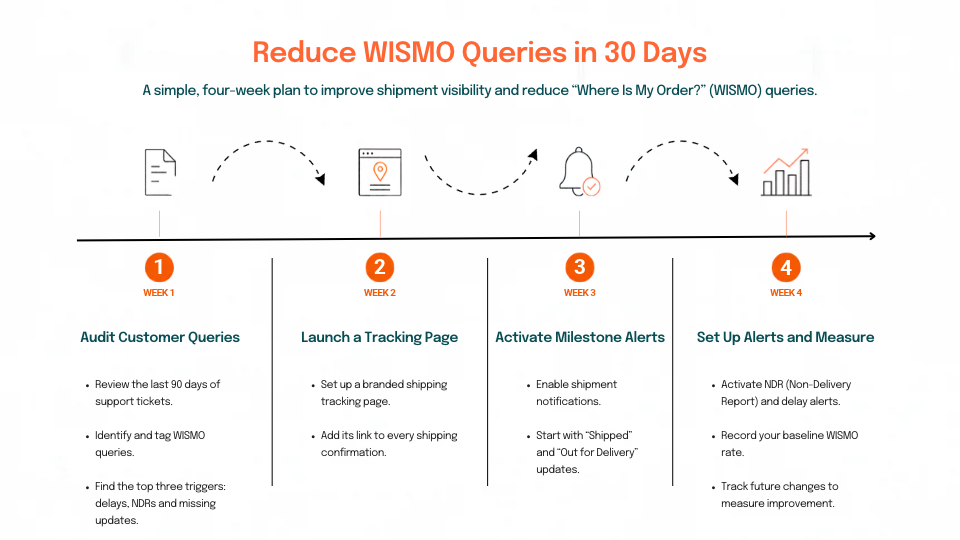
You do not need a big project. Four weeks is enough to set a baseline, launch a tracking page and switch on the first alerts.
- Week 1, audit. Pull the last 90 days of tickets, tag the WISMO ones and find the top three triggers (usually delay, NDR and no update).
- Week 2, tracking page. Launch a branded tracking page and add its link to every shipping confirmation.
- Week 3, milestone messages. Turn on notifications, starting with “shipped” and “out for delivery.”
- Week 4, NDR and delay alerts. Add both, then record a baseline WISMO rate to measure against.
If your goal is to reduce WISMO queries, watch four numbers every week:
- WISMO tickets as a percentage of orders
- First-response time
- NDR resolution rate
- Tracking page visits per order
Visits per order should rise as WISMO tickets per order fall, because customers are checking the page instead of asking you.
How eShipz Helps You Reduce WISMO Queries
eShipz is a shipping automation platform used by 350+ brands across industries. Each part of the platform maps to one of the causes above.
| WISMO cause | eShipz capability |
| No visibility across couriers | Real-time shipment tracking across integrated carriers |
| Customers not informed | Post shipment engagement: proactive notifications by email, SMS, WhatsApp and IVR, plus branded tracking pages |
| Wrong or missing delivery dates | Estimated delivery date software |
| Failed deliveries | NDR management and redelivery management |
| Disputes and “I never got it” | ePOD, electronic proof of delivery |
| Delays caused by courier choice | AI-powered courier allocation |
| Teams reacting too late | Control tower and dashboard |
| Order data scattered across systems | Shopify and sales channel, ERP and OMS/WMS integrations |
In practice the flow runs like this:
- The order ships with the courier that suits the pincode.
- The shipment is tracked in real time across carriers.
- The customer gets a notification at each milestone.
- An exception, such as a delay or a failed attempt, is caught on the dashboard.
- The NDR workflow reaches the customer and resolves the delivery.
- Delivery is confirmed, with ePOD where proof is needed.
Common Mistakes to Avoid
- Sending too many notifications. Five useful messages beat fifteen. Each one should tell the customer something new, or it trains her to ignore the channel.
- A tracking page full of courier jargon. “Shipment arrived at facility” means little to a shopper. “Your parcel reached the Bengaluru hub and leaves tomorrow” tells her what to expect.
- Quoting one delivery date for every pincode. A metro and a remote town do not share a transit time, and the date you promise is the date you are measured against.
- Ignoring NDR until the customer complains. By then the next attempt may already be gone. Contact her while the courier still has the parcel.
- Counting tickets without tracking the cause. A total of 600 WISMO tickets says little. The same 600 split into 250 delays, 200 NDRs and 150 missing updates shows what to fix first, and that order helps you reduce WISMO queries faster.

Conclusion
WISMO is preventable. Visibility, proactive communication and fast exception handling do most of the work. A customer who can see her status, hears about problems first and gets a quick fix when a delivery fails rarely needs to ask where the order is. Brands that reduce WISMO queries free their agents for work that earns money and give customers a better post purchase experience in the same step.
Start with the 30-day plan, measure your own rate and fix the biggest trigger first. See how eShipz can cut your WISMO queries. Book a demo.
FAQ
- What does WISMO stand for?
WISMO stands for “where is my order.” It describes any customer message asking about the status or location of an order that has been placed. A related term, WISMR, means “where is my return or refund.” Both come from missing information. - What is a good WISMO rate for an ecommerce brand?
There is no official benchmark. Vendors report that WISMO makes up 30% to 50% of support tickets, while Gorgias data across thousands of Shopify brands averages about 18%. A rate that falls month after month matters more than the starting number. Measure yours as WISMO contacts per 100 orders shipped and set a target against your own baseline. - How do I calculate my WISMO rate?
Divide WISMO contacts by orders shipped and multiply by 100. If you ship 10,000 orders and get 2,000 WISMO contacts, your rate is 20 per 100 orders. Some teams divide by total tickets instead. Pick one method and keep it fixed so the trend stays comparable. - Does WhatsApp tracking reduce WISMO queries?
It can. WhatsApp is the most used messaging app in India, so a shipped, out-for-delivery or delay message is likely to be seen. Include the tracking link and expected delivery date in each message. WhatsApp needs approved templates, so keep SMS or email as a backup for customers who have not opted in. - How does NDR management reduce WISMO?
A failed delivery leaves the customer waiting with no explanation, and many then write in or refuse the next attempt. NDR management contacts the customer as soon as an attempt fails, collects a new date or address and passes the answer to the courier. That removes the silence and gives the parcel a second chance, which also lowers RTO. - What is the fastest way to reduce WISMO queries?
Start with a branded tracking page and two notifications, shipped and out for delivery. They cover the most common question at the lowest effort. Then add delay and NDR alerts, which handle the cases that otherwise turn into repeat contacts. - How soon can I reduce WISMO queries after launch?
Notifications start working on the next order that ships, so you can compare against your baseline within the first few weeks. A tracking page builds its effect as more customers learn to use it. Track WISMO contacts per 100 orders weekly and judge the trend, not a single day.