









India’s online retail market is scaling to $65–$66 billion in gross merchandise value in 2025, growing at a 19–21% CAGR, according to Bain & Company’s How India Shops Online 2026 report. More orders mean more parcels leaving your warehouse every evening. Each parcel needs a record that you and the driver both trust, and that record is the courier manifest.
A courier manifest looks like a plain list of parcels, yet it decides who is responsible for a parcel at the moment of pickup. When the manifest is wrong, a missing parcel can quietly become your loss instead of the carrier’s. Many “we never picked it up” disputes start with a manifest that nobody checked.
This guide explains the courier manifest in plain terms. You will learn what it contains, how to create and verify one, what mismatches cost, and how to automate the routine. Every rupee figure in the worked examples is illustrative, so replace it with your own numbers before you act.
What Is a Courier Manifest?
A courier manifest is a document that lists every parcel handed to a courier in one pickup, along with the details the carrier needs to accept it. It usually carries the airway bill (AWB) number, order reference, destination pincode, weight, payment mode, and the amount to collect for cash-on-delivery orders. Your dispatch executive and the driver both sign or confirm it when the pickup ends.
In daily operations, the courier manifest works as your proof of handover. Once the manifest is signed and the parcel count matches, the carrier has accepted custody of those parcels. If a parcel later goes missing, the signed manifest shows whether it ever left your hands.
Sellers also call it a pickup sheet, handover sheet or dispatch manifest. The names differ by carrier, but the purpose stays the same: one agreed list, one agreed count and one moment of transfer. Teams that ship through several carriers keep a separate manifest for each carrier and each pickup.
This manifest is different from the freight manifests used in ocean and air cargo, which are customs documents. This guide covers the domestic parcel manifest that e-commerce sellers use every day.
What a Courier Manifest Contains
The fields below appear on most manifest formats. Some carriers add their own columns, so check your carrier’s format before you automate anything.
| Field | What it records | Why it matters |
|---|---|---|
| AWB number | Unique tracking number of each parcel | Lets the carrier scan and match every parcel |
| Order ID | Your internal order reference | Links the parcel back to your store or OMS |
| Consignee name and pincode | Who receives the parcel and where | Confirms serviceability and routing |
| Weight (kg) | Declared dead weight | Prevents later weight disputes |
| Payment mode | Prepaid or cash on delivery | Decides remittance and risk handling |
| COD amount (₹) | Amount the courier collects | Reconciles with COD remittance |
| Parcel count | Total parcels in the pickup | The number both sides sign against |
| Pickup time and signature | When and by whom the parcels were taken | Proof that custody moved to the carrier |
Why Courier Manifest Mismatches Happen
A mismatch means the parcels on the dock do not match the lines on the manifest. Most of the time the cause is a process gap, not a careless person. The table groups the usual causes and the fix that works for each.
| Cause | What happens | Typical fix |
|---|---|---|
| Late packing | Parcels reach the dock after the manifest was closed | Set a packing cut-off before the pickup slot |
| Manual entry | An AWB is typed or pasted wrongly | Scan barcodes instead of typing |
| Split pickups | Two drivers collect separate batches against one sheet | Create one manifest per pickup run |
| Cancelled orders | An order is cancelled after label creation but stays on the sheet | Remove cancelled AWBs before closing |
| Wrong carrier bag | A parcel with carrier A’s label sits in carrier B’s bag | Sort by carrier at the packing bench |
| Weight edits | A parcel is reweighed after the manifest was generated | Lock the weight before you create the manifest |
Each of these gaps is small. Together they create the unaccounted parcels that turn into disputes at month end. The fix is rarely more effort from people; it is a better order of operations.
Volume makes every gap worse. During sale events a manifest grows from a few dozen lines to several hundred, and manual checking breaks first. If missed pickups are also a problem for your team, read our guide to courier pickup management alongside this one.
What a Courier Manifest Mismatch Costs
Mismatches rarely show up as one large loss. They arrive as small leaks spread across the month. The model below uses hypothetical figures to show how those leaks add up for a single warehouse.
The assumptions are illustrative: 500 parcels shipped per day, 26 shipping days a month, an average parcel value of ₹900, and a manifest mismatch rate of 0.5% of parcels. That gives 65 mismatched parcels a month. These numbers are not benchmarks; they exist to make the arithmetic visible.
| Cost item | Illustrative calculation | Monthly cost (₹) |
|---|---|---|
| Unrecovered parcel value | 65 parcels × ₹900 × 40% not recovered | 23,400 |
| Staff time on disputes | 65 cases × 0.5 hour × ₹250 per hour | 8,125 |
| Customer support contacts | 65 parcels × 2 contacts × ₹40 | 5,200 |
| Re-shipping cost | 65 parcels × 50% re-shipped × ₹70 | 2,275 |
| Total | Sum of the four items | 39,000 |
On these assumptions, a 0.5% manifest mismatch rate costs about ₹39,000 a month, or roughly ₹4.7 lakh a year. Halving the rate would save about ₹2.3 lakh a year. Your own figures will differ, but the shape of the cost will not.
The largest bar is the parcel value you cannot recover when the manifest cannot prove handover. That is why an accurate manifest matters more than a fast one.
How to Create a Courier Manifest Step by Step
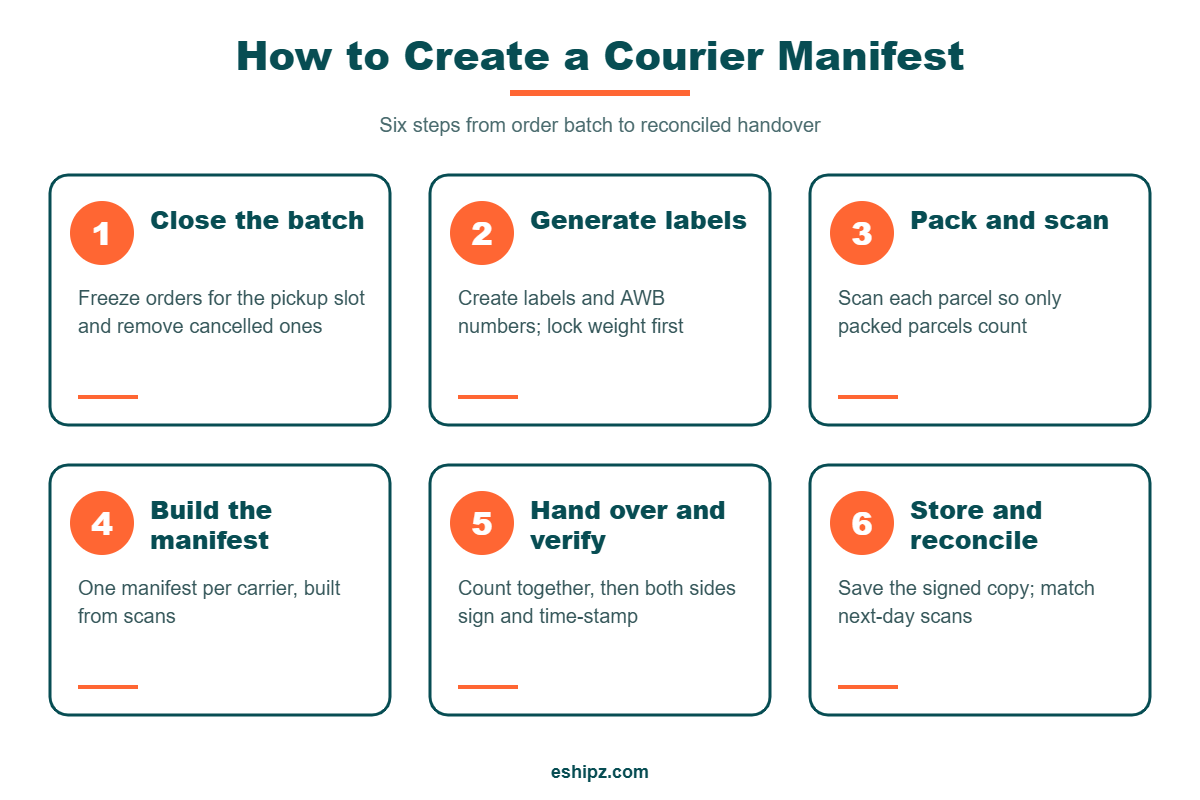
A reliable manifest follows a fixed order of work. The infographic shows the six steps, and the sections below explain each one. Teams that follow the same order every day see fewer surprises at the dock.
Step 1: Close the Order Batch Before the Courier Manifest
Freeze the list of orders that will ship in the next pickup slot. Remove cancelled, on-hold and out-of-stock orders first. A manifest built from a frozen batch cannot change underneath your dispatch team.
Step 2: Generate Labels and AWB Numbers
Assign each order to a carrier and generate its label and AWB number. Check weight and dimensions before you print, because later edits break the manifest. Print labels per carrier so parcels sort naturally.
Step 3: Pack and Scan Every Parcel
Scan the AWB barcode on each parcel as it is packed and sealed. Scanning marks the parcel as ready and blocks duplicates. Only scanned parcels should appear on the manifest.
Step 4: Generate the Courier Manifest From Scanned Parcels
Create one manifest per carrier from the scanned list, not from the order list. Confirm that the total parcel count and the COD total match your scan counters. Print two copies, or share a digital copy if the carrier accepts it.
Step 5: Hand Over and Verify the Courier Manifest
When the driver arrives, count the parcels together against the manifest. Have the driver scan or tick each line, then sign and time-stamp the sheet. Record any shortfall on the manifest itself before the driver leaves.
Step 6: Store the Courier Manifest and Reconcile
Save the signed manifest as a PDF or photo against the pickup. Next morning, compare it with the carrier’s pickup confirmation and the first tracking scans. Any AWB with no scan after one day needs a call to the carrier.
Reconciliation is where most teams save the most money. A simple daily rhythm works well: confirm the count at pickup, check the first scans by evening, and review exceptions the next morning. Three short checks catch problems while parcels are still in your city and a carrier can still act on them.
Manual vs Automated Courier Manifest Creation
Many sellers start with a spreadsheet and a printer, and that works at low volume. The trouble begins when order counts, carriers and pickup slots multiply. The table compares the two approaches.
| Factor | Manual or spreadsheet manifest | Automated manifest |
|---|---|---|
| Data entry | AWBs typed or pasted by hand | Pulled directly from label creation |
| Error detection | Found at the dock or weeks later | Flagged before the pickup |
| Multiple carriers | One sheet per carrier, built by hand | Grouped by carrier automatically |
| Audit trail | Paper copies and photos | Searchable record per pickup |
| Peak-season scaling | Breaks as lines multiply | Handles hundreds of lines the same way |
| Reconciliation | Manual comparison with tracking | Matched against scan events |
Automation does not remove the need for a physical count at handover. It removes the typing, the sorting and the guesswork around the manifest. The driver still counts parcels, but the sheet in their hand is now correct.
Who Owns What at Pickup: Seller and Carrier Responsibilities
Clear ownership prevents most arguments at the dock. The split below is typical, but your carrier agreement has the final word, so confirm it before you rely on it.
| Task | Seller | Carrier driver |
|---|---|---|
| Freeze the batch and generate labels | Owns | Not involved |
| Pack, scan and sort parcels by carrier | Owns | Not involved |
| Build the manifest from scans | Owns | Reviews |
| Count parcels at handover | Shares | Shares |
| Sign and time-stamp the sheet | Signs | Signs |
| Scan parcels into the carrier network | Not involved | Owns |
| Raise and investigate a shortfall | Raises with proof | Investigates |
The shared steps matter most. When both sides count together, neither side can later claim a different number. Write the agreed count at the bottom of the sheet in plain digits.
Courier Manifest Checklist for Your Dispatch Team
Use this checklist at every pickup. It takes a few minutes and prevents most disputes.
- The order batch is frozen and cancelled orders are removed.
- Every parcel has a printed label with a readable barcode.
- Each parcel was scanned at the packing bench.
- The manifest was generated from scanned parcels only.
- The parcel count and COD total match your scan counters.
- Parcels are sorted into separate bags or cages by carrier.
- The driver counted the parcels against the manifest.
- Any shortfall is written on the manifest before the driver leaves.
- The signed manifest is stored against the pickup.
- Next-day scans are compared with the manifest.
Common Courier Manifest Mistakes
Most errors come from habits, not from the document. These are the mistakes that appear most often in dispatch rooms.
- Building the manifest from the order list. Orders are a plan; scans are a fact. Build from scans.
- Letting the driver sign a blank or partial sheet. A signature on an incomplete manifest proves nothing.
- Skipping the physical count. The count is the only step that catches a parcel left behind.
- Mixing carriers in one bag. One misplaced parcel creates a mismatch for two carriers.
- Editing weights after generation. Regenerate the manifest instead of patching it.
- Never reconciling. A manifest that is filed and forgotten cannot protect you in a dispute.
Fixing these habits costs little. Most need a clearer routine, one extra scan or a two-minute count rather than new software or more staff.
How Manifest Data Supports COD Reconciliation
For cash-on-delivery shipments, the manifest also records the amount the courier will collect on your behalf. That makes it the first checkpoint in COD reconciliation. If the COD total on the sheet differs from your order system, the gap will surface weeks later in a remittance report, when it is hard to trace.
Compare the COD total on each manifest with your order system before the driver leaves. Later, match the carrier’s remittance advice against the AWB numbers on that sheet. Any AWB marked delivered but not remitted can be raised with the carrier, with the signed manifest as the starting evidence.
Preparing Your Manifest Process for Peak Season
Peak season exposes every weak habit at once. Daily parcel counts multiply, pickups arrive in several waves, and temporary staff work the dock. A routine that works at 100 parcels a day can fail at 1,000.
- Add extra pickup slots and create one manifest per wave, so no sheet grows too long to check.
- Train temporary staff with a one-page, scan-first handover guide.
- Name one owner per carrier for every shift, so a mismatch has a single point of contact.
- Reconcile twice a day instead of once, while the memory of the pickup is fresh.
- Keep a buffer shelf for parcels that miss the cut-off, and move them to the next wave’s sheet.
Courier Manifest KPIs to Track
You cannot improve what you do not measure. These KPIs show whether your manifest process is getting tighter. Set your own baseline first, then improve against it.
| KPI | Formula | What it tells you |
|---|---|---|
| Manifest accuracy rate | Parcels matched ÷ parcels listed × 100 | How clean each handover is |
| Mismatch rate | Mismatched parcels ÷ total parcels × 100 | The size of the leak |
| Scan-to-manifest share | Scanned lines ÷ total lines × 100 | How much typing remains |
| Dispute resolution time | Days from dispute raised to closed | Whether the signed record helps |
| Unaccounted parcel value (₹) | Value of parcels with no carrier scan | The money at risk |
| Manifest closing time | Minutes from batch freeze to signed sheet | Dock efficiency |
Review these KPIs weekly by carrier. A carrier with a higher mismatch rate may have a driver or hub issue worth raising. The same data supports your next rate or SLA discussion.
Share these numbers with your carrier partners during reviews. Carriers respond to specifics, such as the date, the AWB number and the signed sheet, far better than to general complaints. Over time, the same data helps you decide which carriers deserve more volume at which pincodes.
How eShipz Helps With Courier Manifest Workflows
A courier manifest is only as good as the data behind it. eShipz connects multiple carriers to one dashboard, so label creation, pickup scheduling and tracking happen in one place. That gives your manifest a single, clean source of truth instead of several spreadsheets.
With eShipz, teams can group shipments by carrier and pickup, then work from one shared view of what was handed over. Tracking scans from each carrier then show quickly if a parcel on the manifest was never picked up. You can explore the eShipz multi-carrier shipping platform to see how these steps connect.
If your team still builds the manifest by hand, start small. Automate label and AWB creation first, then scanning, then reconciliation. Each step removes a source of error without changing how your dock works.
Conclusion
The courier manifest is one of the smallest documents in your supply chain and one of the most valuable. It proves what you handed over, when, and to whom. Treat it as a controlled record, not as paperwork.
Freeze the batch, scan every parcel, build the courier manifest from scans, count at handover and reconcile the next day. Track your KPIs by carrier and automate the steps that rely on typing. A disciplined manifest process turns pickup disputes into quick checks, and you can see how eShipz supports that workflow.
Frequently Asked Questions About the Courier Manifest
What is a courier manifest?
A manifest is a signed list of all parcels handed to a courier in a single pickup. It records AWB numbers, destinations, weights, payment modes and the parcel count. It serves as your proof of handover.
Who prepares the courier manifest, the seller or the courier?
Usually the seller or the seller’s shipping software prepares the manifest, and the courier’s driver verifies and signs it. Some carriers also generate their own pickup sheet. Check your carrier agreement for the exact process.
Is a courier manifest the same as an invoice or a shipping label?
No. A label identifies one parcel, an invoice records a sale, and a manifest lists all parcels in one pickup. The three documents work together but serve different purposes.
What should I do if the parcel count does not match the courier manifest?
Do not let the driver leave before you resolve it. Recount, find the missing parcels, and correct the manifest before both sides sign. If a parcel is truly missing, note it on the sheet and inform the carrier.
How long should I keep a courier manifest?
Keep each signed manifest for as long as disputes, claims and audits could arise for those shipments. Check your carrier contracts and your accountant’s guidance for exact periods. A digital copy tied to the pickup makes retrieval easy.
Can I create a courier manifest for multiple carriers at once?
Yes, but each carrier needs its own manifest because each driver signs for their own parcels. Shipping software can group parcels by carrier and generate every manifest together. This is far faster than building sheets by hand.
Does an automated courier manifest replace the physical count?
No. Automation gives you an accurate manifest, but only a physical count at handover confirms that the parcels match it. Use both together for the strongest record.