




An order rarely takes a straight path from warehouse to doorstep. It moves through picking, packing, dispatch, a handover to a courier partner, one or more transit hubs, and finally a last-mile delivery attempt at the customer’s address. At every one of these stages, something can go wrong, and the biggest risk is that most businesses only find out about it after the customer complains. This is exactly why end-to-end shipment tracking has become a core requirement for online sellers rather than a nice-to-have feature.
The scale of the problem is easy to underestimate. According to IMARC Group, the India e-commerce logistics market was valued at close to USD 19.5 billion in 2025 and is projected to grow at a compound annual rate of over 20 percent through 2034, driven largely by rising order volumes, quick commerce expansion, and heavier investment in automated warehousing and last-mile technology. As shipment volumes climb this fast, the gap between what a warehouse team can see and what actually happens on the road gets wider unless businesses actively close it with better visibility tools.
Fragmented tracking is one of the most common and most expensive gaps. A warehouse management system might show that an order has left the facility, a courier portal might show a different status, and the customer support team might be working off neither. Add a failed delivery attempt into this mix, known in the industry as a Non-Delivery Report or NDR, and the fragmentation turns into lost revenue. Warehouse to Door Tracking with NDR Management is not just a phrase sellers use in review meetings anymore. It has become the operating standard that separates businesses with healthy delivery rates from businesses that are quietly bleeding money on returns and redeliveries.
This guide walks through why shipment visibility should never stop at the warehouse gate, why NDR management deserves its own seat at the table, and what an order management process actually needs to look like if a business wants fewer failed deliveries and a better customer experience.
Why Is End-to-End Shipment Tracking Essential?
Shipment tracking used to mean a single status update: order dispatched. That is no longer good enough. Today’s customers expect to see where their package is at almost every hour of its journey, and businesses need that same visibility internally to run efficient warehouse logistics.
Real-time tracking gives operations teams the ability to spot a delay while there is still time to act on it. If a shipment has been sitting at a hub for longer than expected, a team with live visibility can flag it, contact the courier, or proactively message the customer. Without that visibility, the first sign of trouble is often an angry customer asking where their order is.
Last-mile delivery deserves special attention here because it is the one part of the journey the customer actually experiences. Everything before that point, warehouse processing, sorting, line-haul transport, happens behind the scenes. The last mile is where a business either earns trust or loses it. Amazon’s own guidance for sellers in India notes that last-mile delivery has an outsized effect on customer satisfaction and repeat purchase behaviour precisely because it is the most visible and most failure-prone leg of the journey.
Beyond the customer experience angle, this kind of visibility also removes operational blind spots. Teams stop relying on guesswork or manual follow-ups with couriers and instead work off live data. This matters just as much for the warehouse team managing outbound dispatch as it does for the support team fielding “where is my order” tickets. A connected order management system that pulls tracking data from every courier partner into one dashboard turns shipment tracking from a reactive activity into a proactive one. Pairing this visibility with route optimization also helps couriers reach customers faster, which further reduces the chances of a delivery attempt failing due to delays.
Why NDR Management Matters in the Delivery Journey
A Non-Delivery Report, or NDR, is raised by a courier every time a delivery attempt does not succeed. It is not the end of the story. It is a signal, and how quickly a business responds to that signal decides whether the order gets delivered or comes back as a costly return.
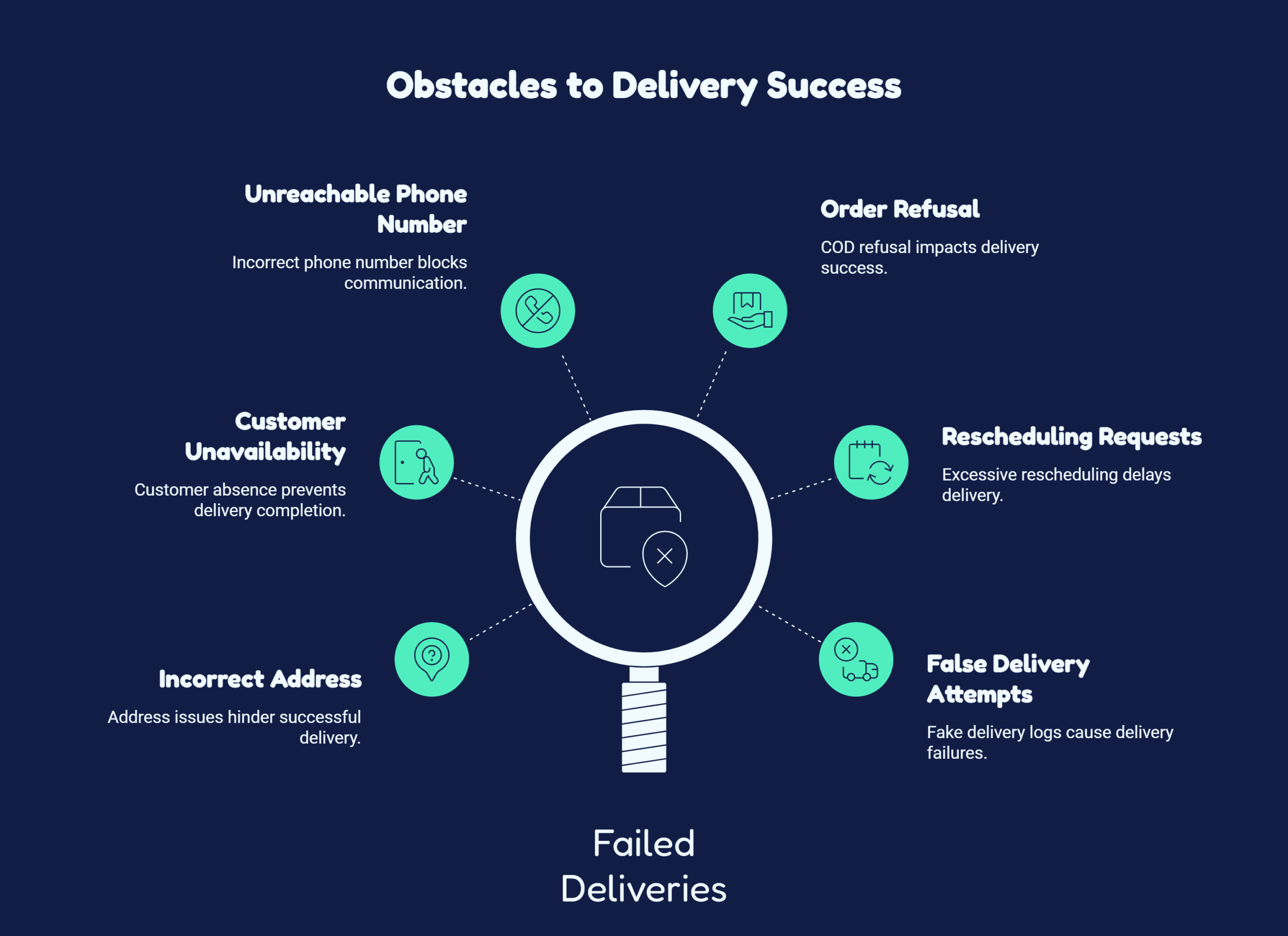
There are a handful of reasons NDRs happen repeatedly across the industry:
- Incorrect or incomplete address, particularly in areas without a formal postal structure or in tier-2 and tier-3 cities where a landmark matters more than a pin code
- Customer unavailable at the time of attempted delivery
- Unreachable or incorrect phone number on file
- Order refusal, which is especially common on cash-on-delivery orders and often ties back to gaps in COD reconciliation that make it harder to confirm an order before it is dispatched
- Repeated rescheduling requests that push a shipment past its ideal delivery window
- Rare but real false attempts logged by a delivery agent without an actual visit
None of these causes are unusual. What varies enormously between businesses is the response time. Industry data suggests that when a business acts on a failed delivery attempt within a few hours, recovery rates for that shipment climb well above 60 percent. Wait until the next business day, and recovery drops sharply, often below 35 percent. That gap is the entire argument for treating NDR management as a time-sensitive workflow rather than a batch task handled once a day.
Left unresolved, an NDR does not just sit quietly. It escalates into a Return to Origin, or RTO, where the parcel heads back to the warehouse. An RTO is expensive in more ways than one. The business has already paid for the forward shipment, now pays again for the reverse leg, absorbs the cost if the product comes back damaged, and loses the sale entirely since the revenue that was supposed to cover all of this never materialises. This is the real cost chain behind a single missed delivery attempt, and it is why Warehouse to Door Tracking with NDR Management needs to function as one connected system rather than two separate processes.
What Does the Current Market Trend Say?
The direction of the market is fairly clear: real-time visibility, automation, and API-connected logistics are moving from competitive advantage to baseline expectation.
According to IMARC Group’s research on the India e-commerce logistics market, transportation accounted for around 41 percent of the market in 2025, reflecting how much weight businesses are placing on efficient movement from warehouse to consumer. The same research points to B2C shipments making up 56 percent of the market, driven by the continued rise of direct-to-consumer brands and doorstep delivery expectations across both large cities and smaller towns. Domestic shipments dominate at 69 percent, underlining just how much e-commerce activity is now happening well beyond the major metros.
What is driving this growth is not simply more orders, but a shift in how those orders are fulfilled and tracked. Logistics providers are investing in AI-driven route optimisation, predictive analytics for shipment delays, and automated warehouse management systems that reduce manual handling. Quick commerce and hyperlocal delivery models have pushed the industry toward faster turnaround expectations, which puts more pressure on accurate, real-time tracking and quicker NDR response times. A business still checking courier portals manually or working off next-day NDR reports is competing against operations that resolve the same issue in under two hours.
This shift also means that order management is no longer just about processing an order correctly at the point of sale. The order management process now extends all the way through delivery confirmation, with tracking and NDR resolution treated as a continuation of that same process rather than a separate, disconnected function handled by a different team.
Who Benefits from End-to-End Tracking and NDR Management?
Different teams get different value from the same underlying system, which is part of why it is worth treating tracking and NDR management as shared infrastructure rather than a tool owned by one department.
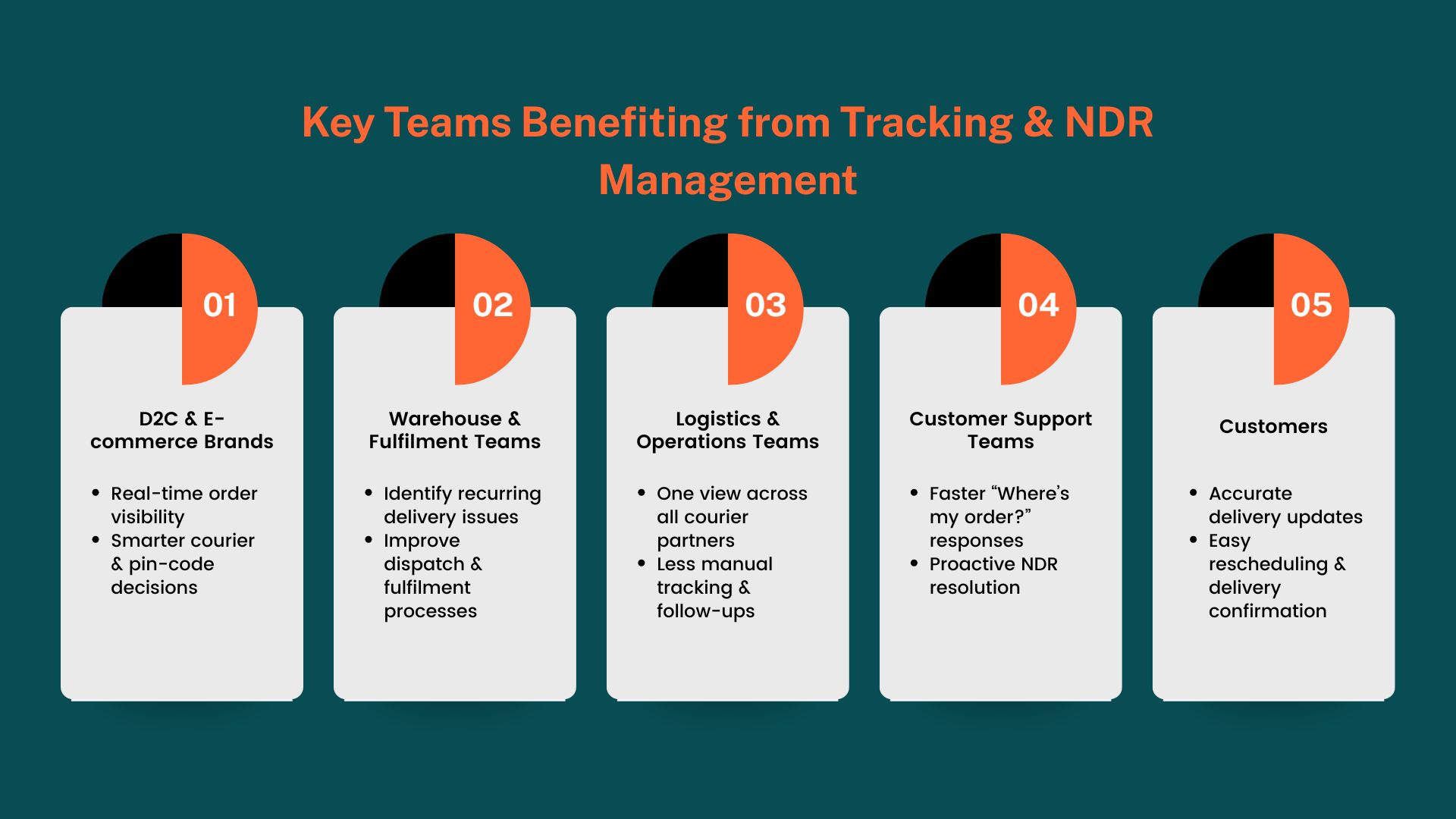
D2C brands and e-commerce sellers get a clearer picture of where their orders stand at any given moment, which helps with everything from customer communication to demand planning. When a brand knows which pin codes have chronically high NDR rates, it can make smarter decisions about which couriers to use in those areas.
Warehouse and fulfilment teams benefit from tighter feedback loops. If a courier is consistently mishandling shipments from a particular dispatch point, the warehouse team can see that pattern and adjust before it becomes a recurring problem. This connects warehouse logistics directly to delivery outcomes instead of treating them as separate stages.
Logistics and operations teams get a single source of truth instead of juggling multiple courier dashboards. This alone cuts down significantly on the manual work of chasing shipment updates across different portals.
Customer support teams can answer a “where is my order” query in seconds instead of escalating it internally. When an NDR happens, support teams with the right visibility can proactively reach out rather than waiting for the customer to call in frustrated.
Customers get what they actually want: accurate delivery estimates, timely updates when something changes, and a smoother way to reschedule or confirm a delivery instead of losing the order altogether.
How Does It Benefit Your Business?
The value of good tracking and NDR management is not abstract. It shows up directly in a business’s numbers.
Fewer failed deliveries mean fewer disrupted orders overall, which keeps inventory planning more predictable. Lower RTO costs follow directly from that, since every avoided RTO saves the business the forward shipping cost, the reverse freight cost, and the risk of product damage in transit.
Customer experience improves because people are not left guessing about their order status, and when something does go wrong, they hear about it from the business first rather than discovering it themselves. This builds a level of trust that keeps customers coming back, which matters more in categories with high repeat-purchase potential like fashion, beauty, and daily essentials.
Faster issue resolution is a direct result of having live data instead of end-of-day reports. A support agent working with real-time shipment tracking can resolve a delivery issue in a single conversation instead of needing to follow up later.
Operational visibility improves across the board, which reduces the manual work that would otherwise go into chasing courier updates, cross-checking spreadsheets, or calling delivery partners for status checks. And because courier performance data is being tracked continuously, businesses get an ongoing, data-backed view of which partners are actually delivering on time and which ones are quietly dragging down performance in specific regions.
Key Features to Look for in a Tracking and NDR Management Solution
Not every tracking tool is built the same way, and the difference often shows up exactly when it matters most, during a delivery exception. Here is what a solid solution should offer:
Real-time shipment tracking across every courier a business works with, not just the major ones, so there is no blind spot depending on which partner is handling a particular order.
A centralised dashboard that pulls status updates from all couriers into one place, removing the need to log into multiple courier portals throughout the day.
Automated alerts that flag delays, exceptions, and failed delivery attempts the moment they happen, instead of surfacing them in a report the next morning.
NDR identification and categorisation that automatically sorts failed deliveries by reason, whether that is an address issue, an unavailable customer, or a refused COD order, so the right response can be triggered for each case.
Customer communication tools built into the workflow, so a failed delivery automatically triggers an SMS, WhatsApp message, or email asking the customer to confirm their address or reschedule, rather than relying on a support agent to catch it manually.
Reattempt management that schedules and tracks redelivery attempts without requiring someone to manually coordinate with the courier each time.
Courier performance analytics that show NDR rates, on-time delivery percentages, and RTO rates broken down by courier and by region, so underperforming partners are visible in the data rather than buried in anecdotes.
RTO tracking that follows a returned shipment all the way back to the warehouse, so inventory records stay accurate.
API integrations with the business’s existing order management system, warehouse management system, and sales channels, so tracking data does not sit in a silo.
Actionable reports that go beyond raw numbers and actually point to where the order management process is breaking down.
How to Choose the Right Tracking and NDR Management App for Your Business
Choosing a solution is less about finding the tool with the most features and more about finding the one that fits how a business actually operates. A practical evaluation framework should cover the following areas.
Start with integrations. Check whether the platform connects cleanly with the sales channels already in use, whether that is Shopify, a marketplace, or a custom storefront, and whether it plugs into the existing order management system and warehouse management system without heavy custom development.
Look closely at courier coverage. A business shipping across India needs a platform that supports the specific courier partners it already works with, along with room to add more as the business expands into new regions.
Evaluate the level of automation on offer, particularly around NDR workflows. A platform that only shows an NDR after it has happened is far less useful than one that automatically triggers customer outreach and books a reattempt without manual intervention.
Check the depth of analytics. Reports should be specific enough to show NDR and RTO trends by courier, by pin code, and by delivery reason, not just a single top-line number.
Consider scalability. A solution that works well at a few hundred orders a day should not fall apart at a few thousand. Ask how the platform performs at higher volumes and whether pricing scales sensibly.
Weigh ease of use for the team that will actually be working in the platform daily, since a powerful tool that nobody wants to log into will not move the needle.
Finally, factor in customer support quality and the realistic ROI. A platform that reduces RTO rates by even a few percentage points can pay for itself quickly once the forward and reverse shipping costs of avoided returns are added up.
Questions to Ask Before Choosing a Solution
Before signing up for any platform, it helps to get direct answers to a short list of practical questions:
- Can it track shipments across all the courier partners currently in use, and can new ones be added easily?
- Can it automate NDR communication across SMS, WhatsApp, and email without manual triggering?
- Can it identify high-risk shipments, such as those going to pin codes with historically high NDR rates, before dispatch?
- Does it integrate directly with the existing store, order management system, or warehouse management system?
- Can RTO reduction actually be measured over time, with clear before-and-after data?
- How quickly does the system flag a failed delivery attempt after the courier logs it?
- What does onboarding look like, and how long before the business sees usable data?
Getting straight answers to these questions upfront saves a lot of frustration later, especially once order volumes start climbing and the cost of a slow or disconnected system becomes harder to ignore.
Conclusion: From Visibility to Successful Delivery
Tracking a shipment is only useful if that visibility leads to action. Knowing that a delivery has failed does not help a business unless someone, or some automated system, does something about it within the window that actually matters. This is the core idea behind Warehouse to Door Tracking with NDR Management: it is not two separate functions bolted together, but one continuous process that starts the moment an order leaves the warehouse and does not end until it is either successfully delivered or resolved.
Businesses that treat shipment tracking and NDR management as connected parts of their order management process tend to see the results where it counts, in lower RTO rates, better courier accountability, and customers who trust that their order is actually coming. As India’s e-commerce logistics market continues its steep growth curve, the businesses that invest in this kind of visibility now will be the ones with the operational headroom to scale without their delivery problems scaling right along with them. The right end-to-end shipment tracking and NDR management setup will not eliminate every failed delivery, but it will make sure far fewer of them turn into lost sales.
Frequently Asked Questions
1. What is the difference between shipment tracking and NDR management?
Shipment tracking shows where an order is at any point in its journey from warehouse to doorstep. NDR management is the specific process of responding to failed delivery attempts, contacting the customer, and arranging a reattempt before the order is sent back to origin. They work best when connected, since tracking data is what flags an NDR in the first place.
2. How quickly should a business respond to an NDR?
As close to real time as possible. Data across the industry consistently shows that acting within a few hours of a failed delivery keeps recovery rates high, while waiting until the next business day sharply reduces the chance of saving that order.
3. What causes most failed deliveries in India?
The most common causes are incorrect or incomplete addresses, the customer being unavailable at the time of delivery, unreachable phone numbers, and order refusals on cash-on-delivery shipments. Address issues are especially common in areas without a formal postal structure.
4. Does NDR management help reduce RTO costs?
Yes. Since an RTO involves paying for both the forward and reverse shipment while losing the sale entirely, resolving an NDR before it escalates directly avoids that cost. Even a modest improvement in NDR recovery rates can meaningfully reduce total RTO spend over a month.
5. Can small D2C brands benefit from end-to-end tracking, or is it only useful at scale?
Smaller brands often benefit the most from getting this right early. Manual NDR follow-up is manageable at low order volumes, but the moment volumes grow, missed NDRs start compounding quickly. Setting up proper tracking and NDR workflows before that growth happens saves a lot of rework later.
6. What role does the order management system play in this process?
The order management system is where order and customer data live, so when it is properly connected to shipment tracking and NDR workflows, the entire order management process becomes far more accurate. Address confirmations, delivery status, and customer communication can all flow through one connected system instead of scattered spreadsheets or courier portals.
7. How does courier performance tracking help reduce future NDRs?
Tracking NDR and RTO rates by courier and by region highlights patterns that are easy to miss otherwise, such as one courier consistently underperforming in a specific pin code. Once that pattern is visible, businesses can shift volume to better-performing partners in those areas, which reduces the number of NDRs before they even happen.