




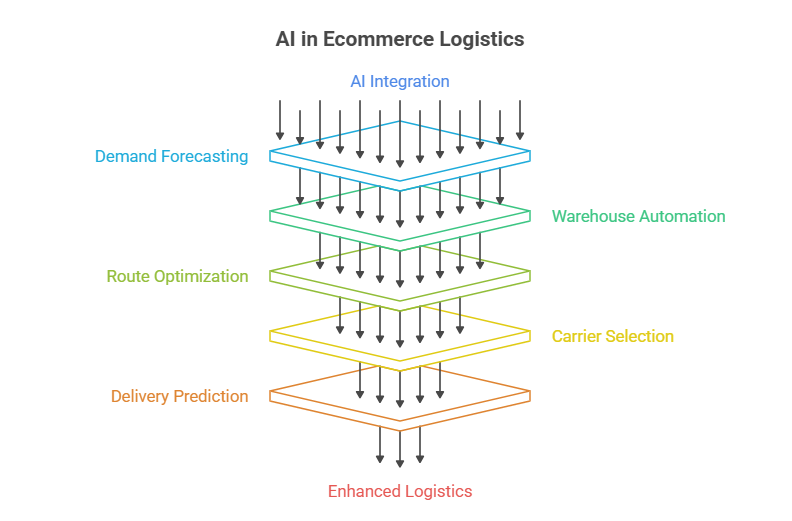
AI in ecommerce is changing how online orders are planned, processed, shipped, tracked, and delivered. A purchase may look simple to the customer, but it depends on a complex set of decisions behind the scenes. Businesses must decide where to fulfill an order, how much inventory to hold, which carrier to use, and which route makes sense. They also need to assess whether a shipment will arrive on time and decide what to do if it doesn’t. As ecommerce networks spread across more locations and customer expectations rise, traditional logistics systems are struggling to keep up. AI makes logistics more predictive, responsive, and data-driven.
The change is already visible across the industry. DHL’s 2025 E-Commerce Trends Report found that 55% of global ecommerce businesses already use AI across their platforms, while 96% of retailers see logistics as important to securing sales. For customers, delivery and returns options can make or break a purchase. DHL reports that 81% of shoppers will abandon a purchase if their preferred delivery option isn’t available, and 79% will do the same when their preferred returns option is missing. It also found that 70% of global shoppers want AI-powered shopping tools, showing how quickly AI is becoming part of the wider ecommerce experience.
These figures show that logistics now shapes the customer experience. Moving an order from a warehouse to a customer’s doorstep isn’t enough. Businesses need clear visibility and control throughout the order journey, and AI ecommerce tools can help by processing large volumes of operational data, spotting patterns, predicting issues, and suggesting the next action.
Intelligent logistics shifts businesses away from systems that only record past events. Instead, they can understand what may happen next. AI can forecast demand before stock runs out, flag shipments at risk of delay, recommend a carrier for a specific order, optimize routes, identify unusual return patterns, and send proactive customer updates. That’s how AI improves logistics: it helps teams spot early signals and act before problems become more costly.
Ultimately, how AI is transforming ecommerce logistics comes down to better decisions across the full order lifecycle. AI can affect inventory, warehousing, carrier selection, delivery, tracking, NDR, returns, customer service, and fleet operations. The following 10 applications show where businesses can use AI in ecommerce to build faster, smarter logistics operations and capture the benefits of AI in eCommerce logistics.
10 Key Applications of AI in Ecommerce Logistics
AI is becoming an important part of modern ecommerce logistics, helping businesses make faster and more informed decisions across the entire order journey. From predicting demand and managing inventory to selecting carriers, optimizing delivery routes, tracking shipments, managing returns, and improving customer communication, AI can bring greater intelligence to processes that were traditionally managed through fixed rules and manual intervention. The following 10 applications show how AI in ecommerce is being used to make logistics more predictive, efficient, responsive, and customer-focused.
- AI-Powered Demand Forecasting and Inventory Planning
Ecommerce businesses need to know what customers are likely to buy before orders arrive. They may manage thousands of SKUs across warehouses, cities, marketplaces, and sales channels, while demand shifts with seasonality, promotions, holidays, product launches, pricing changes, social trends, and unexpected events. Traditional forecasting relies heavily on historical sales, but past results don’t always reflect current market conditions. ai in ecommerce gives businesses a way to factor more variables into demand planning and build a clearer view of what may happen next.
AI-powered forecasting can analyse historical orders, seasonal patterns, promotional calendars, product launches, regional demand, website searches, customer behaviour, market signals, inventory levels, and previous campaign performance. Predictions can update as new data arrives instead of remaining fixed after a single forecast. That helps teams spot likely stockouts and excess inventory sooner, then make smarter replenishment decisions. This is where intelligent logistics becomes practical rather than theoretical.
SKU-level and location-level forecasting is especially useful. Businesses can predict demand for a specific product and identify where that demand is likely to come from. ai ecommerce systems can flag fast-moving products, slow-moving inventory, seasonal items, and unusual shifts in demand. They can also recommend replenishment levels and show how stock should be allocated across fulfilment locations.
For example, an ecommerce brand that usually sells 500 units of a product each month may be planning a major promotional campaign. A basic forecasting model might rely mainly on previous sales. An AI-powered system can also consider past campaign results, current customer interest, search activity, discount levels, regional demand, and inventory availability to produce a more realistic forecast. That shows how AI is transforming ecommerce logistics and how AI improves logistics, because stronger demand visibility helps reduce stockouts, avoid overstocking, improve fulfilment planning, and make better use of warehouse capacity.
The benefits of AI in eCommerce logistics go beyond keeping products in stock. Excess inventory creates storage costs, ageing stock, markdowns, and working-capital pressure. Too little inventory leads to lost sales and disappointed customers. More detailed, responsive demand planning helps businesses balance product availability against inventory costs.
- AI-Powered Warehouse Automation and Intelligent Fulfillment
The warehouse is another area where AI ecommerce technology can create significant operational improvements. Ecommerce warehouses are becoming increasingly complex as businesses manage larger product catalogues, faster delivery promises, multiple fulfilment centres, marketplace orders, and seasonal demand. Every order creates decisions around inventory location, picking sequence, packing, labour allocation, and shipment prioritization. AI can help make these decisions dynamically instead of relying entirely on fixed warehouse rules.
One key application is intelligent inventory placement. AI can analyse product velocity, order frequency, warehouse layout, picking distance, and demand patterns to determine where products should be stored. Fast-moving products can be positioned closer to packing stations, while slower-moving inventory can be placed in less accessible locations. AI can also support dynamic slotting, allowing warehouse layouts to change as demand patterns change.
Another important capability is AI-powered pick-path optimization. Instead of asking warehouse workers to follow the same route for every picking task, AI can determine more efficient sequences based on current orders, product locations, warehouse congestion, and delivery priorities. Computer vision can also support product identification, barcode recognition, quality inspection, packaging verification, and damage detection.
AI can further support order prioritization and labour planning. The system can consider promised delivery dates, carrier cut-off times, order priority, warehouse capacity, and inventory availability when determining which orders should be processed first. During peak periods, AI can identify areas where additional labour or warehouse capacity may be required.
This creates a more intelligent logistics environment where warehouse operations can adapt to changing conditions. AI does not necessarily mean replacing warehouse employees. Instead, it can reduce repetitive decision-making and allow teams to focus on supervision, quality control, exception handling, and tasks that require human judgement. This combination of automation and human expertise is one of the practical ways AI in ecommerce can improve fulfilment.
- AI-Powered Route Optimization and Last-Mile Delivery
Last-mile delivery is one of the hardest parts of ecommerce logistics because conditions can shift during the day. Traffic, weather, road closures, failed delivery attempts, customer availability, incoming orders, and vehicle capacity all affect route efficiency. A route that made sense in the morning may be a poor choice a few hours later. AI-powered route optimization helps logistics teams adapt as conditions change. AI can analyse traffic patterns, delivery locations, promised delivery windows, vehicle capacity, driver availability, distance, fuel consumption, weather conditions, historical route performance, and current shipment priorities. Dynamic rerouting is especially useful. The system can spot when a planned route is no longer efficient and recommend a better option.
AI also supports multi-stop route optimization by helping businesses choose the most efficient order for several deliveries. Delivery density analysis highlights areas with clusters of orders, and historical data can predict which routes are likely to face congestion at certain times. First-attempt delivery optimization is another important use. AI can analyse previous delivery outcomes and customer availability patterns to determine when a specific address is more likely to accept a delivery. Rather than sending a driver back to the same location at the wrong time, businesses can use that information to plan deliveries more effectively. This shows how AI improves logistics. The goal isn’t simply to find the shortest route. It’s to choose a route that balances delivery speed, cost, vehicle utilization, and delivery success. As these decisions update in real time, last-mile operations become more intelligent and responsive.
- AI-Powered Carrier Selection and Shipment Allocation
Choosing the right carrier is increasingly complex for ecommerce businesses. Growing brands often work with multiple logistics providers because no single carrier performs equally well across every region, product category, service level, weight profile, and destination. One carrier may offer a lower shipping cost but have higher RTO rates in a particular region, while another may cost slightly more but provide faster and more reliable delivery.
AI in ecommerce can turn carrier selection into a predictive decision instead of a simple rule-based process. AI can analyse carrier cost, transit time, delivery success rate, RTO performance, COD success, serviceability, historical delays, destination, shipment weight, dimensions, product type, and current carrier capacity to determine which carrier is most suitable for a particular order.
A major feature here is predictive carrier allocation. Rather than automatically selecting the cheapest carrier, the system can evaluate which carrier is most likely to meet the required delivery outcome. The preferred carrier can therefore change depending on the destination, customer, product, shipment value, delivery promise, and historical performance.
AI can also create carrier performance scores. Businesses can compare carriers across multiple metrics and understand where each carrier performs best. If a particular carrier consistently performs poorly for a specific region, the system can reduce its allocation for those shipments. If another carrier improves its performance, allocation can shift accordingly.
This creates a more responsive carrier network and helps businesses balance cost against service quality. Even small improvements in carrier allocation can help reduce failed deliveries, lower RTO costs, improve transit times, and protect margins. This makes intelligent carrier selection one of the most valuable benefits of AI in eCommerce logistics.
- AI-Powered Delivery Prediction and Delay Detection
Customers increasingly expect more than a generic “order shipped” notification. They want to know when their package is likely to arrive and whether the promised delivery date can still be trusted. Traditional estimated delivery dates often depend on standard transit times, but real-world performance can vary depending on carrier, route, weather, hub congestion, and network disruptions.
AI can make delivery predictions more dynamic by analysing historical carrier performance, origin-destination combinations, shipment status, hub performance, traffic conditions, weather, and current network behaviour. Instead of treating every shipment between two locations as identical, AI can estimate delivery time based on the specific circumstances surrounding the shipment.
One of the most valuable capabilities is predictive delay detection. AI can compare the current movement of a shipment with historical patterns and identify abnormal behaviour. If a shipment normally moves through a hub within a particular timeframe but remains there significantly longer, the system can flag it as a potential delay before the expected delivery date is missed.
AI can also support exception prioritization. Not every delayed shipment needs the same level of intervention. A high-value shipment, urgent order, or time-sensitive delivery may need immediate attention, while another shipment may simply require monitoring. AI can rank exceptions based on urgency, customer impact, and business value.
Businesses can then take proactive action by contacting the carrier, notifying the customer, escalating the shipment, or triggering another workflow. This is one of the clearest examples of how AI improves logistics by moving operations from reactive problem-solving to proactive exception management.
- AI-Powered Shipment Tracking and Supply Chain Visibility
Traditional shipment tracking mainly answers one question: where is the package? Modern ecommerce logistics requires a much broader view. Businesses need to know whether a shipment is moving normally, whether it is likely to be delayed, what may happen next, and whether intervention is required. This is where AI in ecommerce can turn tracking data into predictive logistics intelligence.
AI can analyse shipment scans, carrier updates, hub movements, transit times, delivery attempts, geographic information, historical performance, and exception events to identify patterns across thousands of shipments. One important capability is predictive shipment monitoring, where the system continuously compares current shipment behaviour against historical patterns.
For example, if shipments travelling through a particular hub have suddenly started taking longer than usual, AI can detect that pattern across multiple orders. Instead of operations teams manually reviewing individual tracking events, the system can identify the broader issue and bring it to their attention.
Another capability is risk-based shipment prioritization. AI can identify shipments with a higher probability of delay, failed delivery, or another exception. Operations teams can then focus their attention on these shipments rather than manually monitoring every order.
AI can also support root-cause analysis by identifying recurring problems associated with particular carriers, hubs, routes, regions, or shipment types. This changes tracking from a passive visibility tool into an active decision-making system.
Traditional tracking answers, “Where is the shipment?” AI-enabled visibility can help answer, “Where is the shipment, what is likely to happen next, why might it happen, and what should we do about it?” That is a defining characteristic of intelligent logistics.
- AI-Powered NDR, Returns, and Reverse Logistics
The logistics journey does not end when a package reaches the customer. A customer may be unavailable, an address may be incorrect, a shipment may be refused, or a product may eventually be returned. These situations create additional transportation, processing, and customer service costs. AI can help businesses make NDR and reverse logistics more predictive.
For NDR management, AI can analyse historical delivery failures to identify patterns in customer availability, delivery windows, COD behaviour, address quality, and carrier performance. If a particular location consistently experiences failed deliveries during working hours, the system can identify the pattern and recommend a different delivery window or communication strategy.
For returns, AI can analyse return reasons across products, customers, regions, carriers, and order types. This can help identify products with unusually high return rates or recurring issues related to sizing, quality, product expectations, or delivery. Businesses can then use these insights to improve product information, packaging, quality control, or fulfilment processes.
Another powerful capability is intelligent return routing. A returned product does not necessarily need to travel to the same warehouse from which it was originally shipped. AI can evaluate product condition, warehouse capacity, inventory demand, location, processing time, and recovery value to determine the most suitable destination.
AI can also support return fraud detection by identifying unusual patterns such as repeated high-value returns, excessive return frequency, or inconsistent customer behaviour. This demonstrates how AI ecommerce can extend beyond forward shipping and help businesses manage the complete product lifecycle.
- AI-Powered Customer Service and Logistics Communication
Logistics drives a high volume of customer questions, from “Where is my order?” to “Why is my shipment delayed?” and “When will my refund arrive?” Many are repetitive, yet customers still want quick, accurate answers. AI can connect customer communications to real-time logistics data, giving customers information that’s actually useful. AI-powered intent detection can determine whether someone is asking about tracking, a delivery delay, an address change, cancellation, return, refund, or another issue. It can then share the relevant details or send the conversation to the right team. AI can also send proactive updates by identifying shipments likely to be affected and automatically notifying customers. The message can explain the issue, provide a revised delivery estimate, and outline the next available option.
AI also gives customer service agents a clearer view of shipment history, past conversations, exception details, carrier information, and suggested responses. Agents don’t have to search across multiple systems before replying. The aim isn’t to automate every interaction. It’s to handle repetitive questions automatically while giving human teams better information for complex cases. This benefit of AI in eCommerce logistics can reduce support workload and improve the speed and quality of logistics communication.
- AI-Powered Predictive Maintenance and Fleet Management
AI is changing the physical infrastructure behind ai in ecommerce. Delivery vehicles, warehouse equipment, conveyors, sorting machines, and other assets need regular maintenance, yet fixed schedules don’t always show when equipment is likely to fail. Predictive maintenance uses AI to analyse operational data and spot early warning signs.
AI can review vehicle usage, mileage, engine performance, fuel consumption, maintenance history, sensor data, temperature, operating conditions, and driver behaviour to find patterns that suggest future failures. Businesses can schedule repairs before a vehicle breaks down during an active delivery cycle. AI can also improve fleet utilization. By analysing order density, route requirements, vehicle capacity, delivery volumes, and historical demand, businesses can estimate how many vehicles they need across different regions and periods. Driver performance analysis is another use. AI can flag harsh braking, excessive idling, speeding, fuel consumption, route deviations, and other behaviours. That information supports safer driving, better fuel efficiency, and stronger fleet performance.
The benefits of AI in eCommerce logistics go beyond lower maintenance costs. Vehicle breakdowns can lead to missed delivery windows, driver downtime, replacement vehicle costs, and customer complaints. Predictive maintenance shows how AI improves logistics by improving digital processes and the physical infrastructure that moves products.
- AI-Powered Autonomous Delivery and Next-Generation Logistics
The final application takes AI beyond optimization and into autonomy. Autonomous delivery includes technologies such as drones, delivery robots, and autonomous vehicles that can use AI to navigate environments, recognize obstacles, adjust routes, and make certain delivery decisions with limited human intervention.
One important capability is real-time environmental decision-making. An autonomous system may need to interpret road conditions, identify obstacles, recognize delivery locations, adjust its route, and respond to unexpected events. AI and computer vision can help these systems process environmental information and make decisions accordingly.
Another area is last-mile automation. Autonomous systems could eventually be used for specific delivery environments such as campuses, warehouses, controlled communities, short-distance routes, or high-density delivery areas. Rather than completely replacing conventional delivery networks, autonomous systems could operate alongside human-led fleets.
However, autonomous delivery is still developing, and regulations, infrastructure, safety, operating costs, technology maturity, and customer acceptance will influence adoption. For most ecommerce businesses, the immediate opportunity is likely to use AI to optimize existing delivery networks before moving toward fully autonomous operations.
The direction is nevertheless important because it represents the next stage of how AI is transforming ecommerce logistics. Logistics is gradually moving from systems where humans manually coordinate every decision toward systems where machines can predict, optimize, and eventually execute more decisions independently.
Key Features of AI in Ecommerce Logistics
The 10 applications above show that AI in ecommerce is not a single feature. It is a combination of technologies and capabilities that can work together across the entire logistics lifecycle. These include predictive analytics, machine learning, demand forecasting, anomaly detection, intelligent carrier allocation, route optimization, computer vision, natural language processing, predictive alerts, recommendation engines, real-time monitoring, and automated workflows.
The real value appears when these capabilities are connected. Demand forecasting can influence inventory allocation, inventory availability can influence fulfilment location, fulfilment location can influence carrier selection, carrier performance can influence delivery estimates, and tracking data can trigger proactive customer communication. This creates a connected intelligence layer rather than a collection of disconnected automation tools.
| AI Capability | Logistics Application | Business Impact |
| Predictive analytics | Demand, delivery and shipment forecasting | Better planning |
| Machine learning | Carrier and route optimization | Smarter decisions |
| Computer vision | Warehouse inspection and automation | Faster fulfilment |
| Anomaly detection | Delay and exception identification | Proactive intervention |
| Natural language processing | Customer communication and support | Faster responses |
| Recommendation engines | Carrier, inventory and route decisions | Improved efficiency |
| Real-time monitoring | Shipment and fleet visibility | Better control |
| Automated workflows | NDR, returns and exceptions | Reduced manual effort |
That is what separates intelligent logistics from basic automation. Traditional automation follows predefined rules, while AI can analyse changing data and determine which action may be most appropriate. When the two are combined, businesses can automate repetitive processes while using AI to support more complex decisions.
What Are the Benefits of AI in eCommerce Logistics?
The benefits of AI in eCommerce logistics cover cost, speed, accuracy, visibility, scalability, and customer experience. AI helps businesses make faster decisions by processing large volumes of operational data and spotting patterns that are hard to find manually. It improves inventory planning and warehouse operations, while reducing unnecessary transportation. It can also support smarter carrier selection and flag potential delivery problems before they become major issues.
Predictability is another major benefit. Traditional logistics often responds only after problems occur. AI can spot signals of a possible stockout, delivery delay, failed delivery, return, or fleet issue, giving businesses time to act sooner. Moving from reactive to predictive operations improves efficiency and customer experience.
AI also helps businesses grow without increasing manual workload at the same pace as order volumes. As ecommerce businesses expand across regions, channels, warehouses, and carriers, operational decisions increase significantly. AI can process large volumes of data, prioritize exceptions, and recommend actions at a scale that’s difficult to manage manually. Most importantly, AI can connect every part of the logistics journey. Instead of handling inventory, warehouses, carriers, tracking, delivery, and returns as separate functions, businesses can build a connected decision-making environment. That’s where the long-term benefits of AI in eCommerce logistics become more significant.
How eShipz Can Support AI-Driven Ecommerce Logistics
AI creates the most value when it is connected to the operational systems that actually move shipments. This is where eShipz can support businesses looking to build smarter and more connected logistics operations. For ecommerce businesses managing multiple carriers, shipment volumes, delivery locations, and operational workflows, the challenge is not simply collecting data. The challenge is turning that data into useful decisions and actions.
eShipz brings together shipping automation, carrier management, tracking, shipment visibility, and logistics workflows in one connected environment. This provides the operational foundation required to apply intelligence to everyday logistics decisions. Businesses can use shipment and carrier data to understand performance, monitor exceptions, identify recurring issues, and improve operational workflows.
For example, instead of simply showing that a shipment has been delayed, an intelligent logistics environment can use historical and current information to identify patterns in carrier performance and highlight shipments that may require attention. Similarly, carrier performance data can help businesses understand which logistics partners perform best across different regions and shipment profiles.
The combination of AI ecommerce capabilities and logistics automation can therefore help businesses move beyond basic shipment management. AI provides the intelligence, while connected logistics infrastructure helps turn that intelligence into operational action. As AI becomes more deeply integrated into logistics platforms, businesses can use these capabilities to create faster, more predictive, and more responsive supply chain operations.
The Future of AI in Ecommerce Logistics
The future of AI in ecommerce is not simply about replacing manual logistics processes with automated ones. It is about making logistics increasingly predictive, connected, and adaptive. Today, businesses may use AI to forecast demand, optimize routes, select carriers, predict delays, manage returns, or automate customer communication. In the future, these capabilities will increasingly work together.
A demand forecast could automatically influence inventory allocation. Inventory availability could influence warehouse selection. Warehouse selection could influence carrier allocation. Carrier performance could influence estimated delivery dates. Tracking data could trigger proactive customer communication. A delivery exception could automatically trigger a new operational workflow. This creates a logistics network where decisions are connected rather than isolated.
This is the real evolution of intelligent logistics. The goal is not to make every decision automatically. The goal is to make every important decision better informed. As AI systems become more capable, businesses will increasingly move from reactive logistics toward operations that can anticipate demand, identify risks, optimize resources, and respond to changing conditions in real time.
The most successful businesses will therefore not necessarily be those using the most AI. They will be those using AI in the right places, connecting it to reliable operational data, and measuring whether it actually improves cost, speed, delivery performance, and customer experience.
From AI Adoption to Smarter Ecommerce Logistics
AI in ecommerce is shifting logistics from a reactive function to a predictive, connected system built around intelligent logistics. From demand forecasting and inventory planning to warehouse automation, dynamic routing, carrier selection, delivery prediction, tracking, returns, customer service, predictive maintenance, and autonomous delivery, AI now shapes nearly every part of the ecommerce logistics journey. The question isn’t whether businesses should adopt AI. It’s where it can solve their most costly logistics issues. Better demand forecasting may matter most for one business, while another may need smarter carrier allocation, more accurate delivery predictions, lower RTO, stronger warehouse utilization, or clearer customer communication.
The benefits of AI in eCommerce logistics only matter when the technology addresses real operational problems and produces measurable business outcomes. That’s why the future won’t be defined by AI alone. It will depend on how well businesses combine ai ecommerce capabilities, logistics automation, reliable data, human expertise, and connected technology to build faster, more adaptable supply chains. How AI is transforming ecommerce logistics is ultimately about making better decisions, not automation for its own sake. Businesses can predict demand more accurately, place inventory more intelligently, choose the right carrier, spot delivery issues early, manage returns efficiently, and keep customers informed. That’s how AI improves logistics, making operations more responsive and resilient. Companies that strike this balance won’t just ship more efficiently. They’ll build logistics operations that anticipate problems, respond faster, learn from operational data, and improve as the business grows.
Ready to move ecommerce shipping beyond basic automation? Explore how intelligent shipping automation with eShipz can help you manage carriers, track shipments, optimize delivery operations, and create a more connected logistics experience.
![The Complete Guide to Returns Automation in eCommerce [2027]](https://www.eshipz.com/wp-content/uploads/2026/10/The-Complete-Guide-to-Returns-Automation-in-eCommerce-2027.png)