




Post purchase experience is no longer simply about getting an order from the warehouse to the customer’s doorstep. For modern ecommerce businesses, what happens after checkout can influence customer satisfaction, repeat purchases, support volume, brand perception, and long-term loyalty. Customers want to know where their order is, when it will arrive, whether anything has changed, and what they should expect next. When these questions are not answered clearly, even a successful delivery can feel like a poor customer experience.
The scale of customer expectations makes this increasingly important. According to DHL’s 2025 E-Commerce Trends Report, 81% of shoppers abandon their carts when their preferred delivery option is unavailable, while 79% abandon their carts when their preferred returns option is unavailable. The same research found that 70% of global shoppers want AI-powered shopping tools, showing that customers are becoming increasingly comfortable with technology throughout the ecommerce journey. DHL E-Commerce Trends Report 2025.
Delivery communication also plays an important role in building confidence after checkout. Customers do not want to repeatedly open an app or website just to determine whether an order has shipped. They expect timely delivery notifications, clear status updates, and convenient real time order tracking. When a business provides relevant information at the right moment, customers feel more informed and in control of their purchase.
The opposite is also true. Missing delivery notifications, vague tracking information, outdated shipment statuses, broken tracking links, generic carrier pages, and unclear delivery estimates can create unnecessary uncertainty. Customers may contact support simply because they cannot find an answer themselves. This is why businesses need to examine the entire post purchase journey, not just the final delivery. From the first order shipment notification to dispatch, transit, delivery, exceptions, and returns, every interaction represents an opportunity to either strengthen or weaken the customer relationship.
A strong post purchase experience should therefore answer a simple question at every stage: Does the customer know what is happening with their order, what happens next, and where to get help if something goes wrong?
In this article, we explore 10 ways to identify gaps in your post purchase experience and explain how delivery notifications, real time shipment tracking, branded tracking pages, and post purchase engagement can help businesses create a more connected customer journey.
What Is the Post Purchase Experience?
The post purchase experience refers to everything that happens after a customer completes an order. It includes order confirmation, shipping communication, dispatch updates, shipment tracking, delivery notifications, estimated delivery information, delivery completion, support interactions, returns, exchanges, and other communications connected to the order.
Many businesses focus heavily on the buying experience because it directly influences conversion. However, the relationship does not stop after payment. The period between placing an order and receiving it can involve several days and multiple customer interactions.
During this period, customers may wonder whether their order has been confirmed, whether it has shipped, where it currently is, whether the estimated delivery date has changed, and whether they need to be available for delivery. A well-designed post purchase journey answers these questions proactively. A weak one forces customers to search for answers. This difference can have a significant impact on customer satisfaction.
10 Ways to Identify Gaps in Your Post Purchase Experience
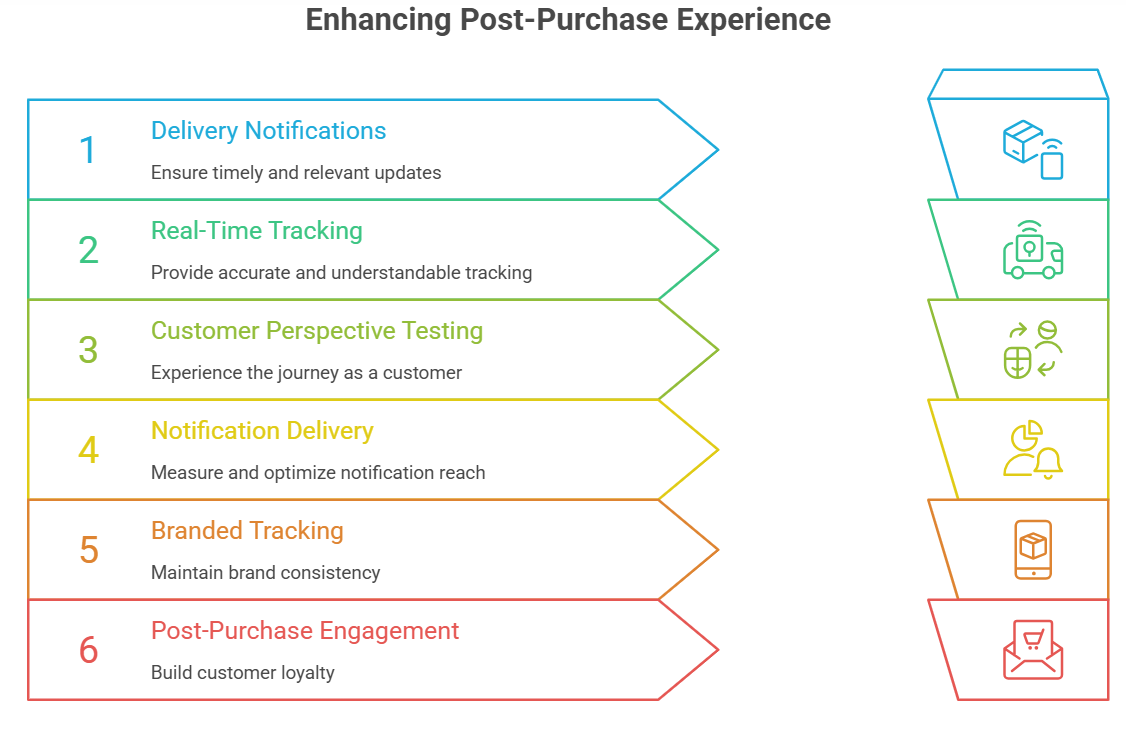
Identifying gaps in the post purchase experience requires looking beyond whether an order was delivered successfully. Businesses need to examine every interaction a customer has after checkout, from the first order shipment notification and delivery notifications to real time shipment tracking, delivery updates, exceptions, and returns. Small gaps, such as delayed notifications, unclear tracking information, broken links, or a lack of communication during delays, can create unnecessary frustration and increase support queries. By reviewing each stage of the post purchase journey from the customer’s perspective, ecommerce businesses can identify where information is missing, where communication can be improved, and where better post purchase engagement can strengthen the overall customer experience.
 1. Check Whether Customers Receive Timely Delivery Notifications
One of the easiest ways to identify a gap in the post purchase experience is to examine your delivery notifications. Customers should receive relevant communication when important order events occur. These may include order confirmation, order processing, shipment creation, dispatch, out-for-delivery status, successful delivery, delivery exceptions, and return initiation. If customers are not receiving these updates, the business may be creating unnecessary uncertainty. For example, imagine a customer places an order on Monday and receives an order confirmation immediately. They then hear nothing until Friday when the package suddenly arrives. Even though the order was delivered successfully, the communication experience was incomplete. Effective delivery notifications bridge the information gap between checkout and delivery. They allow customers to understand what is happening without needing to contact support. Businesses should therefore review their notification journey and ask whether customers are receiving the right message at the right stage.
2. Evaluate Your Real Time Shipment Tracking Experience
Real time shipment tracking is one of the most important components of a modern post purchase experience. Customers increasingly expect visibility after placing an order. However, simply providing a tracking number does not necessarily mean the business is providing useful tracking. A customer may click the tracking link and see a generic status such as “in transit” without any meaningful explanation. The shipment may have moved through multiple hubs, but the customer has no idea where it currently is or when it is likely to arrive. Businesses should evaluate what customers actually see when they track an order. Is the information updated regularly? Is the estimated delivery date visible? Can customers understand the current shipment status? Does the tracking experience work properly on mobile devices?These questions can reveal important gaps. Real time shipment tracking should make the delivery journey easier to understand rather than simply exposing raw carrier information.
3. Test the Real Time Order Tracking Journey From a Customer’s Perspective
Another useful way to identify gaps is to experience your own real time order tracking process as a customer.
Place a test order and follow the entire journey from confirmation to delivery. Check every message, link, tracking page, status update, and notification. Look at how much information is provided after checkout. Is the order status easy to understand? Does the tracking page load quickly? Does the estimated delivery date remain accurate? Are customers informed when something changes? The goal is to experience the journey exactly as the customer experiences it. Many businesses discover problems only when they test the complete journey themselves. A tracking link may work internally but look confusing to customers. A notification may contain too much information. A status may use logistics terminology that customers do not understand. Regularly reviewing real time order tracking can help identify these issues before they affect a large number of customers.
4. Look for Gaps in Notification Delivery
Sending a message does not necessarily mean the customer received or understood it. Businesses should examine notification delivery across email, SMS, WhatsApp, push notifications, or other communication channels they use. A customer may have opted out of one channel but still be reachable through another. Some messages may fail because of incorrect contact information, technical issues, provider failures, or communication preferences. The business should therefore measure notification delivery performance instead of assuming that every message reaches its intended recipient.
Important metrics can include delivery rate, failure rate, open rate, click-through rate, response rate, and channel performance. This analysis can reveal whether important delivery notifications are actually reaching customers. It can also show which communication channels are most effective at different stages of the post purchase journey.
5. Examine Whether Your Tracking Page Represents Your Brand
A customer who clicks a tracking link should not feel like they have suddenly left your ecommerce experience. This is where a branded tracking page can make a significant difference. Many businesses redirect customers to generic carrier tracking pages. These pages may provide useful shipment information, but they often offer little connection to the brand the customer actually purchased from. A branded order tracking page creates a more consistent experience by keeping the business identity visible throughout the shipment journey.
The page can include the company logo, colours, product information, delivery status, estimated delivery date, customer support information, and relevant recommendations. This transforms tracking from a purely functional activity into an opportunity for post purchase engagement. Instead of sending customers away from the brand, businesses can use tracking interactions to reinforce the relationship they started at checkout.
6. Measure Post Purchase Engagement
The post purchase experience should not end with tracking. Once customers have completed their purchase, businesses can use relevant interactions to build engagement without becoming intrusive. For example, a tracking page could provide useful product information, recommendations, loyalty benefits, customer support options, or content related to the purchased product.
This creates opportunities for post purchase engagement. However, businesses need to be careful about timing. Customers primarily want useful information while their order is moving through the delivery process. Promotional messages should therefore complement the experience rather than distract from it. A useful way to identify gaps is to measure what customers actually do after receiving tracking information. Do they return to the website? Do they engage with recommendations? Do they interact with support content? Do they purchase again? These signals can help businesses understand whether their post purchase communication is creating value.
7.Check Whether Your Order Shipment Notifications Are Clear
An order shipment notification may look like a small interaction, but it can have a significant effect on customer confidence. The message should clearly explain what has happened and what happens next. For example, instead of simply saying “Your order has shipped,” the notification could communicate that the package has been handed over to the carrier, provide the estimated delivery date, and offer a direct way to track the shipment. The notification should also be easy to understand.
Customers should not have to interpret internal logistics terminology such as hub codes, scan events, or carrier-specific status labels. A strong order shipment notification translates operational information into customer-friendly communication. Businesses should review these notifications regularly and ask whether a customer who has never seen the shipment process before would immediately understand the message.
8. Identify Where Customers Contact Support for Tracking Information
Your customer support data can reveal some of the biggest gaps in your post purchase journey. If customers frequently contact support asking questions such as “Where is my order?”, “When will my order arrive?”, or “Has my order been shipped?”, there may be a visibility problem.
These questions often indicate that existing delivery notifications or real time shipment tracking are not providing enough information. Businesses should analyze support tickets and categorize post-purchase questions. If a large percentage of support interactions are related to order status, delivery dates, shipment location, or delays, the business should investigate whether better tracking and proactive communication could answer those questions before customers need help. Reducing these repetitive queries does not only improve customer experience. It also reduces pressure on support teams.
9. Look for Gaps During Delivery Exceptions
A smooth shipment is relatively easy to communicate. The real test of a post purchase experience comes when something goes wrong. A shipment may be delayed, a delivery attempt may fail, a package may be held at a hub, or the estimated delivery date may change. Customers need communication during these moments. A common problem is that businesses send regular updates when everything is going according to plan but provide little information when an exception occurs. This can create frustration because the customer knows that something has gone wrong but does not know what to do next. Businesses should therefore review their exception communication.
Are customers notified about delays? Are revised delivery estimates provided? Are alternative actions explained? Can customers contact support easily? Effective real time order tracking should not simply show that a shipment is delayed. It should help customers understand what the delay means and what happens next.
10. Map the Entire Post Purchase Journey
The final and most important step is to map the complete post purchase journey.Do not look at delivery notifications, tracking, support, and returns as separate functions. Look at them as connected stages of one customer experience. A typical journey may look like:
Order Confirmation → Order Processing → Order Shipment Notification → Dispatch → Real Time Shipment Tracking → Out for Delivery → Delivery Notification → Delivered → Post Purchase Engagement → Return or Exchange
Mapping each stage helps businesses identify where information is missing, where communication is duplicated, and where customers may be forced to take unnecessary actions. The goal should be to create a seamless experience across the entire journey. Customers should not have to repeatedly search for information or move between disconnected systems. When the post purchase journey is connected, every interaction can build on the previous one.
Key Elements of a Strong Post Purchase Experience
A strong post purchase experience combines visibility, communication, convenience, and brand consistency.
| Element | What Customers Need | Business Opportunity |
| Delivery notifications | Timely order updates | Reduce uncertainty |
| Real time shipment tracking | Current shipment status | Improve transparency |
| Real time order tracking | Easy-to-understand progress | Reduce support queries |
| Branded tracking page | Consistent brand experience | Increase engagement |
| Order shipment notification | Clear dispatch information | Build confidence |
| Exception communication | Proactive delay updates | Improve customer satisfaction |
| Post purchase engagement | Useful interactions after checkout | Encourage repeat purchases |
| Returns communication | Clear next steps | Improve retention |
Each of these elements contributes to the overall post purchase experience. A weakness in one area can affect how customers perceive the entire delivery journey.
How to Measure Your Post Purchase Experience
Identifying gaps requires more than reviewing individual customer complaints. Businesses need measurable indicators that show how customers are experiencing the journey. Useful metrics include delivery notification delivery rate, tracking page visits, tracking engagement, customer support contacts related to order status, delivery exception communication rates, average response time, repeat purchase rate, return rates, and post purchase engagement. Businesses should also examine the relationship between these metrics.
For example, if tracking page visits are high but support questions about order status remain high, the problem may not be a lack of tracking. It may be that the tracking information is unclear. Similarly, if delivery notifications have a high sending rate but low engagement, businesses may need to evaluate the content, timing, or communication channel. This is why post purchase optimization should be based on customer behaviour rather than assumptions.
Common Post-Purchase Experience Gaps
Some gaps appear repeatedly across ecommerce businesses. One common issue is fragmented communication. Customers may receive an order confirmation from one system, a shipping notification from another, a carrier update from a third party, and a delivery notification from another platform. The result can feel inconsistent and confusing. Another common problem is generic tracking. A customer may receive a tracking link, but the experience takes them to a carrier page with limited brand identity and information that may not be easy for a customer to understand.Businesses may also struggle with reactive communication. Customers only receive information after they ask for it or after a problem has already occurred. A stronger approach is proactive communication, where important information reaches the customer before they need to search for it.
How a Branded Tracking Page Can Improve the Customer Journey
A branded tracking page can turn shipment tracking into an extension of the ecommerce experience. Instead of directing customers to a generic carrier website, businesses can provide a centralized tracking environment that reflects their brand and presents shipment information in a customer-friendly format. A branded order tracking page can include shipment status, estimated delivery date, product information, support options, FAQs, and other relevant content. This also creates an opportunity for post purchase engagement.Customers are already interested in their order, which means tracking can become a natural point of interaction between the customer and the brand. The key is to keep the experience useful. The goal is not to overload the page with promotions. The goal is to make tracking easier while creating opportunities for customers to continue interacting with the brand.
Why Real Time Tracking Matters Beyond Visibility
Real time shipment tracking is often viewed as a visibility feature, but its value extends far beyond simply showing where a package is. Accurate and timely tracking information can help businesses reduce customer uncertainty, identify potential delivery problems, improve communication, and create a smoother support experience. When customers can see where their order is, understand its current status, and get a clear view of the expected delivery timeline, they feel more confident about their purchase. Real time order tracking also gives customers greater control over the post purchase journey. Instead of having to contact customer support or repeatedly check different platforms for updates, customers can access shipment information in one place. This is particularly important when an order is delayed, stuck in transit, or approaching the delivery stage. Clear tracking information can explain what is happening and, where possible, provide an updated expected delivery date.
For businesses, real time shipment tracking can reduce the number of repetitive “Where is my order?” queries reaching customer support teams. When customers have access to accurate shipment updates, support teams spend less time responding to basic tracking questions and more time handling issues that genuinely require assistance. Over time, this can improve operational efficiency while also contributing to a better customer experience. Real time tracking can also provide useful logistics data. Businesses can identify recurring delays, understand where shipments frequently experience disruptions, compare carrier performance, and identify patterns across delivery locations. These insights can help ecommerce teams make better decisions about carrier selection, delivery promises, and customer communication.
The value becomes even greater when tracking is connected with delivery notifications and a branded tracking page. Instead of customers receiving isolated updates from different systems, businesses can create a more connected experience where shipment status, estimated delivery information, support options, and relevant updates are available throughout the post purchase journey. Ultimately, real time shipment tracking is not just about knowing where an order is. It is about keeping customers informed, giving operations teams better visibility, reducing avoidable support interactions, and turning shipment information into a more reliable post purchase experience.
Building a More Connected Post Purchase Experience
The best post purchase experiences are not created by sending more notifications. They are created by providing the right information at the right moment through the right channel. Customers should receive an order shipment notification when their order moves from processing to shipping, have access to real time shipment tracking while it is in transit, and receive relevant delivery notifications when the shipment reaches important stages.
Keep Customers Informed at Every Stage
Communication should continue throughout the post purchase journey. Customers should know when their order is shipped, when it is in transit, when it is out for delivery, and when it has been delivered. Clear updates reduce uncertainty and help customers avoid contacting support simply to find out where their order is.
Adapt Communication When Something Changes
The experience should also change when the shipment does. If an order is delayed, customers should receive a timely update with the latest information and revised delivery expectations where possible. If a delivery attempt fails, communication should explain what happened and what the customer needs to do next. Proactive communication can prevent a small delivery issue from becoming a larger customer experience problem.
Make Tracking Part of the Brand Experience
A branded tracking page can bring shipment information into the brand’s own customer experience instead of sending customers to a generic carrier website. It can display the current order status, estimated delivery date, support information, and other relevant details. A branded order tracking page can also support post purchase engagement through useful content, product recommendations, loyalty information, or care instructions.
Connect Delivery With the Complete Journey
The post purchase journey should not end when the package reaches the customer. After delivery, businesses can continue engagement through feedback requests, product guidance, loyalty benefits, or relevant recommendations. If a return or exchange is required, customers should also receive clear communication about pickup, reverse shipment, refund, or exchange status.
A connected experience brings these touchpoints together: Order Confirmation → Order Processing → Order Shipment Notification → Dispatch → Real Time Shipment Tracking → Out for Delivery → Delivery Notification → Delivered → Post Purchase Engagement → Return or Exchange. When every stage is connected, customers know what is happening, what comes next, and where to get help if something goes wrong.
How eShipz Can Improve Your Post Purchase Experience
Managing post purchase communication across multiple carriers, shipment statuses, customer channels, and delivery events can become difficult as ecommerce operations scale. Customers expect accurate updates throughout the delivery journey, while operations teams need a reliable way to manage shipments, identify exceptions, and respond to issues quickly. eShipz helps bring these activities together to create a more connected shipping and customer experience.
Improve Shipment Visibility
eShipz helps businesses bring shipment information together across carriers, giving teams better visibility into the movement of orders. This information can also support customer-facing experiences, allowing businesses to provide clearer real time shipment tracking and help customers understand the current status of their orders without relying on manual updates.
Deliver Timely Customer Updates
Businesses can use shipment events to provide relevant delivery notifications throughout the post purchase journey. Customers can be informed when an order is shipped, in transit, out for delivery, delivered, or affected by a delay or exception. Timely communication reduces uncertainty and can help reduce unnecessary “Where is my order?” support queries.
Create a Branded Tracking Experience
A branded tracking page allows businesses to keep customers connected to their own brand instead of directing them to generic carrier tracking pages. Customers can access shipment status, delivery information, and other relevant details through a familiar branded experience. This also creates opportunities for post purchase engagement through product recommendations, support information, loyalty programs, or useful content.
Connect Tracking With Delivery Operations
Shipping information becomes more valuable when it can be connected to operational workflows. Delivery delays, failed attempts, exceptions, and other shipment events can be identified and acted upon more quickly. This helps operations teams respond proactively instead of waiting for customers to report an issue.
Build a More Connected Post Purchase Journey
By bringing carrier management, shipment visibility, tracking, delivery communication, and operational workflows together, eShipz helps businesses create a smoother experience from checkout to delivery. Customers get better visibility and communication, while operations teams get the information they need to manage shipments more effectively. The result is a more connected post purchase journey where logistics operations and customer experience work together rather than operating as separate processes.
From Order Tracking to Customer Experience
The post purchase experience should not be treated as an operational afterthought. It is an important part of the relationship between an ecommerce brand and its customer. Every delivery notification, every tracking interaction, every order shipment notification, and every exception update contributes to how customers perceive the brand. Real time shipment tracking gives customers visibility. Real time order tracking gives them control. A branded tracking page keeps the brand present throughout the delivery journey. Better notification delivery keeps customers informed, while relevant post purchase engagement creates opportunities to build a longer-term relationship. The biggest opportunity is to connect all of these touchpoints into one consistent experience.
When businesses understand where customers experience uncertainty, where communication breaks down, and where tracking fails to answer basic questions, they can identify the gaps that matter most. The result is more than better tracking. It is a more connected post purchase journey that can reduce support friction, improve customer confidence, strengthen brand engagement, and create a better overall ecommerce experience.
Looking to create a more connected post-purchase experience? eShipz helps ecommerce businesses bring shipment tracking, delivery communication, carrier management, and post-purchase shipping workflows together to create a smoother experience from checkout to doorstep