




Logistic analytics is now central to modern ecommerce operations. Businesses need tighter control over shipping costs, better delivery performance, and a delivery experience that meets higher customer expectations. Every order produces logistics data, including carrier selection, shipping costs, transit times, delivery attempts, exceptions, returns, and customer interactions. Bringing that information together changes logistics from a back-office task into a source of useful business insight.
DHL’s 2025 E-Commerce Trends Report shows why this matters. It found that 96% of global ecommerce retailers say their logistics offering is important to securing sales, while 55% of global ecommerce businesses already use AI across their platforms. The same research found that 86% of retailers say free delivery and returns improve sales, linking logistics performance directly to revenue. DHL 2025 E-Commerce Trends Report.
Customer expectations are rising just as quickly. DHL’s 2025 shopper research found that 81% of shoppers abandon their carts when their preferred delivery option isn’t available, and 70% want AI-powered shopping tools. Based on responses from 24,000 online shoppers across 24 markets, the research shows that delivery options, convenience, and technology now shape the ecommerce buying experience. DHL E-Commerce Trends Report 2025
AI adoption has moved well past the trial stage. McKinsey reports that nearly 90% of surveyed shippers have adopted at least one transportation AI use case, while 96% have deployed at least one AI or digital use case in warehousing. McKinsey: Creating value from AI and digital capabilities in logistics operations. AI powered logistics is being used to solve day-to-day operational problems, not held back as a future-facing concept. logistics and analytics show businesses what is happening across their shipping networks. AI in ecommerce logistics can spot patterns, predict risks, and suggest stronger decisions. ecommerce logistics automation puts those decisions into action without forcing teams to manage every shipment by hand.
This article examines how logistics data, logistics analytics, AI, and logistics optimization software help ecommerce businesses improve delivery operations, cut inefficiencies, improve customer experience, and build logistics networks that adapt over time.
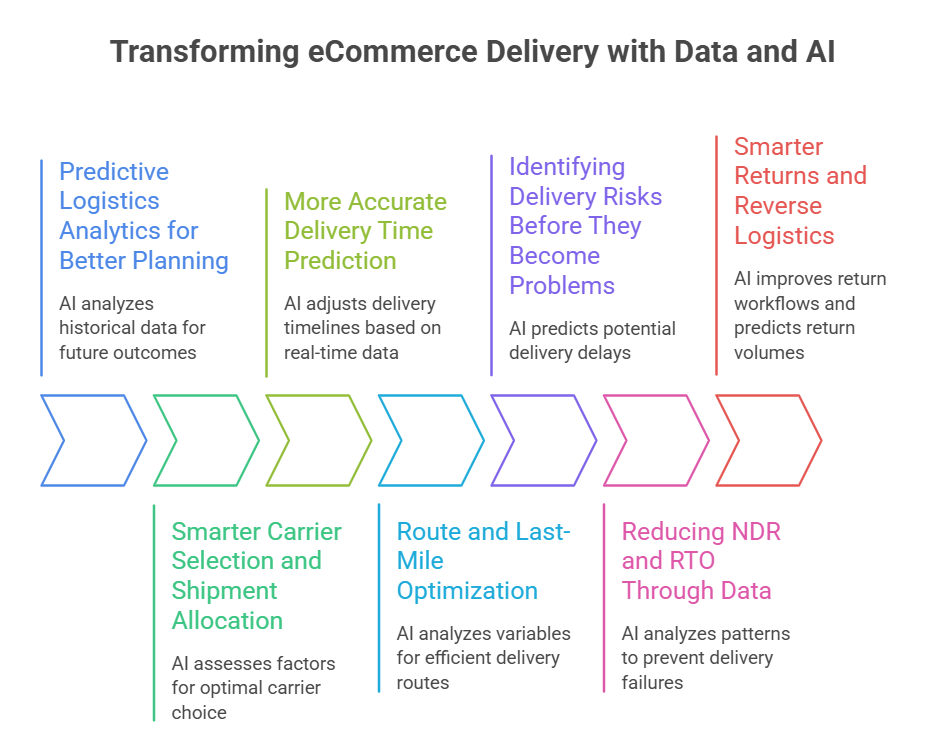
7 Ways Logistics Analytics and AI Are Transforming eCommerce Delivery
The combination of logistics data, AI, analytics, and automation is changing how ecommerce businesses manage the delivery lifecycle. From planning and carrier selection to tracking, exceptions, returns, and customer communication, intelligent technologies can make logistics more predictive and responsive.
-
Predictive Logistics Analytics for Better Planning
Traditional logistics reporting explains what happened in the past. Businesses review last month’s delivery performance, carrier costs, RTO rates, or average transit times to assess operations. Modern logistics analytics goes further by showing what is likely to happen next. AI systems analyze historical logistics data alongside current operational signals, spotting patterns and forecasting future outcomes. That helps with demand planning, capacity management, shipment planning, inventory allocation, and delivery preparation. For example, if logistics data shows order volumes rising before a major shopping event, businesses can secure extra carrier capacity ahead of time. If a region regularly faces delivery delays during certain periods, teams can factor that risk in before dispatching shipments.
That turns logistics analytics into more than a reporting tool. It becomes a planning tool that lets logistics teams prepare for operational changes rather than react after they happen. AI can keep learning from new logistics data, so predictions stay relevant as order patterns, customer behaviour, carrier performance, and delivery conditions change.
-
Smarter Carrier Selection and Shipment Allocation
Carrier selection is a critical decision in ecommerce logistics. Many businesses choose the carrier with the lowest shipping cost, but that choice doesn’t always produce the best result. A cheaper carrier may have longer transit times, higher RTO rates, limited serviceability, or inconsistent performance in specific locations. AI powered logistics lets businesses assess several factors before assigning a shipment, including shipping cost, expected delivery time, destination serviceability, past carrier performance, RTO rates, COD success rates, package weight, dimensions, product category, customer location, and current carrier capacity.
Logistics optimization software can use these signals to recommend or automatically choose the best carrier for each shipment. The goal isn’t simply to find the cheapest option. It’s to select the carrier most likely to deliver successfully while meeting cost and service requirements. Over time, logistics analytics can reveal carrier strengths in far greater detail. One carrier may perform well for metro deliveries, while another is more reliable in remote locations or better suited to COD shipments. This creates a smarter carrier allocation strategy built on actual logistics data, not assumptions.
-
More Accurate Delivery Time Prediction
Customers want to know when their orders will arrive, but delivery timelines often change. Traffic, weather, carrier capacity, warehouse processing, hub congestion, route conditions, and local delivery performance can affect the final delivery date.
AI in ecommerce logistics helps businesses make delivery predictions that adjust as conditions change. Rather than relying only on standard carrier transit times, AI can analyze historical and real-time logistics data to estimate the probability of delivery within a specific timeframe. As new shipment events appear, the expected delivery timeline can be updated. This improves estimated delivery dates and helps businesses spot potentially delayed shipments sooner. For example, if a shipment usually reaches a particular hub within 24 hours but remains there much longer, the system can detect the anomaly and flag it. Businesses can then act before the customer faces a major delay. More accurate delivery predictions also lead to clearer customer communication, since customers receive realistic delivery expectations instead of overly optimistic estimates.
-
Route and Last-Mile Optimization
The last mile is often one of the most complex and expensive parts of ecommerce logistics. Delivery routes can be affected by traffic, weather, vehicle capacity, delivery density, road conditions, customer availability, and changing delivery priorities.
AI powered logistics can analyze these variables to support more effective route planning. Instead of relying entirely on fixed routes, intelligent systems can evaluate current conditions and recommend more efficient delivery sequences. For businesses operating large delivery networks, this can help improve vehicle utilization, reduce unnecessary travel, and support faster deliveries. Logistics optimization software can also help identify locations where delivery performance is consistently below expectations. For example, logistics data may show that shipments to a particular area regularly experience longer transit times because of a specific hub or route. Once this pattern is identified through logistics and analytics, businesses can evaluate alternative routing or fulfillment strategies. The goal is not simply to make routes shorter. The goal is to make the entire delivery operation more efficient.
-
Identifying Delivery Risks Before They Become Problems
One of the strongest applications of AI in ecommerce logistics is predictive exception management. Traditional tracking systems generally show where a shipment is and whether it has already been delayed. AI can help businesses identify whether a shipment is likely to become delayed. A shipment may not technically be late yet, but several signals may indicate that it is at risk. These signals can include repeated hub delays, missing scans, unusual transit times, changes in carrier performance, route disruptions, location-specific delivery problems, or historical delivery patterns.
AI can analyze these signals and assign risk levels to shipments. High-risk shipments can then be prioritized for monitoring or intervention. This changes the role of logistics teams. Instead of manually checking every shipment, teams can focus on the shipments most likely to require attention. Logistics analytics therefore becomes a prioritization mechanism that helps businesses determine which exceptions need immediate action and which shipments can continue through their normal workflow.
-
Reducing NDR and RTO Through Data
Non-delivery reports and return-to-origin shipments can create significant operational costs for ecommerce businesses. A failed delivery does not only mean another delivery attempt. It can also create additional transportation costs, customer support activity, reverse logistics expenses, inventory handling, and potential revenue loss. Logistics data can help businesses understand why these failures occur. Analytics can reveal whether specific pin codes have higher failed delivery rates, whether certain carriers experience more NDRs, whether COD orders have a higher failure probability, or whether particular products and customer segments are associated with repeated delivery issues. AI can then identify patterns across large shipment volumes and predict which upcoming orders may have a higher risk of failure. Businesses can use these insights to create targeted workflows. High-risk shipments may receive proactive customer communication, alternative carrier allocation, additional delivery instructions, or specialized NDR workflows.
This is a practical example of how AI powered logistics can move from analysis to action. Instead of simply reporting that an RTO occurred, businesses can use logistics analytics to understand why it happened and how similar failures can potentially be prevented.
-
Smarter Returns and Reverse Logistics
The logistics journey does not end when a customer receives an order. Returns create another movement of products, inventory, information, and money. For ecommerce businesses, managing this reverse journey efficiently is becoming increasingly important. Logistics analytics can help businesses understand return patterns across products, locations, customer segments, carriers, and return reasons. For example, analytics may reveal that a particular product category has unusually high return rates in one region. Another analysis may show that reverse shipments through a particular carrier consistently take longer to reach the warehouse. AI can use these patterns to improve return workflows. It can help predict return volumes, identify unusual return behaviour, recommend reverse logistics routes, prioritize returned inventory, and identify potential operational issues. When these insights are connected with ecommerce logistics automation, businesses can trigger workflows automatically instead of requiring teams to manage every return manually. This creates a more connected approach to forward and reverse logistics.

Why Logistics Analytics Matters in eCommerce
Ecommerce logistics has become significantly more complex. A growing online business may operate multiple warehouses, work with several carriers, serve thousands of pin codes, manage COD and prepaid orders, and handle both forward and reverse shipments. At the same time, customers expect accurate delivery estimates, real-time tracking, flexible delivery options, and easy returns. Managing all these variables manually makes it difficult to identify the real causes behind logistics problems. A shipment may be delayed because of a carrier issue, a warehouse processing problem, a hub-level bottleneck, a route disruption, or a combination of several factors. Similarly, rising RTO rates may be connected to customer availability, COD behaviour, address quality, carrier performance, or delivery attempts.
This is where logistics analytics becomes valuable. Instead of looking at individual shipments separately, businesses can analyze logistics data across carriers, locations, warehouses, products, routes, customers, and time periods. This makes it possible to identify patterns that would otherwise remain hidden. For example, a business may discover that one carrier delivers faster in metropolitan areas but has higher RTO rates in certain tier-2 cities. Another carrier may have slightly higher shipping costs but significantly better delivery success rates for COD orders. Without analytics, these differences may be difficult to see. With the right logistics and analytics capabilities, businesses can use these insights to make better shipping decisions.
The Role of Logistics Optimization Software
As ecommerce businesses grow, collecting logistics data is not enough. They also need technology that can turn that information into decisions and actions. This is where logistics optimization software becomes important. Modern platforms can connect data from carriers, orders, warehouses, tracking systems, shipping workflows, and customer interactions into a centralized operational environment. Businesses can then use logistics analytics to understand performance and automation to act on those insights. A strong logistics optimization platform can support carrier selection, shipment allocation, tracking, delivery prediction, exception management, NDR workflows, returns, reporting, and operational monitoring. The real value comes from connecting these capabilities rather than treating them as isolated functions. For example, logistics analytics may identify that a particular carrier has a higher RTO rate for a specific region. The optimization layer can then use that insight when allocating future shipments. This creates a continuous improvement cycle:
Logistics Data → Analytics → AI Insights → Decision → Automation → New Data → Continuous Optimization
The more effectively businesses connect these stages, the more intelligent their logistics operations can become.
Key Features of AI-Powered Logistics
AI powered logistics is not a single technology. It is a combination of capabilities that work together to improve logistics decision-making.
| AI Capability | Logistics Application | Business Impact |
| Predictive analytics | Demand and delivery forecasting | Better planning |
| Machine learning | Carrier and route optimization | Smarter decisions |
| Anomaly detection | Shipment and delay monitoring | Faster intervention |
| Recommendation engines | Carrier and shipping decisions | Improved efficiency |
| Real-time analytics | Shipment visibility | Better operational control |
| Predictive alerts | Exception management | Reduced response time |
| Natural language processing | Customer support | Faster communication |
| Automated workflows | NDR and returns | Less manual effort |
When these capabilities are connected with reliable logistics data, businesses can move beyond basic automation and create more intelligent shipping operations.
How logistics Analytics Work Together
The relationship between logistics and analytics is becoming increasingly important as shipping networks become more complex. Logistics generates the data, analytics interprets the data, AI identifies patterns and makes predictions, and automation turns those insights into action. Together, these capabilities create a connected logistics ecosystem. Consider a simple example: an ecommerce business notices that delivery failures have increased in a particular region. Logistics Analytics identifies the increase, while further analysis shows that a specific carrier is experiencing lower delivery success in that region. AI can then evaluate upcoming shipments and identify those with a higher probability of failure. The business can respond by changing carrier allocation, triggering proactive customer communication, or applying a specific delivery workflow. Without logistics data, the problem may not be visible. Without analytics, the pattern may not be understood. Without AI, predicting future risk becomes more difficult. Without automation, the business may still need to act manually. Together, they create a much more responsive logistics operation.
Benefits of Logistics Analytics for eCommerce Businesses
The benefits of logistics analytics extend well beyond better reporting. One of the biggest advantages is cost optimization, as businesses can identify expensive shipping lanes, inefficient carrier relationships, repeated delivery failures, unnecessary transportation activity, and operational bottlenecks. Another major benefit is better delivery performance. By understanding carrier and route performance, businesses can make more informed allocation decisions and identify potential delays earlier. Logistics analytics can also improve customer experience because more accurate delivery predictions, proactive notifications, and faster exception handling can make the shipping journey more transparent and predictable. There are also significant benefits for internal teams. Instead of spending hours collecting reports and manually monitoring shipments, logistics teams can focus on exceptions, strategic decisions, and continuous improvement. Most importantly, data-driven logistics can create a stronger foundation for scalability. As order volumes increase, businesses can use technology to manage greater operational complexity without increasing manual effort at the same rate.
How eCommerce Logistics Analytics Complements AI
AI can identify what should happen next, but businesses also need systems capable of executing those decisions. This is where ecommerce logistics automation becomes important. Suppose AI identifies that a shipment has a high probability of delay. An automated workflow can flag the shipment, notify the relevant team, trigger customer communication, or initiate another operational action.
Similarly, if logistics analytics identifies that one carrier consistently performs better for a specific region, an automated carrier allocation workflow can use that insight for future shipments. This creates a powerful relationship between intelligence and execution. AI provides the intelligence. Analytics provides the visibility. Automation provides the execution. Together, these capabilities can create a more responsive and efficient ecommerce logistics operation.
How to Build a Data-Driven eCommerce Logistics Analytics
Businesses do not need to transform their entire logistics operation overnight. A practical approach starts with understanding the logistics data they already generate. The first step is to identify important logistics metrics such as delivery success rate, transit time, RTO rate, NDR rate, shipping cost, carrier performance, return cycle time, and exception frequency. The next step is to bring this information together so that teams have a consistent view of logistics performance. Once reliable data is available, businesses can identify recurring problems and determine where AI, analytics, or automation can create the greatest impact. For some businesses, carrier optimization may be the biggest opportunity. For others, the focus may be delivery prediction, NDR reduction, returns management, shipment visibility, or cost optimization. The objective should not be to introduce AI simply because it is available. The objective should be to apply AI where it can solve a measurable logistics problem.
The Future of AI in eCommerce Logistics
The future of AI in ecommerce logistics will be increasingly predictive. Instead of simply showing businesses what happened to a shipment, intelligent systems will help them understand what is likely to happen next. This shift will make AI powered logistics more deeply integrated into everyday shipping decisions, from carrier selection and delivery planning to exception management and customer communication.
Predictive Logistics Decisions
AI will increasingly help businesses identify potential delivery risks before they become operational problems. By analyzing logistics data such as carrier performance, shipment history, delivery locations, transit times, and exception patterns, businesses can identify where delays or failures are more likely to occur. This allows teams to take action earlier instead of waiting for a delivery problem to happen.
Smarter Carrier Allocation
Carrier selection can also become more intelligent. Instead of relying only on fixed rules or historical preferences, AI systems can continuously evaluate carrier performance and recommend the most suitable option based on factors such as destination, service level, delivery history, cost, and current performance. This can support better logistics optimization and help businesses balance delivery speed, cost, and reliability.
From Reporting to Actionable Logistics Data
Businesses will also move away from treating logistics data as something used only for reports and dashboards. With AI and logistics analytics, data can become an operational asset that supports real-time decisions. Teams can identify changing delivery patterns, monitor carrier performance, detect exceptions, and understand where improvements are needed without manually analyzing every shipment.
The Role of eShipz
This is where platforms such as eShipz can support the move toward smarter ecommerce logistics. By bringing carrier management, shipment visibility, tracking, automation, and logistics data together, eShipz can help businesses build a stronger foundation for AI-driven logistics operations. Connected shipping information can help teams monitor performance, identify trends, and improve everyday shipping workflows.
AI and Human Expertise Together
At the same time, human expertise will remain important. AI can identify patterns, highlight risks, and make recommendations, but experienced teams are still needed to define business priorities, manage unusual situations, and make strategic decisions. The strongest logistics operations will therefore combine human expertise with AI, logistics analytics, automation, and reliable operational data.
The future of ecommerce logistics is not about replacing people with AI. It is about giving logistics teams better information, faster insights, and smarter tools so they can make more informed decisions and create a more efficient, predictable, and customer-focused delivery experience.
From Logistics Analytics to Better Delivery Decisions
The future of ecommerce delivery will not be defined by speed alone. It will be defined by how intelligently businesses can manage the entire delivery journey. Logistics analytics provides the visibility needed to understand performance. Logistics and analytics together help businesses identify patterns hidden within everyday operations. AI in ecommerce logistics adds predictive intelligence, while logistics optimization software helps turn those insights into better decisions. When combined with ecommerce logistics automation, these capabilities can help businesses reduce unnecessary costs, improve carrier performance, identify delivery risks earlier, manage exceptions more efficiently, and create a more predictable customer experience.
The real opportunity is not simply to collect more logistics data. It is to make that data useful. Businesses that can connect their logistics data, analytics, AI, and automation will be better positioned to build delivery operations that continuously learn, adapt, and improve. As ecommerce continues to grow, smarter logistics will increasingly become a competitive advantage. The businesses that turn their logistics data into action will be the ones best prepared for changing customer expectations, growing order volumes, and increasingly complex delivery networks. Looking to make your shipping operations more intelligent and data-driven? eShipz helps businesses connect shipping automation, carrier management, tracking, visibility, and logistics workflows to build a more efficient ecommerce delivery experience.