




A shipping API for custom stores is a software connection that links your storefront directly to courier and carrier networks, so shipping rates, order booking, labels, and tracking updates move automatically instead of being handled by hand. In simple terms, a shipping API is a set of rules that lets your website “talk” to a carrier’s system, sending order details out and getting rates, labels, and tracking numbers back in return, usually within a second or two.
This matters more for stores built on custom or headless architecture than for stores running on a standard theme. A headless or custom-built store does not come with a plug-and-play shipping plugin the way a template-based platform does. It needs an integration built through APIs, which gives the brand far more control over checkout, order routing, and fulfillment logic, but also means the shipping layer has to be built rather than switched on. According to McKinsey research on e-commerce delivery preferences, the majority of shoppers now say on-time, reliable delivery matters more to them than pure speed, and they are far more likely to abandon a cart when shipping costs or delivery windows feel unpredictable. That shift puts pressure on every custom store to get its shipping infrastructure right from the start, not bolt it on later.
An API-based shipping solution for custom stores typically covers a set of core capabilities: live shipping rates at checkout, automated order booking with the courier, label generation, real-time tracking, courier or carrier selection logic, and returns or NDR (non-delivery report) management. Together, these functions turn shipping from a manual, order-by-order task into a connected, automated part of the store’s backend.
For a store built on a standard ecommerce platform, most of this comes bundled into an app or extension that can be installed in a few clicks. For a custom-built or headless store, that convenience is not automatic. The development team has to decide which shipping software or shipping application to connect to, how order data should flow from checkout to the carrier, and how tracking information should flow back to the customer. That is exactly the gap an API-based shipping solution for custom stores is built to close.
Why Is an API-Based Shipping Solution Essential for Custom Stores?
Custom and headless stores are built for flexibility, and the shipping layer needs to match that flexibility. Here is why an API-based approach has become close to mandatory for growing stores.
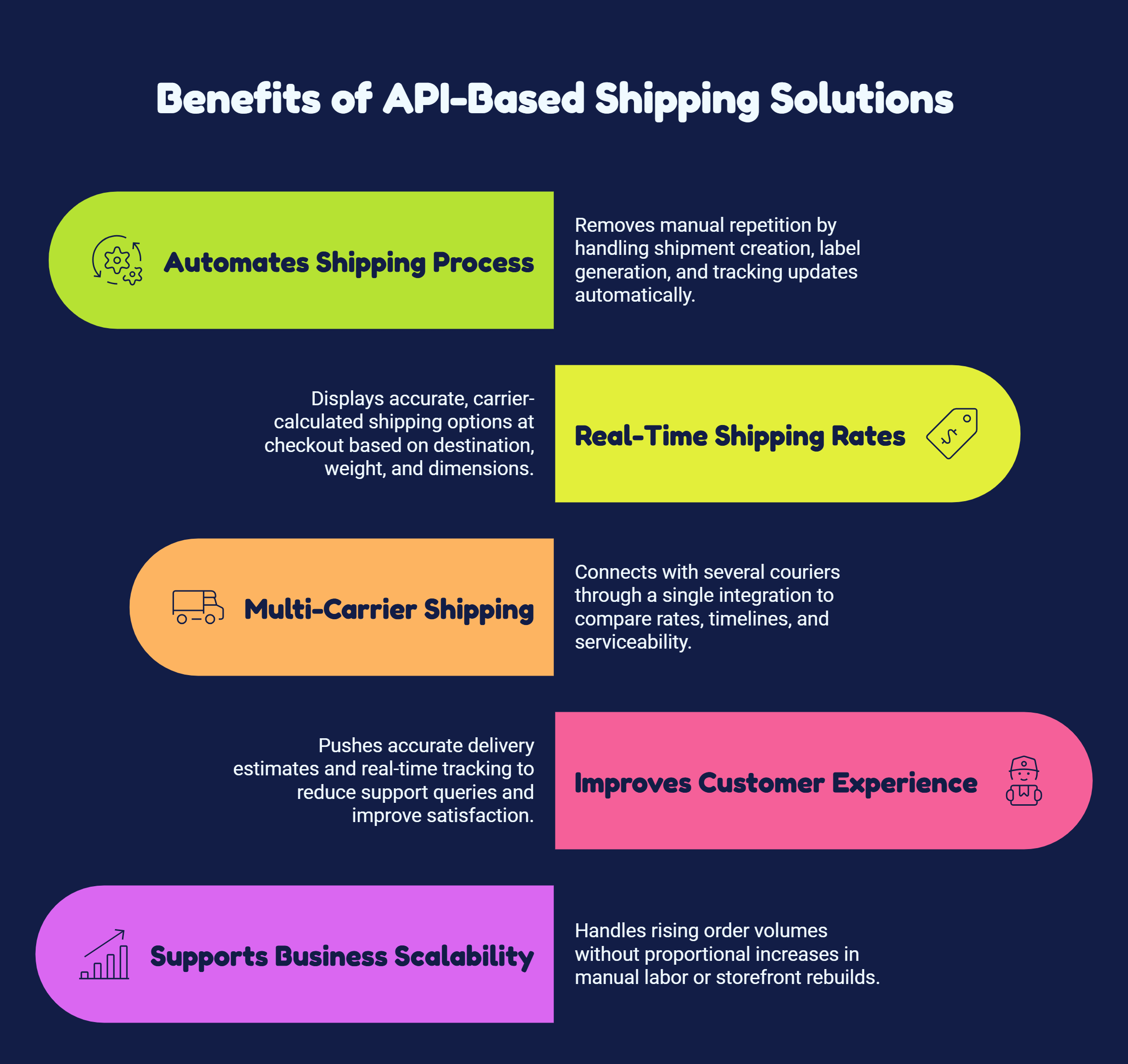
Automates the Shipping Process
Manual shipping means someone logs into a carrier portal, keys in the same order details again, prints a label, and copies a tracking number into a sheet or email. A shipping API removes that repetition. Once an order is placed, the API handles shipment creation, label generation, and tracking updates without anyone re-entering data. This alone cuts down the human error that comes from tired eyes typing the same address for the fiftieth time in a day.
Provides Real-Time Shipping Rates
A shipping API pulls live rates based on the destination, package weight, dimensions, and the carrier being queried. Instead of showing a flat or estimated shipping charge, the storefront can display accurate, carrier-calculated options right at checkout. This builds trust with the shopper and avoids the price surprises that often lead to abandoned carts.
Enables Multi-Carrier Shipping
A multi carrier shipping API lets a custom store connect with several couriers through a single integration rather than building a separate connection for each one. This makes it possible to compare rates, delivery timelines, and serviceability across carriers, and to route each order to whichever carrier makes the most sense for that specific shipment, whether that decision is based on cost, location, or delivery speed. Serviceability checks matter here too. Knowing which courier can actually reach a given pincode before a shipment is booked, as covered in Pincode Serviceability Explained: Choosing the Best Courier for Your Business, helps avoid failed deliveries before they happen.
Improves Customer Experience
Customers want to know when their order will arrive and where it currently is. An API-based setup can push accurate delivery estimates and real-time tracking straight to the customer, which reduces the volume of “where is my order” queries that otherwise pile up in a support inbox. Fewer support tickets and calmer customers tend to go hand in hand with fewer returns and better repeat purchase rates. For a closer look at how tracking data and non-delivery reports connect end to end, see Warehouse to Doorstep: A Complete Guide to End-to-End Shipment Tracking and NDR Management.
Supports Business Scalability
As a custom store grows, order volume grows with it, but manual shipping work does not scale the same way. An API-based shipping solution for custom stores lets a business handle rising order counts without a proportional increase in manual labor. It also means new carriers, regions, or shipping rules can be added through configuration rather than a rebuild of the storefront itself.
Taken together, these five points explain why so many growing brands stop treating shipping as an afterthought. A shipping API integration is not just a technical convenience. It directly affects how much manual work a team carries, how accurate the checkout experience feels to a shopper, and how easily the business can take on more orders without hiring proportionally more people to process them.
What Does the Current Market Trend Have to Say About API-Based Shipping?
Shipping automation is not a niche interest anymore. A few clear patterns explain why the topic is getting more attention right now.
Shift Toward Custom and Headless Commerce
More brands want a storefront experience that looks and feels different from a templated theme. Headless commerce, where the front end is separated from the backend commerce engine, has become a common way to achieve that. This separation is exactly why APIs matter so much: without a built-in shipping plugin, the storefront has to connect to courier systems through a dedicated integration.
Growing Demand for Shipping Automation
As order volumes climb, manual shipping workflows become harder to sustain. Shipping tools on the market today are increasingly built around automation, tracking visibility, and multi-carrier management rather than single-carrier, single-purpose tools.
Multi-Carrier Integration Is Becoming Important
Depending on a single courier leaves a business exposed if that courier has a bad week, raises rates, or cannot serve a particular region well. Businesses are increasingly using several carriers together and selecting the right one per shipment, based on cost, delivery speed, or where the package is going. This holds true across delivery types too. Stores balancing quick, local orders alongside standard nationwide shipping often need a platform built for both, a point explored in Best Shipping Platform for Hyperlocal and National Deliveries in India.
Real-Time Visibility Is Becoming a Customer Expectation
Shoppers now expect to see where their order is without asking. A shipping API integration can push tracking data directly into the storefront or into customer-facing notifications, keeping that expectation met without extra manual work.
API-First Infrastructure Is Gaining Importance
Modern ecommerce operations increasingly connect storefronts, ERPs, order management systems, warehouses, and carriers through APIs. A shipping API for custom stores is one piece of that larger API-first infrastructure, and it usually needs to work alongside these other connected systems rather than in isolation.
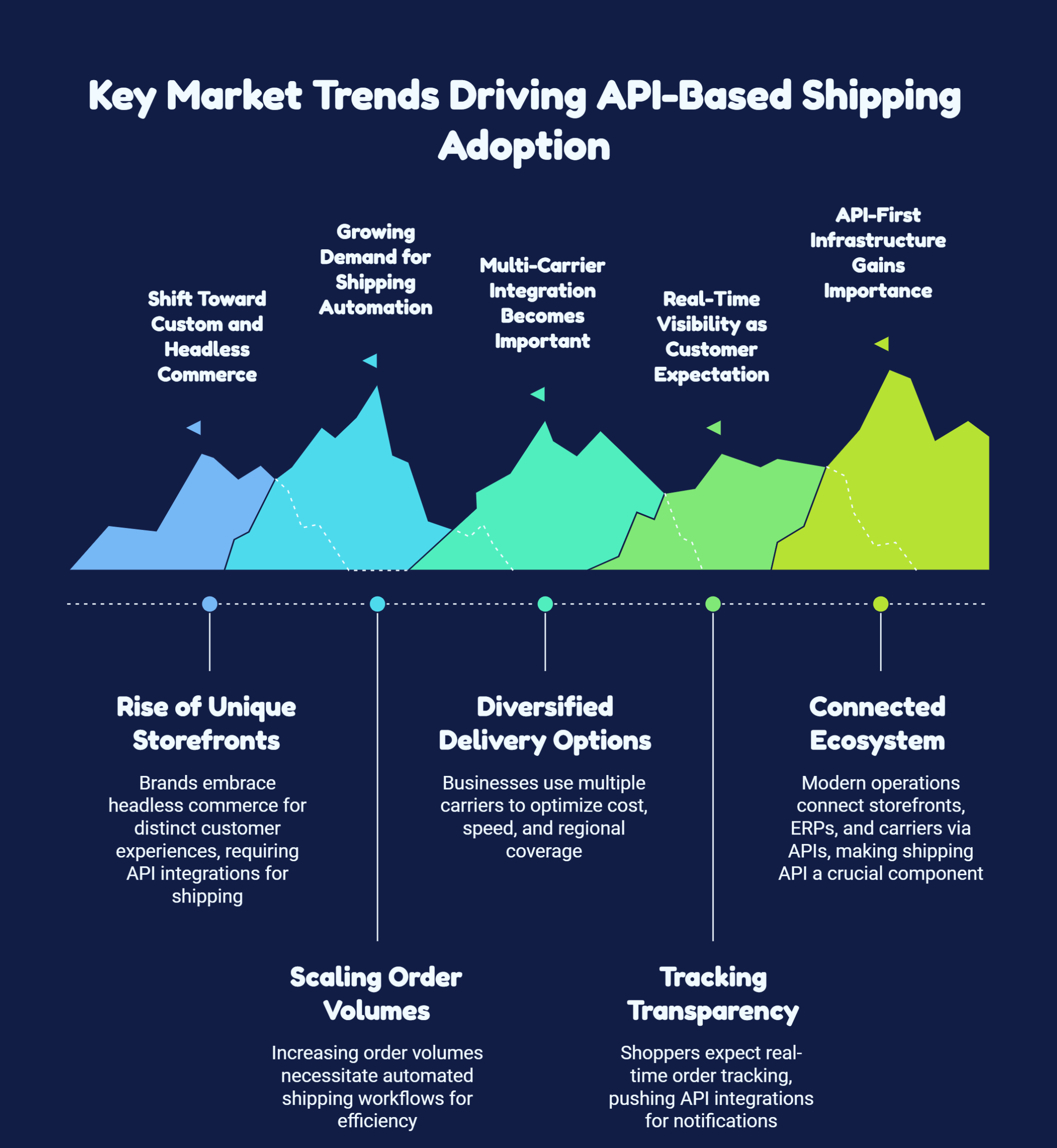
This trend matters because it changes how shipping decisions get made inside a business. A shipping API is no longer chosen on its own. It is chosen as part of a wider stack, alongside the order management system, the warehouse setup, and the storefront itself. A shipping software choice that cannot talk to the rest of that stack, through webhooks, clean documentation, and predictable data formats, tends to become a bottleneck rather than a solution, no matter how good its individual features look on paper.
Who Benefits From an API-Based Shipping Solution and How?
An API-based shipping solution for custom stores does not just help one type of business. It benefits several roles across the ecommerce chain, each in a different way.
| User / Business | How They Benefit |
| D2C brands | Automate shipping tasks and manage multiple carriers from one system |
| Custom or headless stores | Gain greater control over the checkout and shipping experience |
| High-volume sellers | Reduce manual work and speed up order fulfillment |
| B2B ecommerce businesses | Build shipping rules and workflows suited to bulk or contract orders |
| Marketplaces | Connect multiple sellers, carriers, and fulfillment systems in one place |
| Developers and tech teams | Integrate shipping functionality directly into existing systems |
| Operations teams | Centralize shipment management, exceptions, and tracking |
| Customers | Receive accurate delivery estimates and real-time tracking updates |
A quick way to think about this: a custom fashion brand shipping domestically might mainly care about live rates and NDR management, since failed deliveries and return-to-origin shipments are where they lose the most margin. A B2B store shipping bulk orders across states might care more about carrier selection logic and shipment consolidation. The same underlying shipping API integration can serve both, but the rules each business configures around it will look quite different.
Key Business Benefits
- Lower operational workload for the team handling orders
- Faster order fulfillment from cart to courier pickup
- Fewer manual errors in addresses, labels, and shipment data
- Better control over shipping costs through carrier comparison
- Improved delivery visibility for both the business and the customer
- Easier scaling as order volume grows
- A more consistent, trustworthy customer experience
How to Choose the Best Shipping API for Your Custom Store?
This is the part that matters most once a business has decided to move forward. Picking the right shipping API integration shapes how smoothly the rest of the shipping process runs.
Check API and Integration Capabilities
Look for REST API availability, clear and complete documentation, SDKs where relevant, webhook support for real-time events, solid authentication and security practices, and a sandbox or testing environment so your team can test before going live. Documentation quality is easy to underestimate until a developer is stuck on a poorly explained endpoint at 11 p.m. before a launch. Ask to see the actual API reference before committing, not just a sales deck describing it.
Evaluate Carrier Coverage
Confirm which domestic and international carriers are supported, whether new carriers can be added without a major rebuild, and whether the solution actually covers the regions your store ships to today and plans to ship to next. If international expansion is even a possibility over the next year or two, it is worth checking now rather than discovering a coverage gap after the storefront is already built around a narrower set of carriers.
Look at Core Shipping Features
A capable shipping solution for ecommerce should support rate calculation, shipment creation, label generation, tracking, address validation, cancellations, returns and RTO (return to origin) handling, NDR management, and cash-on-delivery workflows if your market needs them. Businesses that handle a meaningful share of cash-on-delivery orders should also look closely at how a provider reconciles those payments, a step covered in The Benefits of COD Reconciliation in Delivery Management. It is also worth checking how a platform flags risky orders before they ship, since fraud and RTO prediction are becoming a bigger part of what shipping software is expected to handle, as discussed in Shipping Platforms with Fraud and RTO Prediction. On the returns side, look at whether the API supports a proper reverse logistics workflow, as outlined in Reverse Logistics Software for D2C Brands in India, and whether customers can raise a return themselves without waiting on support, the approach covered in How Can Ecommerce Brands Offer a Seamless Self-Serve Returns Portal.
Consider Scalability
Ask whether the API can handle your current order volume comfortably, and more importantly, what happens during peak sales periods. Check for API rate limits and whether the solution supports multiple warehouses or fulfillment locations if your operation is growing in that direction. A shipping API that works fine at 50 orders a day can behave very differently at 5,000 orders a day during a sale, so it is worth asking the provider directly how their system performs under a sudden spike in volume rather than assuming it will hold up. Efficient dispatch also depends on how well orders are grouped and routed once volume climbs, a topic covered in Route Optimization: A Guide to Maximize Logistics Efficiency.
Evaluate Pricing
Compare per-shipment or per-API-call costs, monthly subscription fees, setup or integration charges, carrier-specific charges, and the cost of any additional features you might need later. A cheap starting price with expensive add-ons can end up costing more than a straightforward plan.
Check Developer Support
The quality of documentation, sandbox access, technical support responsiveness, integration assistance, and API uptime all affect how smooth the rollout will be and how quickly issues get resolved once you are live.
Consider Customization
The solution should let you build shipping rules based on destination, weight, cart value, product type, delivery speed, or preferred carrier. A unified, multi carrier shipping integration tends to work well when you need several carrier connections through one API call, while a direct carrier integration can make more sense when you need a specific carrier’s specialized functionality that a general aggregator does not support.
None of these seven factors work well in isolation. A shipping API integration with excellent documentation but weak carrier coverage will frustrate your operations team just as much as one with wide carrier coverage but no customization options. It helps to walk through your own order data, a few weeks of real shipments, weights, destinations, and courier choices, and score each candidate solution against that real pattern rather than against a generic feature list. 
Conclusion: Build a Smarter Shipping Infrastructure for Your Custom Store
Shipping is no longer just a fulfillment task tucked away in the back office. It shapes how a customer feels about a brand from the moment they see a delivery estimate at checkout to the moment the package arrives at their door. For custom and headless stores in particular, this is not something a standard plugin can handle well, which is exactly why a dedicated shipping API for custom stores has become part of the core infrastructure rather than an optional add-on.
The right shipping API should not just help a custom store get orders out the door. It should make the entire shipping process more automated, more scalable, more flexible, and ultimately more customer-friendly, so the business can grow without shipping becoming the bottleneck that slows it down.
Frequently Asked Questions
- What is a shipping API for custom stores?
It is a software connection that links a custom or headless storefront to one or more courier networks, automating tasks like rate calculation, order booking, label generation, and tracking instead of requiring manual entry for each shipment. - Why do custom and headless stores need a shipping API instead of a plugin?
Custom and headless stores are not built on a standard platform with a built-in shipping plugin. Their backend and frontend are often separate, so shipping functionality has to be added through an API integration to connect the storefront with carrier systems. - Can a shipping API support multiple carrier at once?
Yes. A multi carrier shipping API connects a store to several couriers through a single integration, which allows the business to compare rates and delivery timelines and route each order to the carrier that fits best. - Does an API-based shipping solution help reduce shipping costs?
It can, mainly by making it easier to compare rates across carriers before booking a shipment and by reducing the errors, like address mistakes, that lead to failed or reshipped deliveries. - Is a shipping API only useful for large ecommerce businesses?
No. Businesses of different sizes benefit, from smaller D2C brands managing a handful of orders a day to high-volume sellers and marketplaces processing thousands. The scale of the setup can grow with the business. - What should I check before choosing a shipping API for my store?
Review the API documentation and sandbox access, the carriers it supports, the core features it offers such as tracking and returns management, how well it scales during peak periods, its pricing structure, and how much customization it allows for shipping rules. - How long does it take to integrate a shipping API into a custom store?
Timelines vary based on the complexity of the storefront and the number of carriers involved, but a well-documented API with sandbox testing typically allows a development team to move from initial setup to a working integration within a few weeks.